Posts Tagged ‘vegetable gardening’

Beautiful Broccoli


Any honest gardener will admit to a lot of disappointments, small disasters, and unfulfilled ambitions. Heat waves sizzle delicate plants to a crisp. Hail happens. Or, maddeningly, a particular plant that’s supposed to be easy sizes you up and drops dead rather than be bothered with you.
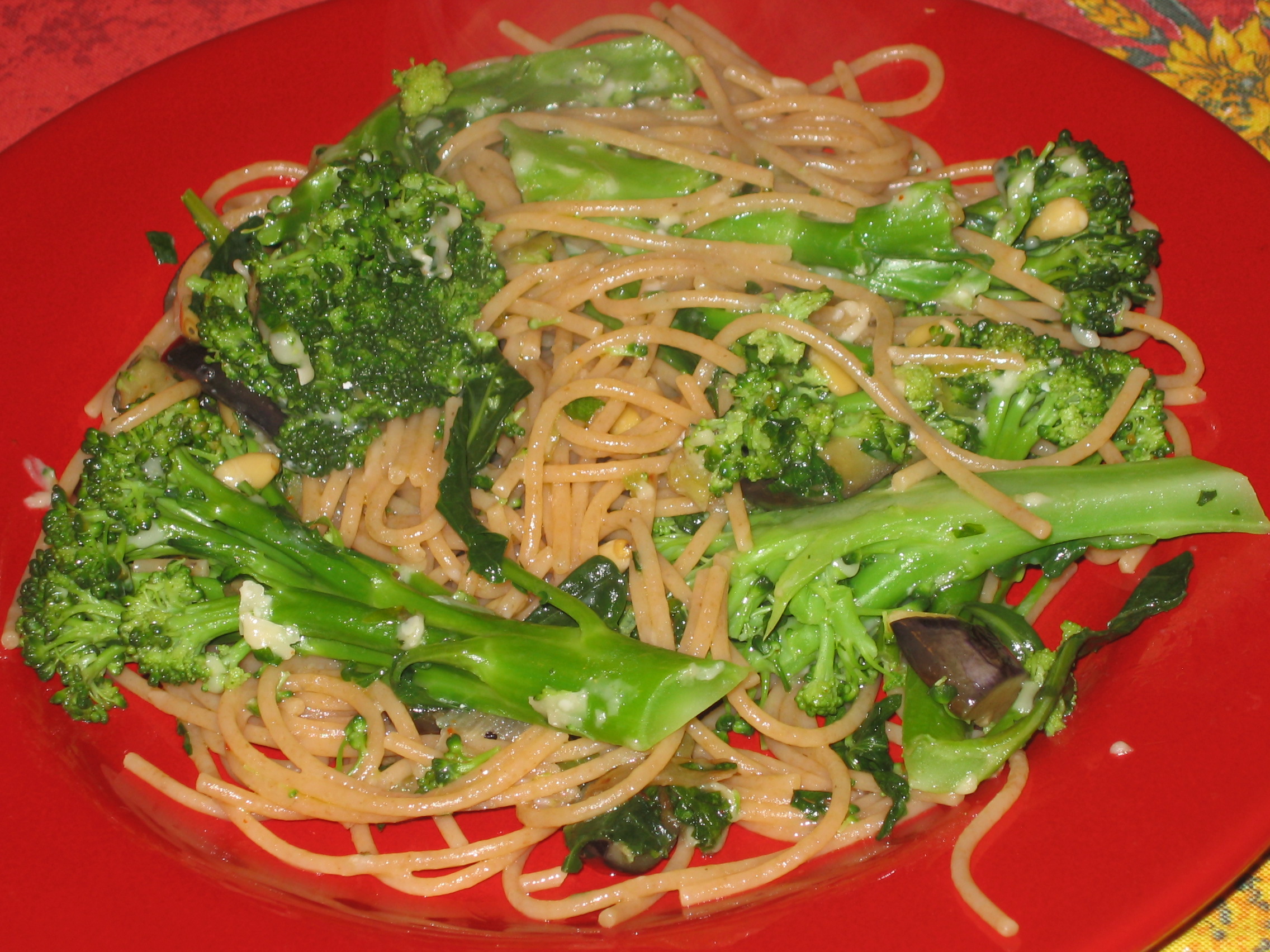
You get hooked, though, because something always does so well that you can hardly believe it. This year, supposedly heat-loving exotics like winged beans and chayote refused to grow, but broccoli, which likes cool weather, is producing better than ever before. I’ve gotten heads almost a foot across and side shoots as big as my fist or bigger. When picked twenty minutes before dinner, broccoli has a delicate flavor and none of the funk that can develop when it sits around. There are hundreds of good ways to cook it, but one of my favorites for a fast healthy meal is a pasta with broccoli cooked in the pasta pot.

For two large servings and good leftovers, you need:
1 large head of broccoli or two smaller ones
8 oz of dry pasta (whole wheat pasta tastes pretty good in this dish)
1/4 cup olive oil
3 large or 5 medium cloves garlic, sliced thinly.
one anchovy fillet, mashed (optional but gives depth)
half a teaspoon (or more) hot red pepper flakes
1/2 cup red wine
half a lemon
1/2 cup toasted pine nuts
a scant cup of best Parmesan cheese, grated

Start a pot of salted water boiling. Cut the broccoli into slender “branches” by splitting the stems. Slice the garlic cloves. When the water comes to a boil, put in the pasta. Heat half the olive oil in a small skillet and saute’ the garlic cloves until cooked through over medium heat. Add the anchovy and red pepper, saute’ another minute, then add the red wine and boil until it’s reduced to half. Add salt to taste. Keep checking the pasta, and about 3 minutes before it’s done, put the broccoli in the pot. Make sure it’s submerged and the water returns to a boil, then check the pasta in 2-3 minutes, and as soon as it’s perfectly done, drain the pot and return the drained noodles and broc to the pot. Toss in the remaining olive oil, then the skillet contents, then toss in all but a little of the cheese and promptly plate the pasta, remembering to leave enough in the pot for lunch the next day. Squeeze a little fresh lemon juice over each serving. Toss the pine nuts over the top along with the remaining cheese, and eat while hot. Elapsed time: about 15 minutes from the time the water comes to a boil to the table, if you’re reasonably quick and deft about splitting up the broccoli.
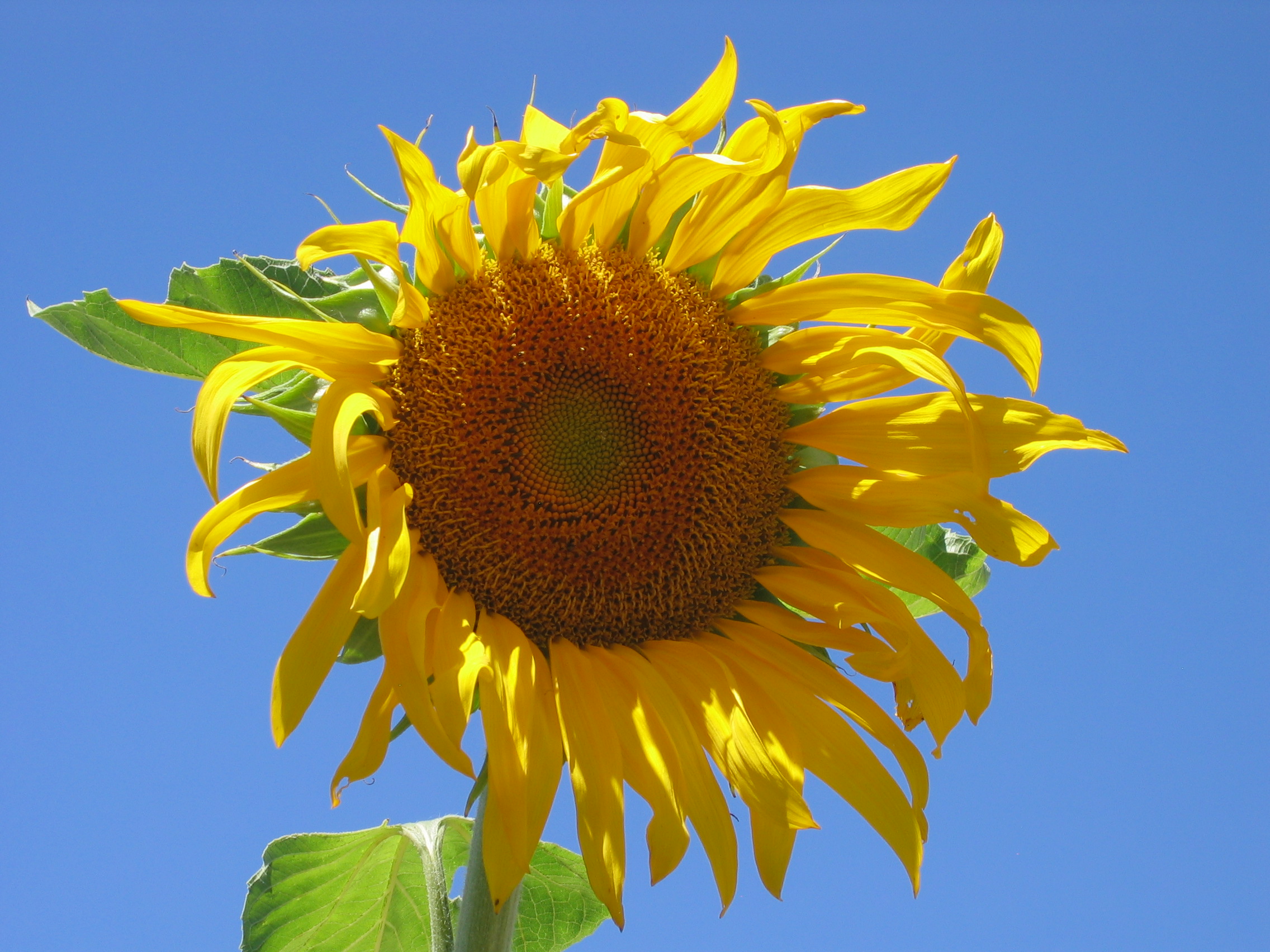
Don’t forget to scatter your vegetable garden with some flowers. It benefits the bees and it benefits your spirits.
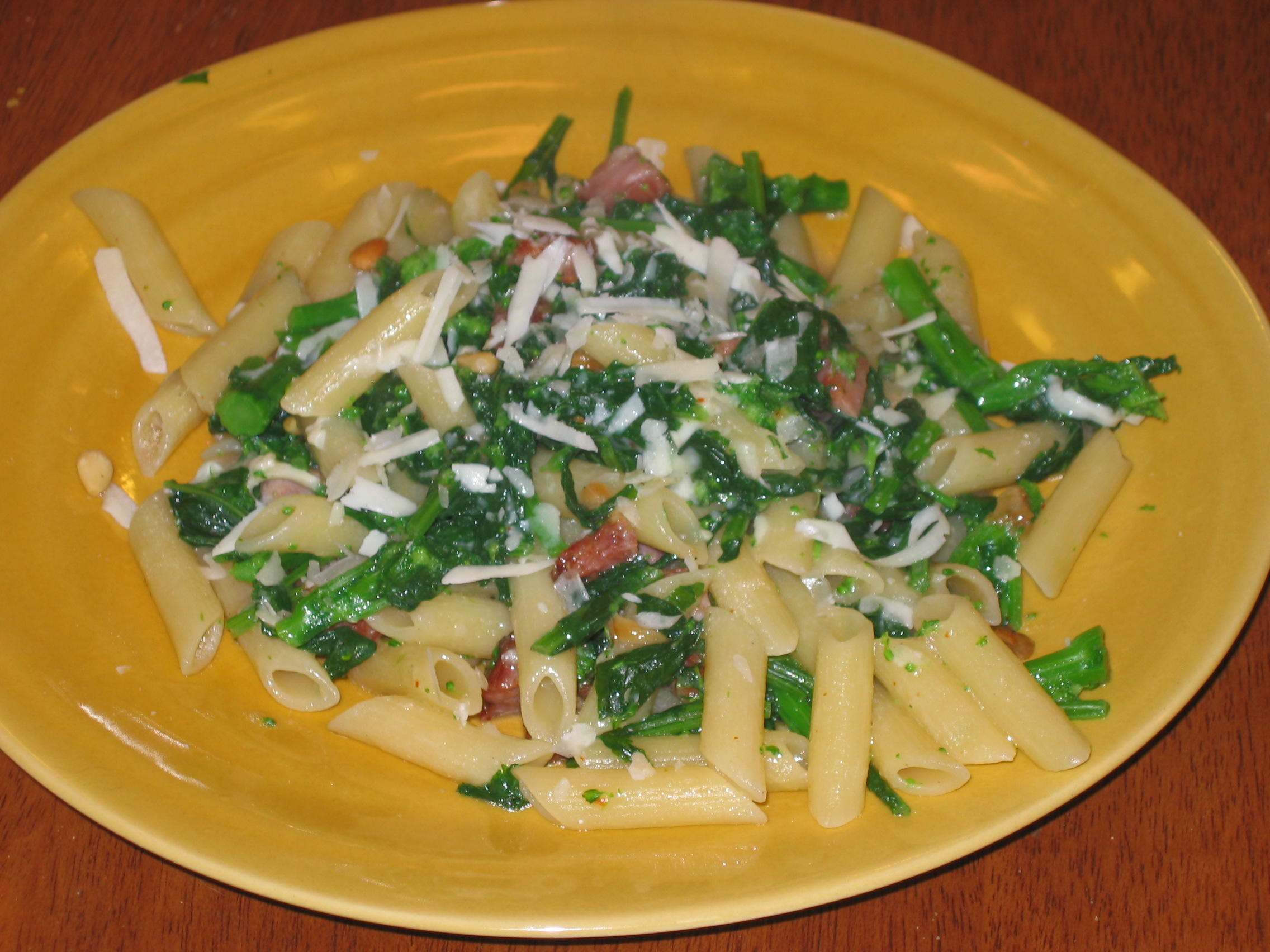
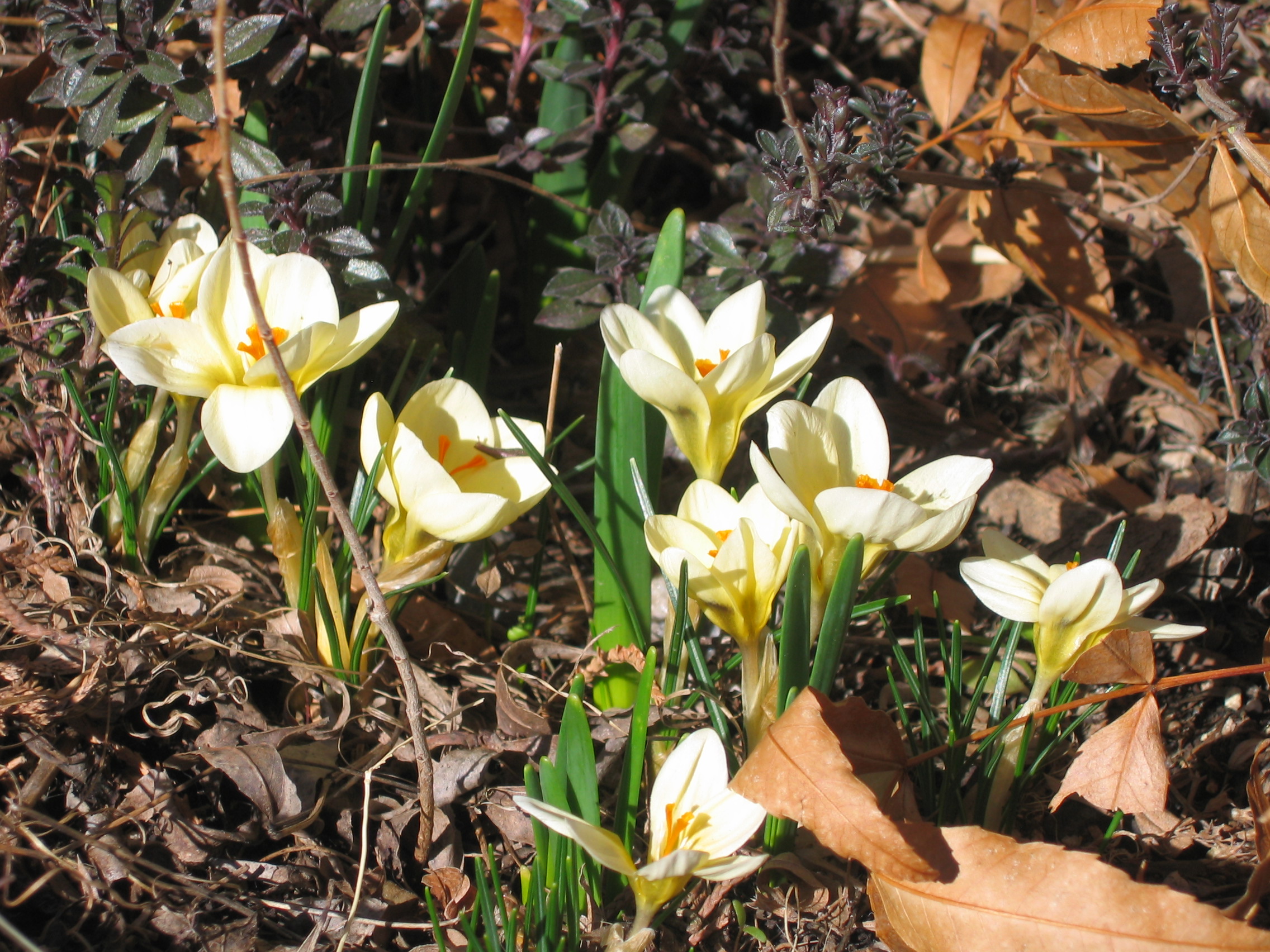
The Greens of Spring: Broccoli Raab, and a brief note on spring flowers

This is a good time of year to eat some broccoli raab from the store, because you may well be convinced to plant your own while there’s still time. You may find the seeds sold as broccoli rabe, broccoli raab, or rapini. This is a vigorous grows-like-a-weed kind of vegetable, but it won’t tolerate hot weather, so get it in the ground now. Direct seeding works well as long as the ground is well prepared and you keep it weeded until it’s big enough to compete. Harvest as soon as it shoots to seed; you’ll notice broccoli-like heads which can vary from the size of a nickel to 3 inches across, depending on variety and weather conditions. Harvest while the buds are still tight, before any blooms appear. Just whack off the top 6-8 inches, leaves and all, compost the rest, and you have time to grow another crop in that space. It’s a close relative of the turnip, but instead of the pronounced (some would say extreme) earthiness of turnip leaves, it has a lovely clean flavor with a slight bitterness that makes it the perfect companion for mellow pasta.

Usually I like greens in mixtures, but I prefer this one by itself. My favorite way to cook it is so simple that it isn’t really a recipe, and it’s on the plate within fifteen minutes of the water coming to a boil. The various steps fit in so well with one another that I prefer to write this as a brief kitchen story rather than a recipe. Read it through before beginning, so that the kitchen logic and logistics will be clear.

You will need: half a pound of good dried pasta, a large bunch of broccoli raab, good olive oil, red pepper flakes, a couple of ounces of good ham, Italian sausage, or pancetta (a small handful when chopped into cubes), an anchovy fillet if you like them, and a few ounces of good cheese, either Parmesan or part Parmesan and part Romano. Toasted pine nuts can be added as a bonus of you have any on hand.

Put on a pot of water to boil for the pasta. Don’t forget to salt it.

While the water is coming to a boil, chop up a small chunk of ham, or some good Italian sausage, or some pancetta, or a little slab bacon if it isn’t too smoky. Chop two large or three small cloves of garlic. Throw them in a small hot skillet with some olive oil, probably 2-3 tablespoons. Stir frequently. As soon as the garlic and meat are cooked, put in half a teaspoon of red pepper flakes and, if you like, a chopped rinsed anchovy fillet or a dash of colatura. Add a tablespoon or two of water, just enough to stop the cooking, and take the skillet off the heat. Wash a bunch of broccoli rabe, using a bunch as big as you can hold in two hands, and set it in a strainer to drain a little.

Meanwhile, the water should have come to a boil. Put in half a pound of good dried pasta. I think penne goes especially well with chunky greens. If you like whole wheat pasta, this is an especially good place to use it. Don’t reduce the heat. Keep it at a hard boil until after you add the greens.

While the pasta is boiling, cut the bunch of rapini in cross section across the bunch, slicing about every half inch. Discard the stem ends if they are more than half an inch in diameter. Five minutes after the pasta went in the water, put the chopped rapini in the water to boil with it. Once the water returns to the boil you can turn it down a little, but be sure to maintain a boil, not a simmer. Grate about 2/3 cup of good Parmesan and 1/3 cup of good Romano, or use all Parmesan if that’s what you have. These measurements refer to loosely packed measuring cups. My trip to Florence convinced me that Americans over-sauce and over-cheese their pasta. Personally I don’t meaure grated cheese in any formal way, and prefer to think in terms of two loose, scant handfuls of grated cheese.

When the pasta is ready, pour out into a strainer, return to the pan, toss with a glug of good olive oil, toss in the meat mixture and half the cheese, plate, sprinkle with the rest of the cheese, and toss some toasted pine nuts on top if you like. Eat and savor this splendid green.

By the way, I estimate that a “glug” is about two tablespoons. But in a dish like this, use kitchen sense rather than measurements. How much olive oil do you need in the skillet to keep the meat and garlic from sticking, and how much olive oil do you need to give a light delicious sheen to your pasta and greens? Your eyes are a better guide than a measuring spoon.

My garden is intended as a food garden, but there’s no reason why it can’t be a treat for the senses as well, and nothing lifts my spirits in late winter like bright crocuses blooming away in whatever appalling circumstances the season hands them. I strongly recommend at least a dozen bulbs of the cream-yellow Crocus crysanthus “Cream Beauty.” It’s always the first to bloom for me, and if you put it in the warmest part of your yard it will bloom in February in the Albuquerque area, a visible harbinger that your garden, like you, has survived another winter.

The Greens of Spring: Alliums

march-2009-054
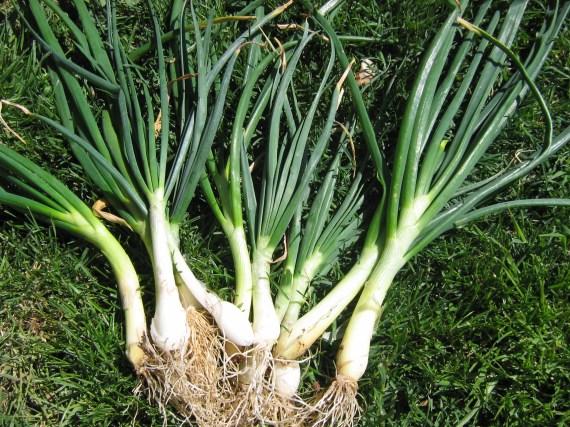
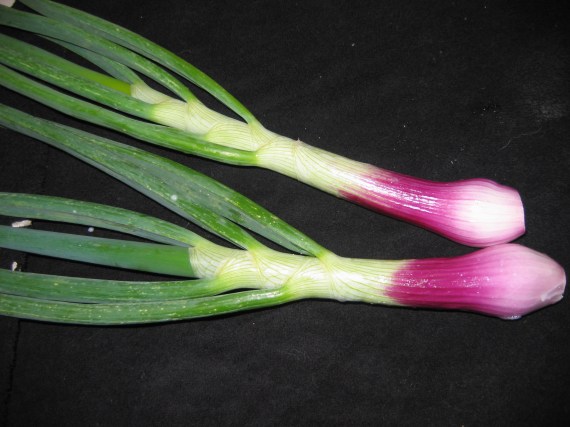
Onions and garlic are among the most common and useful seasonings worldwide, as well as in my kitchen. In spring my garden is full of green fresh forms of these lovely vegetables, and this is the time to plan for the green onions you’ll want later in the year. Start now, because they won’t be ready for a while. I suggest starting some long red onions from seed. They are available under several names. At Gourmet Seeds International in Tatum, New Mexico, they’re sold as Rossa lunga de Firenze. Also get a packet of the lovely Japanese green onions. My favorite is Shimonata. Don’t worry about the late start; you’re planting for the future. Start them now, and plant them out in fertile soil when they’re big enough to take care of themselves. I plant mine in clusters of 3-5 plants, with at least 8″ between clusters. They will grow slowly through the summer, and some of the Shimonata will be big enough to eat in the fall. In early fall the red onions will seem to mature and die at a small size. Don’t panic. Leave them in place. Both types will sit motionless, sulking, through the winter and will burst into lively growth in early spring. Usually the red onions will divide, and you will get two or even three beautiful mother-of-pearl-colored spring onions like the ones below from each. The shafts of both types will be thick, sometimes an inch in diameter. Harvest them as soon as they’re big enough to be usable, and keep harvesting until the flowerscapes appear.
They are useful in all kinds of cooking, and I love the shafts trimmed, rubbed with olive oil, and grilled slowly until sweet and softened. Slice up with a good sharp knife (very messy eating if you skip this step) and serve with sea salt and a little of your best olive oil.
april-2009-009

march-2009-045
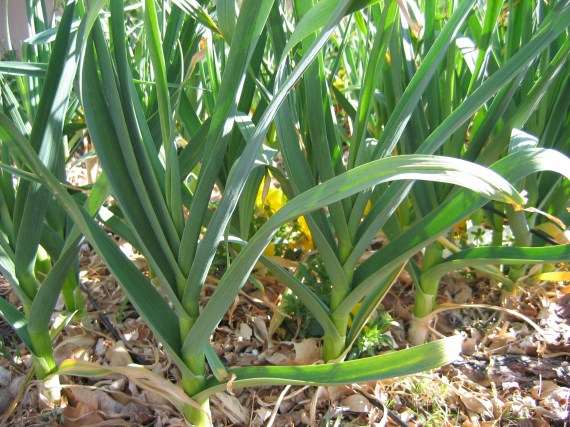
To have green garlic next spring, stick cloves in the ground about 6″ apart in the fall. For this purpose, any good organic garlic from the store is fine. Harvest when they just begin to form a bulb swelling, trim the roots and peel, slice finely, saute in good butter, and season with sea salt. Good with pasta, on good toasted sourdough bread, or as a sauce for fish.
A few years ago I ordered some “French gray shallots,” which the catalog claimed were the only real shallot to use in French cooking. I was unimpressed: the shallots were strong-flavored, garlicky, small, and maddening to peel. I left a lot of them in place out of disinterest, and discovered that in late winter and spring their foliage makes great greens. Cut and use like chives, but they are significantly stronger in flavor. They add zip scattered in a salad, or add them to greens dishes for the last few minutes of cooking.
Sauteed green onions are a great addition to hortapita fillings and other greens dishes, so please check out my “greens” category on the sidebar for more recipes. Or, for a recipe in which green onions are the stars, click here!

winter salads

december08-012
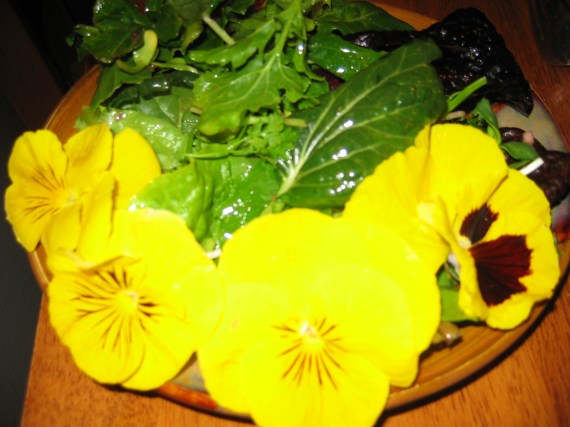
As part of our Christmas dinner, we had salads made entirely from our own yard produce. I had not used any season-extending devices at all, and we’d had cold weather and a few light snows, so these are the greens that thrive on cold and neglect. The “trim” is a ring of pansies, which I wrote about in an earlier post. The greens included arugula (see the post before this one,) pansy leaves (cool, tender, and delicious,) chervil, a few nasturtium leaves still surviving in a sheltered corner, my new favorite lettuce, and sunflower sprouts.
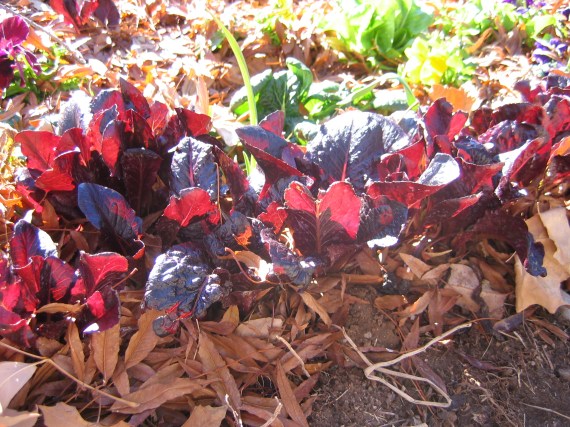
The lettuce that I’ve enjoyed most this year is a gorgeous deep red romaine called “Marshall.” I think I got my seeds from Territorial. the color is a dramatic foil for almost anything else, and it doesn’r get bitter in our sudden hot springs. It’s beautiful in the garden, too. You can see it poking up through a light mulch in the photo below.
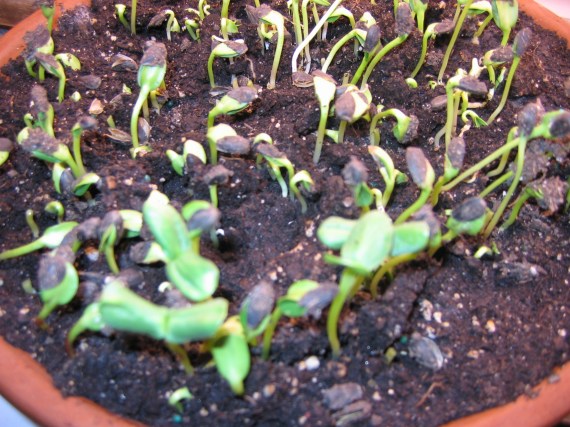
The other photo shows my sunflower sprouts, and I wish I had known earlier how delicious they are. The first taste is pleasant and mild, but a delicious nuttiness rapidly reveals itself. These are the only sprouts that I’ve enjoyed eating out of hand, but they’re even better in a good mixed salad.
december08-006december08-009
Sunflower sprouts seem to be best when soil-grown, and they need a little light. I have a grow-light for my spring seedlings, and it usually goes unused in the winter, so I used it to grow the sprouts, but a sunny window would be fine.
Start with a large flat container. I used a terra cotta saucer intended to hold a large potted plant, just because I had one sitting around. Put in an inch of good organic soil. Scatter raw organic sunflower seeds (in shell) very thickly on top, touching each other. Pat them into the surface, cover with another 1/4 inch or so of soil, water well but don’t make the soil soggy, and wait a few days. The books say to presoak the seeds, but I didn’t and they did fine. When they start to emerge, begin giving them light, and harvest when they are green and are trying to shed their shells. I snap them off at soil level with my thumbnail, flick off the clinging shell, rinse well and dry, and start snacking. They go well with spicy mesclun mixes but can also give depth to a simple lettuce salad. Grow lots, so that you can use them lavishly.