Posts Tagged ‘albuquerque’

The Greens of Spring: Broccoli Raab, and a brief note on spring flowers

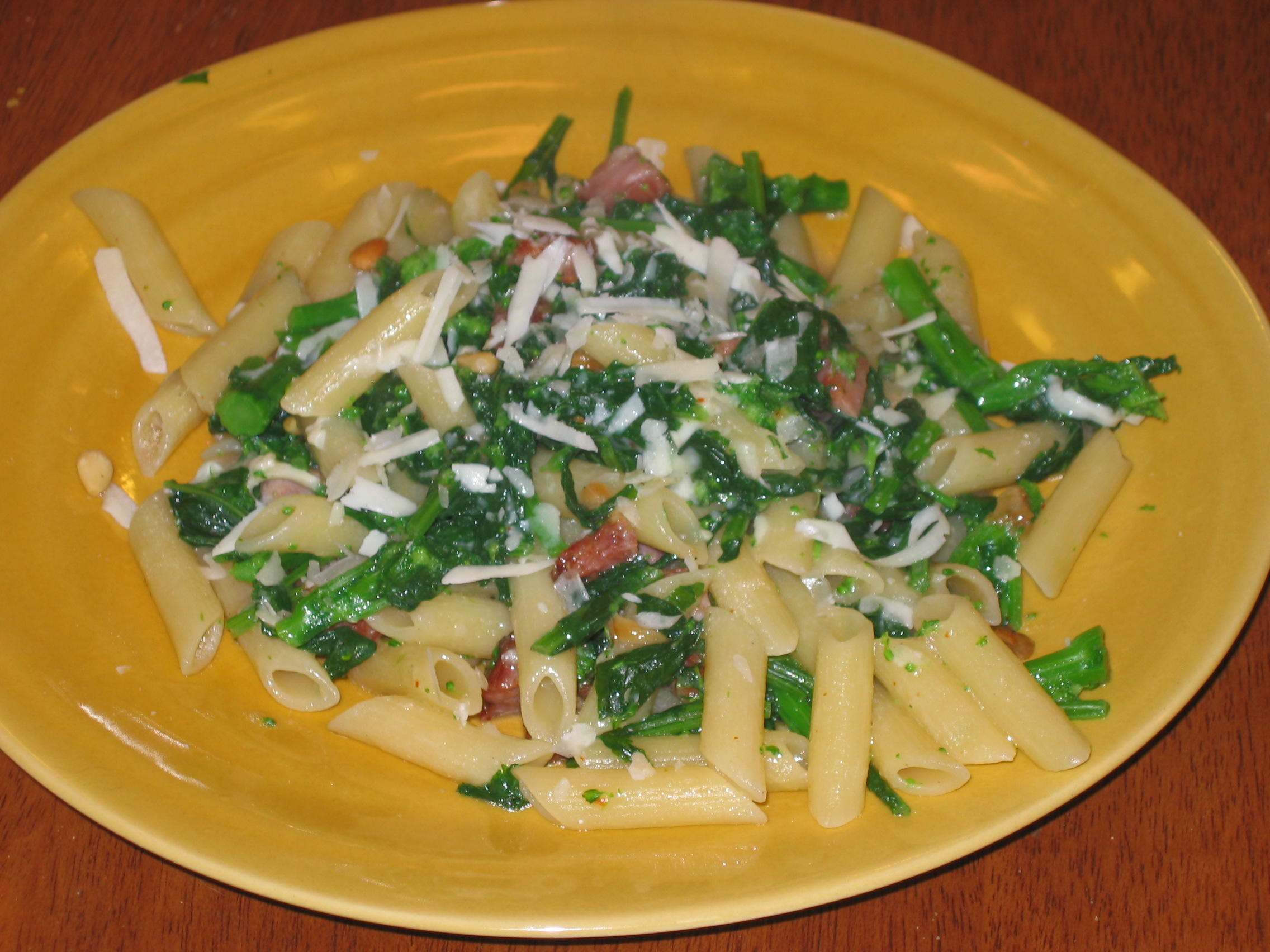
This is a good time of year to eat some broccoli raab from the store, because you may well be convinced to plant your own while there’s still time. You may find the seeds sold as broccoli rabe, broccoli raab, or rapini. This is a vigorous grows-like-a-weed kind of vegetable, but it won’t tolerate hot weather, so get it in the ground now. Direct seeding works well as long as the ground is well prepared and you keep it weeded until it’s big enough to compete. Harvest as soon as it shoots to seed; you’ll notice broccoli-like heads which can vary from the size of a nickel to 3 inches across, depending on variety and weather conditions. Harvest while the buds are still tight, before any blooms appear. Just whack off the top 6-8 inches, leaves and all, compost the rest, and you have time to grow another crop in that space. It’s a close relative of the turnip, but instead of the pronounced (some would say extreme) earthiness of turnip leaves, it has a lovely clean flavor with a slight bitterness that makes it the perfect companion for mellow pasta.

Usually I like greens in mixtures, but I prefer this one by itself. My favorite way to cook it is so simple that it isn’t really a recipe, and it’s on the plate within fifteen minutes of the water coming to a boil. The various steps fit in so well with one another that I prefer to write this as a brief kitchen story rather than a recipe. Read it through before beginning, so that the kitchen logic and logistics will be clear.

You will need: half a pound of good dried pasta, a large bunch of broccoli raab, good olive oil, red pepper flakes, a couple of ounces of good ham, Italian sausage, or pancetta (a small handful when chopped into cubes), an anchovy fillet if you like them, and a few ounces of good cheese, either Parmesan or part Parmesan and part Romano. Toasted pine nuts can be added as a bonus of you have any on hand.

Put on a pot of water to boil for the pasta. Don’t forget to salt it.

While the water is coming to a boil, chop up a small chunk of ham, or some good Italian sausage, or some pancetta, or a little slab bacon if it isn’t too smoky. Chop two large or three small cloves of garlic. Throw them in a small hot skillet with some olive oil, probably 2-3 tablespoons. Stir frequently. As soon as the garlic and meat are cooked, put in half a teaspoon of red pepper flakes and, if you like, a chopped rinsed anchovy fillet or a dash of colatura. Add a tablespoon or two of water, just enough to stop the cooking, and take the skillet off the heat. Wash a bunch of broccoli rabe, using a bunch as big as you can hold in two hands, and set it in a strainer to drain a little.

Meanwhile, the water should have come to a boil. Put in half a pound of good dried pasta. I think penne goes especially well with chunky greens. If you like whole wheat pasta, this is an especially good place to use it. Don’t reduce the heat. Keep it at a hard boil until after you add the greens.

While the pasta is boiling, cut the bunch of rapini in cross section across the bunch, slicing about every half inch. Discard the stem ends if they are more than half an inch in diameter. Five minutes after the pasta went in the water, put the chopped rapini in the water to boil with it. Once the water returns to the boil you can turn it down a little, but be sure to maintain a boil, not a simmer. Grate about 2/3 cup of good Parmesan and 1/3 cup of good Romano, or use all Parmesan if that’s what you have. These measurements refer to loosely packed measuring cups. My trip to Florence convinced me that Americans over-sauce and over-cheese their pasta. Personally I don’t meaure grated cheese in any formal way, and prefer to think in terms of two loose, scant handfuls of grated cheese.

When the pasta is ready, pour out into a strainer, return to the pan, toss with a glug of good olive oil, toss in the meat mixture and half the cheese, plate, sprinkle with the rest of the cheese, and toss some toasted pine nuts on top if you like. Eat and savor this splendid green.

By the way, I estimate that a “glug” is about two tablespoons. But in a dish like this, use kitchen sense rather than measurements. How much olive oil do you need in the skillet to keep the meat and garlic from sticking, and how much olive oil do you need to give a light delicious sheen to your pasta and greens? Your eyes are a better guide than a measuring spoon.

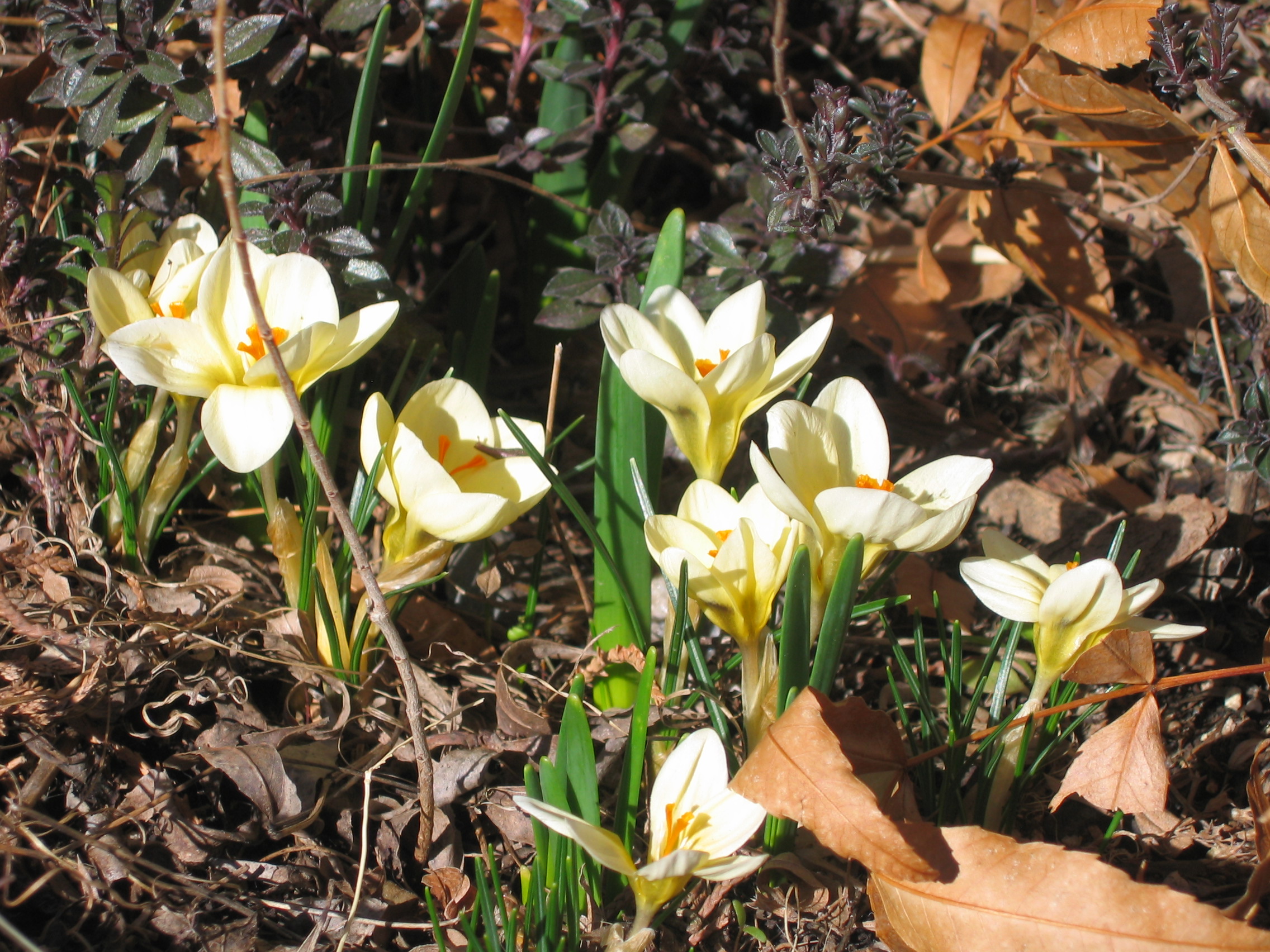
My garden is intended as a food garden, but there’s no reason why it can’t be a treat for the senses as well, and nothing lifts my spirits in late winter like bright crocuses blooming away in whatever appalling circumstances the season hands them. I strongly recommend at least a dozen bulbs of the cream-yellow Crocus crysanthus “Cream Beauty.” It’s always the first to bloom for me, and if you put it in the warmest part of your yard it will bloom in February in the Albuquerque area, a visible harbinger that your garden, like you, has survived another winter.
winter salads

december08-012
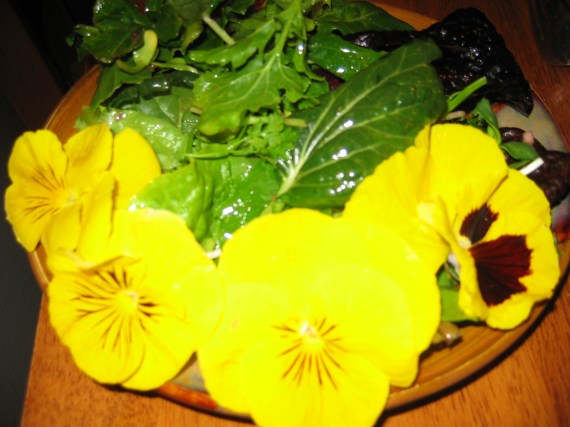
As part of our Christmas dinner, we had salads made entirely from our own yard produce. I had not used any season-extending devices at all, and we’d had cold weather and a few light snows, so these are the greens that thrive on cold and neglect. The “trim” is a ring of pansies, which I wrote about in an earlier post. The greens included arugula (see the post before this one,) pansy leaves (cool, tender, and delicious,) chervil, a few nasturtium leaves still surviving in a sheltered corner, my new favorite lettuce, and sunflower sprouts.
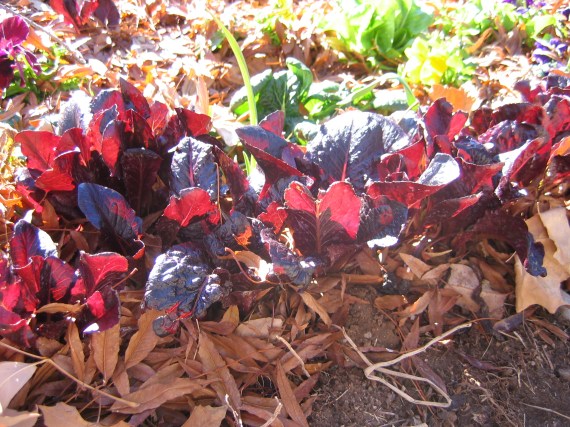
The lettuce that I’ve enjoyed most this year is a gorgeous deep red romaine called “Marshall.” I think I got my seeds from Territorial. the color is a dramatic foil for almost anything else, and it doesn’r get bitter in our sudden hot springs. It’s beautiful in the garden, too. You can see it poking up through a light mulch in the photo below.
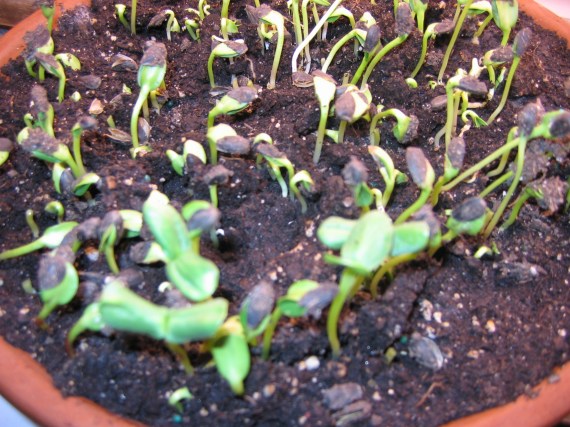
The other photo shows my sunflower sprouts, and I wish I had known earlier how delicious they are. The first taste is pleasant and mild, but a delicious nuttiness rapidly reveals itself. These are the only sprouts that I’ve enjoyed eating out of hand, but they’re even better in a good mixed salad.
december08-006december08-009
Sunflower sprouts seem to be best when soil-grown, and they need a little light. I have a grow-light for my spring seedlings, and it usually goes unused in the winter, so I used it to grow the sprouts, but a sunny window would be fine.
Start with a large flat container. I used a terra cotta saucer intended to hold a large potted plant, just because I had one sitting around. Put in an inch of good organic soil. Scatter raw organic sunflower seeds (in shell) very thickly on top, touching each other. Pat them into the surface, cover with another 1/4 inch or so of soil, water well but don’t make the soil soggy, and wait a few days. The books say to presoak the seeds, but I didn’t and they did fine. When they start to emerge, begin giving them light, and harvest when they are green and are trying to shed their shells. I snap them off at soil level with my thumbnail, flick off the clinging shell, rinse well and dry, and start snacking. They go well with spicy mesclun mixes but can also give depth to a simple lettuce salad. Grow lots, so that you can use them lavishly.

Thanks Giving

july-08-0323

What a deeply joyful Thanksgiving I was privileged to have: here in New Mexico we had both a new president and a good long soaking rain, and in the high desert it’s a little hard to say which is more exciting. The garden is still providing some lettuce, arugula, herbs, and carrots, but I have more time to reflect on what I’m doing. This has led to thinking about what, exactly, my urban homestead means. It certainly doesn’t mean self-sufficiency. That won’t happen until I can grow coffee and olive oil. It doesn’t mean grimly making do. It’s a happy celebration of what one small piece of city dirt can produce. I have a medical practice and a number of hobbies, but growing my own food in the most space-intensive way possible is a lot of fun, and I have a website and blog to let other people know that, if they want to provide for themselves a little more, they don’t need to quit their job and move to the country. I don’t even think that’s the best way to start. Start where you are, with what you have. People with no land at all can bake sourdough bread and brew beer, and those are indoor “yeast gardens.” People with a balcony can grow herbs in pots. People with a tiny yard can utilize it. In the quest for local food, we can have the most local food of all, and if we have more garden space at other points in our lives, we’ll know more about how to use it if we’ve practiced in small ways. Please go to my website, www.localfoodalbuquerque.com, for more about urban gardening, and look at my blog entries on other pages for details about the many small pleasures that crop up along the way.

Most of my winter posts will be about canning, preserving, and using what was made during the summer. That’s also a way of remembering the abundant season and being grateful for what I received. So, here’s a fond look backward at

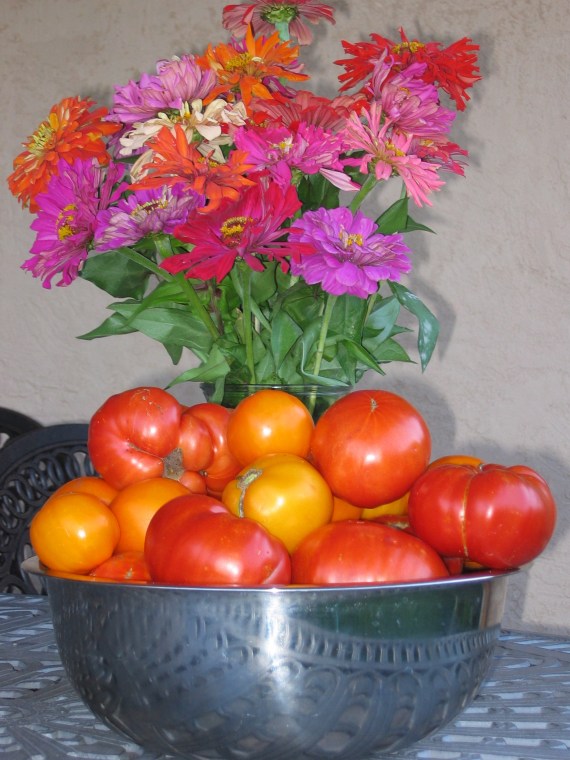
the colors of summer.   august-08-029

Si se puede! Starting to sum up my garden year.

august-08-031

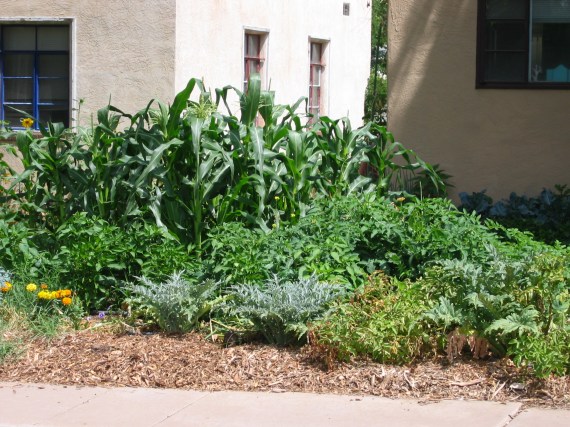
       The very last tomatoes of the season are simmering into a sauce on the stove, waiting to be canned later today. The freezer is full and the shelves are bending slightly under the weight of canned sauce, salsa, chutney, and broth. Carrots, leeks, chard, chervil, the last potatoes, and some herbs are still outside. Not bad, given that we live on about 1/8 acre.

       My interest is in encouraging more people to grow and cook at least a little of their own food. I have a website to promote “yard farming,” and I invite you to visit it at www.localfoodalbuquerque.com. The purpose of this blog is to explore and report some of the small pleasures that come up along the way.


Learning new things about familiar plants seemjs to have been the theme of my harvest season. Nasturtiums are high on the list. I started growing them because, in our fierce sun, they grow well in light shade. They go through a slightly ratty period in midsummer, but then come back strong in the fall and bloom until there’s a really hard frost. I’ve always loved the blossoms on salads, for their watercress sharpness with a sweet nectar twist as well as for their beauty. But until this year, I didn’t grasp the culinary possibilities of the leaves.

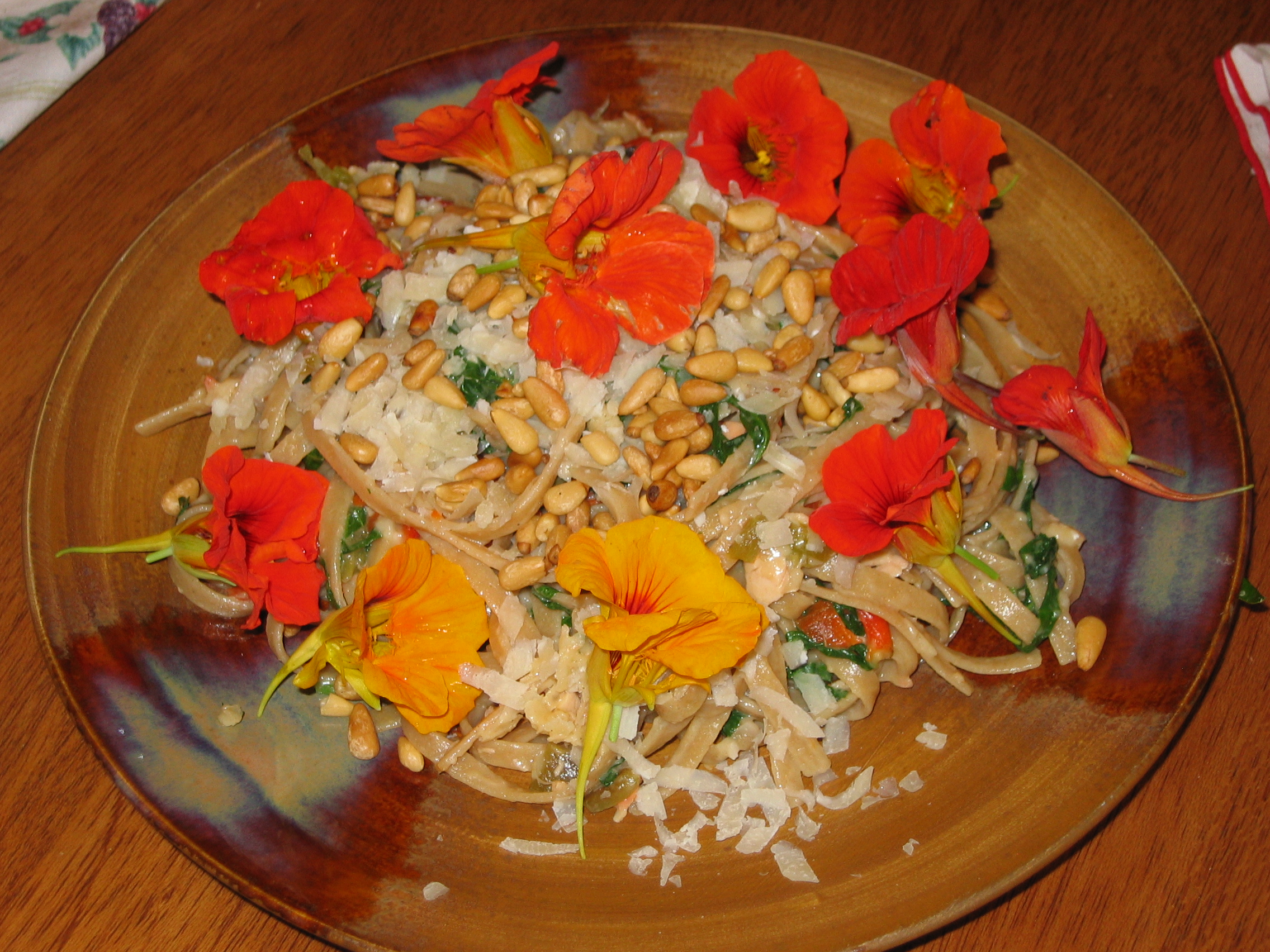
       They bear a strong resemblance to watercress, although with a thicker meatier texture. Raw, they add bite to a sandwich or can be slivered into chiffonade and dressed with a fairly strong vinaigrette to make a nice sharp small salad to lighten a plate of pasta or steak. Cooked, they mellow a lot. I love to cook extravagant mixtures of greens, and nasturtium leaves can be up to half the total as long as the other half is milder-flavored material like spinach or chard. They also make wonderful stuffed dolmas, and bring a fresher quality to the dish than brined grape leaves. I consider leafy greens some of the healthiest vegetables that you can eat, and the wider the variety the better. See the “recipes” page on my website and click “greens” for some simple and good recipes, and the not-so-simple Nasturtium leaf dolmas. Or, just see below for the simplest way you can use this versatile plant.october08-0051