Posts Tagged ‘salad’

The Greens of Summer: Frisee’

may 2009 027
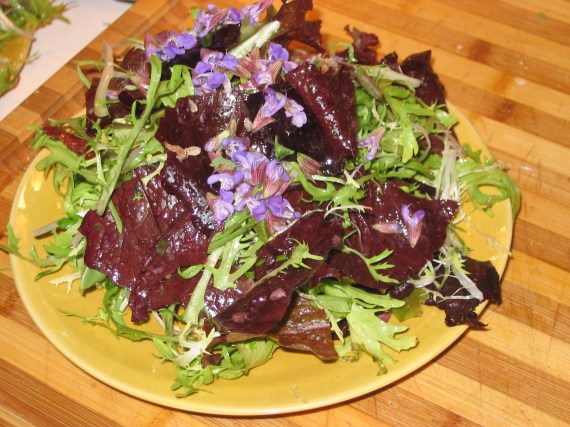
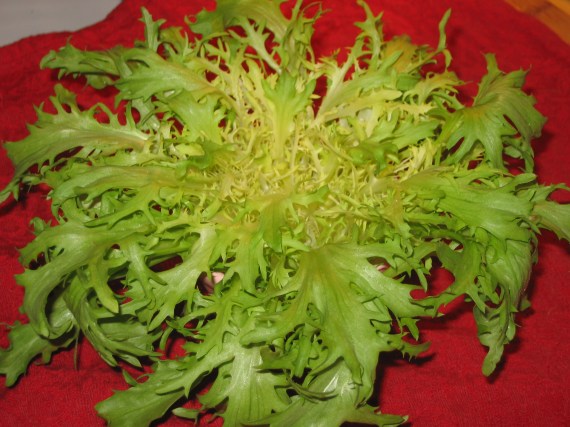
This is one of my favorite members of the chicory family to use in salads, and is a rugged and tolerant plant besides. Planted at the same time as lettuce, it comes along a little later. I start my early crop indoors for use in late April, and the later crop from seeds planted outdoors as soon as the ground unfreezes. Deep containers work fine, and it tolerates a little shade without fuss. Thin the plants to at least 8″ apart each way so that they have room to grow. When you have a big green fuzzball about 9″ across, it’s time to blanch. Simply invert a dinner plate on the plant and leave it there anywhere from 3 to 5 days, depending on how blanched you want it. I like mine only moderately blanched, as shown above, because at that stage the underlying chicory bitterness is still detectable. If you want yours milder, wait the full five days before cutting.

     Remove the plate, harvest the whole plant about 1-2 inches above the ground with kitchen shears, wash well, and enjoy. When cutting, avoid injuring the crown, and leave the plant in place. Most of the time it will produce another somewhat smaller head, which you can blanch and eat in its turn.

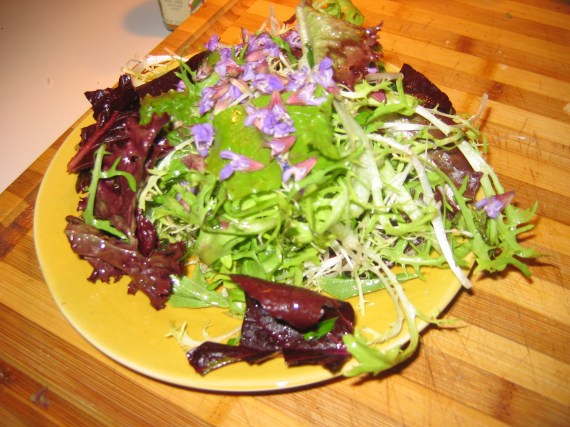
     When dressing a frisee’ salad, I prefer bold vinaigrettes. This is an occasion for a little roasted garlic in the dressing, or slice a small shallot very finely and marinate it in the vinegar for 15 minutes before completing the vinaigrette. This is a good place for your flavorful homemade red wine vinegar (see my post on making vinegar.) Bold and peppery Tuscan-style olive oils are good. A little crumbled bacon or crisped proscuitto on top is wonderful. And consider a dash of colatura (garum) in the dressing; see the “notes on specialty ingredients” section on my website.I like sturdy romaines in these salads, but this is not a place for tender butter lettuces. Thyme or the new, tender leaves of winter savory or (best of all, in my view) the exquisite blue blossoms of common sage are good herbal flavorings. Just for fun, I’ll add a pictture of a recent frisee’ and romaine salad, made in the brief sage blossom season.
may 2009 038

Passing Pleasures: sage blossoms

may 2009 040
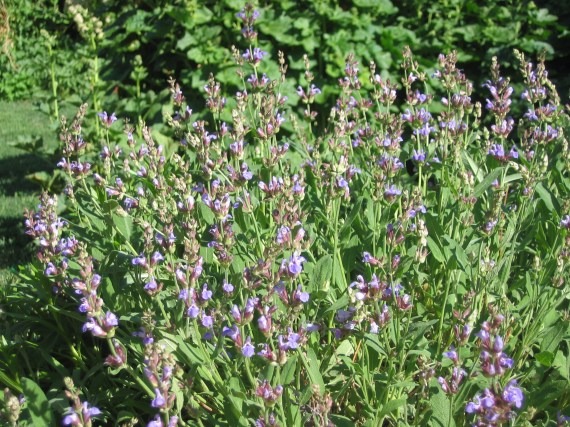
Sage is a useful culinary herb which loves our climate and grows with unbounded enthusiasm. My own specimen has been grown in a container for three years with no care or attention other than periodic watering and has reached 3 feet across and seeded itself around, providing a number of nice plants to give away. A major advantage to growing your own is that you can enjoy its lovely Delft-blue flowers, both in your yard and on your plate. The flowers also taste of sage, but the flavor is softer, sweeter, and more floral. They are lovely on salads. Pick them just before you use them, toss them on top of the dressed leaves, and enjoy. This is one of the ephemeral pleasures of the garden, to be enjoyed for a week or two and then let go. But, like most such pleasures, it makes an impression and leaves a memory of a pure and lovely thing enjoyed in its season.
You can buy a sage plant nearly anywhere. I suggest avoiding the variegated or variously-scented ones unless you have space to spare. Common culinary sage is the most useful in the kitchen.
may 2009 028

The Greens of Spring: a meal on a pita

february-09-008
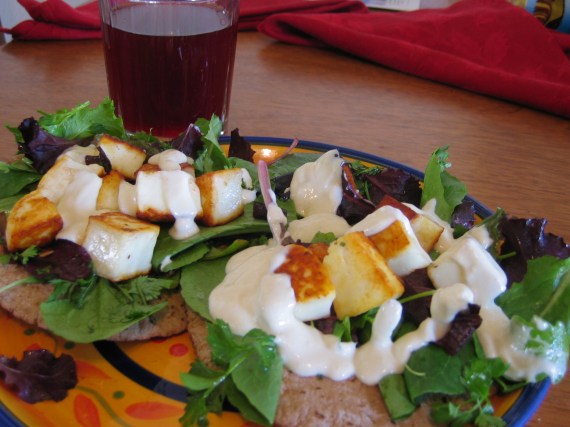
Halloumi cheese from Cyprus grills beautifully, and make a wonderful meatless “barbecue” to combine with your garden produce. It’s a great way to reduce your meat intake, if you want to do that, or just have a lovely and healthy meal.
First, catch your salad. You need a goodly quantity of the freshest salad greens, and it tastes best if some sharp flavors like young mustard, arugula, and herbs are included. My choice for this meal is a smallish bunch each of young mustard and arugula, with a few baby lettuce leaves (preferably red, for contrast,) about a quarter cup of a finely chopped combination of parsley and cilantro, a few fronds of fennel chopped, and about a teaspoon of thyme leaves. If I were using store-bought greens, I’d use half young letture and half watercress, plus the herbs, for a sharp but not aggressive taste. Commercial mustard greens are too mature and strong to use in salads. A handful of chopped chives or shallot greens is a great addition. Remember, herbs are loaded with antioxidants, and they taste great. For two people, you need about a quart of mixed salad greens, tightly packed.

Now locate your Halloumi. La Montanita Co-op and Whole Foods both have it in our area. Then you can proceed with the cooking part:

Dressing:
¾ cup extra virgin olive oil
5 tablespoons chopped fresh parsley
5 teaspoons grated lemon zest
1 teaspoon salt (or to taste)
1 teaspoon freshly ground pepper
¼ cup lemon juice
6 teaspoons chopped cilantro
4 cloves garlic, chopped
¼ cup capers (rinsed and soaked if salt-cured)

Make the dressing by combining all ingredients in your mortar and pestle (see my recipe page under Herbs for more about this) Pound until nicely amalgamated. Set aside. If you use the food processor instead, be careful to leave it with a vigorous texture. Avoid processing to mush.

2 ¼ pounds Cypriot Halloumi cheese, cut into 16 cubes
A few tablespoons of olive oil

Preheat a gas barbecue to medium heat, or let a coal barbecue heat until all coals are mostly white. Coat the cheese lightly with the olive oil. Grill the cheese cubes until they have caramelized on at least two sides. If you don’t feel like grilling, cook them on the stove in a heavy, hot skillet.

Meanwhile, lightly toast two or four whole wheat pitas, depending on appetite.

While the cheese finishes browning lightly, put the hot pitas on plates, two to a plate if you’re really hungry. Toss the greens and herbs with some of the sauce, pile them on the pitas, and distribute the hot cheese cubes on top. Drizzle with more of the sauce and eat. Even an avid carnivore is unlikely to feel shortchanged.

You will probably have a good bit of leftover sauce, and can use it to dress a little pasta for a quick one-person meal. Crumble on a little feta or Kefalotyri if you like.

A delicious variation is to hard-boil two or three eggs per person and slice them. Spread the slices over the dressed greens, and dribble on the sauce. It makes a nice post-Easter lunch, when you’re sick of looking at those eggs.

ADDENDUM: A friend who follows my blog gently pointed out that the sauce in the picture couldn’t be the one in the recipe. Major oops: I posted the wrong picture. But the pictured dressing is delicious on grilled halloumi too, so I decided to leave the picture and add the recipe for Tahini Dressing. Crush a clove of garlic in a mortar and pestle with half a teaspoon of salt. Add the juice of half a lemon and two tablespoons of tahini. Stir untilwell amalgamated, and add enough olive oil to give the consistency of thick cream. I usually use about 3 tablespoons, or a little more. Use a little plain olive oil to dress your greens, arrange them on a pita, and scatter the Halloumi cubes on top. Drizzle over the dressed greens and grilled Halloumi.

winter salads

december08-012
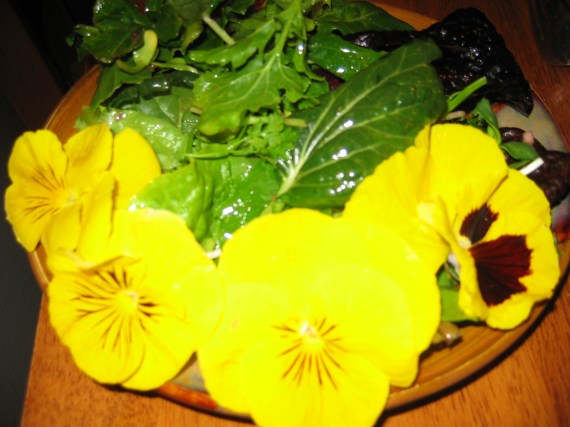
As part of our Christmas dinner, we had salads made entirely from our own yard produce. I had not used any season-extending devices at all, and we’d had cold weather and a few light snows, so these are the greens that thrive on cold and neglect. The “trim” is a ring of pansies, which I wrote about in an earlier post. The greens included arugula (see the post before this one,) pansy leaves (cool, tender, and delicious,) chervil, a few nasturtium leaves still surviving in a sheltered corner, my new favorite lettuce, and sunflower sprouts.
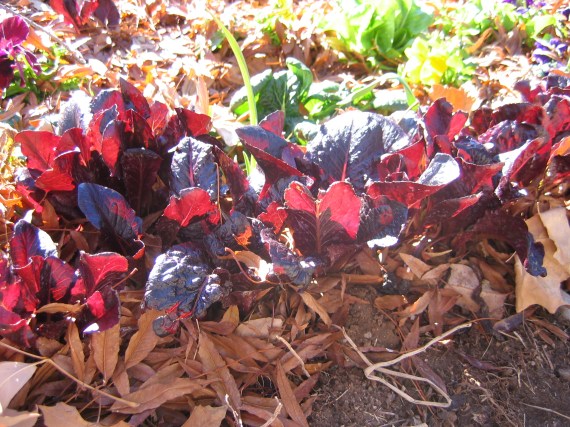
The lettuce that I’ve enjoyed most this year is a gorgeous deep red romaine called “Marshall.” I think I got my seeds from Territorial. the color is a dramatic foil for almost anything else, and it doesn’r get bitter in our sudden hot springs. It’s beautiful in the garden, too. You can see it poking up through a light mulch in the photo below.
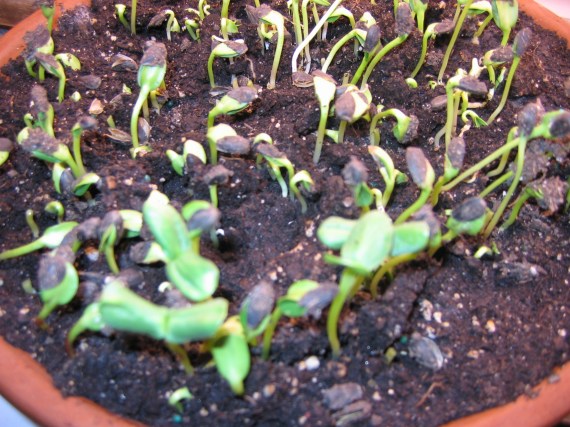
The other photo shows my sunflower sprouts, and I wish I had known earlier how delicious they are. The first taste is pleasant and mild, but a delicious nuttiness rapidly reveals itself. These are the only sprouts that I’ve enjoyed eating out of hand, but they’re even better in a good mixed salad.
december08-006december08-009
Sunflower sprouts seem to be best when soil-grown, and they need a little light. I have a grow-light for my spring seedlings, and it usually goes unused in the winter, so I used it to grow the sprouts, but a sunny window would be fine.
Start with a large flat container. I used a terra cotta saucer intended to hold a large potted plant, just because I had one sitting around. Put in an inch of good organic soil. Scatter raw organic sunflower seeds (in shell) very thickly on top, touching each other. Pat them into the surface, cover with another 1/4 inch or so of soil, water well but don’t make the soil soggy, and wait a few days. The books say to presoak the seeds, but I didn’t and they did fine. When they start to emerge, begin giving them light, and harvest when they are green and are trying to shed their shells. I snap them off at soil level with my thumbnail, flick off the clinging shell, rinse well and dry, and start snacking. They go well with spicy mesclun mixes but can also give depth to a simple lettuce salad. Grow lots, so that you can use them lavishly.