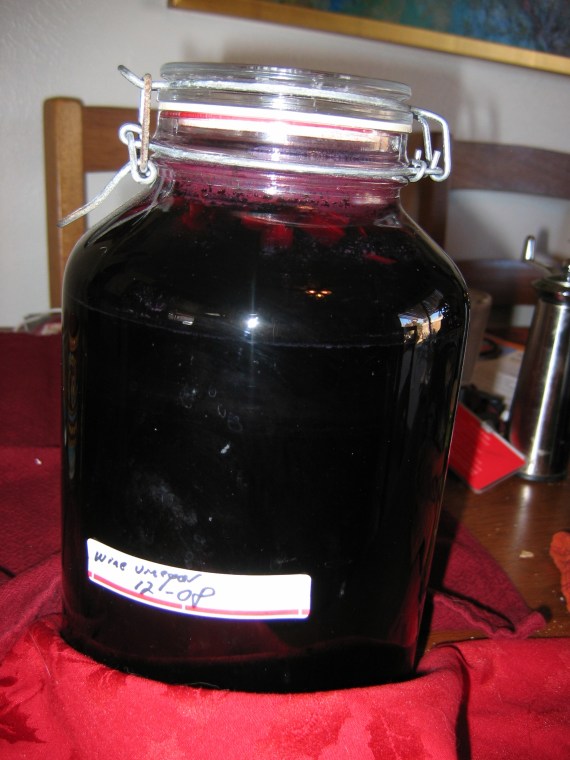
There’s a very good reason to make your own red wine vinegar at home: it will be about twice as good as any you can buy, because the wine you put into it will be twice as good as that in commercial vinegars. If you want a more formal process, you can find excellent directions in Paul Bertolli’s book Chez Panisse Cooking. My own more rough-and-ready process goes something like this:
1. Get a large glass jar (anywhere from quart to gallon-size, depending on how much vinegar you want) with a glass lid and rubber sealing gasket. They are widely sold as canisters. Buy enough good red wine to (eventually) fill it. The wine must be good enough that you would thoroughly enjoy drinking a glass of it. The best vinegar I’ve made so far was made with J. Lohr cabernet, which is widely available.
2. Get some vinegar mother. Some winemaking supply stores sell them, but I got mine from a bottle of Bragg cider vinegar, which is available at La Montanita co-op.
3. Add one bottle of wine to the jar, add the mother or about 1/4 cup of the Bragg vinegar, put the lid of the jar someplace where you can find it later, cover the jar loosely with a dish towel held on tightly by a rubber band, and set it in a dark place. Check it every few days. Somewhere between a week and a month later, depending on temperature and other factors, you will notice light grey wispy streaks on the surface of the wine. This is the developing mother.
4. Once the mother starts to grow, you can add more wine, but it has to be done carefully. You want to leave the surface as undisturbed as possible. I use a short length of clear tubing from our local winemaking supply shop, Victor’s Grape Arbor. I put one end of the tubing below the surface of the developing vinegar and use a funnel to pour wine slowly into the tube. That way, wine can be added without drowning the mother. Be sure not to add too much at once. Adding about two cups every week or two works well, until you have filled the jar that you plan to fill. Be sure to fill it right to the top; I’ll go into the reason for this later.
5. When the jar is full, keep it in the dark place and, every week, taste a little with a spoon, being sure to disturb the surface as little as possible. Keep it tightly covered with the dish towel between tastings. When it tastes like vinegar, you’re ready to proceed to step 6. It will still taste sort of rough and raw. Don’t worry.
6. There is no question that wine vinegar needs oak aging to taste its best. If you want to fill an oak cask that’s fine, but it isn’t necessary. Use a wide spoon to carefully remove all the mother and a little of the vinegar under it. Put this in a small jar. Scrape the bottom of your vinegar jar with a slotted spoon to see if a gelatinous substance has formed. This is a submerged part of the mother. If it’s there, add it to your removed mother in a small jar and store in the refrigerator for the next time you want to make vinegar. Now for the oak aging part. At winemaking supply stores you can get small bags of oak chips. Carefully add the oak chips to your vinegar. You will have lost a little volume removing the mother, so the chips should bring it back up to brimming full. Make sure all the chips are wet (Over the next few weeks, they will gradually absorb vinegar and sink to the bottom.) Now put on the lid, not the dish towel, and seal it. Make sure that the vinegar doesn’t touch the gasket when the jar is sitting level. If it does, remove a little vinegar until it doesn’t.
8. Now let the vinegar age in a dark place for as long as you can stand. It gains mellowness with age. Richard Olney says it needs 2-3 years to reach its best, but I’ve never held out that long. In six months it will be very good.
9. When ready to use it, funnel it into empty wine bottles and cork them tightly. At this point you don’t want it exposed to the air any more than necessary. You can store it in the refrigerator if you have room. I usually keep it on the counter.
10. Start to use it. It will make a great vinaigrette dressing, of course, but you’ll find lots of other uses. Click below for some recipes.
click here for recipes
1 Jan
Red Wine Vinegar
28 Dec
winter salads
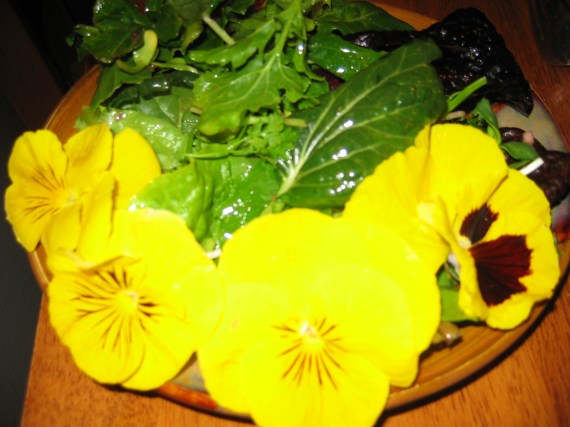
As part of our Christmas dinner, we had salads made entirely from our own yard produce. I had not used any season-extending devices at all, and we’d had cold weather and a few light snows, so these are the greens that thrive on cold and neglect. The “trim” is a ring of pansies, which I wrote about in an earlier post. The greens included arugula (see the post before this one,) pansy leaves (cool, tender, and delicious,) chervil, a few nasturtium leaves still surviving in a sheltered corner, my new favorite lettuce, and sunflower sprouts.
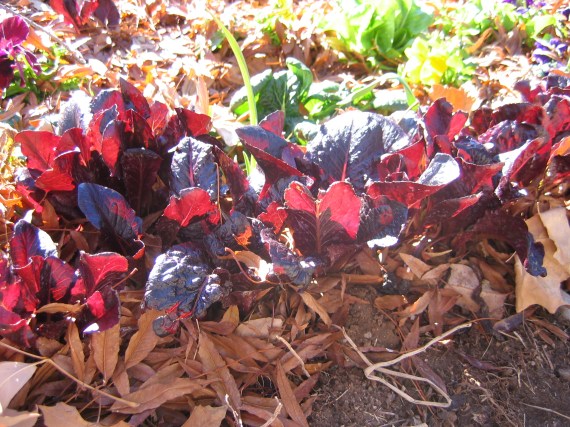
The lettuce that I’ve enjoyed most this year is a gorgeous deep red romaine called “Marshall.” I think I got my seeds from Territorial. the color is a dramatic foil for almost anything else, and it doesn’r get bitter in our sudden hot springs. It’s beautiful in the garden, too. You can see it poking up through a light mulch in the photo below.
The other photo shows my sunflower sprouts, and I wish I had known earlier how delicious they are. The first taste is pleasant and mild, but a delicious nuttiness rapidly reveals itself. These are the only sprouts that I’ve enjoyed eating out of hand, but they’re even better in a good mixed salad.
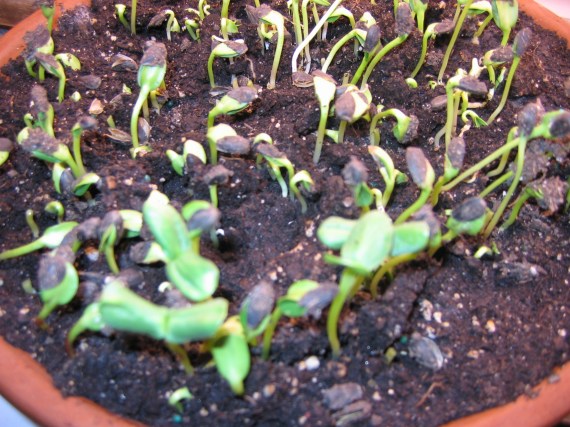
Sunflower sprouts seem to be best when soil-grown, and they need a little light. I have a grow-light for my spring seedlings, and it usually goes unused in the winter, so I used it to grow the sprouts, but a sunny window would be fine.
Start with a large flat container. I used a terra cotta saucer intended to hold a large potted plant, just because I had one sitting around. Put in an inch of good organic soil. Scatter raw organic sunflower seeds (in shell) very thickly on top, touching each other. Pat them into the surface, cover with another 1/4 inch or so of soil, water well but don’t make the soil soggy, and wait a few days. The books say to presoak the seeds, but I didn’t and they did fine. When they start to emerge, begin giving them light, and harvest when they are green and are trying to shed their shells. I snap them off at soil level with my thumbnail, flick off the clinging shell, rinse well and dry, and start snacking. They go well with spicy mesclun mixes but can also give depth to a simple lettuce salad. Grow lots, so that you can use them lavishly.
12 Dec
Arugula, my favorite weed

At times I’m very surprised by what grows well in my high desert garden. I wouldn’t have guessed that arugula would not only grow well but would naturalize and happily spread itself about. Arugula is my favorite salad green, and I’ve learned to love it for cooking too. Something about its tender nutty sharpness is like watercress gone to heaven. It likes cold weather, and manages with surprisingly little water.
First, get your seed. I don’t recommend the wild-type often sold as “sylvetta” because the leaves are small leading to low yield, and in dry conditions it can get too sharp to be pleasant. Try to get the type designated as ‘cultivated” or the named variety Apollo, although the latter lacks the frilly leaves that make such a nice show on the salad plate. In winter or very early spring, scatter the seed in drifts on prepared ground and rake them in lightly, or scatter them in prepared containers and scratch the seed in a little with your fingers. Water occasionally and keep an eye out. Early in the spring, you’ll notice the little plants struggling up bravely. Give them a little water when the soil is dry, and thin them out to stand about 4-6″ apart. Throw the washed thinnings in your salads, of course. When the plants are about 6″ tall, harvest them heavily for salads, but don’t cut the crown or pull the roots up. Use dressings containing nut oils and good olive oil. Never dress the arugula more than a couple of minutes before eating, because it wilts easily. Eventually the plants will start to bolt to seed. Do nothing to stop them. The next phase of the arugula season is starting.
The maturing plant will now stand about 2 feet high, with small clusters of buds. It’s perfect for cooked greens now. Leave one or two plants to bloom and make seed, and cut the rest down to about 3″ high, and bring the cuttings into the kitchen. Pull off and save all leaves, and break the bud sections off wherever the stem will snap without resistance. These are your cooking greens. Wash them carefully. If you want to use the large stems that are left over, cut them in cross sections no more than 1/4 inch long, because they contain strong stringy fibers. I compost them instead of eating them. blanch the washed greens in a large quantity of rapidly boiling water for 1 minute, no more. Drain and proceed as desired toward dinner. They have a flavor a little like broccoli rabe, and I love to eat them with pasta. See recipe below, and for other recipes see my website, www.localfoodalbuquerque.com, go to the “recipes” page, and click on “greens.”
Now, what about the plants you left alone? They will develop into great wispy clouds of small white flowers, a little like annual baby’s breath. Bees adore them. Then they’ll set hundreds of tiny seed pods. When these dry out, let some spill around the mother plant (which can now be pulled up, and should be, because it looks pretty scruffy by now) and toss the rest around wherever you want more arugula. Usually these seeds will be dry and ready for seeding in late summer, will sprout by September, and will be in the salad stage by late October. Leave them over the winter, and the cycle continues.
5 Dec
Thanks Giving
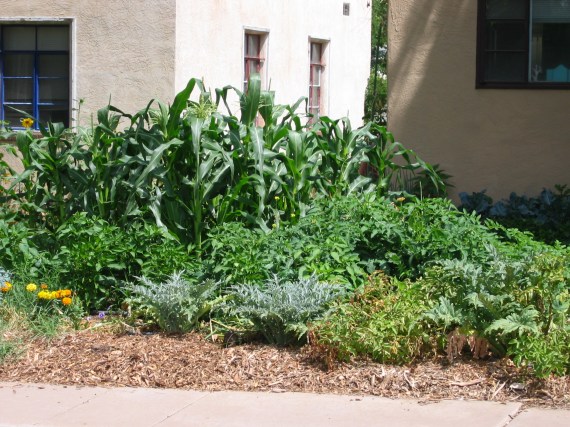
What a deeply joyful Thanksgiving I was privileged to have: here in New Mexico we had both a new president and a good long soaking rain, and in the high desert it’s a little hard to say which is more exciting. The garden is still providing some lettuce, arugula, herbs, and carrots, but I have more time to reflect on what I’m doing. This has led to thinking about what, exactly, my urban homestead means. It certainly doesn’t mean self-sufficiency. That won’t happen until I can grow coffee and olive oil. It doesn’t mean grimly making do. It’s a happy celebration of what one small piece of city dirt can produce. I have a medical practice and a number of hobbies, but growing my own food in the most space-intensive way possible is a lot of fun, and I have a website and blog to let other people know that, if they want to provide for themselves a little more, they don’t need to quit their job and move to the country. I don’t even think that’s the best way to start. Start where you are, with what you have. People with no land at all can bake sourdough bread and brew beer, and those are indoor “yeast gardens.” People with a balcony can grow herbs in pots. People with a tiny yard can utilize it. In the quest for local food, we can have the most local food of all, and if we have more garden space at other points in our lives, we’ll know more about how to use it if we’ve practiced in small ways. Please go to my website, www.localfoodalbuquerque.com, for more about urban gardening, and look at my blog entries on other pages for details about the many small pleasures that crop up along the way.
Most of my winter posts will be about canning, preserving, and using what was made during the summer. That’s also a way of remembering the abundant season and being grateful for what I received. So, here’s a fond look backward at
the colors of summer. 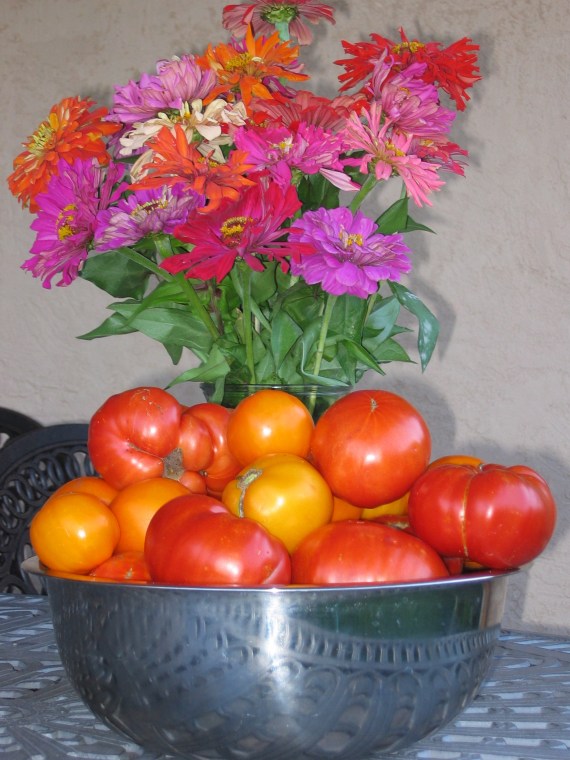
 My urban homestead