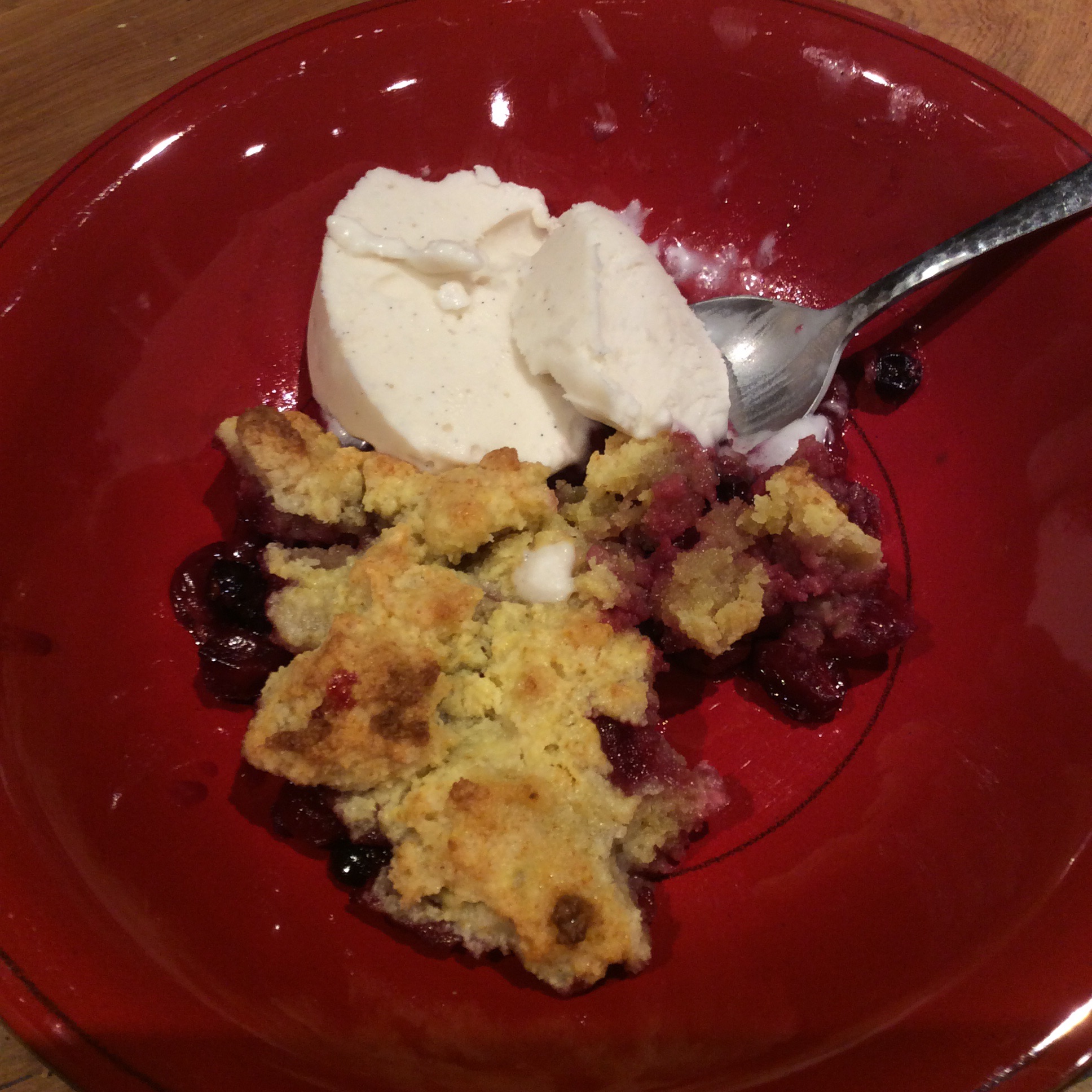
The tart or pie cherry is a pretty yard tree all season, and gorgeous in full fruit, with the glowing colors of a Russian enamel. This year my pie cherry tree bore heavily for the first time, and after making a new supply of tart cherry liqueur (no sugar this time,) I made a few cherry cobblers.
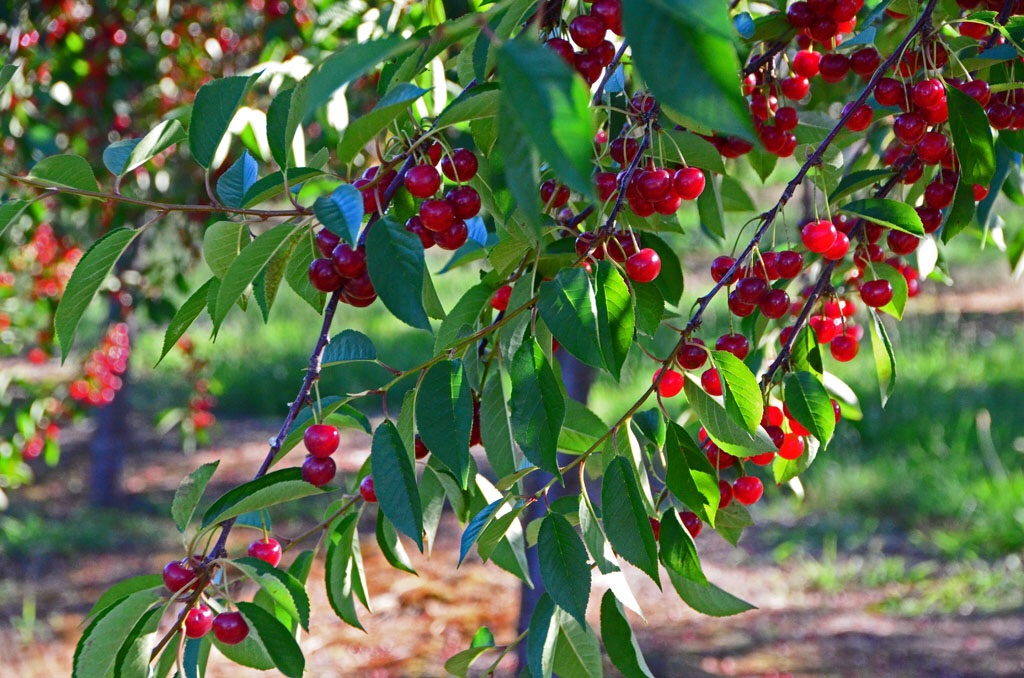
First, catch your cherries. They need to be the bright lacquer-red pie type, not the darker sweet cherries, which will turn a rather dreadful color if you try to cook them.
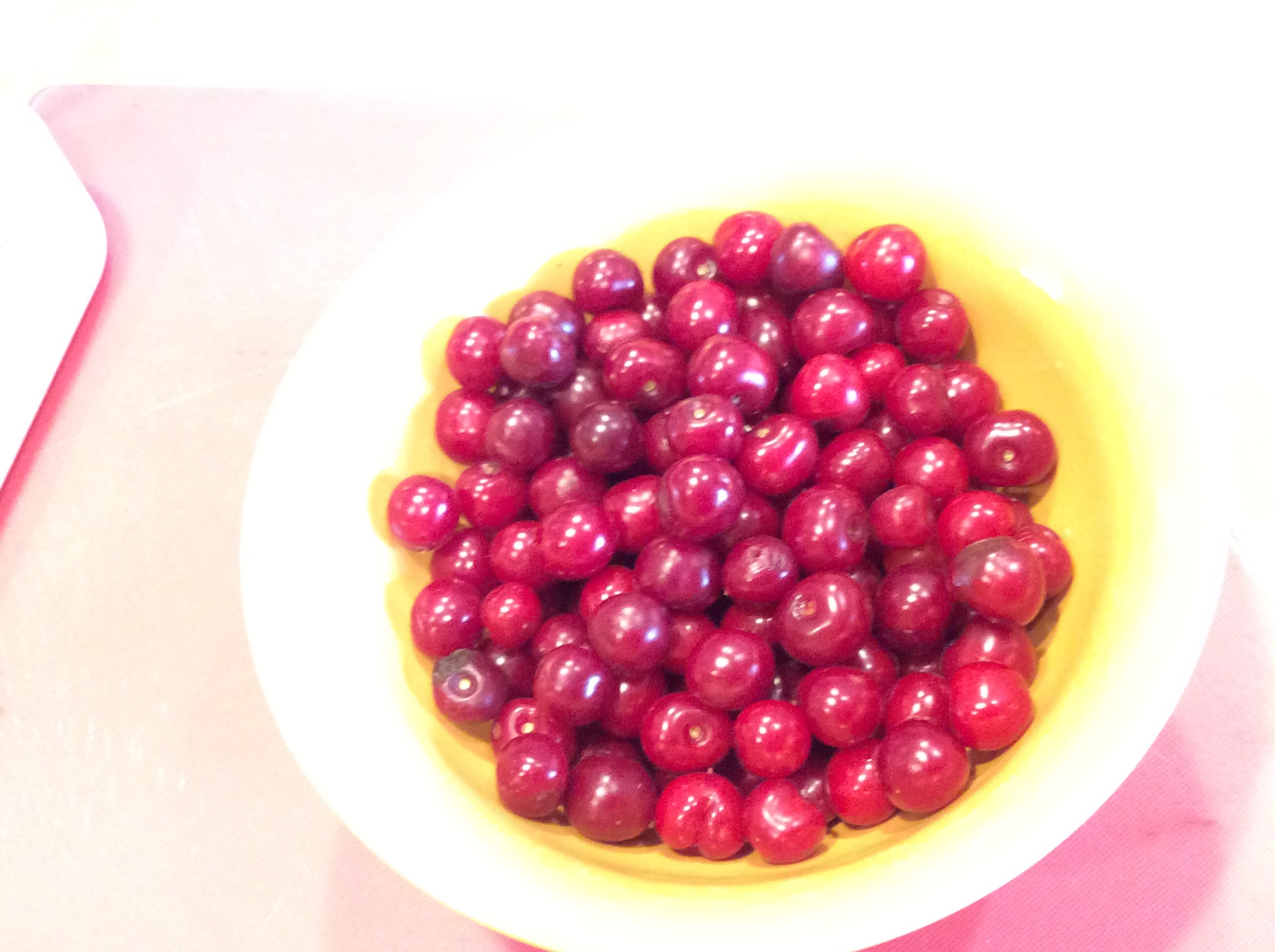
Next, pit enough of them to make 1 1/2 cups of pitted cherries. This will serve 2 gluttons or four normal people. I have a pitting device from OXO that pits four at a time, but it’s still tedious work. Be certain to run your clean fingers through the pitted cherries several times to find any pits that you missed, so that no teeth are cracked later.

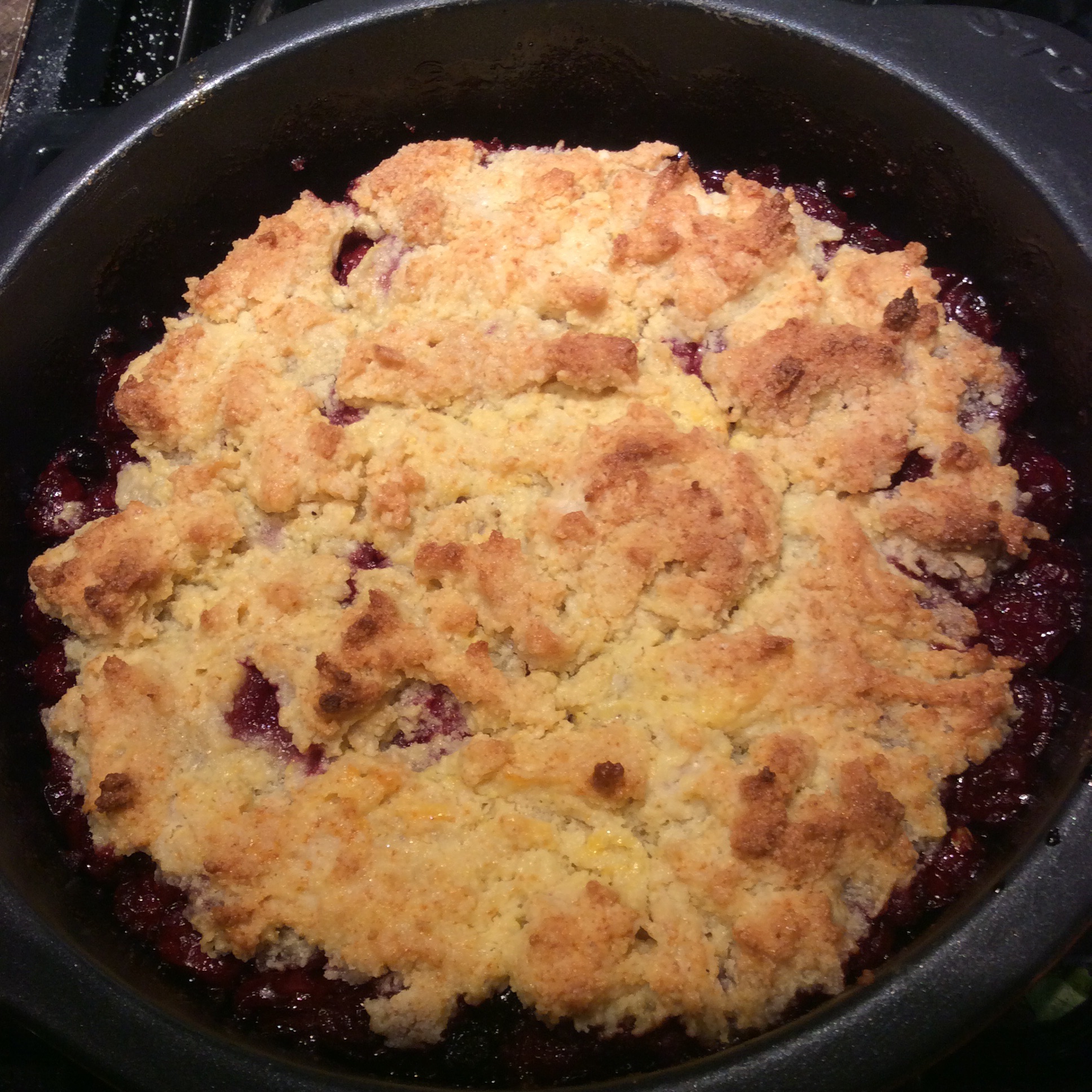
If you eat sugar, it’s very simple from here on. Add a handful of wild blueberries or (from my yard) fully ripe clove currants or serviceberries for the blue element, sweeten to taste, and make your favorite biscuit dough but sweeten it a little more than usual. Put the cherries and berries in a buttered 7 inch tart pan, top with artistic globs of the biscuit dough, and bake at 375 until the dough is done and browning attractively. If you eat low-carb it’s a little more complicated but not much. Sweeten the cherry mixture to taste with half erythritol and half Sweet Perfection oligofructose, working the sweeteners in with your fingers so that they don’t cake, and add a teaspoon of vanilla extract. Make the topping as follows:
1 1/2 cups almond flour
1/2 teaspoon salt
1/2 teaspoon baking powder
1/4 cup of Swerve sweetener confectioners type
1/3 cup Sweet Perfection oligofructose
1/4 cup butter, cold
2 egg yolks
Combine all the dry ingredients in a bowl and stir well with a fork. Work in the butter, cutting it in with the fork until the largest remaining butter pieces are the size of baby peas. Add the egg yolks, working them in with a fork until the mixture is fairly well amalgamated. Drop on top of the cherry mixture in the small buttered tart pan, pat it out just a bit with your fingertips (it will be sticky and messy,) and bake at 375 until the dough is cooked through and coloring. This dough doesn’t brown evenly as sugar-containing doughs do, and you have to watch carefully so that it doesn’t burn. Serve hot with low-carb
vanilla ice cream.
Happy Independence Day!
The gorgeous image of a cherry branch second from the top was on a Google page and I can’t find an attribution for it. If anyone knows who the photographer is, please let me know so that I can give credit.
Archive for the ‘recipe’ Category
4 Jul
Red, White, and Blue Cobbler
14 Jun
Perennial Arugula, With Notes on Montpellier Butter
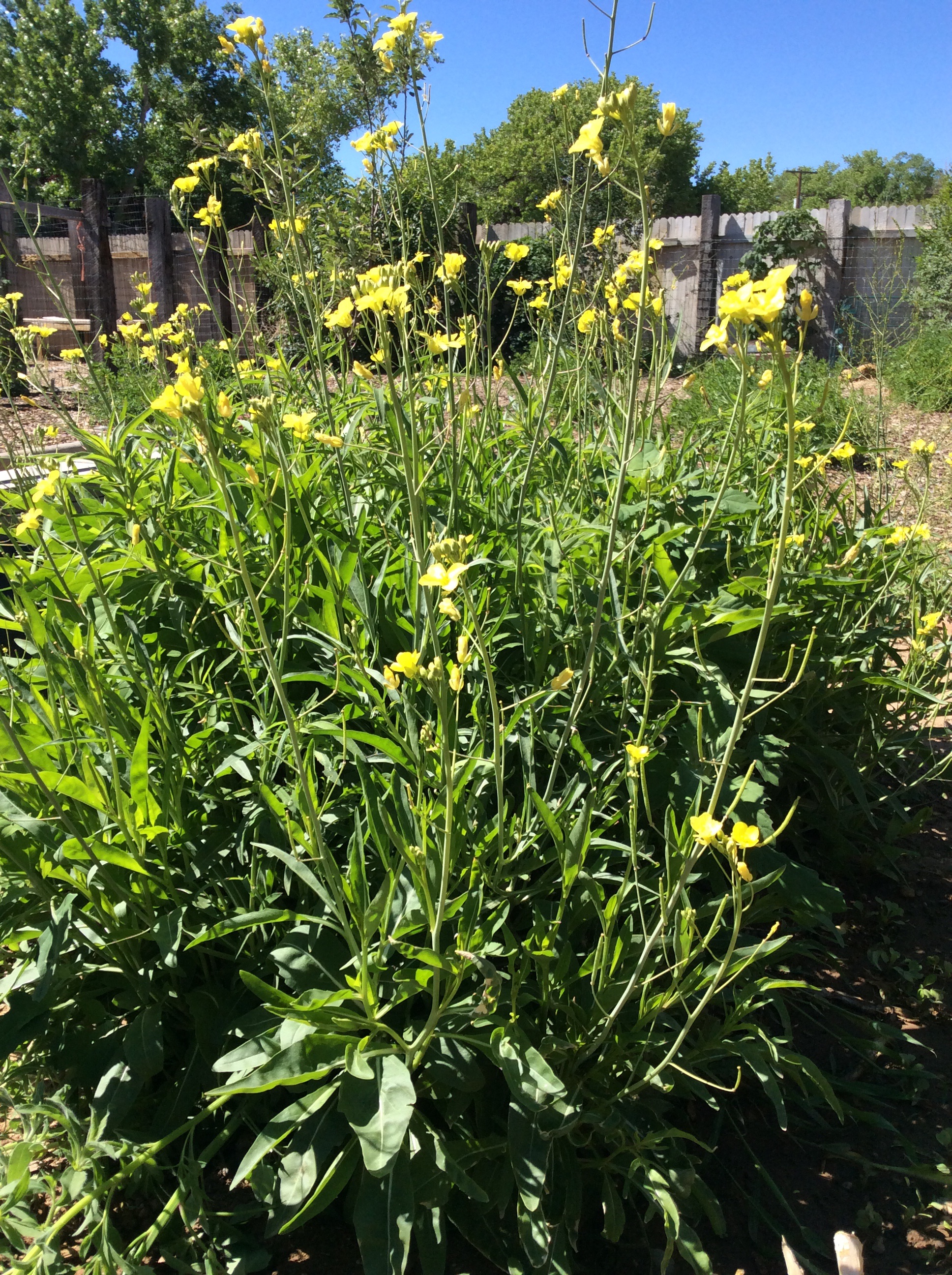
I have written frequently about annual arugula and how delicious, versatile, and easy it is. A few years ago I bought a packet of seed for perennial arugula, Diplotaxis tenuifolia. I planted them in a likely spot and then, as so often happens at my place, I was overcome by the sight of bare earth, forgot I had sown seeds already, and planted something large and rambunctious there. At the end of the gardening year I cleared the debris away and found tiny wispy plants that I recognized as the perennial arugula. They survived the winter, resprouted tentatively in the spring, and then all of a sudden they were a mass. A thuggish mass, ready to overpower anything in the way of their gangland fervor for territory. And they were, literally, hot. The initial flavor when I chewed on a leaf was pleasantly mustardy, developing gradually to a burn in the back of the throat as I swallowed that wasn’t painful, but certainly wasn’t pleasant either. While I puzzled over how to use them, they bloomed, and the delicately pretty sulfur-yellow blossoms drew bees from miles around. So, needless to say, they were kept.
Sometimes it takes me a while to find the best use for a perennial. So far, my favorite use for this sturdy perennial is to blanch the leaves briefly in boiling water and use them more as a seasoning than a bulk ingredient. Used as a small part of a cooked greens mixture, they add interest. I like a small buttered pile of them as a sort of “cooked herb salad” alongside meats or salmon. I intend to try pounding them with a mortar and pestle as a wasabi-like seasoning. And they are superb in Montpellier Butter. I learned about this lovely seasoning in one of Elizabeth David’s books, I forget which one. But the greatest recipe of them all is the one published by Jeremiah Tower, and it goes like this:
Jeremiah Tower’s Montpelier Butter (this is as he published it. My own tweaks are below.)
Coarse salt
6 spinach leaves, washed
2 shallots, finely chopped
1/2 bunch watercress leaves (I use 15 good-sized nasturtium leaves)
2 tablespoons fresh flat-leaf parsley leaves
2 tablespoons fresh chervil leaves
2 tablespoons chopped fresh chives
1 tablespoon fresh tarragon leaves
2 cornichons, rinsed and chopped
4 salted anchovy fillets, rinsed, soaked in water for 10 minutes and dried with a paper towel
2 tablespoons salted capers, rinsed, soaked, and drained
1 small garlic clove
1/4 teaspoon cayenne pepper
Freshly ground black pepper
3 hard-cooked large egg yolks
2 large raw egg yolks
1/2 cup (one quarter pound) good grassfed butter, room temperature
1/2 cup extra-virgin olive oil
1 teaspoon white-wine vinegar
Bring a large saucepan of water to a boil; add salt. Combine spinach, shallots, watercress, parsley, chervil, chives, and tarragon in a fine sieve. Carefully place sieve in boiling water until greens are wilted, about 30 seconds. Remove, and place in ice-water bath to cool, or hold under very cold running water for several seconds until cool. Remove, and squeeze dry. Transfer to the food processor. Add cornichons, anchovies, capers, garlic, and cayenne pepper. Season with salt and black pepper. Process to a smooth paste. Add cooked and raw yolks, and butter. Process until thoroughly combined. Transfer to a medium bowl and slowly whisk in olive oil. Add vinegar, and whisk to combine. Adjust seasoning, if necessary.
This will keep a day or two in the refrigerator, and two months in the freezer.
My tweaks: I leave out the spinach leaves, watercress or nasturtium leaves, and chervil, and use about 25 perennial arugula leaves instead, blanched with the other seasonings as described above. I increase the tarragon to a quarter cup of whole leaves, and I also use a few large cloves of confited garlic rather than one raw clove. I use five hard-cooked egg yolks so that I don’t have to worry about harming an immunocompromised guest. And sorry, Jeremiah, but I do the whole thing in the processor and don’t whisk by hand at the end. I keep the butter in roughly formed little bars in the freezer, tightly wrapped, so that I can cut off large (LARGE) pats with a heated knife and plop them on steaks or grilled salmon and heat briefly under the broiler just before serving to soften and partially melt the butter, or on steamed vegetables, or on nearly anything. I don’t eat the carb-y stuff anymore, but if you do, it is wonderful on chunks of grilled baguette and transcendent on handmade egg linguine with grated Parmesan. If you try this with frozen Montpellier butter and don’t want to take time to thaw it, try grating it on a coarse grater before tossing with the linguine, piling on the salmon, or adding generously to the cooked greens.
1 Jun
A Veggie Cookbook Worth Owning
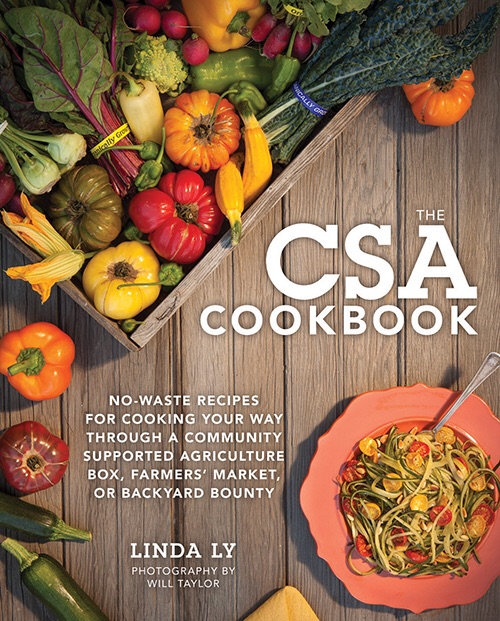
There are a lot of vegetable cookbooks on the market currently,most of them much of a muchness and pretty forgettable as far as I’m concerned, but now and then I come across one that must be bought. I bought this one. Then I bought another copy for a friend. It’s of special interest to anyone who grows their own vegetables or gets a CSA box for a few reasons:
1. The organization is by vegetable type, so if you have leafy greens in the garden you can turn to the leafy greens chapter and consider some cooking options.
2. It offers suggestions for vegetables, or parts of vegetables, that aren’t usually eaten. Broccoli leaves, for example, which are good to eat and highly nutrient-dense ( be careful how many you harvest, though, or your broccoli-bud crop will be significantly reduced.) Ms. Ly’s improvisational kale-stem pesto gives you a flexible way to use up the “nasty bits” of your kale. Tomato leaves are used well as a seasoning, and no, they aren’t poisonous. There are numerous other examples: I am looking forward to trying her chard-stem hummus later in the season. The recipe for pan-charred beans with bean leaf pesto looks like another winner.
3. The recipes that I have tried work and taste good. This does not go without saying. I have come across recipes, especially no-waste recipes, that look lovely in the picture but aren’t really edible. Ms. Ly’s recipes are good.
Oh, and 4. It’s available on Kindle if you need to save space on your cookbook shelves.
I don’t accept review copies of cookbooks. I buy them at my local indie bookstore, paying the same price that you will pay. That’s the only way that I can judge whether the value/ price ratio is really favorable. I think this one is worth the money. Even an old hand in the kitchen will pick up some new ideas for using vegetables.
19 May
Salmon in Springtime
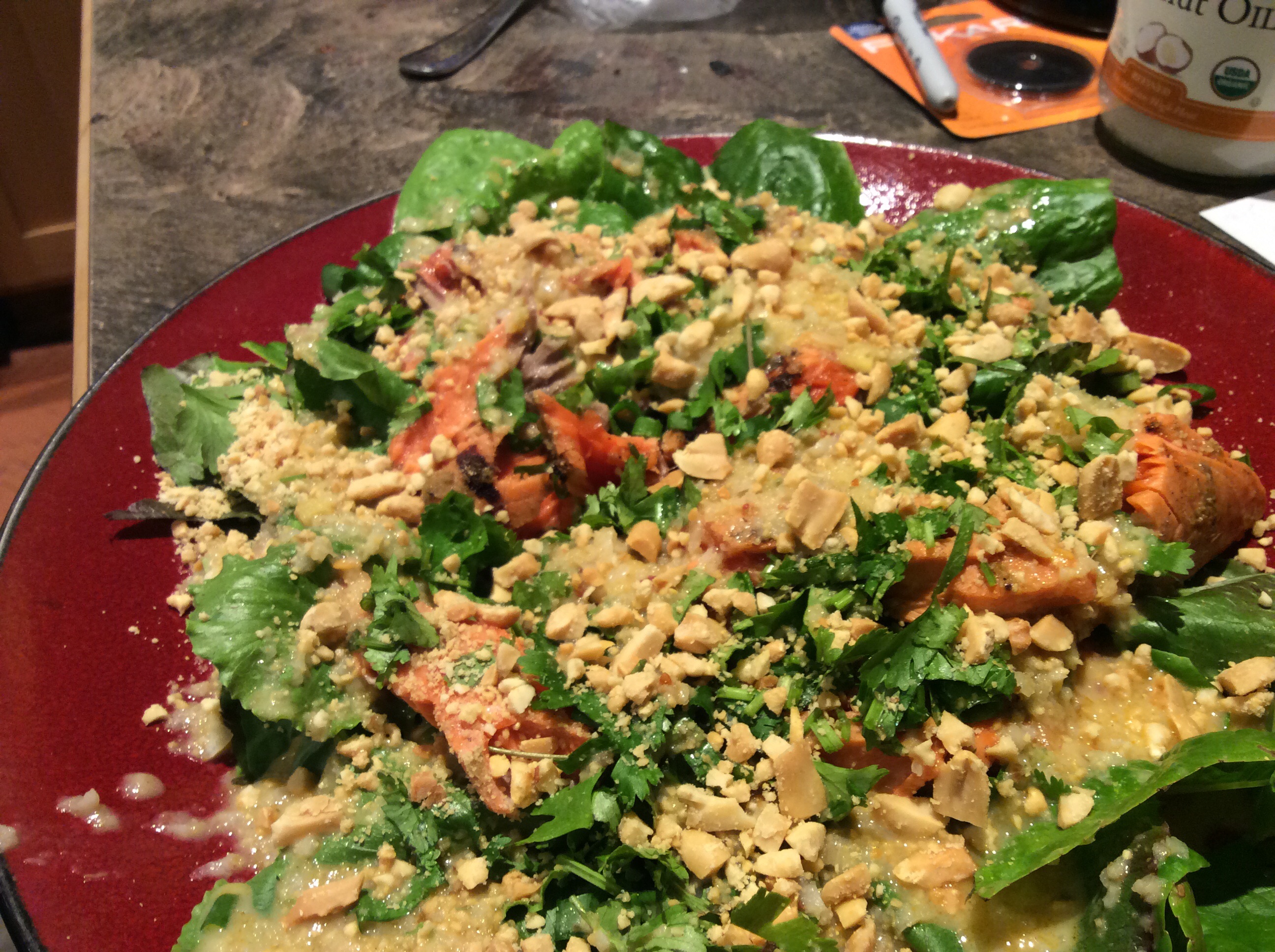
Here in central New Mexico we are enjoying a cool and unusually wet spring, and the romaine lettuce is still in great shape. Our local Fishhuggers are back at the markets with lovely Alaskan sockeye salmon caught by Kenny, and there is no healthier meal. For some reason I like my warm-weather lunches to lean Southeast Asian, and this one is a bit Thai-ish.
I used romaine, green onions, and cilantro from the garden, a fillet of sockeye salmon, crushed peanuts, and the vaguely Thai dressing below, which I keep jars of in the refrigerator in warm weather. Put generous heaps of sliced romaine on plates, rub the fillet with salt, grill quickly ( on a hot Green Egg grill, about 2 1/2 minutes each side will do it,) let cool a bit while you chop the cilantro and green onions ( green part only,)break up the fillet and remove all skin and put chunks of warm salmon on the lettuce, scatter on a handful of chopped cilantro and green onions, dress generously, and sprinkle crushed peanuts over the top. Delicious and very quick as well as insanely healthy.
Sort-of-Thai dressing:
Large chunk of ginger, about 1″ by 3″, peeled and sliced
7-10 large cloves of garlic
1/4 cup coconut fat
1 tablespoon green curry paste
2 tablespoons fish sauce
1 cup water
1 can full-fat coconut milk
Sriracha sauce to taste
Artificial sweetener ( I use liquid stevia,) or sugar, and more fish sauce to taste
Finely chop the ginger and garlic, heat the coconut fat in a saucepan, and stir-fry the garlic and ginger until cooked and fragrant but not browned. Add the green curry paste, stir-fry about another minute, add the fish sauce and water and bring to a boil, add the coconut milk and cook just until it’s all melted and creamy, then remove from heat. Let it cool to lukewarm, taste, and add more fish sauce if indicated. Add some sriracha if you like it hot (I love hot food and use about a tablespoon,) and then add sweetener, if you are ketogenic or low-carb, or sugar if that’s still in your kitchen, slowly, tasting frequently. I like mine on the sweet side, to balance the heat. Let cool all the way and use or keep in the refrigerator for later use.
This makes a perfect lunch to eat outside.

 My urban homestead