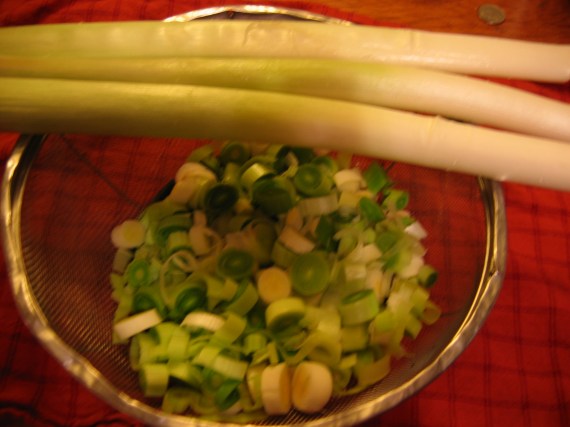
Leeks are delicious luxury vegetables that withstand mistreatment and hang in there well into winter. You can eat them all winter if you make some effort to protect them. I don’t give mine any protection at all, and they’re still good.
I start with purchased plants, and nearly always get mine from Territorial Seeds. You can get very fancy about digging a trench, planting the new plants in the bottom of the trench, then gradually filling it in over the summer to get the longest white shafts possible. Or you can use my rough-and-ready method: Stick a trowel its full blade length into well-prepared and rich soil, use the trowel to hold open a slit the depth of the blade, stick the new little plant down into the slit you have created behind the trowel blade until only about an inch of the leaf tips are showing, draw out the trowel blade without displacing the plant, and firm the soil a little. Keep the plants at least 6″ apart each way. When all done, water your new planting. If I get ambitious later in the year, I’ll heap compost around the plants or even build a rough frame about 6″ deep that fits around the leek patch and fill it with mulch to blanch more of the leeks. But when I’ve planted deeply to begin with, I know that I’ll have at least 6″ of white shaft even if I never get around to hilling them up any further. Keep them weed-free through the summer, and make sure they have enough water. If they send up flower stalks, cut the stalk away asap.
They are ready for harvest in the fall, and will hold until January or longer, depending on the variety and the amount of protection they receive. I don’t protect mine at all, and the outside of the shaft gets ratty-looking, but when ready to use them I pull them carefully out of the ground, strip off the ragged outer layers right in the garden, cut the tops off with my garden knife, and am left with leek shafts about a foot long and a little under 1″ in diameter. The books say only to use the white part, but I use the green part too, up through the part where the center looks bright shamrock green but stopping where it starts to look emerald green. I do not find the light green parts tough at all.
They are the sweetest and most delicate member of the onion family and have hundreds of uses, and I advise checking out any good vegetable cookbook for recipes, but my own favorite is classical French creamed leeks. I serve this as the main dish for dinner with slices of good hot baguette to eat with it and a glass of light red wine to enliven the ensemble.
Click here for the recipe!
Archive for the ‘edible landscaping’ Category
12 Jan
Leeks in the winter garden
28 Dec
winter salads
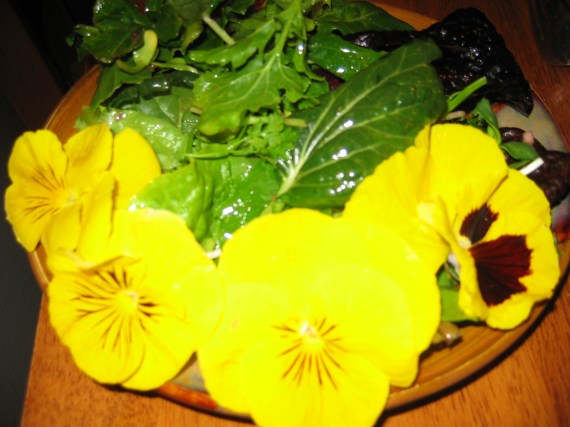
As part of our Christmas dinner, we had salads made entirely from our own yard produce. I had not used any season-extending devices at all, and we’d had cold weather and a few light snows, so these are the greens that thrive on cold and neglect. The “trim” is a ring of pansies, which I wrote about in an earlier post. The greens included arugula (see the post before this one,) pansy leaves (cool, tender, and delicious,) chervil, a few nasturtium leaves still surviving in a sheltered corner, my new favorite lettuce, and sunflower sprouts.
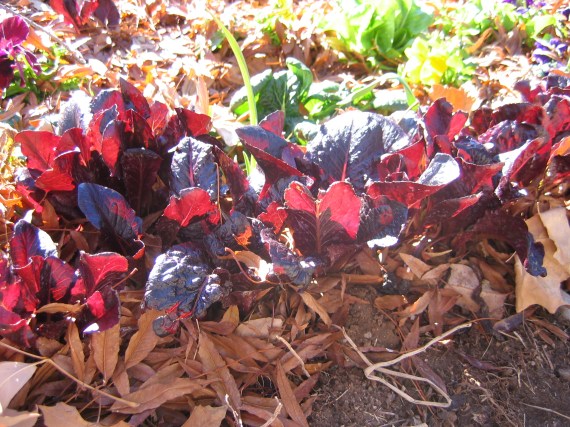
The lettuce that I’ve enjoyed most this year is a gorgeous deep red romaine called “Marshall.” I think I got my seeds from Territorial. the color is a dramatic foil for almost anything else, and it doesn’r get bitter in our sudden hot springs. It’s beautiful in the garden, too. You can see it poking up through a light mulch in the photo below.
The other photo shows my sunflower sprouts, and I wish I had known earlier how delicious they are. The first taste is pleasant and mild, but a delicious nuttiness rapidly reveals itself. These are the only sprouts that I’ve enjoyed eating out of hand, but they’re even better in a good mixed salad.
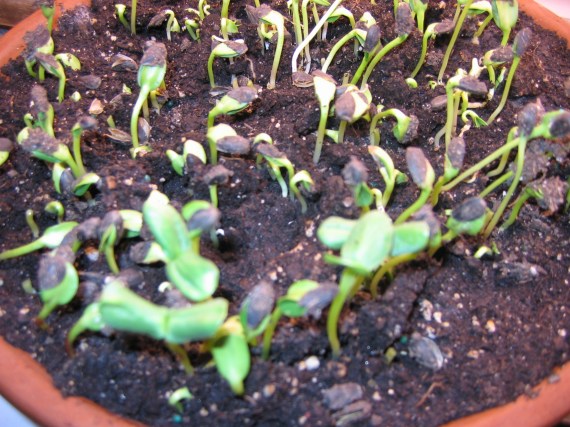
Sunflower sprouts seem to be best when soil-grown, and they need a little light. I have a grow-light for my spring seedlings, and it usually goes unused in the winter, so I used it to grow the sprouts, but a sunny window would be fine.
Start with a large flat container. I used a terra cotta saucer intended to hold a large potted plant, just because I had one sitting around. Put in an inch of good organic soil. Scatter raw organic sunflower seeds (in shell) very thickly on top, touching each other. Pat them into the surface, cover with another 1/4 inch or so of soil, water well but don’t make the soil soggy, and wait a few days. The books say to presoak the seeds, but I didn’t and they did fine. When they start to emerge, begin giving them light, and harvest when they are green and are trying to shed their shells. I snap them off at soil level with my thumbnail, flick off the clinging shell, rinse well and dry, and start snacking. They go well with spicy mesclun mixes but can also give depth to a simple lettuce salad. Grow lots, so that you can use them lavishly.
12 Dec
Arugula, my favorite weed

At times I’m very surprised by what grows well in my high desert garden. I wouldn’t have guessed that arugula would not only grow well but would naturalize and happily spread itself about. Arugula is my favorite salad green, and I’ve learned to love it for cooking too. Something about its tender nutty sharpness is like watercress gone to heaven. It likes cold weather, and manages with surprisingly little water.
First, get your seed. I don’t recommend the wild-type often sold as “sylvetta” because the leaves are small leading to low yield, and in dry conditions it can get too sharp to be pleasant. Try to get the type designated as ‘cultivated” or the named variety Apollo, although the latter lacks the frilly leaves that make such a nice show on the salad plate. In winter or very early spring, scatter the seed in drifts on prepared ground and rake them in lightly, or scatter them in prepared containers and scratch the seed in a little with your fingers. Water occasionally and keep an eye out. Early in the spring, you’ll notice the little plants struggling up bravely. Give them a little water when the soil is dry, and thin them out to stand about 4-6″ apart. Throw the washed thinnings in your salads, of course. When the plants are about 6″ tall, harvest them heavily for salads, but don’t cut the crown or pull the roots up. Use dressings containing nut oils and good olive oil. Never dress the arugula more than a couple of minutes before eating, because it wilts easily. Eventually the plants will start to bolt to seed. Do nothing to stop them. The next phase of the arugula season is starting.
The maturing plant will now stand about 2 feet high, with small clusters of buds. It’s perfect for cooked greens now. Leave one or two plants to bloom and make seed, and cut the rest down to about 3″ high, and bring the cuttings into the kitchen. Pull off and save all leaves, and break the bud sections off wherever the stem will snap without resistance. These are your cooking greens. Wash them carefully. If you want to use the large stems that are left over, cut them in cross sections no more than 1/4 inch long, because they contain strong stringy fibers. I compost them instead of eating them. blanch the washed greens in a large quantity of rapidly boiling water for 1 minute, no more. Drain and proceed as desired toward dinner. They have a flavor a little like broccoli rabe, and I love to eat them with pasta. See recipe below, and for other recipes see my website, www.localfoodalbuquerque.com, go to the “recipes” page, and click on “greens.”
Now, what about the plants you left alone? They will develop into great wispy clouds of small white flowers, a little like annual baby’s breath. Bees adore them. Then they’ll set hundreds of tiny seed pods. When these dry out, let some spill around the mother plant (which can now be pulled up, and should be, because it looks pretty scruffy by now) and toss the rest around wherever you want more arugula. Usually these seeds will be dry and ready for seeding in late summer, will sprout by September, and will be in the salad stage by late October. Leave them over the winter, and the cycle continues.
22 Nov
fiesta de pimientos
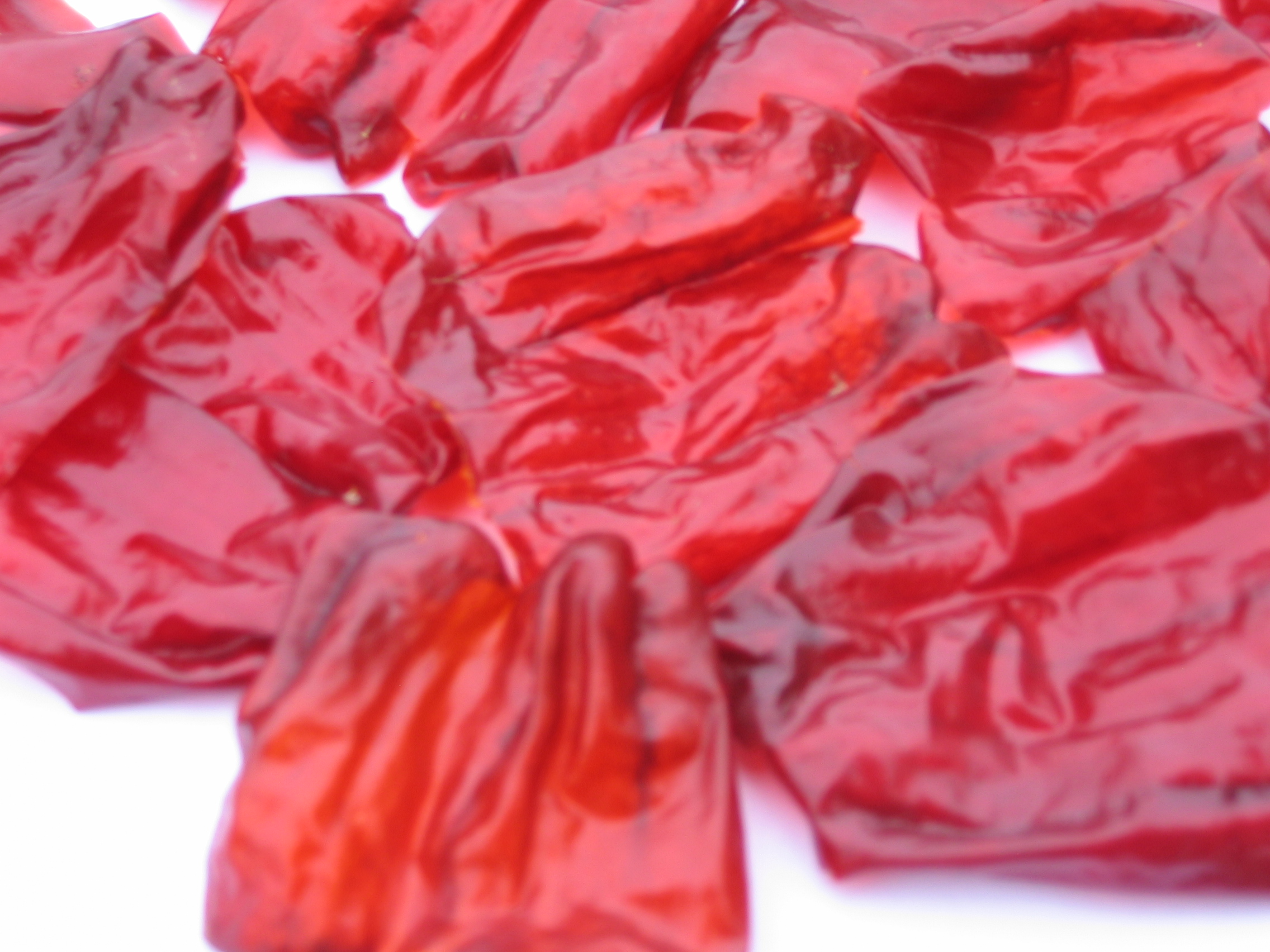
Here in New Mexico, we’re rich in chiles of all kinds. However, I seldom see or hear about one of the best, the Spanish Pimiento de Padron. In northern Spain, there’s a festival devoted to them when they come into season. The peppers are picked green, when about the size of large olives, and saute’ed whole in olive oil with some sea salt, then eaten hot as a tapa. About one in 8-10 is fiery hot, while the rest are pretty mild. Eating them is called Spanish Roulette, but we New Mexicans are up to it. After a summer of chowing down the green ones, I let the last flush turn red and dry on the plant, and make my year’s supply of wonderfully flavorful red pepper. I pick the somewhat dry, leathery peppers and slit each one open, lay it flat, and remove all the stem, seeds and veins. The sensitive will want to wear latex gloves for this. Spread them out in single layers on one or two large baking sheets and dry them in a very slow oven, 170 degrees if possible. Drying time varies with weather conditions and oven temp. Usually I dry them at 170 for about 4 hours, then leave them in the turned-off oven overnight. When dry, they are shiny and translucent and look like Chinese enamel; see above. Grind them to a powder in the blender and keep them in an airtight container until you need them. I keep a shaker of “yard pepper” on my dining room table, and love the way it adds snap and piquancy to a variety of foods. try it on fried eggs. The plants are very attractive, about 3′ high at maturity and fairly compact, so I like to grow them where they can be seen. You can get seeds at our New Mexico source, Gourmet Seeds.
 My urban homestead