Mini Farming is about producing as much food as possible from as little space as possible. It covers a number of ways to produce food, including vegetable and fruit growing and raising chickens for eggs and meat. It goes into great detail about soil amendment so that your plants will grow. You may not want to garden in this precise fashion, and I’m with you there, since my own gardening methods are more slapdash. But it’s good to know some rules before you start breaking them. It is a very practical book, offering an astounding amount of information per dollar. The author has clearly done these things himself; sadly, this is not always the case in homesteading books. He is careful to tell you what you need to know. A pet peeve of mine is the number of homesteading books that purport to teach you how to raise animals for meat, then when the time comes to harvest the meat they go coy and soft-focus and say “Be sure to have an expert show you how to do the killing.” What nonsense. You may not have anyone available to demonstrate, or a self-elected “expert” may do such an awful job that you think you’ll never eat meat again. A good book can describe the process and ready you for what you will encounter every step of the way. This book tells you exactly how to kill and butcher a chicken as quickly and humanely as possible. If you are going to raise meat birds, read it even if you plan to have a more experienced person help you, so that you understand beforehand what’s going to happen. This is a great value and a good book for the serious “yard farmer.”
I do not ever accept free review copies of the books that appear on my blog. I buy them at my local independent bookstore, paying the price that you are likely to pay. Books like this make me realize why I set that policy. This is a very beautiful book, and the recipes are top-notch. But if you’re buying it because you are interested in wild foods, you need to know a few things:
1. A lot of the wild foods described are mushrooms, which many foragers prefer to avoid.
2. This is not a book about how to forage. You’ll need a couple of good foraging instructional books for that.
3. If you’re one of my local Albuquerque readers, a lot of the foods described don’t grow wild around here.
In short, this is a great coffee-table book and a fine high-end cookbook, and if you love to spend time in the kitchen trying to find the greatest height to which a foraged food can be brought, you’ll love this book. If you love to gaze upon exquisite (and expensive) glossy photos of resplendent food, you’ll love this book. I love this book. But $40 is a price that makes me stop and think hard about value for money, and I can’t honestly say that it represents great value for money. If I had gotten it free, I might unconsciously gloss over that part. I’m glad I bought it, but if your goal is to learn to forage, this is not the book for you.
Posts Tagged ‘foraging’
29 Jan
My Bookshelf: Efficient Gardening and the foraging gourmet
28 Nov
Books Worth Reading: John Kallas on Edible Wild Plants
The holiday weekend was a great time to read in a warm spot, which reminded me that I should be sharing more of the books that I think are really helpful. I should add that I don’t accept free review copies; whenever I review a book, I paid the same price for it that you will. I think that this is essential to an accurate judgment of the value-for-money aspect of the books that I recommend.
With that in mind, John Kallas’s Edible Wild Plants: Wild Foods from Dirt to Plate is a very good value if you want to get started in foraging. I get a lot of inquiries about wild foods, and this is a book that I can recommend without reservation to any beginner; if you read and pay attention, you will learn to collect a number of common plants safely and prepare them well. Kallas concentrates on leafy greens which are found in most parts of the country, and he organizes them by flavor category in addition to giving accurate botanical and ID information. This is a lot more useful and practical than you might realize if you aren’t accustomed to foraging for greens. A well-balanced dish of greens needs a range of flavor notes, as well as a base of mild greens to build upon, and as you learn the plants from Kallas you will learn the notable aspects of their flavors. In my opinion, nearly any experienced forager could pick up a tip or two here, about preparation if not about identification.
Only greens and shoots are found in this book. If this seems too limited, keep in mind that most of us aren’t going to spend the time needed to forage and prepare wild staples, at least not most of the time. It’s romantic to read about gathering wild rice or arrowroot, or to imagine spending a clear autumn day gathering and storing fruit or nuts, but the wild foods that are widely available throughout much of the country for much of the year and that you can forage in a few minutes on your way home from work are mostly greens and shoots. Besides, if most of us were to make one change in our diets and maintain it, the addition of more green veggies would be a good one to pick. If foraging gets you to eat more leafy greens, this is a good thing.
If, like me, you’re a Kindle addict, this book is available on Kindle. I use the Kindle app on my Ipad so that I can see the photos in color. I daydream about eventually having a large collection of good foraging books on one e-device that I can carry around in my backpack, but unfortunately most of the wild-foods books available for Kindle are not of high quality. This one is.
DR. Kallas’s website can be found here if you’d like to order the book directly from him. You can also read his reviews of foraging books, and his thoughtful comments are invaluable when deciding what books you want to add to your collection.
13 Aug
Still more greens, and notes on solar cooking

Since I got a solar oven, I no longer find it difficult to cook chickpeas, and so I’m looking for new ways to use them. I especially like combinations of greens and beans, partly because these primal and earthy dishes are found all over the world wherever people need healthy cheap food, and partly because they taste good. I’m cooking my way through a huge patch of lambs-quarters and amaranth (common pigweed) in my back yard, and getting healthy food from weedy places always satisfies my sense of economy. If you’re not a weed-eater, just use Swiss chard. I like a little smoked meat with greens, but if you don’t eat meat, just leave off the final garnish of bacon. This makes two large main-course servings with leftovers.
One pound young leaves and tender tips of lambs-quarters and amaranth, OR one large bunch of swiss chard, stems removed, chopped coarsely.
One pint cooked chickpeas, with just enough of the cooking liquid to cover them (see Solar Beans, below.)
3-4 tablespoons good flavorful olive oil
1 large onion, finely sliced
2 large cloves garlic, chopped finely
1 tablespoon of fresh thyme leaves
2 teaspoons Spanish Pimenton de la Vera, or smoked paprika
1/2 teaspoon red chile flakes
salt and pepper to taste
a little of your best olive oil for drizzling
1 thick slice bacon, fried crisp and crumbled (optional)
Wash the greens very well, make sure to remove any remaining large stems, and blanch them in boiling water for 1 minute. Drain, press out extra water, and turn out on a cutting board and chop coarsely in both directions. Meanwhile, heat a heavy pot (I like an unglazed clay 3 quart pot) over medium heat, warm the olive oil, and saute the onions in the oil until translucent and cooked through but not browned more than a little. Add the chopped garlic and saute until garlic is cooked. Add the smoked paprika, thyme leaves, and chile flakes, saute a minute but no more, and promptly add the chickpeas and their liquid. When this mixture comes to a boil, add the blanched and chopped greens, salt to taste, turn the heat to low, and let it all mellow together for 10-15 minutes. Check the seasoning, add pepper to taste, and serve with a good drizzle of very good olive oil on each serving and the crumbled bacon on top if you’re using it. With a hunk of good baguette and a glass of full-bodied straightforward red wine, it couldn’t be better or healthier. Without its bacon topping it’s vegan and can be served to people of that persuasion, with the bacon fillip for the carnivores at the table. People who are vegetarian but not vegan will enjoy a pat of butter melted on top to give a little richness. Hedonists will like both a little butter and a little bacon.
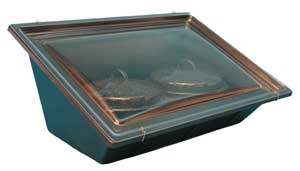
Solar cooking is a natural here in New Mexico, where we have more sunlight than we know what to do with.
So, how do you cook solar beans? Fist you catch your solar oven. There are lots of easy plans on the internet for making them, but I chose to buy mine from the Solar Oven Society. Their solar ovens are capacious, lightweight, and every one you buy helps the society provide solar ovens to the third world, which avoids some deforestation and greenhouse gases from cooking fires. Their ovens are cleverly designed with two potential bases to provide a summer sun-catching angle and a winter sun-catching angle. Optional reflectors are available to achieve higher temperatures. You may want the optional reflectors for other purposes, but for cooking beans you won’t need them. Two graniteware pots are included with the oven, and you can put a pint of dry chickpeas in each one, cover with cold water by at least 2″, and set the oven up facing south in the morning with the two full pots inside. Then employ my special cooking technique: walk away, laughing a carefree laugh, and go to work or just get on with your life. On a reasonably sunny day, the oven without reflectors attached will reach a peak temperature of about 250 degrees and will stay in that range for much of the day. When you get home eight or nine hours later, you will find two steaming pots of perfectly cooked chickpeas, and you can salt them to taste, let them cool, and use immediately or freeze in pint containers with enough of their pot-liquor to cover. I love the oddly meaty-tasting cooking liquid and often use it as the broth for the finished dish, as I do above.
The directions that come with the oven imply that you need to turn it a few times to keep it facing the sun, but at least in summer I just point mine due south and forget about it. Other types of beans are also naturals for this solar slow-cooking, but they take less time, so I do them on weekends when I can check the oven in 4 hours or so to see how they’re coming along. For readers at lower altitudes than our 5500 feet, cooking times would tend to be much shorter. If the day clouds over, you may need to finish inside, or just put the pots in the refrigerator overnight and try again the next day. Don’t forget and leave the beans in the cool solar oven overnight, since some very nasty bacteria including botulinum could grow in room-temperature aqueous solutions. Cool them and pop them in the fridge or freezer when they’re cooked. Eat in the knowledge that you’re taking in all sorts of nutritive and cholesterol-lowering compounds that cost you no energy and very little trouble to cook. Beats canned, doesn’t it?
24 Jul
My Bookshelf: Safe Foraging with Samuel Thayer
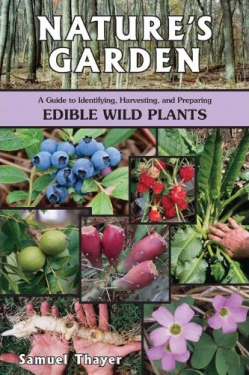
Periodically someone asks me what wild food books I recommend. There are a number of good ones, and a much larger number of bad ones. For overall high quality, level of detail, and knowledge of his subject, I’m a fan of Samuel Thayer and his books on foraging, The Forager’s Harvest and Nature’s Garden. Thayer has chosen to cover a smaller number of plants at a much higher level of detail than other guides, and if you’re a beginner I especially recommend this approach. There’s plenty of time to branch out later. I also recommend the delightful books of Euell Gibbons. They are not field guides and I don’t care for the recipes much, but his sheer joy in his subject is infectious. I became interested in wild foods when I was 12, and my wise mother bought me a set of Euell Gibbons books so that I wouldn’t poison myself. The gift has lasted almost 40 years (so far) and it would be impossible to calculate how much it deepened my love for the natural world.
This is a good opportunity for me to talk about my own view of foraging and use of wild edibles. Too many people with too little knowledge are out there seeking wild foods (and, worse, teaching about wild foods.) Most of us didn’t learn from experienced parents and grandparents, so respect your own learning speed and style. Consult at least two guidebooks before you decide that you have identified a plant, and read the first 40 pages of Nature’s Garden before you do any actual foraging because the information about a safe approach and common pitfalls is invaluable and well written. Remember that you are introducing your body to entirely new foods, and eat very small portions the first time, followed by small portions the second time, to determine your tolerance. NEVER assume that one part of a plant is edible just because another part is edible. Many common vegetables have toxic parts- the ordinary potato has toxic foliage- so there’s no reason to assume that edible leaf equals edible fruit or root, or vice versa. NEVER use this blog to identify a wild edible. I write about cooking and eating, not about plant identification, and the information that I give is not adequate to identify a wild plant when used alone, nor are my photographs taken with clear identification in mind. If you want online information, Thayer has an excellent website at Forager’s Harvest, and Langdon Cook has a delightful blog about wild food adventures in the Seattle area. Our climate in New Mexico is very different, but many of the plants he collects are found in our area.
That said, I can’t think of any hobby that has given me more pleasure than foraging. Sometimes people ask me why I seek and eat wild foods, when I have a garden and can grow all the vegetables I want. Euell said it best: “Wild foods are my way of taking communion with nature, and with the Author of nature.” I can’t think of anything we all need more right now than a positive connection with nature that makes us love it and want to protect it.
 My urban homestead