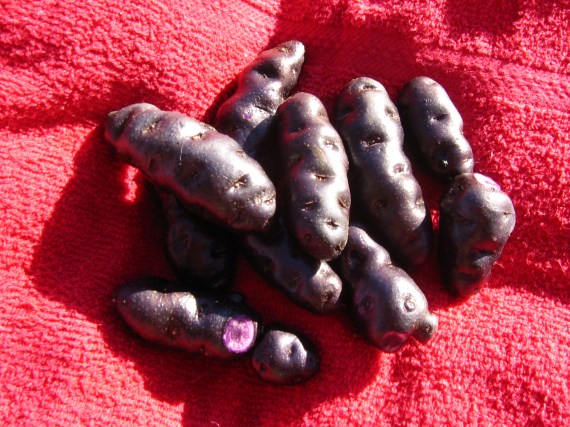
When I first ordered Peruvian Purple seed potatoes, I thought of them more as a curiosity than as a real crop. I was curious about how this native of the Peruvian highlands would adapt to our own high-desert conditions. I was also aware of their very high anthocyanin content, and I’m never one to turn down a good source of antioxidants. I’m still digging them for winter use, and they are one of my most successful crops this year and fill an interesting niche in my household menu: they’re readily available when nearly everything else is dormant.
I planted mine in a strip at the side of my house, which gets very hot in the summer. I did water them but not as much as they might have liked. Even so, they flourished and looked very pretty in their season. Incidentally, this brings up the fact that much gardening information on the Web is clearly written by non-gardeners. Now that edible landscaping is hot, I see recommendations to use the potato as an ornamental, which sounds fine if you don’t know that the vegetative parts die off in late summer and look just awful. So plant them where some other big pretty plant will spill over and fill the empty space in late summer, or put them in an out-of-the-way place where you can admire them in their season and not see them as much when they die back. Do keep them weeded.
When they flowered I scrabbled under themn to look for new potatoes, as I do with all my potatoes, but didn’t find any, and thought they were probably a loss. However, in November when I dug up the space for the winter, I found a treasure trove of earth-amethysts. They were blemish-free and looked very lovely after scrubbing, with deep purple skins that glistened like jewels when wet. I left them in the ground and dug them as I needed them, and on February 1st I’m still digging them and they’re still in perfect condition. They have been completely free of disease and haven’t shown any sprouting yet.
They’re very tasty cut in chunks and roasted in nearly any kind of fat (olive oil and goose fat are probably my favorites) in a 400 degree oven with some coarse salt and a good sprinkling of chopped herbs added near the end of cooking. Chopped garlic added late in the cooking period when it won’t scorch is nice too. A hot potato salad made of chunks of Peruvian Purple boiled in salted water until tender, drained, and dressed with a vinaigrette dressing and a little chopped green onion, parsley, ands celery (plus a good dose of bacon crumbles for non-vegetarians) would be delicious and very decorative. This potato is a survivor, which is probably why it was valued as part of the Peruvian mixed potato patches. It doesn’t demand intensive care and makes do with less water than other potatoes I’ve grown. I recommend it. You can get it at Ronnigers. Formerly I recommended Seed Savers Exchange, and although they don’t have this potato for the 2010 season, I do still recommend them for almost everything else.
For more on growing potatoes. Click here
1 Feb
More winter treats: the Peruvian Purple Potato
26 Jan
salmon with a Thai touch
Here in Albuquerque we don’t have local fish, but we do have a local couple, the Fishhuggers, who sell Alaskan salmon and other fish, sustainably fished in Alaska by the Fishhugger himself. It’s frozen shortly after being caught, and when thawed and promptly cooked, is a lot closer to fresh than anything we can buy in the stores. You can find it at the Corralles farmers’ market. I keep frozen blanched greens in my freezer in one-cup portions, ready when I need a winter pick-me-up.
When I cook salmon I usually use their wild-caught sockeye, which is a brilliant red-orange tone and loaded with omega-3s. I like to use other brilliant colors, usually bright greens, to complement the lovely fish. Today I combined the salmon with Thai accompaniments, and the green coconut-milk curry set off the plainly pan-grilled fish beautifully. Whenever you eat fish, remember to support sustainable fishing! The Seafood Watch card is a handy way to decide what to buy. Click here to print one out.
12 Jan
Leeks in the winter garden
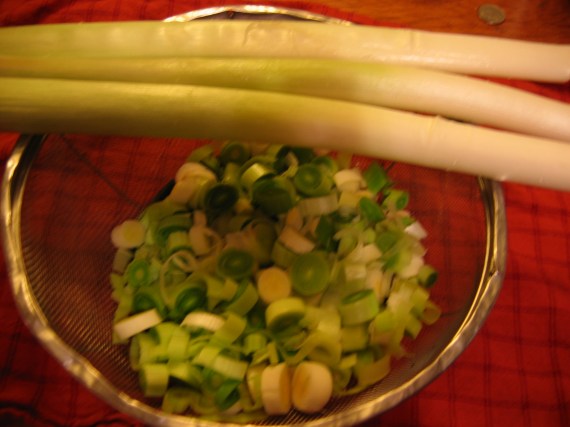
Leeks are delicious luxury vegetables that withstand mistreatment and hang in there well into winter. You can eat them all winter if you make some effort to protect them. I don’t give mine any protection at all, and they’re still good.
I start with purchased plants, and nearly always get mine from Territorial Seeds. You can get very fancy about digging a trench, planting the new plants in the bottom of the trench, then gradually filling it in over the summer to get the longest white shafts possible. Or you can use my rough-and-ready method: Stick a trowel its full blade length into well-prepared and rich soil, use the trowel to hold open a slit the depth of the blade, stick the new little plant down into the slit you have created behind the trowel blade until only about an inch of the leaf tips are showing, draw out the trowel blade without displacing the plant, and firm the soil a little. Keep the plants at least 6″ apart each way. When all done, water your new planting. If I get ambitious later in the year, I’ll heap compost around the plants or even build a rough frame about 6″ deep that fits around the leek patch and fill it with mulch to blanch more of the leeks. But when I’ve planted deeply to begin with, I know that I’ll have at least 6″ of white shaft even if I never get around to hilling them up any further. Keep them weed-free through the summer, and make sure they have enough water. If they send up flower stalks, cut the stalk away asap.
They are ready for harvest in the fall, and will hold until January or longer, depending on the variety and the amount of protection they receive. I don’t protect mine at all, and the outside of the shaft gets ratty-looking, but when ready to use them I pull them carefully out of the ground, strip off the ragged outer layers right in the garden, cut the tops off with my garden knife, and am left with leek shafts about a foot long and a little under 1″ in diameter. The books say only to use the white part, but I use the green part too, up through the part where the center looks bright shamrock green but stopping where it starts to look emerald green. I do not find the light green parts tough at all.
They are the sweetest and most delicate member of the onion family and have hundreds of uses, and I advise checking out any good vegetable cookbook for recipes, but my own favorite is classical French creamed leeks. I serve this as the main dish for dinner with slices of good hot baguette to eat with it and a glass of light red wine to enliven the ensemble.
Click here for the recipe!
8 Jan
A colorful and delicious toast to 2009
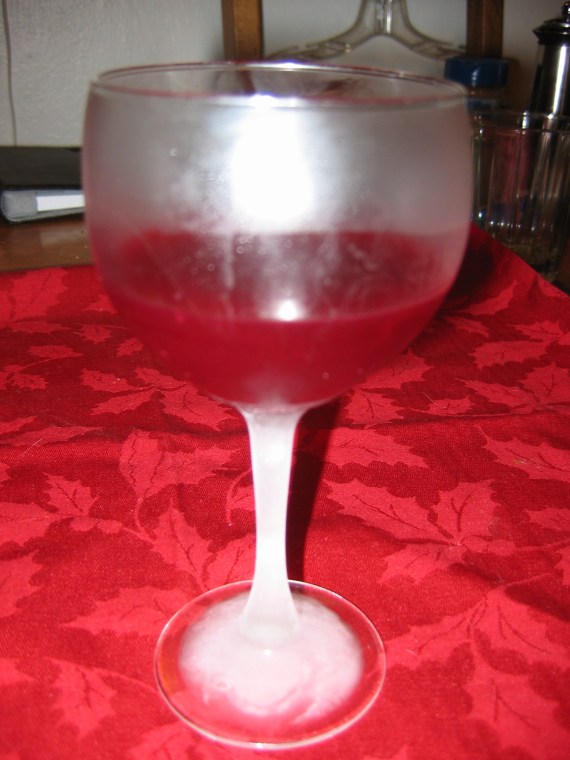
Over the holidays my husband devised a pomegranate margarita which is deliciously fresh. Drink it only when beautiful fresh organic pomegranates are in the market. The bottled juice won’t do. They’re a popular ornamental in our area, and if you have a bush of them in your yard, all the better. You can juice the pomegranates with a citrus juicer, but my own favorite method is to cut them in half, hold each half over a bowl, and scrape it with the back of a spoon until all the juice has run out. The juice is loaded with antioxidants and has as beautiful a color as nature offers. We are all working toward a more sustainable life, but there can be (and should be) color, freshness, and fun along the way. Click here for the recipe
 My urban homestead