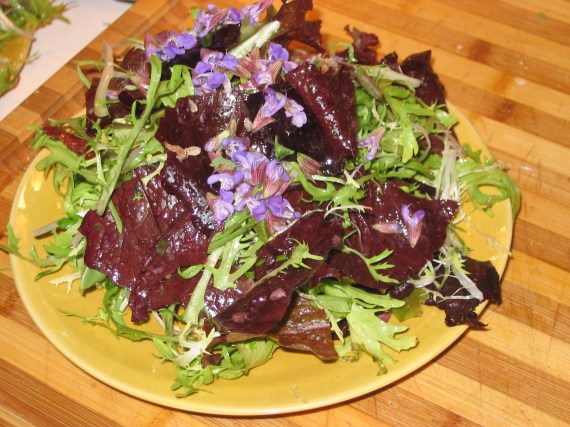
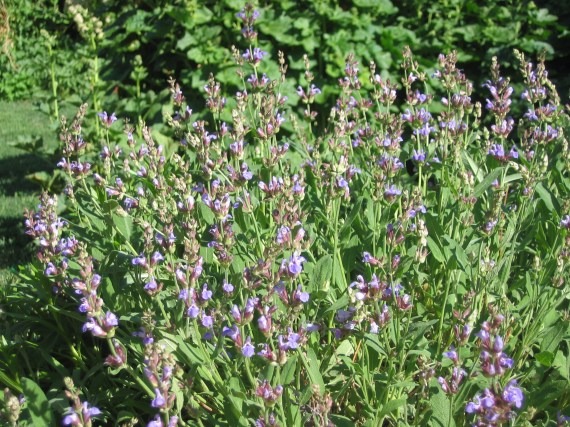
Sage is a useful culinary herb which loves our climate and grows with unbounded enthusiasm. My own specimen has been grown in a container for three years with no care or attention other than periodic watering and has reached 3 feet across and seeded itself around, providing a number of nice plants to give away. A major advantage to growing your own is that you can enjoy its lovely Delft-blue flowers, both in your yard and on your plate. The flowers also taste of sage, but the flavor is softer, sweeter, and more floral. They are lovely on salads. Pick them just before you use them, toss them on top of the dressed leaves, and enjoy. This is one of the ephemeral pleasures of the garden, to be enjoyed for a week or two and then let go. But, like most such pleasures, it makes an impression and leaves a memory of a pure and lovely thing enjoyed in its season.
You can buy a sage plant nearly anywhere. I suggest avoiding the variegated or variously-scented ones unless you have space to spare. Common culinary sage is the most useful in the kitchen.
Archive for the ‘salads’ Category
18 May
Passing Pleasures: sage blossoms
3 May
The Greens of Spring: Alliums
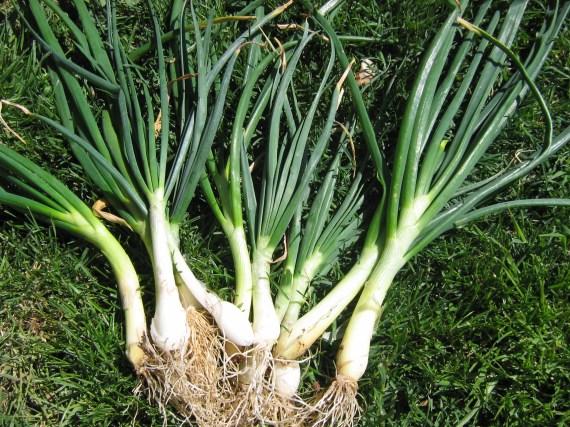
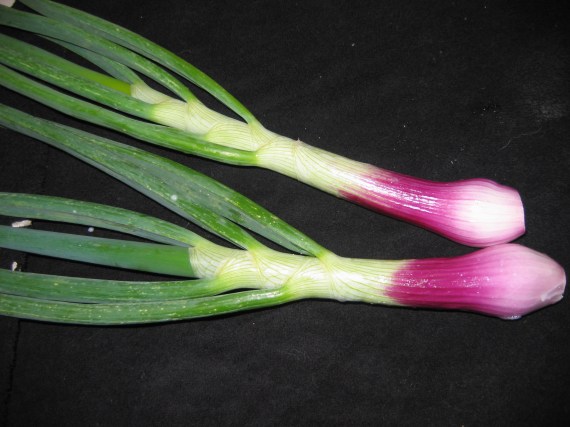
Onions and garlic are among the most common and useful seasonings worldwide, as well as in my kitchen. In spring my garden is full of green fresh forms of these lovely vegetables, and this is the time to plan for the green onions you’ll want later in the year. Start now, because they won’t be ready for a while. I suggest starting some long red onions from seed. They are available under several names. At Gourmet Seeds International in Tatum, New Mexico, they’re sold as Rossa lunga de Firenze. Also get a packet of the lovely Japanese green onions. My favorite is Shimonata. Don’t worry about the late start; you’re planting for the future. Start them now, and plant them out in fertile soil when they’re big enough to take care of themselves. I plant mine in clusters of 3-5 plants, with at least 8″ between clusters. They will grow slowly through the summer, and some of the Shimonata will be big enough to eat in the fall. In early fall the red onions will seem to mature and die at a small size. Don’t panic. Leave them in place. Both types will sit motionless, sulking, through the winter and will burst into lively growth in early spring. Usually the red onions will divide, and you will get two or even three beautiful mother-of-pearl-colored spring onions like the ones below from each. The shafts of both types will be thick, sometimes an inch in diameter. Harvest them as soon as they’re big enough to be usable, and keep harvesting until the flowerscapes appear.
They are useful in all kinds of cooking, and I love the shafts trimmed, rubbed with olive oil, and grilled slowly until sweet and softened. Slice up with a good sharp knife (very messy eating if you skip this step) and serve with sea salt and a little of your best olive oil.
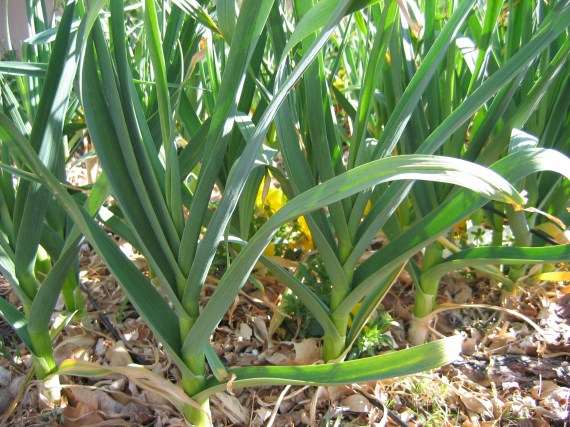
To have green garlic next spring, stick cloves in the ground about 6″ apart in the fall. For this purpose, any good organic garlic from the store is fine. Harvest when they just begin to form a bulb swelling, trim the roots and peel, slice finely, saute in good butter, and season with sea salt. Good with pasta, on good toasted sourdough bread, or as a sauce for fish.
A few years ago I ordered some “French gray shallots,” which the catalog claimed were the only real shallot to use in French cooking. I was unimpressed: the shallots were strong-flavored, garlicky, small, and maddening to peel. I left a lot of them in place out of disinterest, and discovered that in late winter and spring their foliage makes great greens. Cut and use like chives, but they are significantly stronger in flavor. They add zip scattered in a salad, or add them to greens dishes for the last few minutes of cooking.
Sauteed green onions are a great addition to hortapita fillings and other greens dishes, so please check out my “greens” category on the sidebar for more recipes. Or, for a recipe in which green onions are the stars, click here!
27 Apr
The Greens of Spring: Scorzonera and Chicories
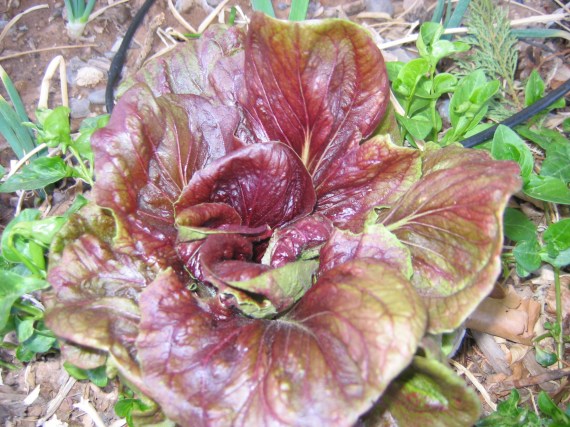
If all the greens you grow are sweet mild greens, your greens dishes will be bland. You need some vigor and some bitterness to make a hortapita or other mixed greens dish come alive. Chicories are a large, drought-tolerant, highly adaptable family well worth getting to know. Our local company Gourmet Seeds in Tatum, New Mexico has the most comprehensive selection I’ve come across. I bought my seed from them last year, and haven’t had to replant. Above, you can see what radicchio looks like in early life. I plant mine in late summer, harvest a small but usable head in late fall, ands take care not to harm the crown of the plant when I cut it for use. If the root and crown are left in place, next April they will look like “earth roses” as you see above. Cut the outer leaves for cooking. Taste before use, and if they’re very bitter blanch them in boiling water for 1-2 minutes and drain well before cooking further in whatever way you choose. Otherwise, when concentrated by cooking, they will be more bitter than you want. Some people like even the outer leaves in salads. Taste before serving. See my “greens” and “recipe” categories for some dishes made with mixed blanched greens, including the hortapita post, which is a great way to eat a lot of greens and enjoy it.
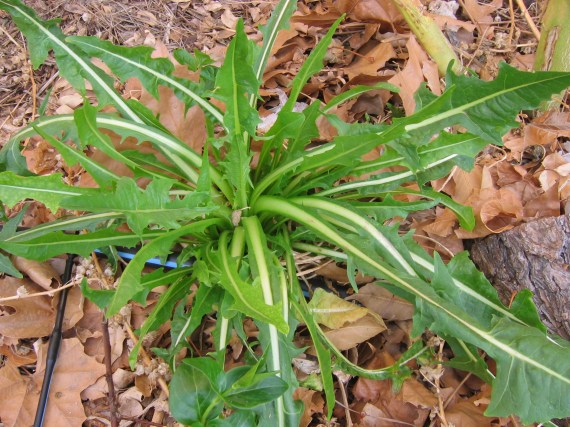
This is the chicory usually sold as “dandelion” in grocery stores. Cut the leaves until May or June; keep taking nibbles raw befre cutting, and when they go from pleasantly bitter to unpleasantly bitter, stop cutting or blanch before use. When very young, they’re good in salads. If allowed to go to seed, they’ll get 4 feet tall and seed themselves all over your garden. If this is not what you want, keep cutting back the stalks before they flower.
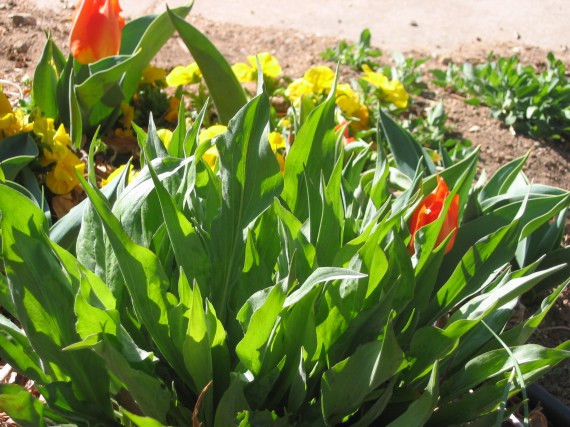
I planted scorzonera for the roots, but found that I wasn’t wowed by them. I left the remaining plants in place, and harvest a nice bunch of mild cooking greens from each plant every spring. After one good cutting, I leave them alone for the year. I’ve read that they can be used in salads, but to my tooth they’re too tough to use uncooked. They require no care and are very drought-tolerant. I prefer to mix them with stronger-flavored greens like chicories, and providentially, they’re harvestable at the same time. Vegetables that come up perennially with no fuss are too good to ignore.
For more about greens, see my “greens” and “herbs” pages on my website.
5 Apr
The Greens of Spring: herb extravaganzas
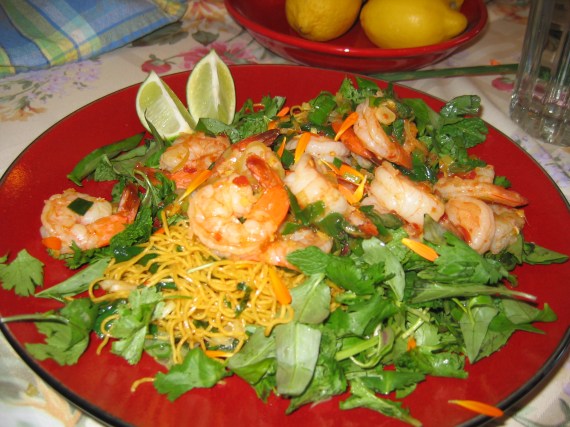
As much as I love cooked greens and good traditional green salads, I like to find other ways to enjoy spring greens. Herbs are concentrated little packets of flaror, fragrance, and antioxidants, and will amply repay the time you spend growing them. Right now I’m interested in the multifaceted cuisine of Indonesia, and find their lavish use of herbs very appealing. A pile of chopped cilantro, rau ram, mint, and Thai basil is one of the most appealing “salads” you can imagine, and strewn across this simple dish, it adds freshness and complexity. There is still time to plant some interesting Asian herbs in your yard, and the mint, Thai basil, rau ram, and cilantro are easy to grow. You can order rau ram plants (click “More on Asian herbs” below for a source)or you can buy a bunch of it at Ta Lin or your own favorite Asian grocery and root some sprigs. Clich at the end of this post for more info on growing Asian herbs. Or, you can find all these ingredients at Ta Lin in Albuquerque. Those of us who left a few small onions in the ground last year are harvesting big, beautiful green onions right now, and this is a good place to use them.
For two very large servings or four small ones, you’ll need:
- 3 large or 6 small green onions, white parts finely chopped and green parts cut in 1/4″ lengths.
- one bunch cilantro, leaves pulled off stems
- 10-12 sprigs each of mint, rau ram, and Thai basil, well washed and all leaves pulled off the stems
- 1 betel leaf (can be omitted)cut in very fine shreds
- 2 sprigs of murraya leaves (sold at Ta Lin as “curry leaves”)with the leaflets pulled off the stem and shredded very finely
- 1″ X 2″ piece ginger, peeled and chopped to matchhead-sized pieces
- 1 pound shrimp, peeled
- 1/2 pound fresh thin egg noodles, soaked in hot water until softened, about 10 minutes
- 1/2 cup coconut milk.
- 1 tablespoon shaved palm sugar or white sugar
- 1 tablespook sambal oelek, or more to taste.
- Thai or Vietnamese fish sauce handy by the stove.
- corn oil as needed for stir-frying
- 1 lime, quartered
Have everything prepared as described, because this dish takes about ten minutes to cook, and you won’t have time for any prep while cooking. Be aware that you are going to use half the ginger, sambal, and green onions for the shrimp and half for the noodles.
Heat your largest wok . Keep the heat very high while cooking. When very hot, pour in a glug of corn oil (I’d guess that a “glug” is about 2 tablespoons) and immediately throw in half the chopped ginger. Stir around in the hot oil until very fragrant, about a minute. Throw in half the chopped white parts of the green onions and stir-fry for another minute. Add the shrimp and drizzle fish sauce over them. Probably about a tablespoon is needed. As they sizzle, add a tablespoon of sambal oelek. Cook the shrimp another 1-2 minutes, stirring once to distribute the sambal. If you kept the heat high enough, they’ll be nearly done. Throw in half the green onions, stir in well for about half a minute, and dump the shrimp into a bowl. Set aside, covered, to keep hot. Now wipe out the wok very quickly with a rag or paper towel, return it promptly to the heat, and add another glug of oil. Put in the rest of the ginger and the shredded betel leaf and curry leaves, fry a minute, and put in the rest of the white parts of onion. Cook another minute, then add a tablespoon of sambal oelek, a tablespoon of sugar, and the coconut milk. Boil hard for one minute, drizzling in some fish sauce. Taste quickly for seasoning: it should be fairly salty, since this is the seasoning for the noodles. Now put the drained noodles in the wok with the remaining chopped green onion tops. Stri-fry over high heat for about 5 minutes. Using a heatproof spatula, keep turning the noodles, drizzling on some fish sauce if needed. Keep a fork handy and keep tasting the noodles to make sure that you don’t add too much fish sauce; a tablespoon or a little less is about right. When they are very hot throughout and the seasoning is well distributed, toss in half the cilantro leaves and turn out onto plates (2 plates for a one-dish meal, four plates if part of a larger meal.) Quickly finger-mix the cilantro into the mint, rau ram, and Thai basil leaves, and divide the herb salad among the plates, covering the noodles. Now distribute the shrimp among the plates, topping the herbs. Serve immediately, with lime quarters for squeezing over the top. The herbs offer an array of different sensations as you eat, since they are not chopped finely, which would amalgamate the flavors.
Incidentally, please consider buying Alaska prawns when you want shrimp, or one of the other environmentally sound choices on the Seafood Watch list.
 My urban homestead