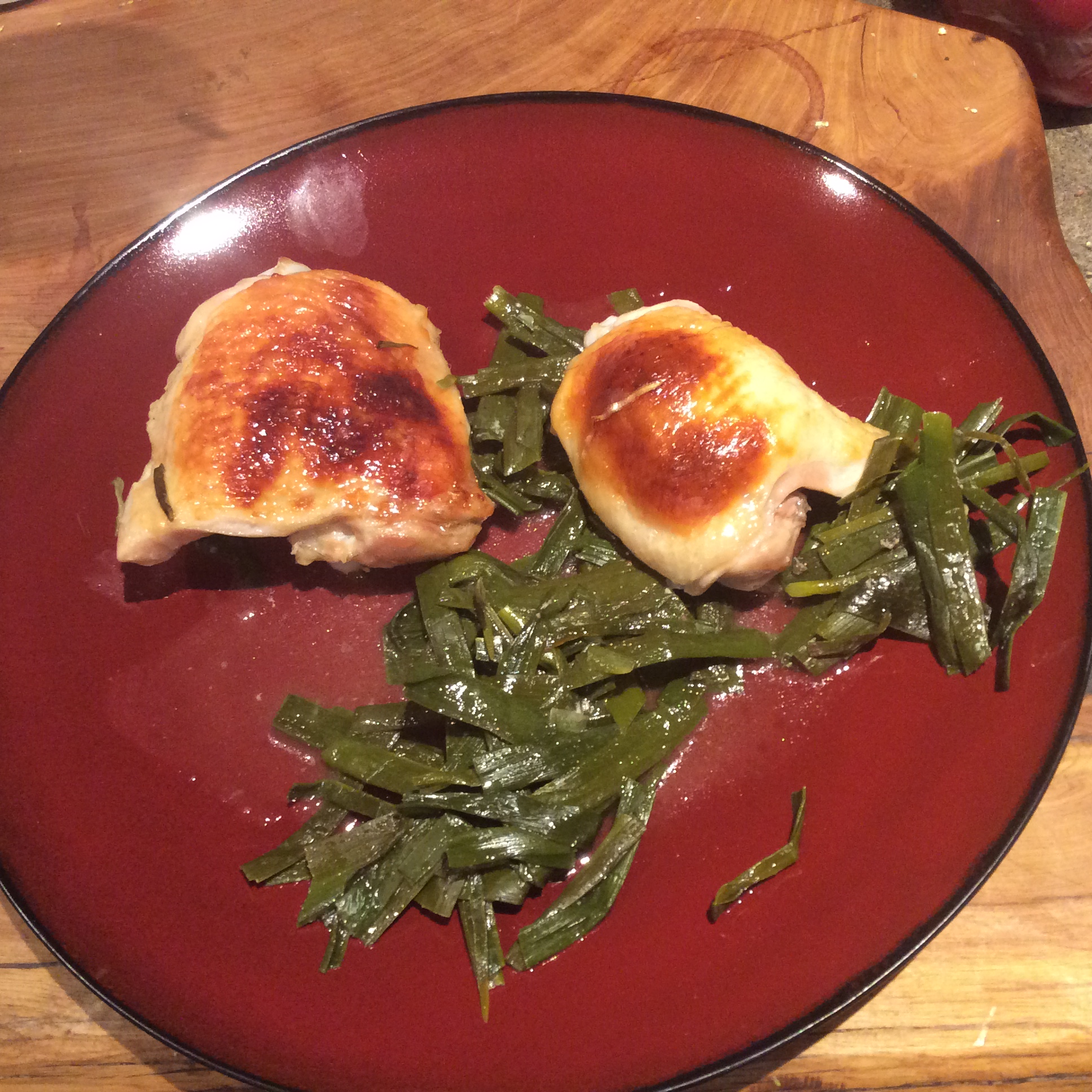
My patient readers might be wondering by now why I have so damn many posts this year on the uses of green or immature garlic. The reason is simple: last summer I ordered my garlic sets as usual, forgot about it, and a few weeks later placed the same order again. When a LOT of garlic sets arrived in fall I decided to treat this as serendipity and planted them all, and the result is that I have hundreds to thousands of stalks of green garlic right at the moment. Since I have become interested in the health benefits of alliums, especially the green parts, I am thoroughly enjoying experimenting with ways to use them. Right now they are just beginning to send up scapes, and the stalk of the plant is hard and difficult to use well. But when I pull a few plants for the newly bulging bulbs, I find that the leaves are still green, and I decided to try using them as a leafy green vegetable. I washed a bunch of them, cut them in 1 inch sections crosswise, and blanched them in boiling water for two minutes. This initial blanching seemed to tenderize them a lot, but if you insist, try cooking them without pre-blanching and see how it goes. Then I slowly roasted in butter with a little salt and rich chicken broth for about 20 minutes, taking care that they did not dry out. I roasted them only because I was also roasting some chicken, and it would be easier to slowly sauté them on the stovetop. Make sure that there is enough broth that no part of the leaves dries out. Kept a little moist, they develop a lovely plush texture. This turned out to be a delicious vegetable, full of flavor but not excessively garlicky. The only thing I’m going to do differently in the future is cut them in shorter sections, about half an inch, since there is a suggestion of fiber in the mouth when cut to the longer length. I did not identify any actual fibers of the nasty kind that stick between the teeth, but I just think the mouthfeel would be better if cut shorter.
I am increasingly delighted to find that every part of the garlic plant is edible, versatile, and delicious, a true nose to tail vegetable with a boatload of health benefits besides. Right now garlic, shallots, onions, and multiplier onions occupy about a third of my total available garden space, and I think this is how it should be and will do the same again next year.
Incidentally, once the emerging scape begins to show at the top of the plant, the stalk is not worth trying to use except as a flavoring for broth, in my opinion. It is just too fibrous and tough. But soon the scapes will be elongating and they are eminently edible when young, so a couple of weeks of patience will provide you with a whole new vegetable.
Archive for the ‘vegetable gardening’ Category
3 May
Garlic Leaves
2 May
An Assortment of Shoots
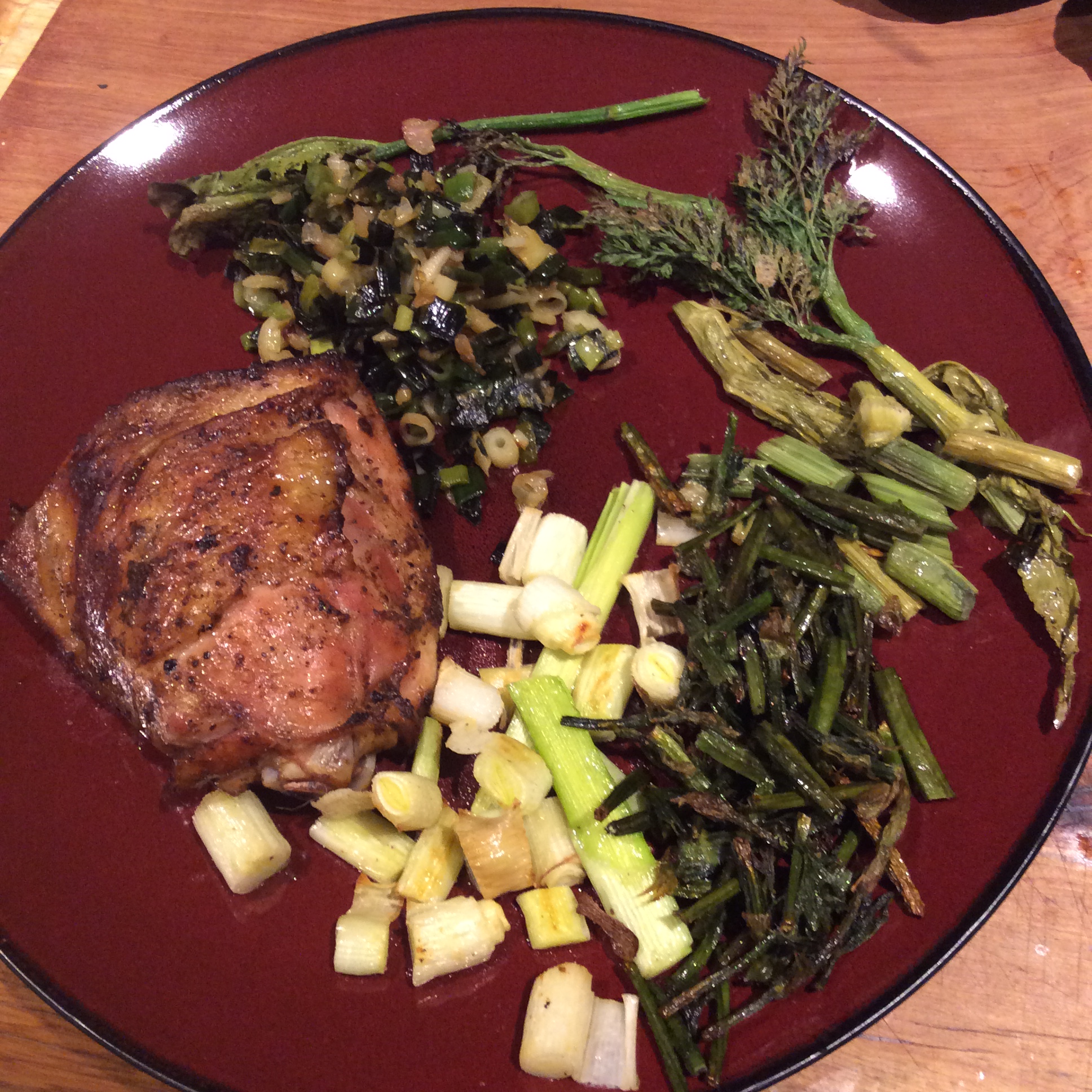
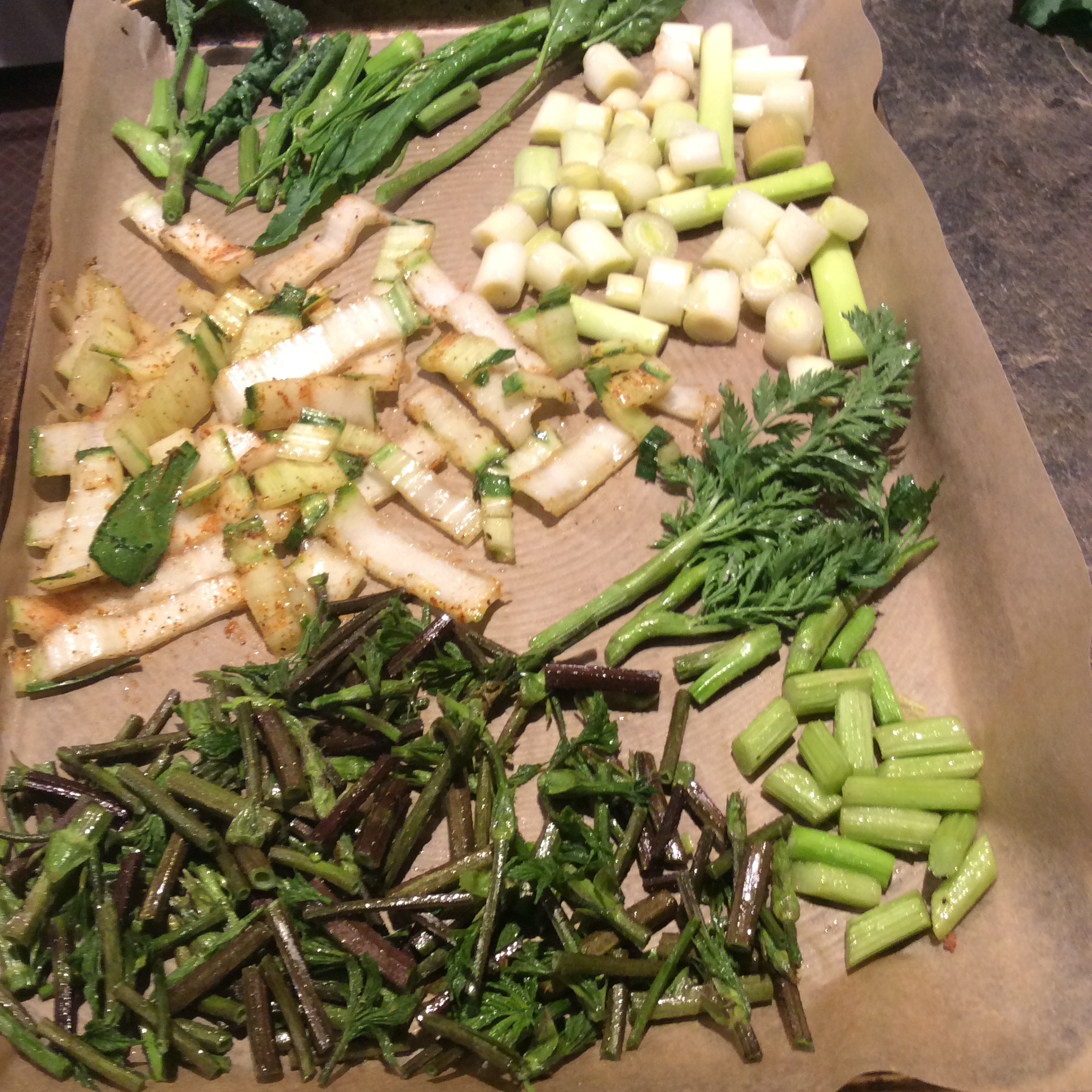
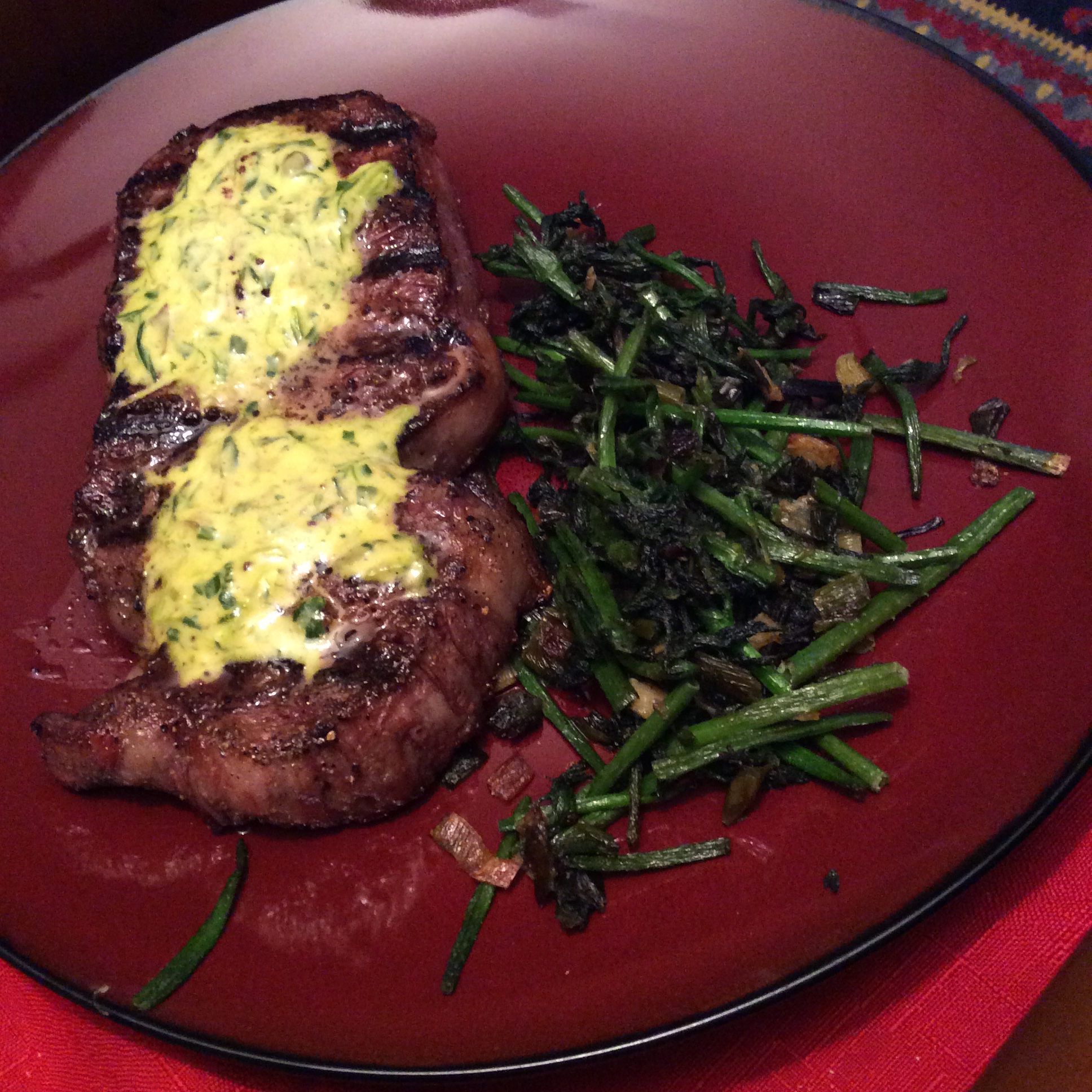
Last night I decided to try a grand assortment of the shoots found on or near my property right now. All would be oven-roasted in olive oil and salt at 500 degrees except for the garlic shoots, which are getting a bit tough this time of year as they elongate toward making scapes and need gentle stewing in olive oil over low heat for a long time, 25-30 minutes. They were cooked sparately on the stovetop.
The materials that I had to work with included a good-sized bundle of hops shoots, which I have shown many times before, and all of the following:
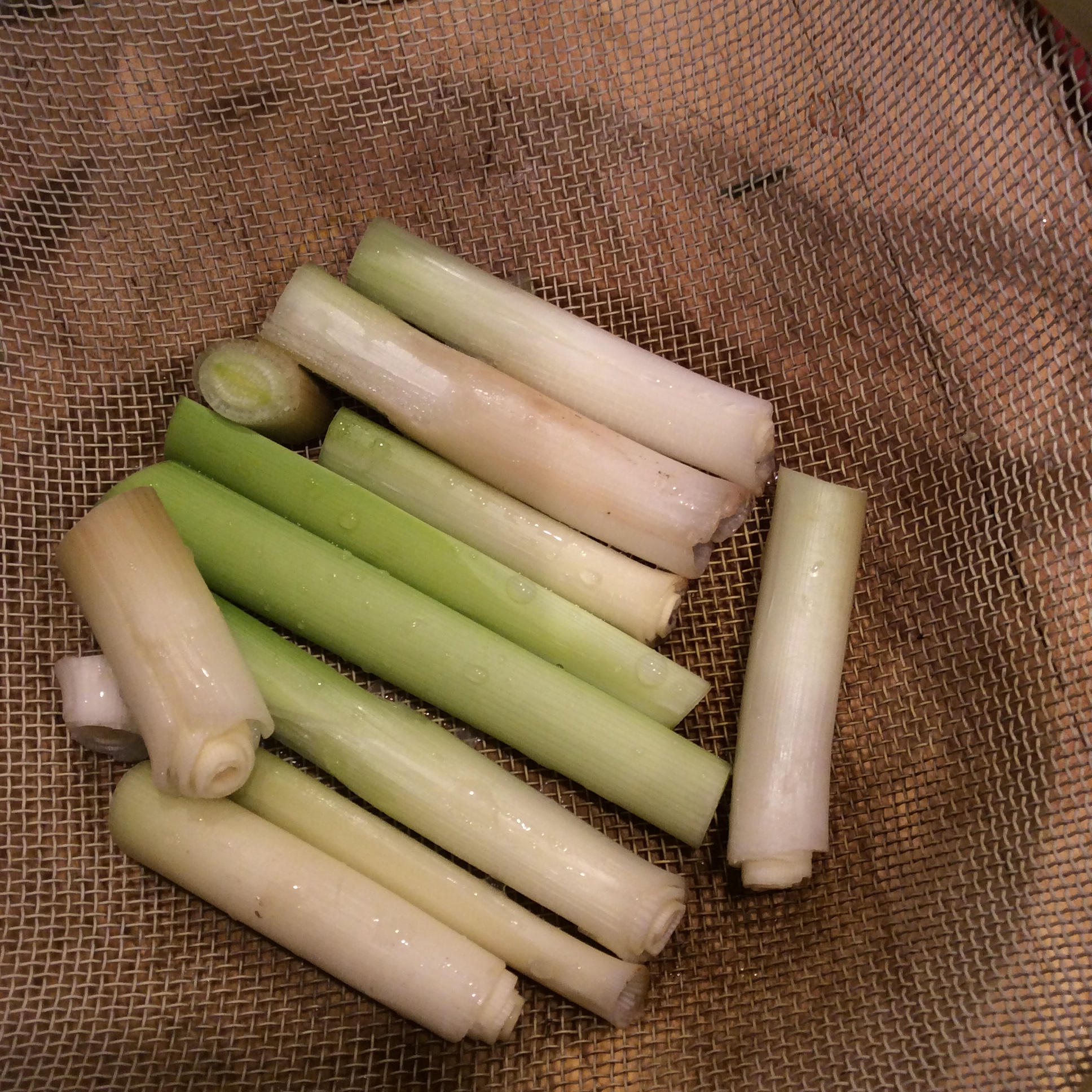
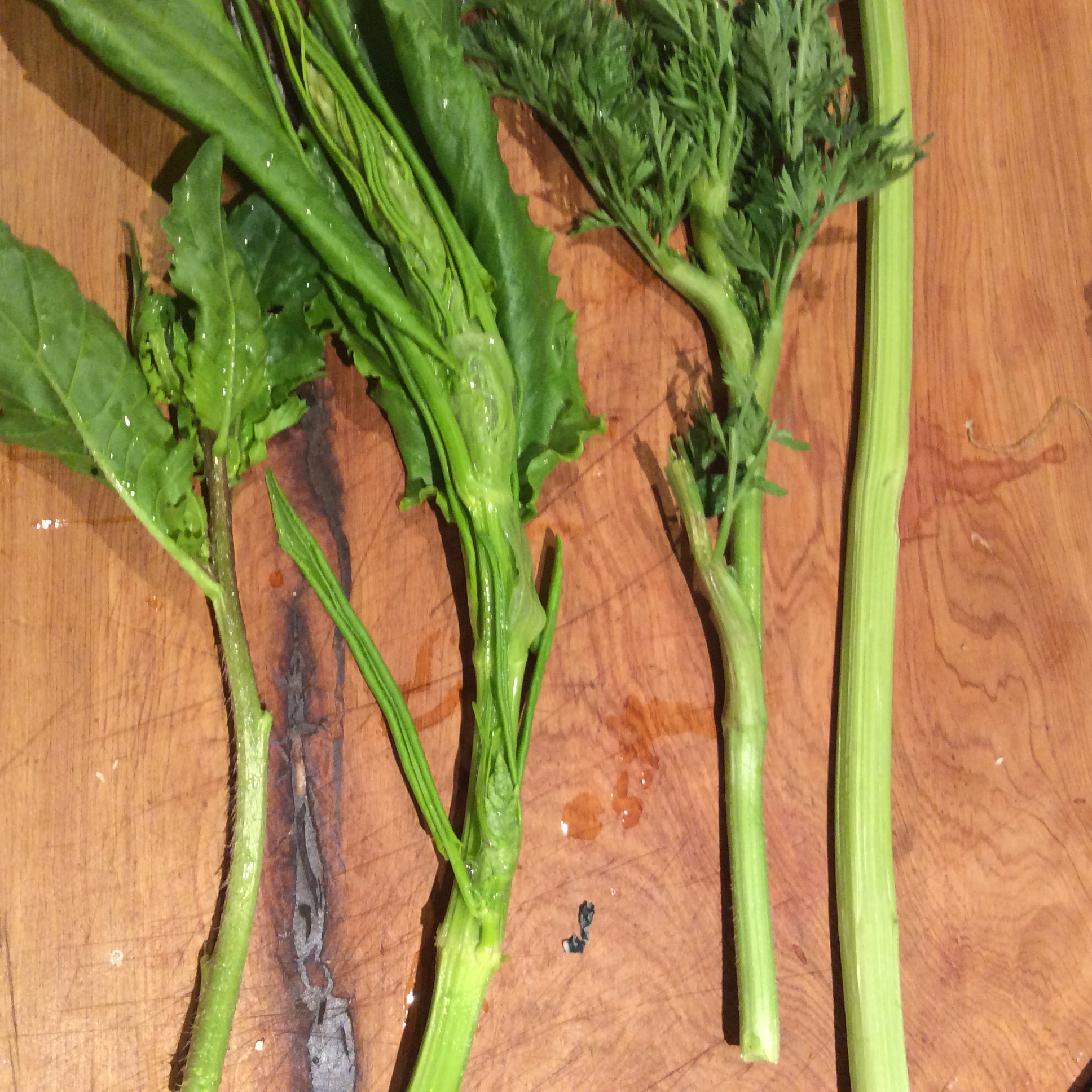
Tender cattail shoots are shown in the upper picture. The one below shows, from left to right:
- Annual arugula shoot with buds only just beginning to show.
- Dock shoots harvested before any flower buds show.
- Carrot shoots from some roots that I didn’t get around to harvesting.
- Stalk of a sunflower picked at about 18″ tall and the very fibrous outer layer carefully peeled off.
They were tossed separately in olive oil and a little salt and kept in separate piles on the baking parchment so that we could discern the flavors accurately. All but the arugula were cut in sections an inch long or less to mitigate possible stringiness. I added a couple of chard stems cut in 1/4″ cross sections, after I used the leaves for something else.
Roast away in a preheated 500 degree oven, checking frequently and removing each at its preferred stage of doneness, i.e. when it looks roasted but not burned.
Consensus:
I have been writing about green garlic all season, so no need to say anything more except that, as always, they were delicious.
I love cattail shoots but my husband finds them only passable. Probably for solitary dinners in the future.
Love hops shoots with their feral, mildly bitter, “unimproved” flavor. Love them.
Sunflower stalks have a pleasant enough, rather innocuous flavor and nice texture when carefully peeled. There are those on the Internet who claim that they just pluck them and eat them. These people have probably never been near a sunflower. More on this later.
I have not yet found any way that I like chard stems except roasted and ground into a fairly good baba ghanoush. Eaten alone, there is a touch of dirt in the flavor that doesn’t do it for me.
Dock shoots were amazingly good, with a soft center tasting of lemon with a strain of bitterness. Be sure to cut into sections before cooking to eliminate the stringy factor, and pull large leaves off. Smaller ones can be left in place and are tasty.
The arugula shoot was very slender but a bit stringy anyway. They, too, need to be cut into sections. Delicious though, although they are small and it would be tedious to pick enough for a meal.
Carrot shoots were the real surprise. When roasted in sections they were tender, sweet, and full-flavored with a touch of the terpene scent that makes carrot foliage smell aromatic and carroty. The remaining leaves got brown and crisp during roasting and added textural interest. I liked them so much that I am going to leave the rest of the row of woody second-year carrots in place until they produce shoots. Even when the roots are at this advanced stage my goat loves them, so the roots will not be wasted.
Initially I wanted to taste each type of shoot individually, but I will make a grand mixture in the near future by sorting sections roughly according to size, i.e. thin, medium, or thick. Then I’ll pan-fry them in olive oil in my biggest skillet, putting thick ones in first, then two minutes later mediums, followed by thin bits in another two minutes, then cook until done. Yum.
Look around you and see what’s producing shoots right now. If (and only if) you’re certain that the foliage of that plant is edible, try them out in hot olive oil. I enjoyed goji berry shoots a little earlier in the season, and will be trying wild lettuce and sow thistle within a week or two. Some grapevines produce delicious shoots, although some ( most notably my Concord vine) have so much papery fiber in the leaves and shoots that I consider them inedible; read more here.
16 Apr
The Shoots of Spring
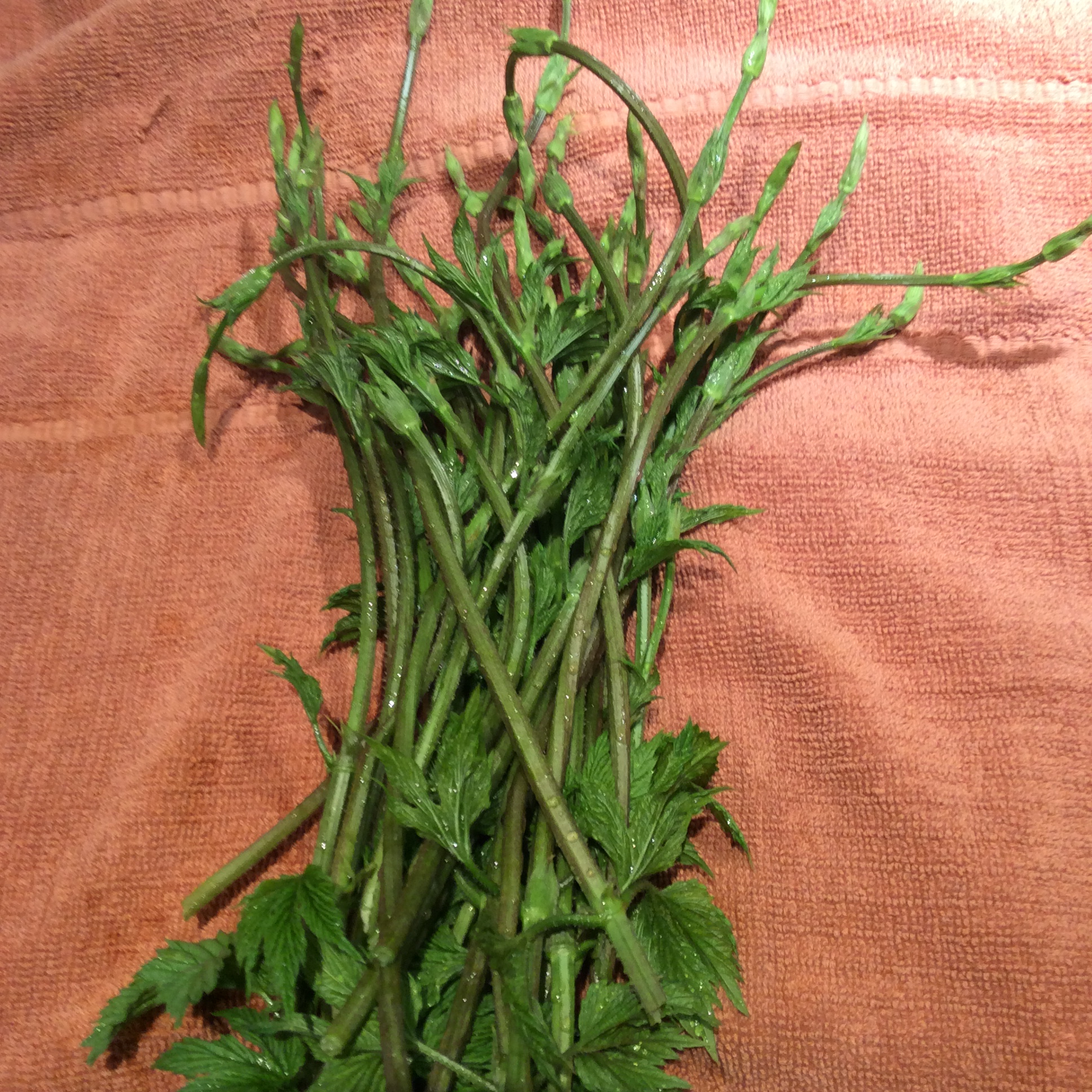
This is the great season for hops shoots. I gather a large handful every day or two, taking care to snap them off where the stem is tender and brittle. I wash them, cut the bundle crosswise in pieces about an inch long, toss in a hot skillet with a generous amount of good olive oil, and sauté over medium-high heat, turning frequently, until the stems are tender and some of the leaves are brown and crisp. Add salt and serve. They have a “wild” and slightly bitter flavor which I love alongside very flavorful meaty main dishes.
This spring I started to experiment with other shoots. I have been eyeing the invasive tendencies of my goji bushes, which routinely send suckers out 10 feet to send a shoot up right where I don’t want another goji plant. They are turning up everywhere as the weather warms.
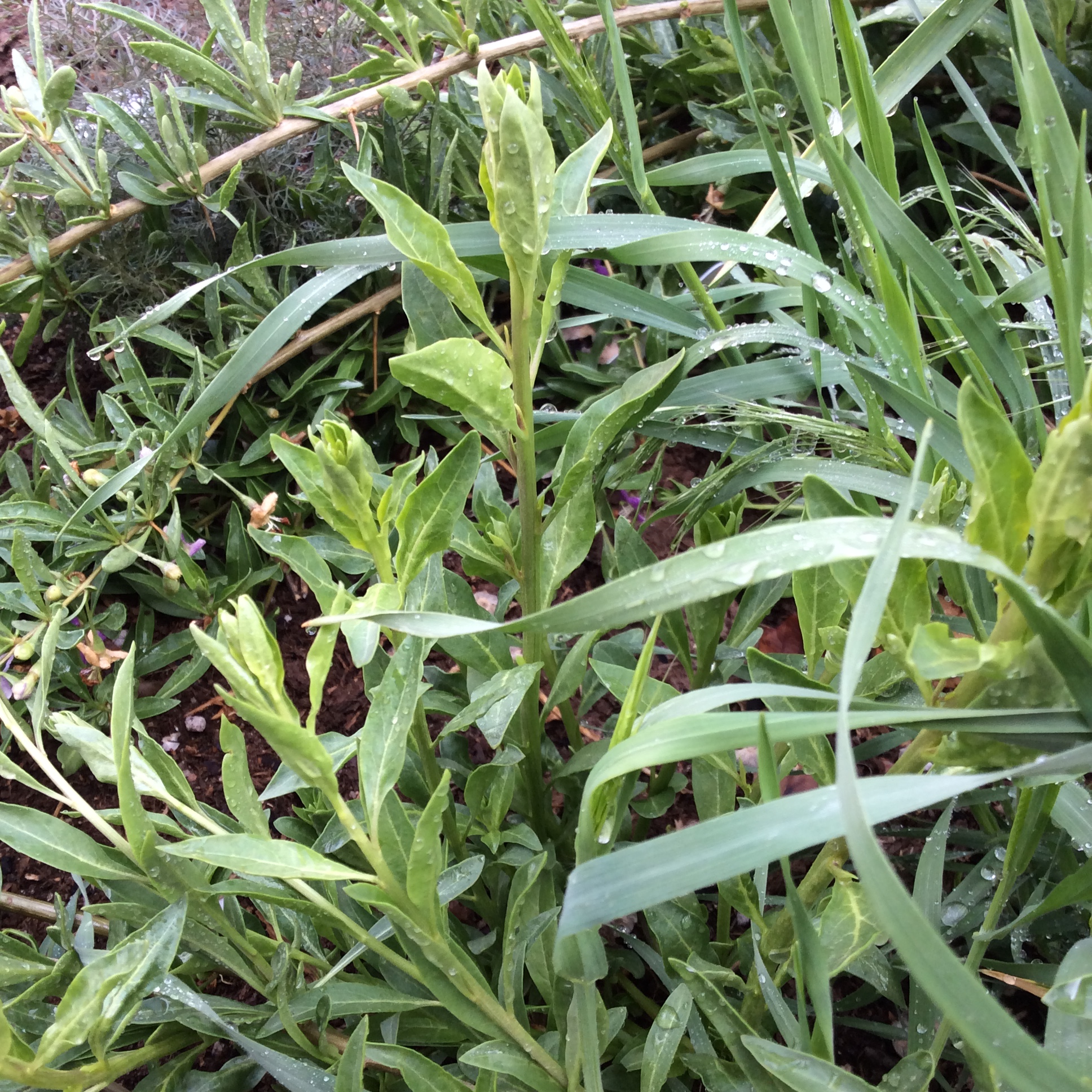
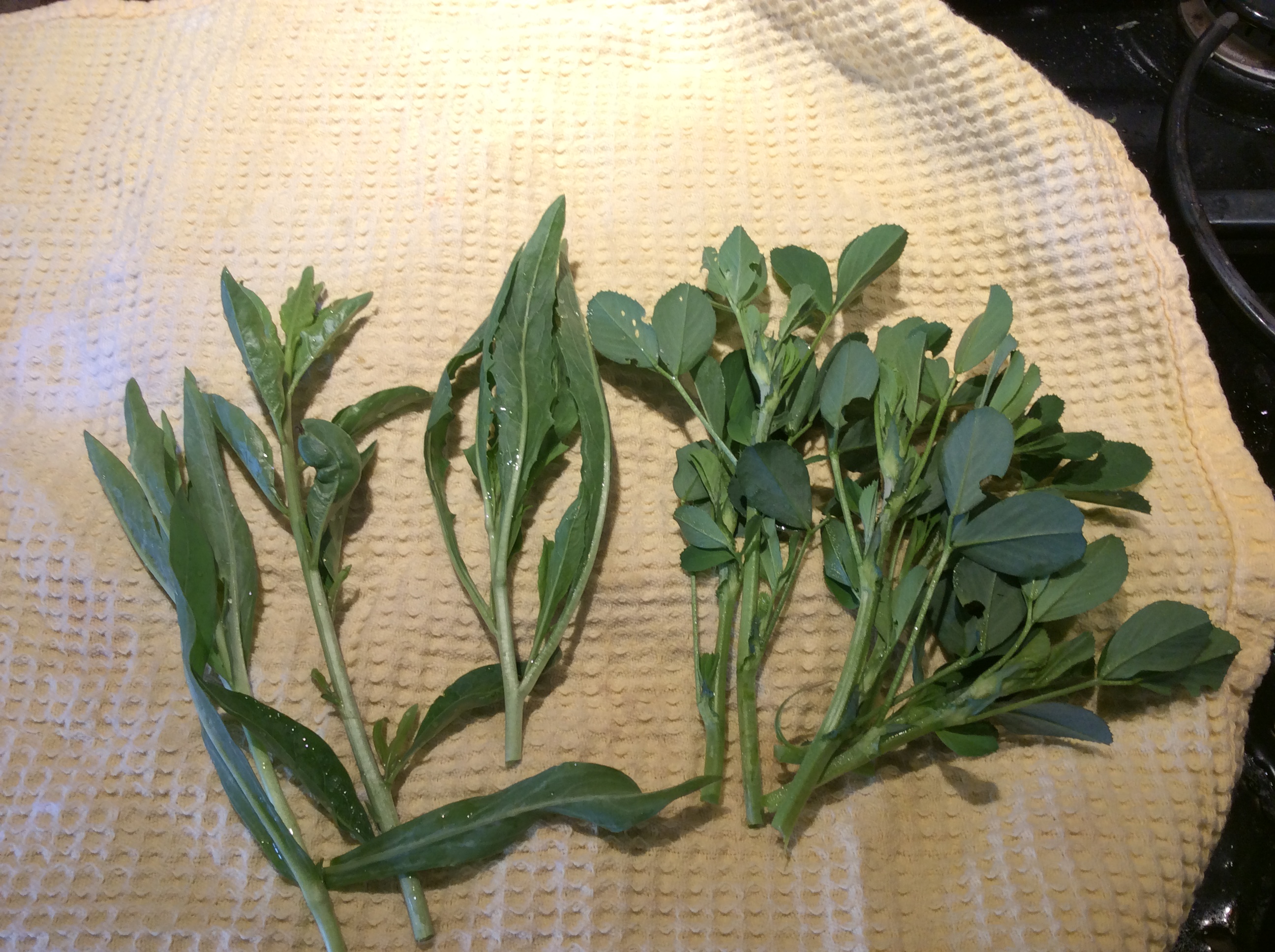
I knew that their foliage was edible but had never been much impressed with the taste, and there aren’t many leaves per bush. The shoots, on the other hand, are bulkier than the leaves, green, tender, and a nuisance unless removed. Yesterday I gathered young shoots of silene (bladder campion,) goji berry bush, perennial arugula, and alfalfa to experiment with ( shown L to R below.) I wouldn’t try cooking with any shoot that didn’t break off with a clean, brittle snap. You don’t want them woody.
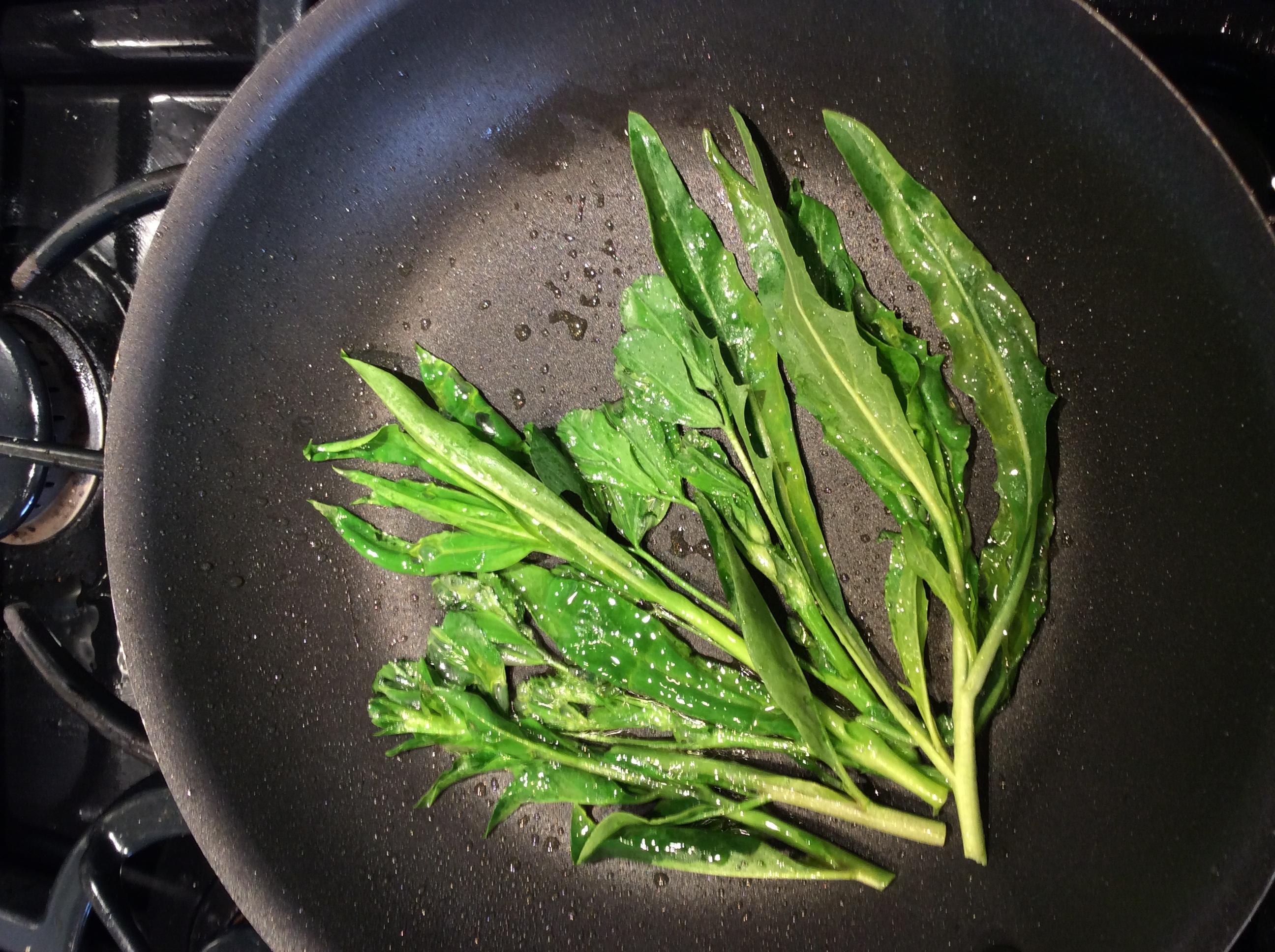
I didn’t cut them up, just washed them and let them drain. Then they were put in a skillet with some olive oil and fried over medium-high heat until the leaves were crisp and browned. I would guess that it was about two minutes a side. Watch carefully; the line between browned and burned is crossed in milliseconds.
They were drained on paper towels, salted, and eaten.
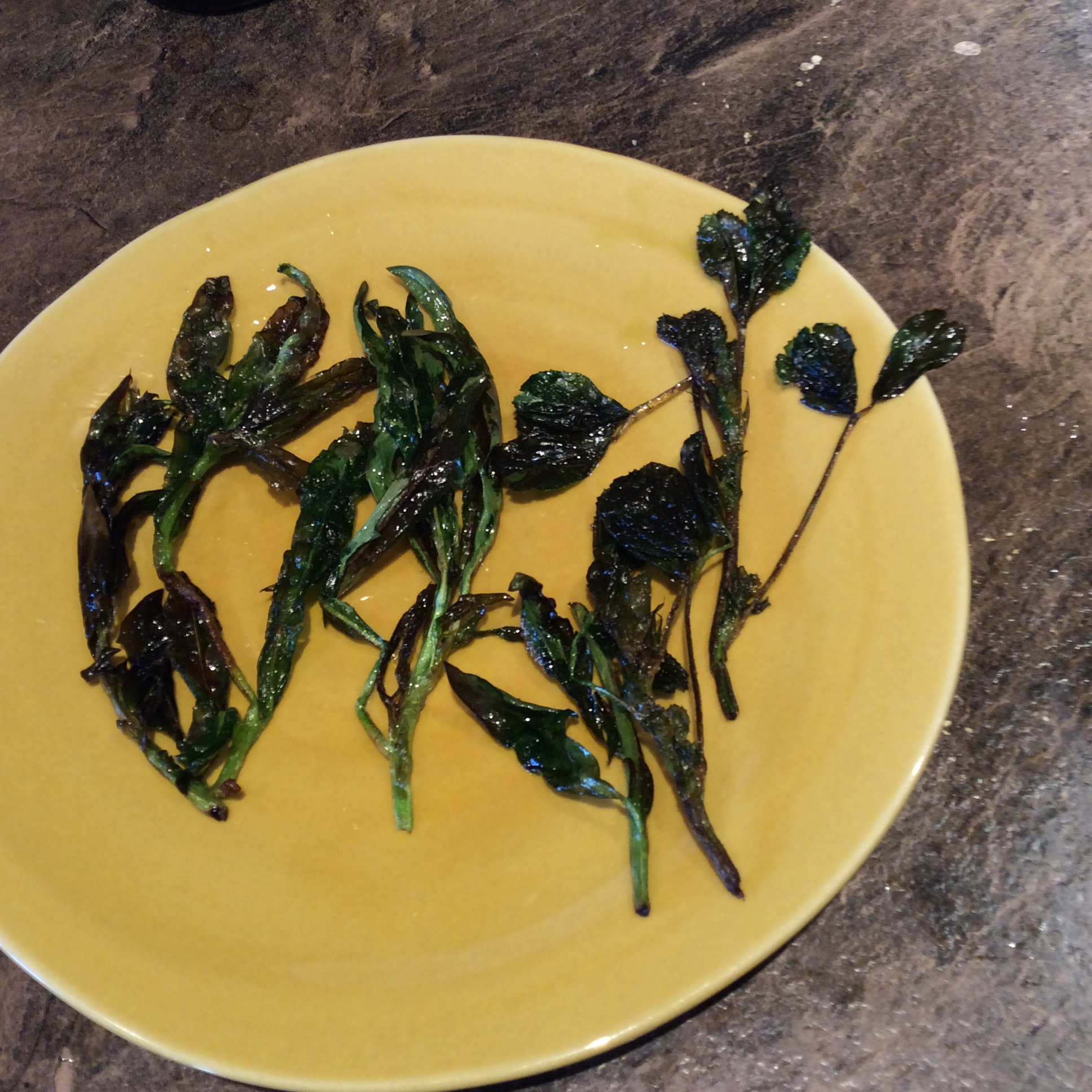
They were actually a rich brown in spots, not black as they appear in my photo. The alfalfa and silene shoots were crisp and pleasant enough to eat, but all I could taste was olive oil and salt. I had used a wonderful olive oil so I didn’t mind that, but I do like a vegetable to taste of itself. The stars were the goji and perennial arugula shoots. The hot and mustardy flavor of perennial arugula was tamed and made interesting but not excessive, and the goji shoots had an herbal flavor and a delightful texture. I will definitely cook them again. I can easily cook them for my husband and myself, but they need lots of room in the skillet to crisp, so I don’t think it’s practical to make them for more than two people. They are too fragile to withstand being dipped into anything, and are best eaten on their own. They are a passing fancy and to be enjoyed as such.
I only wish that all my invasives could be dealt with by eating them.
There are many other shoots to consider, and this is a time of year for perennial veggies to shine. Meaty young milkweed shoots should be wonderful. It has taken me three years to get a milkweed patch to germinate so mine are still spindly infants, but if you live in an area where it occurs naturally, do give it a try. Asparagus, the classic shoot, is wonderful when pan-fried like this. Young slender green onions can be treated this way with good effect, and green garlic could be great, although in this one use I would use only the white part, since the leaves can seem stringy if not chopped in cross-section. I will soon be experimenting with shoots of young wild lettuce as it starts to bolt. I think these would need to be blanched first to reduce bitterness, but I’m not sure yet. I’m very fond of using the fresh tender shoot-tips of coppiced mulberries as a green, and I think they would be very good given this treatment, but they don’t come along until about June, so it will be a while before I find out. See here for a discussion of the ins and outs of selecting and eating mulberry leaves. The young second-year stems of chard leaves that emerge when an overwintered plant sprouts in the spring, before it starts bolting to seed, might be good for this, trimmed of their green leafy bits and maybe cut in inch-long chunks if they seem a bit on the stringy side. And I have written before about using the young flowering shoots of scorzonera this way, and they are definitely the highest culinary incarnation of that tough perennial.
I often mention Cook’s Treats, the series of improvisational tapas for one that I enjoy in the kitchen when nobody’s looking and I’m doing other things. Four or five tasty shoots, thrown in your smallest skillet with olive oil while you’re working on other things, make a great cook’s nibble. You will need to give them your undivided attention for a few minutes and that’s all, which fits well into the rhythm if many kitchen tasks.
15 Apr
Diet in brief
I very seldom talk about low carb/ ketogenic diets except with my patients because I think that your diet decisions are best made by you, in conjunction with the doctor who knows you best. But I will say here that ketogenic diet is, in my opinion, the most desirable treatment for type 2 diabetes and the only one with no side effects. I am also keeping an eye on the evidence for low carb diets in simple weight loss. So I wanted to pass on this public-information piece from the Harvard School of Public Health:
http://www.hsph.harvard.edu/nutritionsource/carbohydrates/low-carbohydrate-diets/
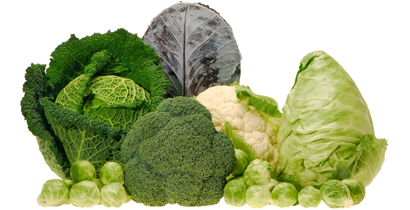
And of course, my reason for bringing this up on a gardening blog to to make yet another shameless plug for green and leafy vegetables. Your nearest farmer’s market will have them if you don’t grow your own. Just eat them. Lots of them. Eat them instead of the starchy stuff. Your body will thank you.
 My urban homestead