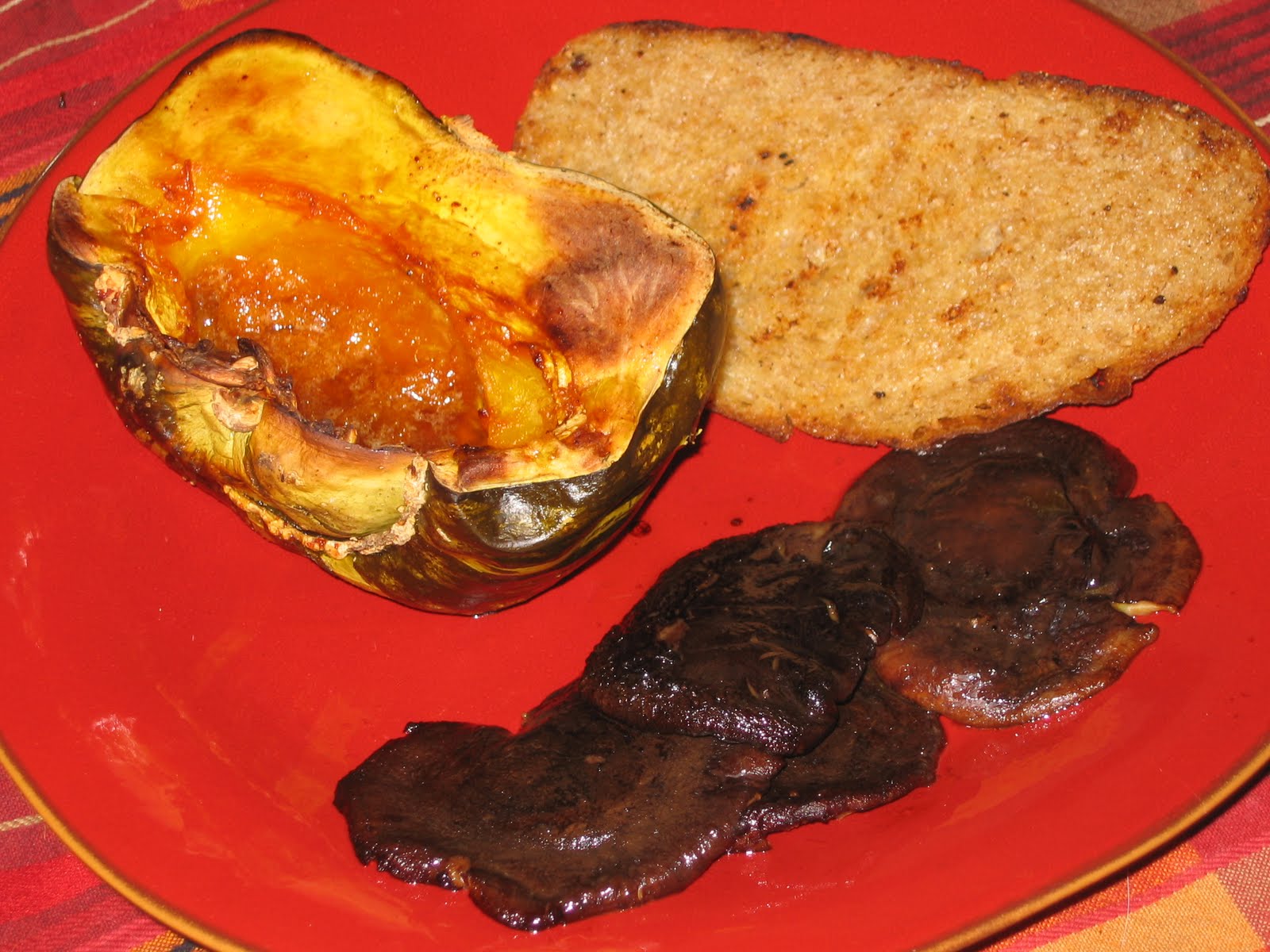
Since reading Carol Deppe’s book The Resilient Gardener, I’ve been thinking more about growing things that are staples rather than side dishes. This does not require that I change what I grow. I need to think in terms of putting my vegetables at the center of the plate rather than letting the “side dish” mentality sneak in. Winter squash is a filling, substantial staple and can easily be the centerpiece of a meal.
In my opinion, roasting is by far the best way to bring out the flavor of squash. It keeps wonderfully in the refrigerator for a few days once roasted, and can also be mashed, packed tightly into containers, and frozen for later use. Once properly roasted, it can be made into ravioli or lasagna fillings, form the basis of hearty soups, or just be reheated later to eat out of the shell, so I roast plenty at a time. If roasting smaller squash, I cook several, so that the oven heat is efficiently utilized, or I put them on the bottom shelf of the oven when roasting something else. I love to put maple syrup or agave nectar, a pat of butter, and a pinch of salt in the cavity if I will be eating the squash straight, but if I might use it for something else like lasagna or ravioli or one of the impromptu dishes below, I just rub the cut surfaces with olive oil and salt before roasting. In the picture above, a roasted Kukuza half dominates the plate, with a few grilled mushrooms brushed with oil and soy for a meaty touch and a slice of grilled bread with olive oil and garlic. THis is a great substantial meal to share with vegetarians and vegans, or with nearly anyone.
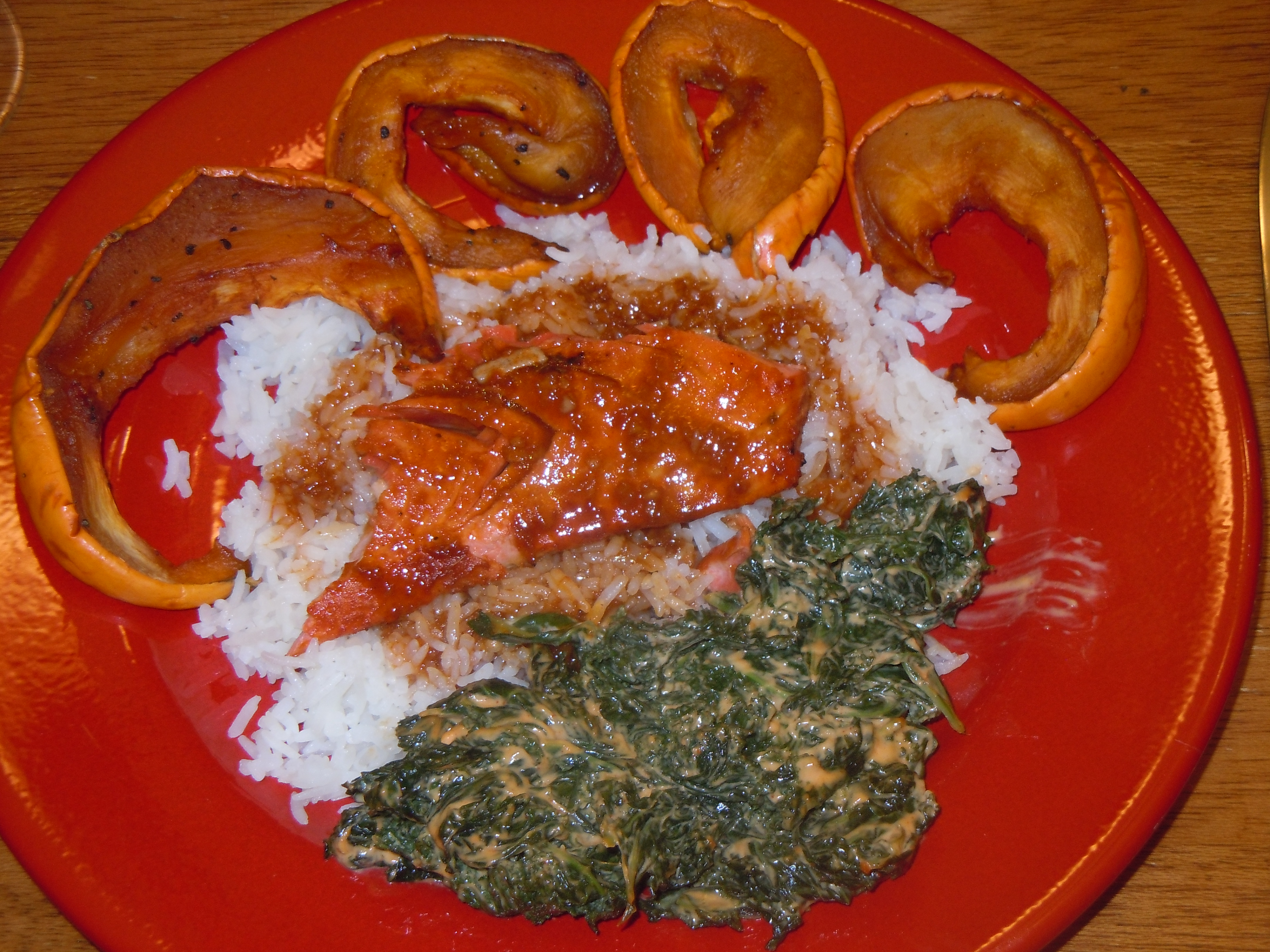
Here I cut a roasted squash half into thick slices, brushed lightly with soy sauce, chili oil, and roasted sesame oil, and broiled for a minute or two to accompany Asian flavors.
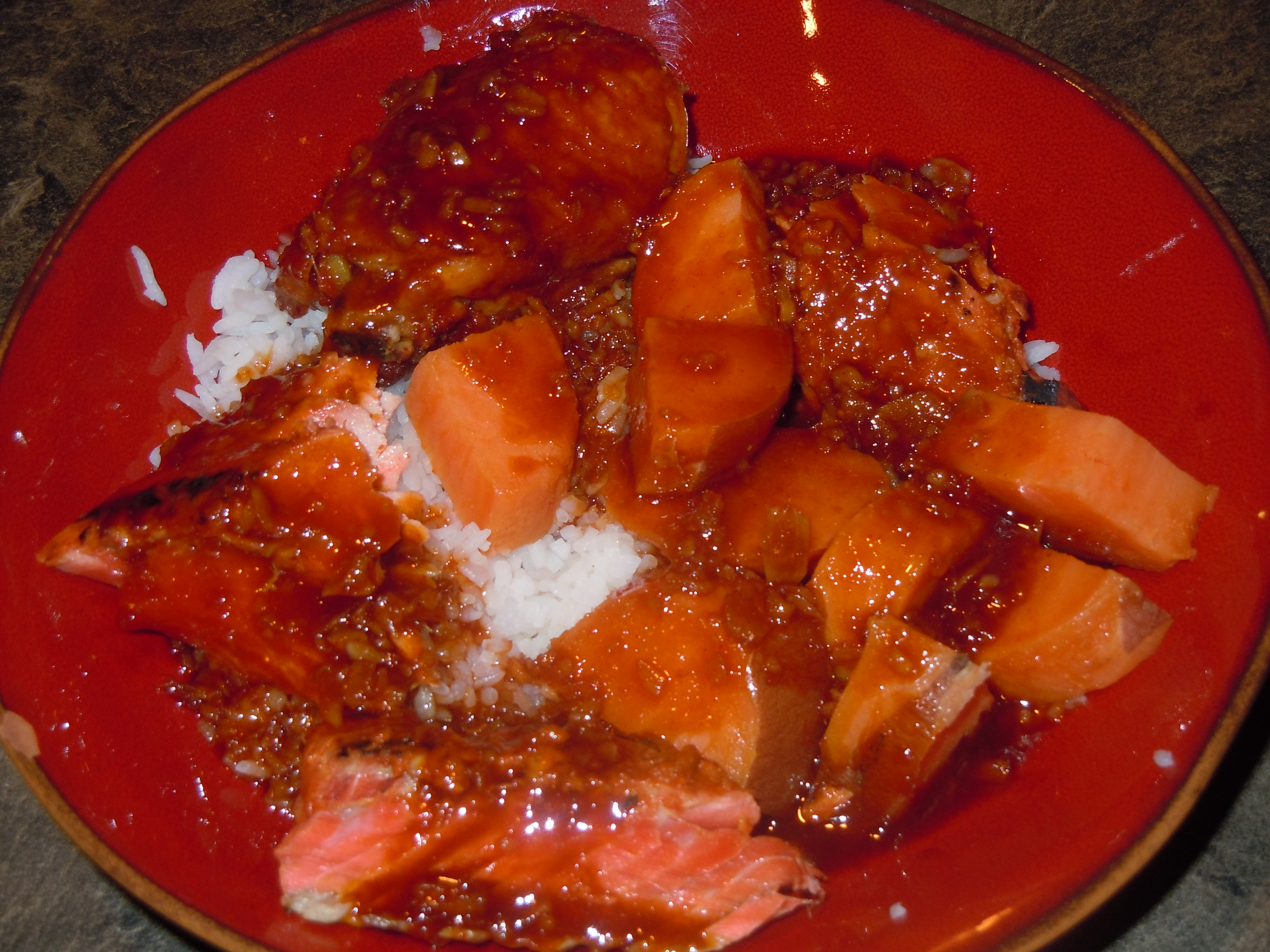
Here chunks of leftover roasted squash join a few chunks of leftover roasted salmon under a cheerfully colored Korean sauce. To make the sauce, chop up 2 cloves of garlic and a 1″ cube of peeled ginger. Heat a couple of tablespoons of oil in a small wok, and when the oil is hot throw in the chopped garlic and chile. As soon as the ginger fragrance comes up, about a minute, put in a tablespoon of gochujang and stir around madly for half a minute, then add half a cup of stock and 2-3 tablespoons of soy sauce. As soon as it comes to a boil, turn off the heat and add a teaspoon of dark sesame oil. Have ready a teaspoon of arrowroot dissolved in a tablespoon of water, and stir in. Let the sauce thicken briefly and serve over a bowl of rice topped with hot chunks of salmon and squash.
If you are going to think of squash as one of your winter staples, you need to find a squash that you can grow well and that you really enjoy eating. A few posts ago, I wrote about the immense harvest of squash that I grew this year because I planted only Cucurbita moschata varieties, which love hot weather and are resistant to squash borers. C. moschata types need a hot summer to do well, and we can certainly provide that here (they are less esteemed in cooler parts of the country). All squash need curing before you eat them in order to taste their best. Needs vary among varieties. In general, I let all squash ripen on the vine and don’t pick it until a frost is expected. Then I set it on shelves to cure. It will cure faster in warmer ambient temperatures but will hold longer in cool places, so I keep some in the house, and some in my cool but nonfreezing garage to eat later. I give the smaller squashes three weeks to cure, and the bigger ones 8 weeks before I sample the first specimen.
Even with the best treatment, squashes vary immensely in quality in flavor. My favorite C. moschata so far is a big turban-shaped beauty called Chiriman. It has moist but not watery flesh, no strings, and a lovely sweet-earthy flavor. The much smaller Kikuza is also delicious, and its small size may be preferable for some. Both are rather shy yielders, and Kikuza has rather thin flesh. Sucrine du berry yielded prolifically, and the flesh is very thick and is a dark and splendid orange-red, but the flavor is poor and the flesh is both stringy and watery, so most of the bounty is going to the chickens. I wrote to the seed company about my experience with it, and they sent back an excerpt from a gardening book explaining that winter squash needs to be vine-ripened and then cured for best flavor. Well, duh. Some squash just isn’t much good no matter how you raise it. If I ever get into hybridizing, though, I’m going to try some crosses of the prolific and bullet-proof Sucrine du berry with better-tasting C. moschatas. I still have splendid 20-lb specimens of Musque de Provence sitting around curing, but I won’t broach those until Christmas, so I’ll report on the flavor and texture after the holidays.
If you save your own seed, remember that squash of the same species interbreed wildly, so consult Ms. Deppe’s book or a good book on seed-saving to learn how to ensure squash that is true to type. It isn’t as easy as just “saving the best one for seed.”
Archive for the ‘sustainable’ Category
29 Nov
Kitchen Staples: Squash, and further notes on squash varieties
23 Nov
Books Worth Reading: The Resilient Gardener
There are a lot of gardening books out there, and a lot of books on urban/suburban homesteading and on self-sufficiency. Many of them draw heavily from one another or from older books rather than from actual experience, but every now and then I come across a gardening book that I’m eager to share with others. Carol Deppe’s new book, The Resilient Gardener, is clearly based on years (decades?) of personal hands-on experience and is a must-read for anyone interested in the issue of personal food security. It is not a general gardening how-to book. Ms. Deppe discusses the best ways to improve your own food security by producing your own staple crops, and what makes a staple suitable for home food production with no unusual harvesting, threshing, or milling equipment. This isn’t one of the obnoxious-survivalist manifestos about how to be a country and a law unto yourself. It’s a sensible discussion of how ordinary people can direct their efforts to make themselves better equipped to endure the hiccups that life throws at us, whether environmental or health-related. As I read it, I found myself thinking about the spreading problems in my native Louisiana after Hurricane Katrina devastated New Orleans. Nearby cities like Baton Rouge weren’t hard hit by the storm. But Baton Rouge would nearly double in size in a week as evacuees poured in, grocery stores there would be nearly emptied of staple foods and anything fresh, streets would be filled with excess traffic and often impassable, and water and sewer systems would be strained. People with prudent habits were better equipped to help themselves and others through a difficult time.
No book about someone else’s needs and choices will ever be completely applicable to your own situation. Ms. Deppe includes a section on her own nutritional needs and decisions that can best be considered idiosyncratic. But then, as a doctor I believe that everyone’s needs are to a degree idiosyncratic, i.e. unique to themselves. Some basics apply to nearly everyone, but there’s a lot of individual variation. Her choices may have no applicability to you or me. They are, however, an encouragement to think carefully about our own needs and start doing more of what works for us.
I have no desire to be completely food-independent, even if such a thing were possible. But I do get great pleasure from contemplating the winter squash, potatoes, and sweet potatoes that came out of my own soil and will help feed me through the winter, and on winter evenings by the stove I’ll be studying Ms. Deppe’s ideas and planning how to be a more prudent member of my community next year.
18 Oct
Cooking in Clay: cazuela apple crisp
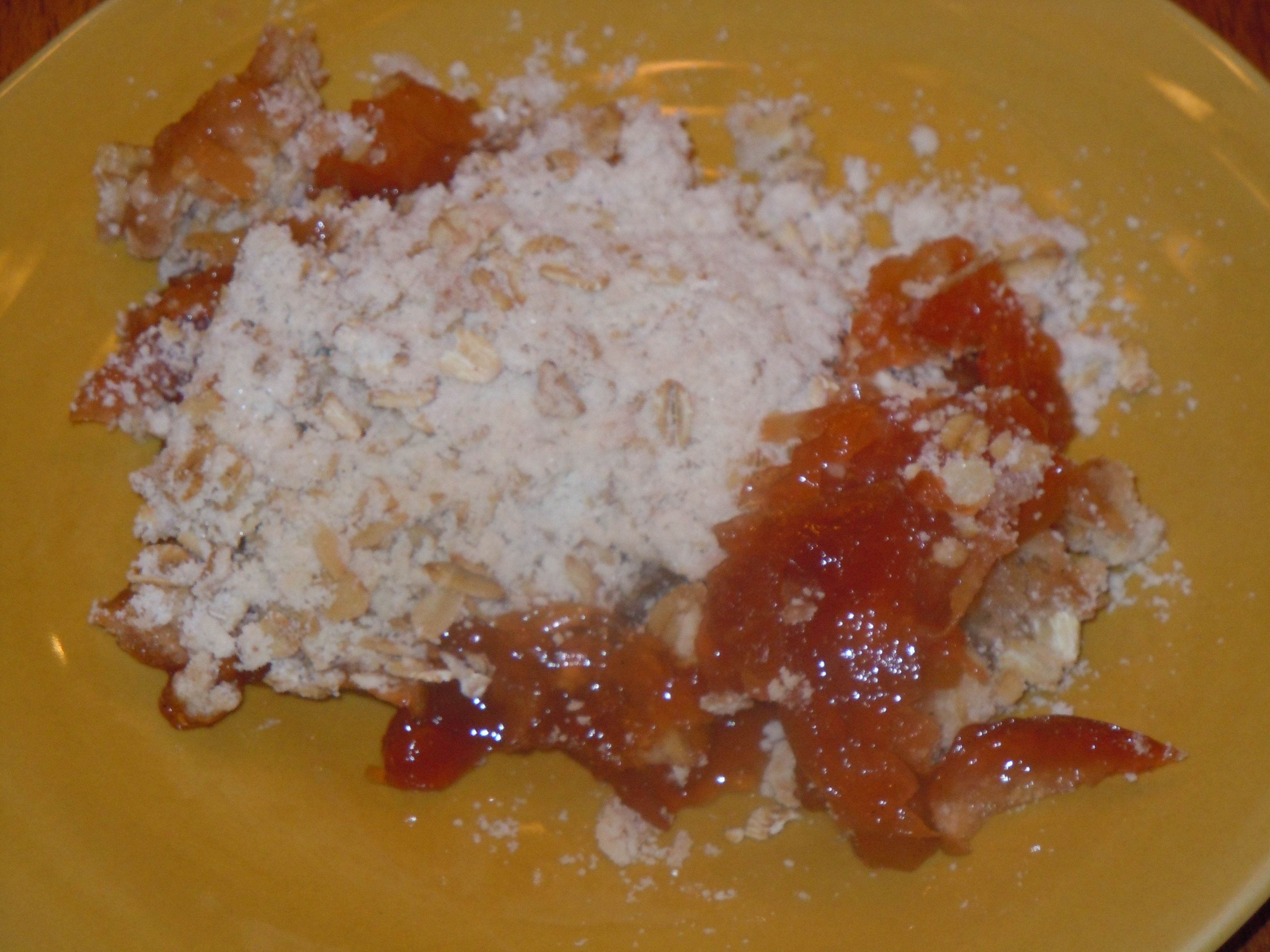
In my new home my apple trees are infants about five feet high, but the day will come when I’m eating apples from my own trees, all heirlooms chosen for superb flavor. In the meantime the farmers’ markets are full of apples, and in a moment of impulse I bought an enormous bag of Winesaps. After eating all that I could fresh, I indulged my passion for fruit crisps. Desserts are seldom justifiable on purely nutritional grounds, but this one is a lot healthier than most, particularly because the peel is left on the apples. Try it. As long as you follow the directions, the peel won’t bother you a bit, and it adds fiber and antioxidants and saves time. Use organic, unwaxed apples. Ask to taste them first, because any apple is affected by its immediate conditions and the season. Don’t ever bother cooking with an insipid or mealy apple. Your time and effort will not be rewarded.
I strongly advise cooking in a clay pan for best flavor. I keep a 10″ Spanish cazuela from The Spanish Table in Santa Fe, and find that it’s the most used pan in my kitchen, because I can use it on the stovetop or in the oven. I strongly advise reading Paula Wolfert’s “Mediterranean Clay Pot Cooking” for the ins and outs of using clay pots. Season the cazuela according to the directions that come with it, and follow the temperature and timing directions below closely. This dessert takes a few hours to make, but 90% or more of the time is unattended oven-cooking time, so you’ll get a lot of other things done at the same time.
The whole beauty of this dessert is the pure flavor of the slow-cooked, semicaramelized apples, made a little richer by the vanilla. I definitely don’t recommend adding spices.
You will need:
a seasoned 10″ cazuela
Fruit layer:
8 large flavorful apples such as Winesap or Granny Smith, each at least 3″ in diameter, or a dozen or more smaller apples
juice of half a small lemon
1/2 cup (or more) light agave nectar
2 tablespoons cornstarch
2 teaspoons vanilla
a pinch of salt
Crisp layer:
1 cup rolled oats
1 cup unbleached flour
1/2 cup sugar
8 tablespoons good grass-fed butter
2 teaspoons vanilla
1/2 teaspoon salt
l
Wash, halve, and core the apples, then slice into very thin slices lengthwise. Aim for slices 1/8″ thick, but if a few are a little thicker it won’t matter much. A food processor or mandoline is helpful, but I just use a good sharp knife. Don’t leave any really thick slices in, because the peels will be tough in the finished dessert, while very thin slices of peel become unnoticeable during the long slow cooking. In a large bowl, toss the apple slices with the cornstarch, lemon juice, agave nectar, vanilla, and salt. Pile them into the cazuela. They will probably have to be stacked up a little inn order to fit. Don’t worry, they cook down a lot. Pop the cazuela in the oven, set it for 300 degrees, and bake about 90 minutes. Stir once or twice during that time. If the apples seem to be browning on the bottom, turn the oven down some and stir a little more frequently.
To make the topping, combine the oats, flour, salt, and sugar in a bowl. Cut the cold butter in chunks, then work it into the mixture with your fingers, making sure that it is “smooshed” well into the dry ingredients and no large chunks remain. Toss in the vanilla with a fork, then check the baking apples. After about 90 minutes they should be well cooked down. Pile the crumble mixture on top, return to the slow oven, and bake another hour. At that point you can turn up the heat to brown the top a little, or turn on the broiler for a minute or two, but don’t let it get darker than medium gold and watch carefully to avoid burning. Remove from the oven, let cool a little, and serve with vanilla ice cream on top, or cool it completely to rewarm at another time. It keeps at least a few days.
The desert is not terribly sweet, and I love it that way. If you prefer, you can add a little more sweetener to both the apple mixture and the topping. This topping is very crumbly and crispy. If you want something more like a cake topping, you can add an egg and a little milk and a pinch of baking powder to the dry mixture, but keep it on the dry clumpy side and don’t stir it too much, or you’ll develop the gluten in the flour and make it tough. This version doesn’t reheat nearly as well as the crumbly version.
Viva Fall! I love summer and hate to see it go, but the end of the harvest season has its own pleasures. Besides, it inspires me to dig more planting holes for more apple trees next spring.
3 Oct
Vegetable Dinners: Black Bean Cakes, and notes on cornmeal
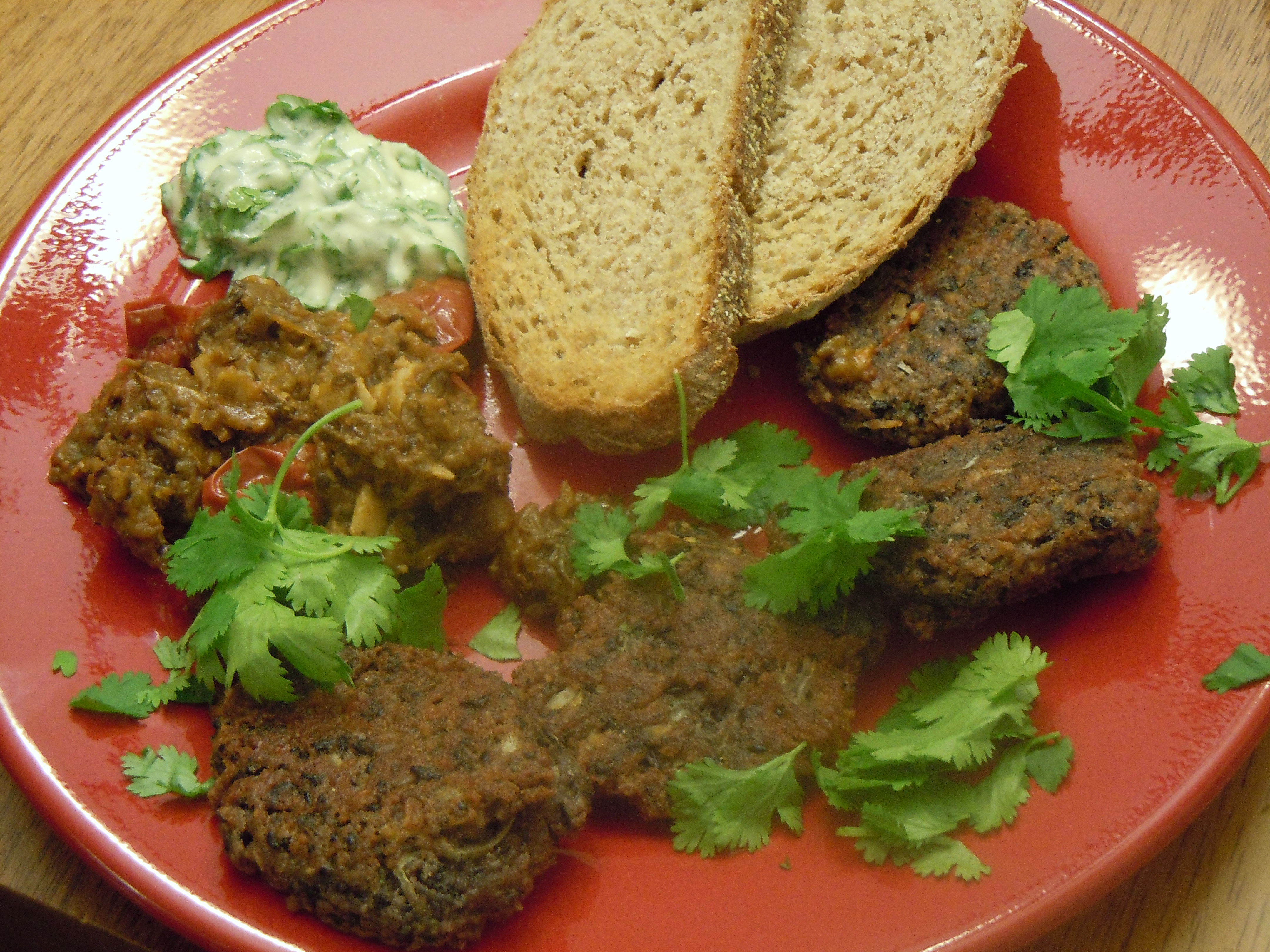
The famous nutritionist Marion Nestle once claimed that she could tell anyone in a sentence how to improve their health and nutritional status: “Eat less, move more, eat more fruits and vegetables.” Around my house we love to fill our plates with vegetables, so no problem there, but lately I’ve been experimenting with ways to add more dried beans to our diet. This coincides with my aquisition of a solar oven, but in this recipe the beans don’t even have to be cooked. You can soak them for 24 hours, or you can use drained cooked black beans if you have some handy. These patties make a substantial main course and are a good main dish for occasions when you have vegetarians and/or vegans over for dinner.
Black Bean Cakes
Start with one cup dried black beans. Soak in a quart of soft or filtered water at room temperature for 24 hours. If you can’t give them the full soaking time, use 2 cups of cooked drained black beans instead.
About a cup of fine cornmeal (I like finely ground blue cornmeal, which helps keep the color dark)
1 small bunch each of epazote and cilantro, or 1 large bunch cilantro
1 teaspoon lightly roasted ground cumin
2 medium or three small shallots, very finely chopped
2 limes, one juiced, one cut in wedges or slices
salt to taste
1 teaspoon ground chipotle chiles
1/2 teaspoon baking powder
about half a cup of olive oil
Drain the soaked beans very thoroughly. They should now be about 2 cups in volume. If using cooked beans, drain very thoroughly. Whichever kind of beans you are using, let them sit in the strainer for at least half an hour, because you want them as dry as you can get them. Now grind them finely in a food processor. MIx in a small handful of chopped epazote or, if you couldn’t find epazote, a large handful of chopped cilantro. Mix in the chopped shallots, cumin, chipotle, the juice of one lime, and about half a teaspoon of salt, and taste for salt. Add more if needed to make the mixture taste properly seasoned. Make it a little tiny bit on the salty side, because you are still going to add more dry ingredients. Heat about a quarter cup of olive oil in a skillet over medium heat. When almost ready to cook, process in half a cup of cornmeal mixed with the baking powder. Check the consistency; if it’s possible to mold it into cakes, you’re ready to go. Otherwise, add more cornmeal until it can be molded (with difficulty) but is still very soft. Sprinkle cornmeal on a piece of waxed paper and scoop out heaping tablespoonfuls of the mixture onto the paper. When the oil is good and hot, carefully lay the cakes in the hot oil, patting a little with fingers or a spatula to make them no more than 1/2 inch in diameter. Be careful, they’re fragile, but you don’t want to add more cornmeal unless strictly necessary because they can get dry and tough if you add too much. You can also skip the waxed-paper step and spoon the mixture directly into the hot skillet, spreading it out with the back of a damp spoon to make the cakes about 3/8″ thick. Let them sizzle at least 3-4 minutes, then when you’re sure that a good brown crust has formed on the bottom side to hold them together, carefully turn with a narrow spatula and cook on the other side until done. You can keep them warm in a 200 degree oven while you fry the second batch. The main “secrets” are to keep the dough on the moist and fragile side, get the oil hot enough, don’t omit the baking powder because it does improve the texture, and wield your spatula with caution to turn them without breaking the cakes around them. .
Once cooked, you can decide how to serve them. They are fine naked on a warmed platter, garnished with a large handful of cilantro leaves and wedges of lime as shown above. A squeeze of the fresh lime juice is important to the flavor, in my opinion, and I pick up a few cilantro leaves to add to each bite. My favorite garnish (vegetarian but not vegan) is some very good olive oil mayonnaise with a little extra lime juice and a lot of chopped cilantro stirred in. They can also be served with warmed small corn tortillas and guacamole, and a little heap of crumbled cotija cheese on top is a delicious tangy addition; the vegans at the table can just omit it.
The beans and blue cornmeal are both full of antioxidants, blue cornmeal is a whole-grain product, and beans have beneficial phytosterols as well as lots of fiber and other desirable nutritional factors. But I only eat things that taste good, and these cakes taste good.
Notes on cornmeal: a lot of cornmeal on the market is very uneven in grind, and any meal containing large particles will leave unpleasant hard fragments in your finished cakes. I buy a blue cornmeal made locally and ground to flour fineness. If you buy yours at the store, I suggest sifting it to get the largest chunks out, or whir it in the blender for a few minutes to grind it more finely. I would avoid the Bob’s Red Mill “medium grind” cornmeal: it seems to be a mix of the company’s fine grind and polenta grind, and can leave tooth-cracking particles in your bean cakes or cornbread. Seek out a better product.
 My urban homestead