Archive for the ‘home food production’ Category

Another Quickie


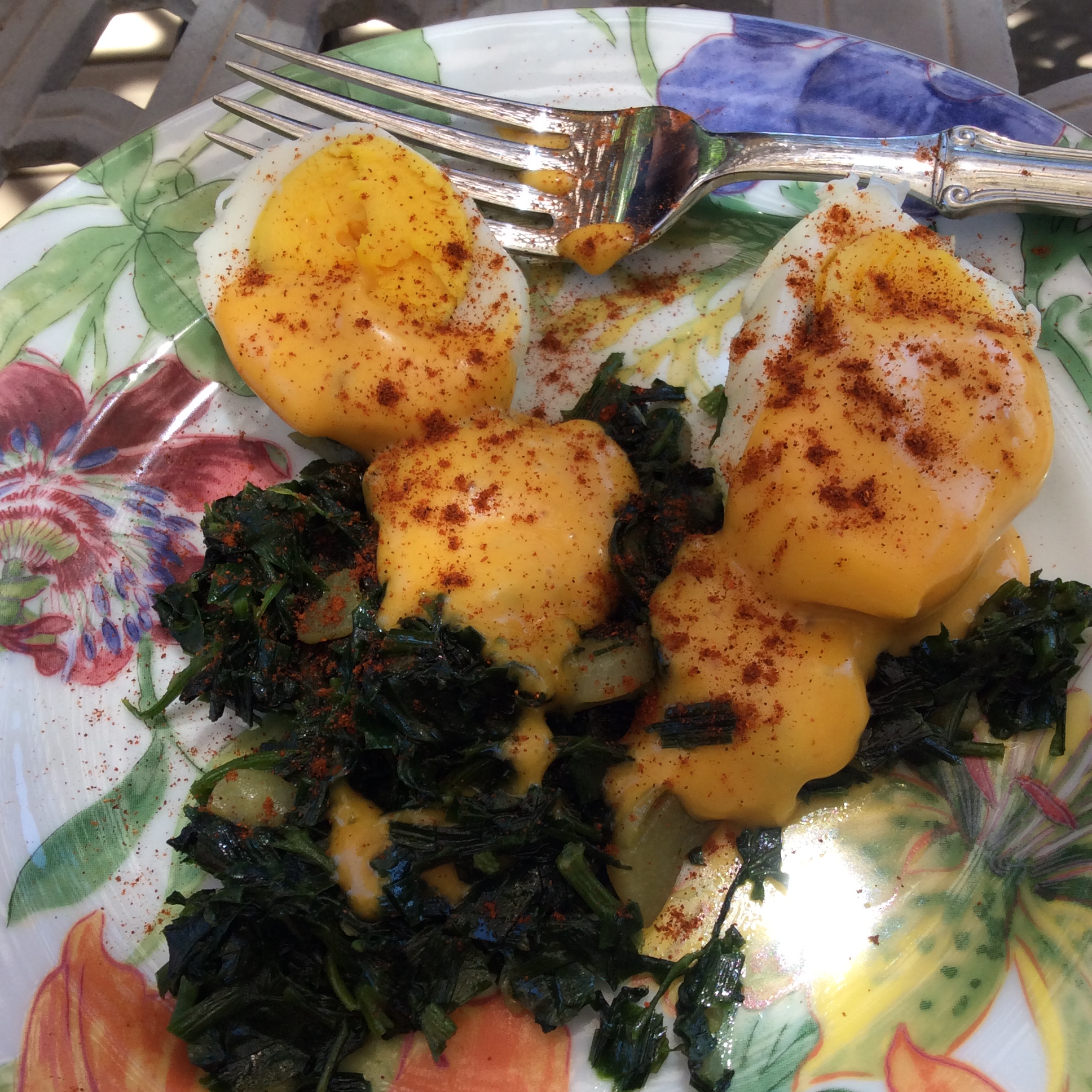
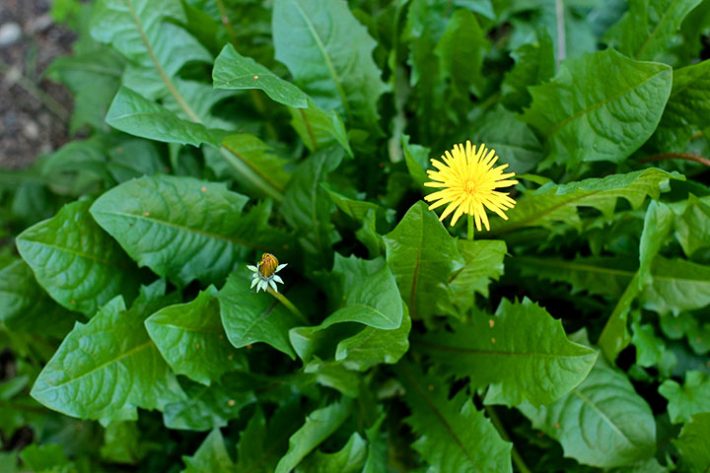
Yesterday I wrote about a quick light snack/meal made mostly from stored staples and fresh greens, and today it happened again that we weren’t terribly hungry at lunchtime but wanted something healthy and good. It was the work of ten minutes to chop up some lambs-quarters tops and a clove of garlic and sauté them with some salt while I peeled a few hard-boiled eggs out of the refrigerator. If you don’t have any already hard boiled, you can cook the number you want and chill them in ice water and eat them still velvety-warm in the center, which is delicious.

The finishing touch for the dish is a good glop of Mayonaisse. I make my own with the glorious deep orange yolks of greens-fed chickens and a mixture of olive oil and avocado oil. With a little salt and lemon juice and seasoning of your choice, its creamy unctuousness is quite superb and elevates a commonplace snack into something special. This particular batch was seasoned with some puréed canned chipotles in adobo, and finished with a sprinkle of ground chipotles.

Green leaves are the most active and extraordinary solar collectors in the world, and ideally they nourish you directly and nourish any animals that you eat. If you don’t want to garden or don’t have space, there is probably some foragable lambsquarters not too far away. You will invariably eat more greens if you make it convenient for yourself to eat them. Washing and cleaning them before they go in the refrigerator helps a lot, and sautéing them lightly before they hit the fridge can be even better. Better to compost some that you don’t use in time than to not eat them because they aren’t ready and waiting for you.

Perennial Edibles: input from my blogging friend Luke

Thomas Jefferson wrote toward the end of his life “Though I am an old man, I am but a young gardener.” Today I’m writing about Luke of the Mortaltree blog, who, though a young man, is an old, experienced gardener.

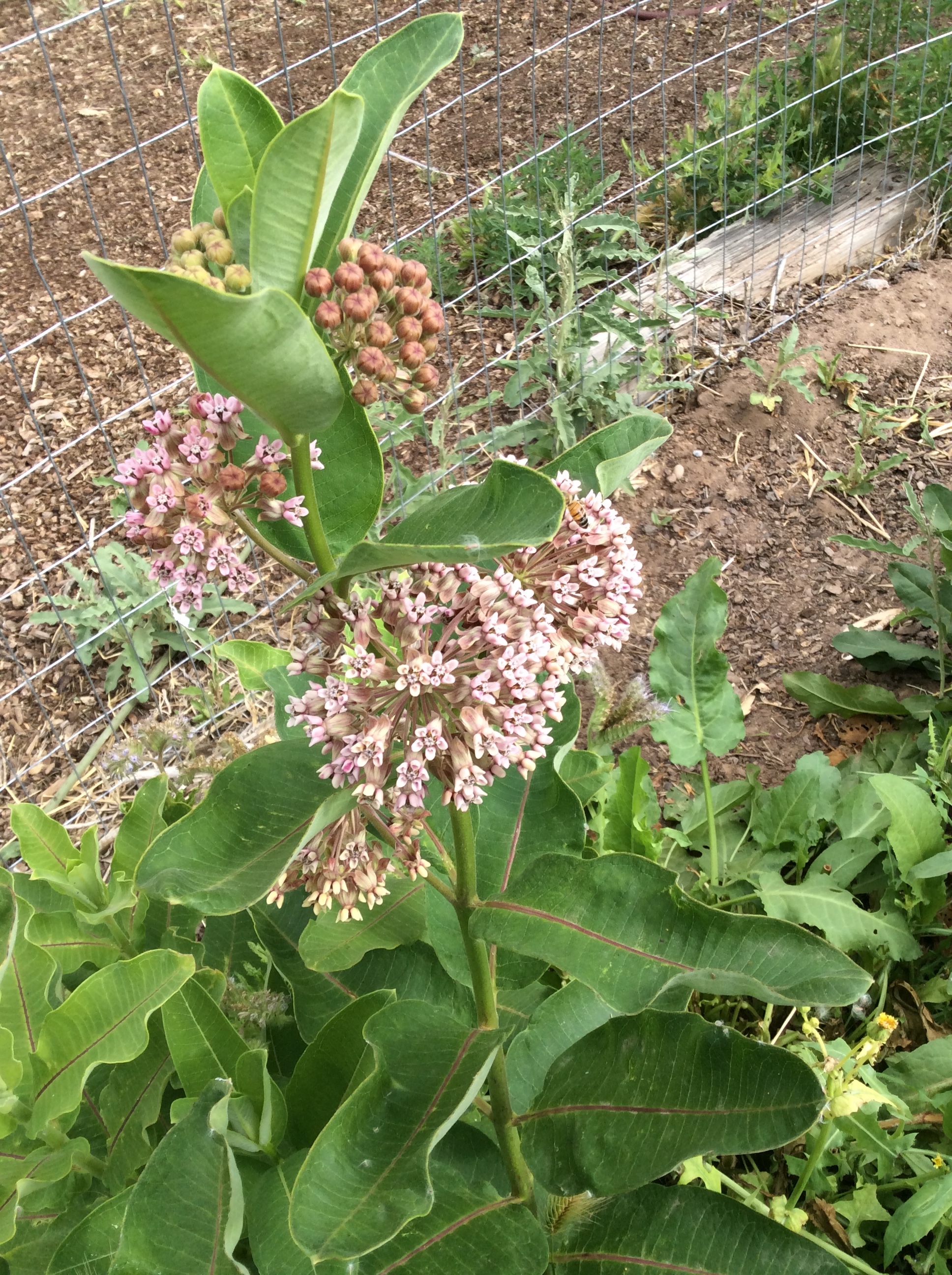
Quite some time ago I wrote a post about the lack of genuine permaculture cookbooks to tell people what to do with unusual perennial vegetables if they were to grow them.  Luke took me seriously and started writing exactly such a guide.  It will be developed more and come out as a book later this year, so follow his blog if you want a notice when that happens, but he was kind enough to publish the preliminary material on his blog. Here are the introduction and Part I, with brief excerpts. Both Luke and I would love to hear reader’s thoughts. The photos here are mine; his are much more artistic.

Permanent Harvests

“Perhaps we could say yield is a ratio of utility to effort. In permaculture, we want everyone to utilize everything to the fullest. It’s reducing waste. It’s increasing pleasure. It’s making more of less, by realizing what we already have.

For the plant-crazed gardener, the efficiency-crazed gardener, the wild-plant forager, or anyone that eats with ethics, here is one look at obtaining your permanent harvest.”

Part I: The Primacy of Perennials

“Many of the best perennial vegetables are weeds that grow in quite inhospitable conditions. They only thrive all the more if given fertile sites. So much effort is put into the art of encouraging a plant to grow. Why shouldn’t we just find the plants that grow themselves. Then we can take our preference of tearing down and removing what we like just to keep the population of weeds in check. Perennial vegetables seem to be the perfect match for how we dream of managing natural resources.”

Part one goes on to describe a number of unusual perennial vegetables and a few annuals that are available very early in the year, during the hunger gap, and gives delicious-sounding  recipes for them.

The Perennial Paddock: Mycelial Madness

Nothing made me more joyously certain that I had created a real, albeit tiny, ecosystem in my suburban yard than when the first mushrooms grew among perennial plants rather than in a grow-bag or other artificial arrangement. Last year two kinds of mushrooms spread from spawn I had introduced and appeared far from the original “planting.” I was ecstatic; the mycelial Internet was forming! And this spring I was even more gratified to find a big cluster of Stropharia rugosa-annulata pushing up through the mulch months before I had expected to see any mushrooms. By perfectionist standards they were  overly mature when I discovered them, as evidenced by size, lightened cap color, and the cracks in the cap. But I am no perfectionist and knew that they were still perfectly good to eat.

So a few notes on introducing mushrooms, in no particular order:

1. Stropharia rugosa-annulata is the easiest mushroom  to grow in your garden. Even here in the high desert, it thrives in a deep mulch of straw and oak sawdust. In my opinion the almond agaricus is the most delicious, but it is more finicky and less productive. I have grown oyster mushrooms in containers, but this year I’m experimenting with introducing them into more unlikely spots. I’ll report back.

2. Get good spawn. Mine came from Field and Forest Products, and it was ready to grow.

3. Know how to indentify the mushroom that you introduced. Know its field marks and identify it before you eat it. When you create a good outdoor environment for mushrooms, you are not in complete control of what grows, any more than you are immune to weeds in your garden beds.

4. Be aware of how many commercial mulch products are treated with fungicides to prevent fungus from moving in. If you want select funguses to move in and thrive, you need to avoid these products.

5. Cook and eat with a sense of reverence and awe for the complex and extraordinary interactions of nature. If you want to learn more about this, Mycelium Running, Mycelial Mayhem, and Radical Mycology are useful books.

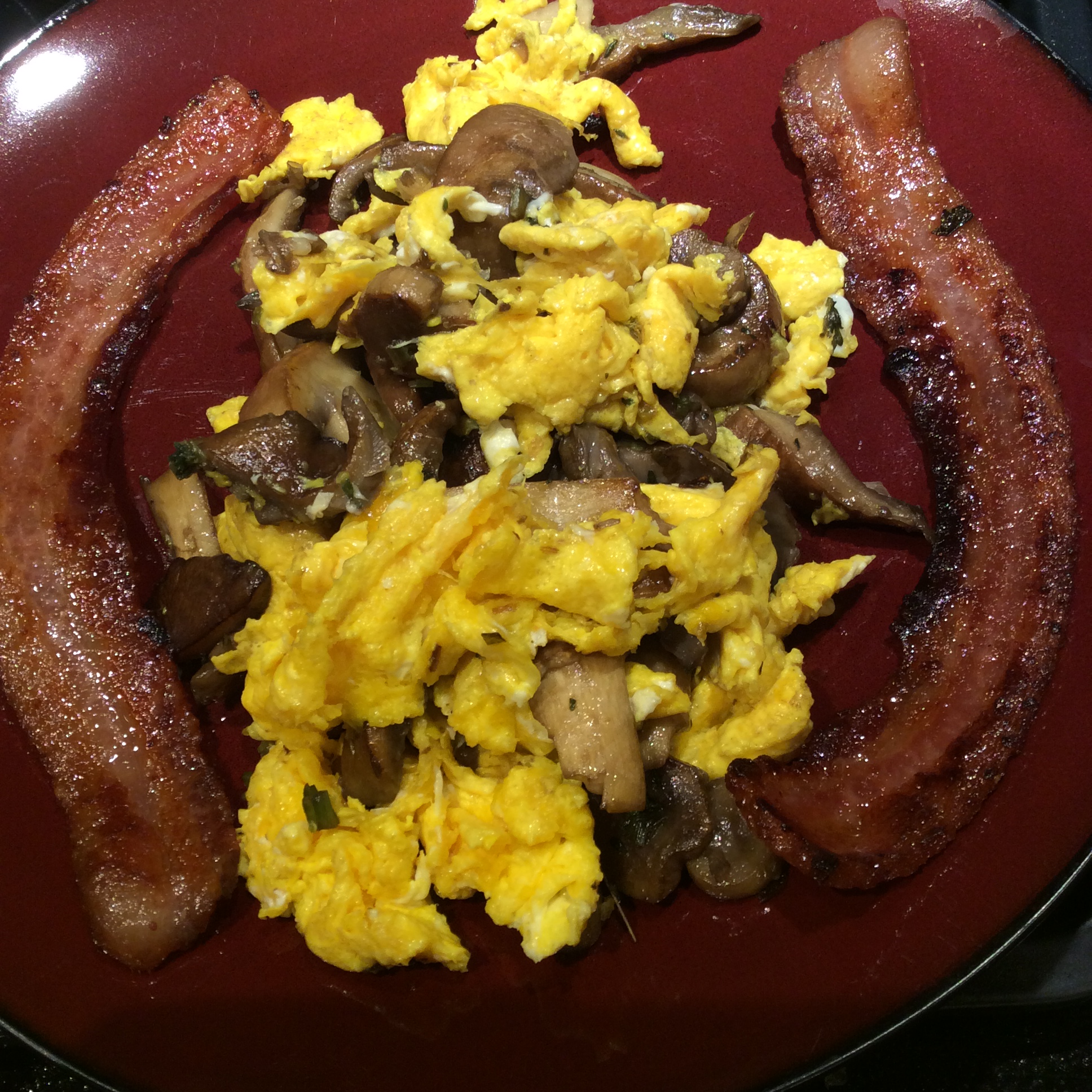
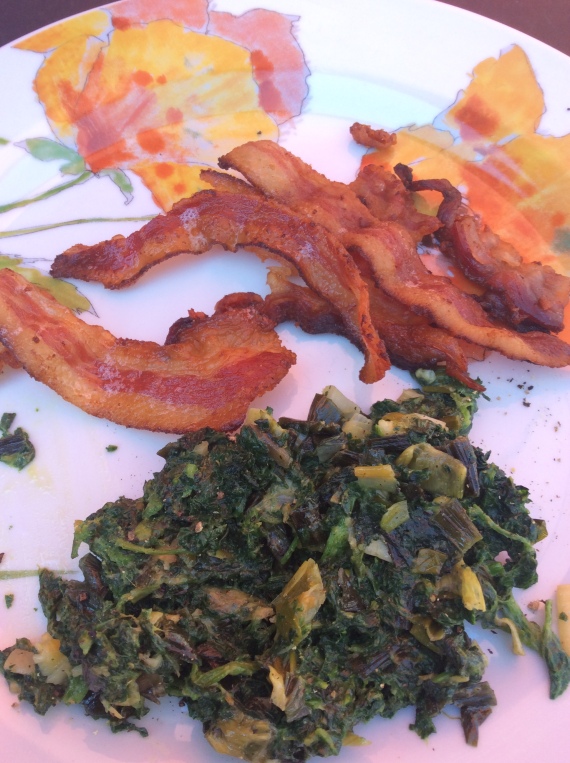
I sautéed my mushrooms in olive oil with generous additions of green garlic and fresh thyme, then removed them from the skillet, set aside in a warm spot, and scrambled some eggs in additional olive oil with a little salt. When the eggs were cooked, the mushrooms were folded back in. Simple as that. Scrambling is an underestimated technique. In this case I cooked the eggs fairly firm, for texture contrast with the softer mushrooms.  I framed the fragrant heap with a couple of slices of bacon. It made a quick delicious dinner, mostly from my own property, and was a culinary salute to the mycelial web that underlies, well, damn near everything.

The First Nettles of Spring

This year we ate all winter from the broccoli and greens growing under frost blankets. Even so, it remains a major spring event when the first nettles are ready to pick. They taste so good and give such an all-over glow of virtue.  There are people who think that nettles have special medicinal benefits. My own belief is that all dark leafy greens have medicinal benefits, and the important thing is to eat as wide a variety of them as possible. But that first meal from the uncovered soil does confer a special feeling that spring is finally and truly here.
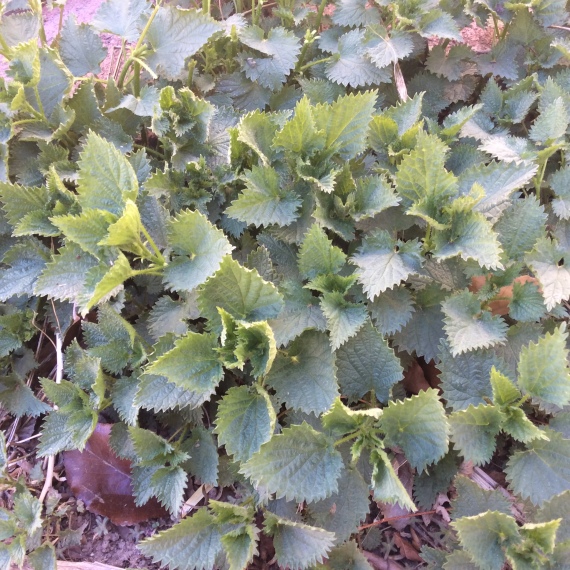
If you aren’t familiar with them, consult a good wild-food field guide, and be aware that the sting is quite uncomfortable and can last hours. Have leather gloves handy for picking. They’re ready to harvest when 6-8” tall. I cut off the top 2” or so, including as much leaf and as little stem as possible.

I turn them into a big bowl of water and stir gently with a wooden spoon for 2-3 minutes to get dirt off.

My favorite tool for lifting them out of the water, leaving any dirt that was present at the bottom of the bowl, is a pair of “salad hands” that somebody once gave me as a hostess gift. A large slotted spoon would work too. I make sure to throw the water on a garden bed. We live in the desert, after all.

Cooking nettles is a breeze, but in my opinion chopping is a necessary step, to eliminate stringy stems. First I put them in the pan with about half a cup of water, and cook over high heat, stirring, for about two minutes or until thoroughly wilted. The water should be pretty much gone. Turn out on a cutting board, let cool for five minutes or so, and chop. The cooking has eliminated their capacity to sting, and you can handle them with impunity now.

The flavor of nettles is rather like spinach, but deeper and richer, with a slight feral twist. I especially like them creamed, and always eat the first ones this way. Slice up two big fat green onions, sauté them in butter until cooked, add chopped nettles, sauté another minute or so, add heavy cream just to cover, boil for a couple of minutes until the cream is thickened, and salt to taste. Serve with freshly ground pepper and nothing else, so that you can taste the true flavor of the nettles.  You can also use netales in absolutely any way that you would use cooked spinach. They are infinitely versatile, and I have never served them to anyone who disliked them.  After the initial cooking and chopping, they can be frozen for later years. Whenever I wash and cook nettles, I try to make about twice as much as I need for immediate use, so that I can freeze the other half.

They can be dried for tea, although I do not care for the watery tasting tea that results and don’t bother.  Adding a twist of orange peel or something similar would give more flavor. I am not much of a tea drinker, but if you are, this might be worth considering.

If, like me, you live in an area who are nettles don’t grow naturally, there are some considerations to growing them in your yard.  First is obtaining them. When I first started growing them in central New Mexico about 12 years ago, I could not get seeds to germinate and no herb nurseries offered them. I finally called an herb nursery from whom I was buying other things and asked if they could please find me some nettles.  The “plants” I received had clearly just been dug from the nearest roadside, and were little more than cut rhizomes in potting soil, but they grew just fine.  These days they are easier to find and a number of mail order nurseries have them.

Siting  must be done carefully, because of the sting and because they are invasive.  I have mine in an area surrounded by concrete, where they cannot escape to parts of the yard where I don’t want them.  My large dogs are readily able to avoid them, but I have heard that they could do real harm to very small dogs, so keep this in mind.   Growing them in areas where small children could get into them is an obvious no-no. They get tall and gangly and flop around, but if cut or mown back in summer, they stay neater and make a second crop in fall.  I hope that I am never without nettles in spring.