Archive for the ‘front yard gardening’ Category

Still more greens, and notes on solar cooking


Since I got a solar oven, I no longer find it difficult to cook chickpeas, and so I’m looking for new ways to use them. I especially like combinations of greens and beans, partly because these primal and earthy dishes are found all over the world wherever people need healthy cheap food, and partly because they taste good. I’m cooking my way through a huge patch of lambs-quarters and amaranth (common pigweed) in my back yard, and getting healthy food from weedy places always satisfies my sense of economy. If you’re not a weed-eater, just use Swiss chard. I like a little smoked meat with greens, but if you don’t eat meat, just leave off the final garnish of bacon. This makes two large main-course servings with leftovers.

One pound young leaves and tender tips of lambs-quarters and amaranth, OR one large bunch of swiss chard, stems removed, chopped coarsely.
One pint cooked chickpeas, with just enough of the cooking liquid to cover them (see Solar Beans, below.)
3-4 tablespoons good flavorful olive oil
1 large onion, finely sliced
2 large cloves garlic, chopped finely
1 tablespoon of fresh thyme leaves
2 teaspoons Spanish Pimenton de la Vera, or smoked paprika
1/2 teaspoon red chile flakes
salt and pepper to taste
a little of your best olive oil for drizzling
1 thick slice bacon, fried crisp and crumbled (optional)
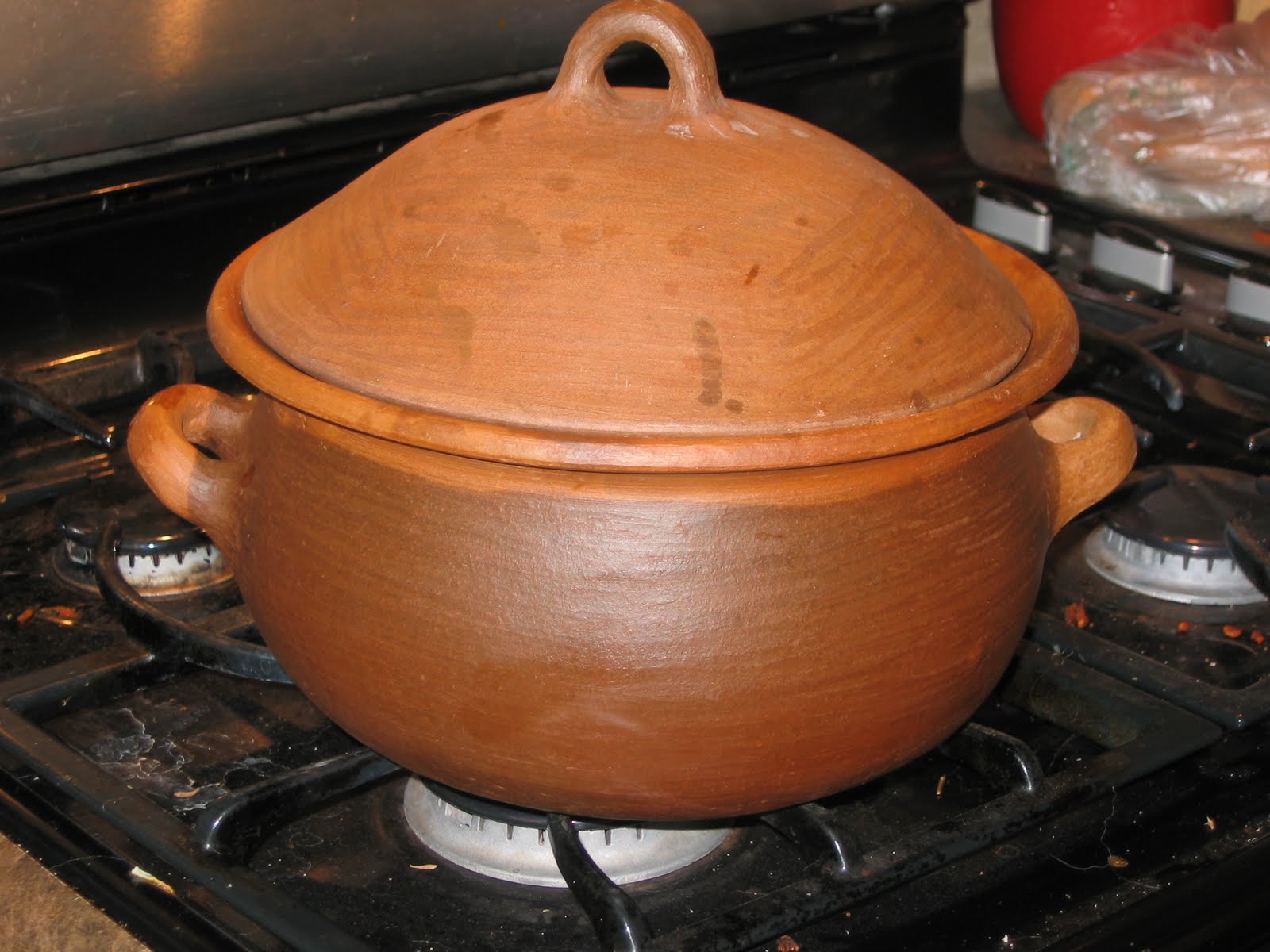
Wash the greens very well, make sure to remove any remaining large stems, and blanch them in boiling water for 1 minute. Drain, press out extra water, and turn out on a cutting board and chop coarsely in both directions. Meanwhile, heat a heavy pot (I like an unglazed clay 3 quart pot) over medium heat, warm the olive oil, and saute the onions in the oil until translucent and cooked through but not browned more than a little. Add the chopped garlic and saute until garlic is cooked. Add the smoked paprika, thyme leaves, and chile flakes, saute a minute but no more, and promptly add the chickpeas and their liquid. When this mixture comes to a boil, add the blanched and chopped greens, salt to taste, turn the heat to low, and let it all mellow together for 10-15 minutes. Check the seasoning, add pepper to taste, and serve with a good drizzle of very good olive oil on each serving and the crumbled bacon on top if you’re using it. With a hunk of good baguette and a glass of full-bodied straightforward red wine, it couldn’t be better or healthier. Without its bacon topping it’s vegan and can be served to people of that persuasion, with the bacon fillip for the carnivores at the table. People who are vegetarian but not vegan will enjoy a pat of butter melted on top to give a little richness. Hedonists will like both a little butter and a little bacon.
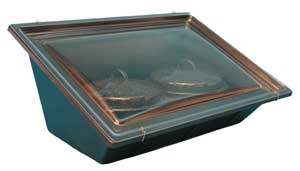
Solar cooking is a natural here in New Mexico, where we have more sunlight than we know what to do with.
So, how do you cook solar beans? Fist you catch your solar oven. There are lots of easy plans on the internet for making them, but I chose to buy mine from the Solar Oven Society. Their solar ovens are capacious, lightweight, and every one you buy helps the society provide solar ovens to the third world, which avoids some deforestation and greenhouse gases from cooking fires. Their ovens are cleverly designed with two potential bases to provide a summer sun-catching angle and a winter sun-catching angle. Optional reflectors are available to achieve higher temperatures. You may want the optional reflectors for other purposes, but for cooking beans you won’t need them. Two graniteware pots are included with the oven, and you can put a pint of dry chickpeas in each one, cover with cold water by at least 2″, and set the oven up facing south in the morning with the two full pots inside. Then employ my special cooking technique: walk away, laughing a carefree laugh, and go to work or just get on with your life. On a reasonably sunny day, the oven without reflectors attached will reach a peak temperature of about 250 degrees and will stay in that range for much of the day. When you get home eight or nine hours later, you will find two steaming pots of perfectly cooked chickpeas, and you can salt them to taste, let them cool, and use immediately or freeze in pint containers with enough of their pot-liquor to cover. I love the oddly meaty-tasting cooking liquid and often use it as the broth for the finished dish, as I do above.
The directions that come with the oven imply that you need to turn it a few times to keep it facing the sun, but at least in summer I just point mine due south and forget about it. Other types of beans are also naturals for this solar slow-cooking, but they take less time, so I do them on weekends when I can check the oven in 4 hours or so to see how they’re coming along. For readers at lower altitudes than our 5500 feet, cooking times would tend to be much shorter. If the day clouds over, you may need to finish inside, or just put the pots in the refrigerator overnight and try again the next day. Don’t forget and leave the beans in the cool solar oven overnight, since some very nasty bacteria including botulinum could grow in room-temperature aqueous solutions. Cool them and pop them in the fridge or freezer when they’re cooked. Eat in the knowledge that you’re taking in all sorts of nutritive and cholesterol-lowering compounds that cost you no energy and very little trouble to cook. Beats canned, doesn’t it?
Passing Pleasures: Squash Blossoms


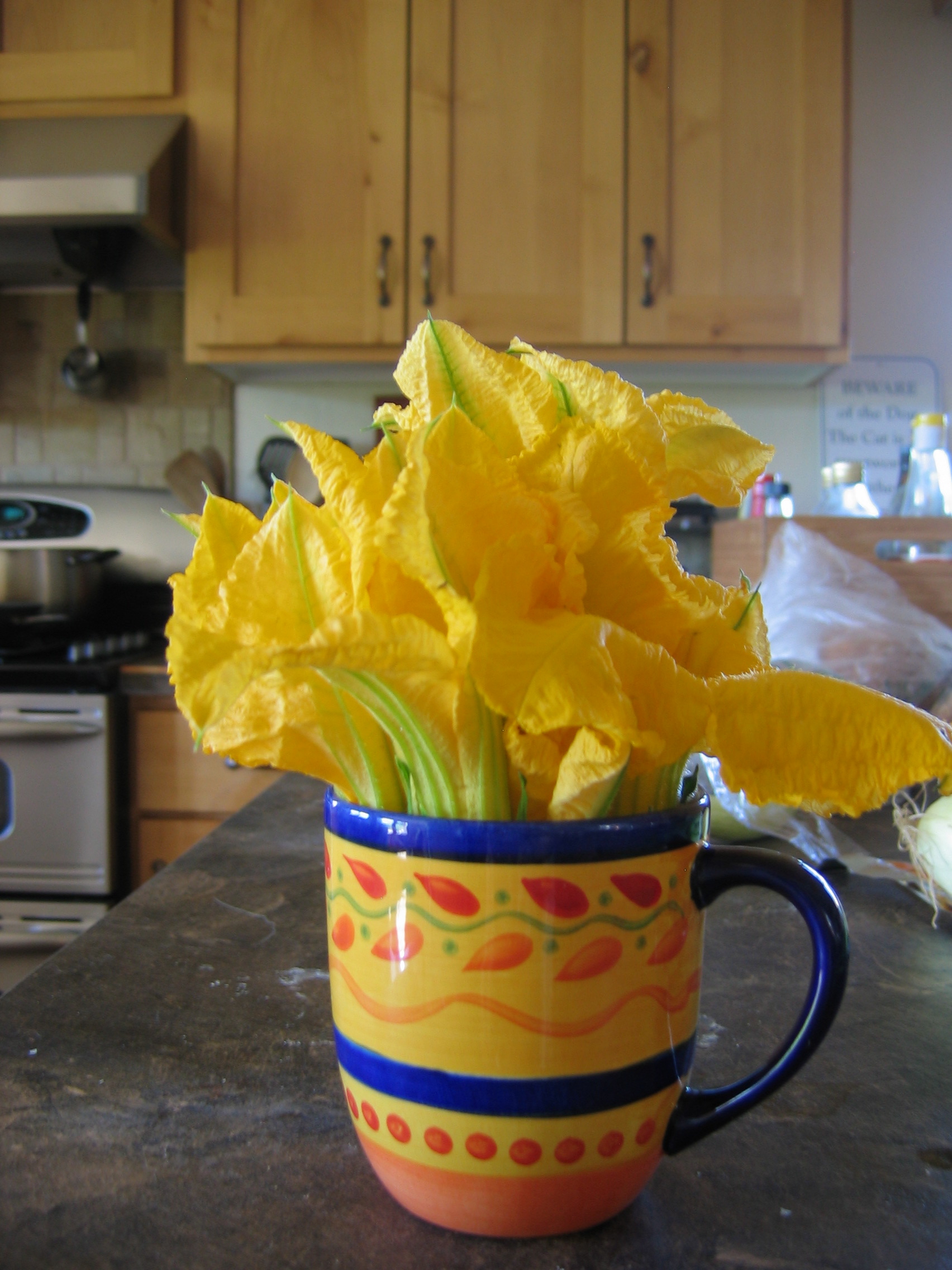
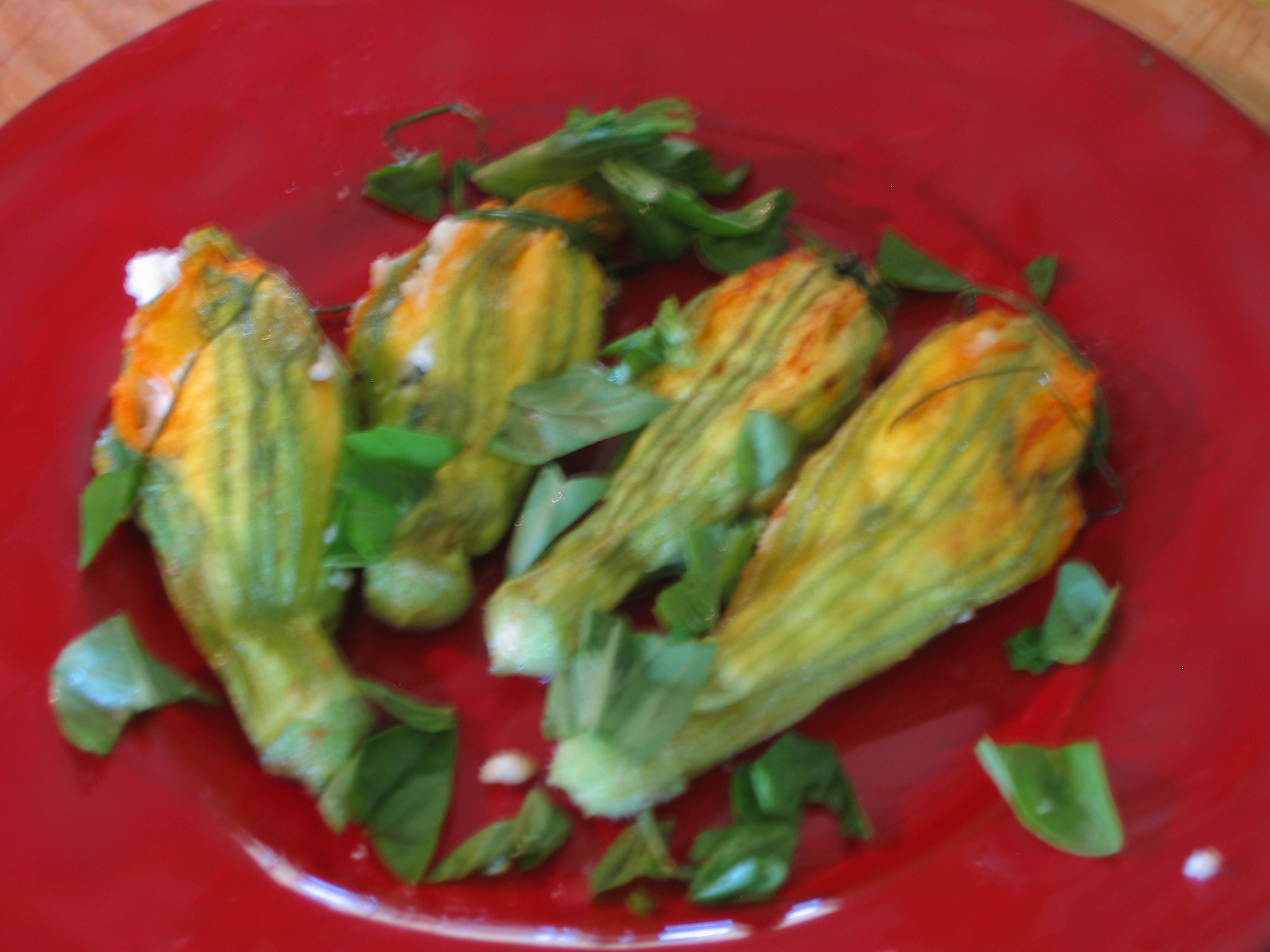
There are a lot of edible flowers, but no flower expresses the joy of summer as well as the resplendent squash blossom. The sheer exuberance of them in the garden on a July morning lifts the heart of anyone who sees them, and they are a delicious edible. They’re fragile, and your best chance of getting good ones is to grow them yourself. I like the flowers of winter squash and pumpkins best for eating. They are huge gold trumpets six or seven inches long. You can use the smaller flowers of zucchinis, but you’ll need almost twice as many. There are lots of ways to cook them, but my favorite method is to stuff them with a delicate ricotta and basil filling.
I pick only the male flowers, making sure to leave at least one male blossom in the squash patch every day for pollination purposes. You can also use the female flowers, which have embryonic little squash between the stem and the flower, but of course you won’t get as many squash if you pick females. These flowers are wildly attractive to bees, so check for bees inside before you pick the flower, and give them a chance to escape safely out in the garden. I rinse them well and place them trumpet-down on a dish towel to drain. Some sources tell you to pick out the stamens or pistol, but I don’t think this is necessary. Just get them clean and fairly dry. Then carefully pull or snip off the six long green sepals that stick up from the base outside the petals. These have a coarse texture and detract from the delicacy of the finished dish. The blooms need to be cooked the day they are picked. To keep them from morning to evening, wrap them gently in the damp towel that they drained on, put the bundle in a plastic bag, and refrigerate until dinnertime. It’s better to use them for lunch, though.

Stuffed Squash Blossoms
A dozen large squash blossoms or 20-24 small ones, rinsed and drained, stems trimmed off level with the base of the flower
1 pound of very fresh ricotta
1/2 cup very finely grated best quality Parmesan, loosely packed
6 large sprigs of basil, leaves picked off the stem and torn (NOT cut) into large chunks
White part of one large or 2 small scallions, very finely minced.
Long chive leaves, twice as many as the number of blossoms
5 tablespoons butter
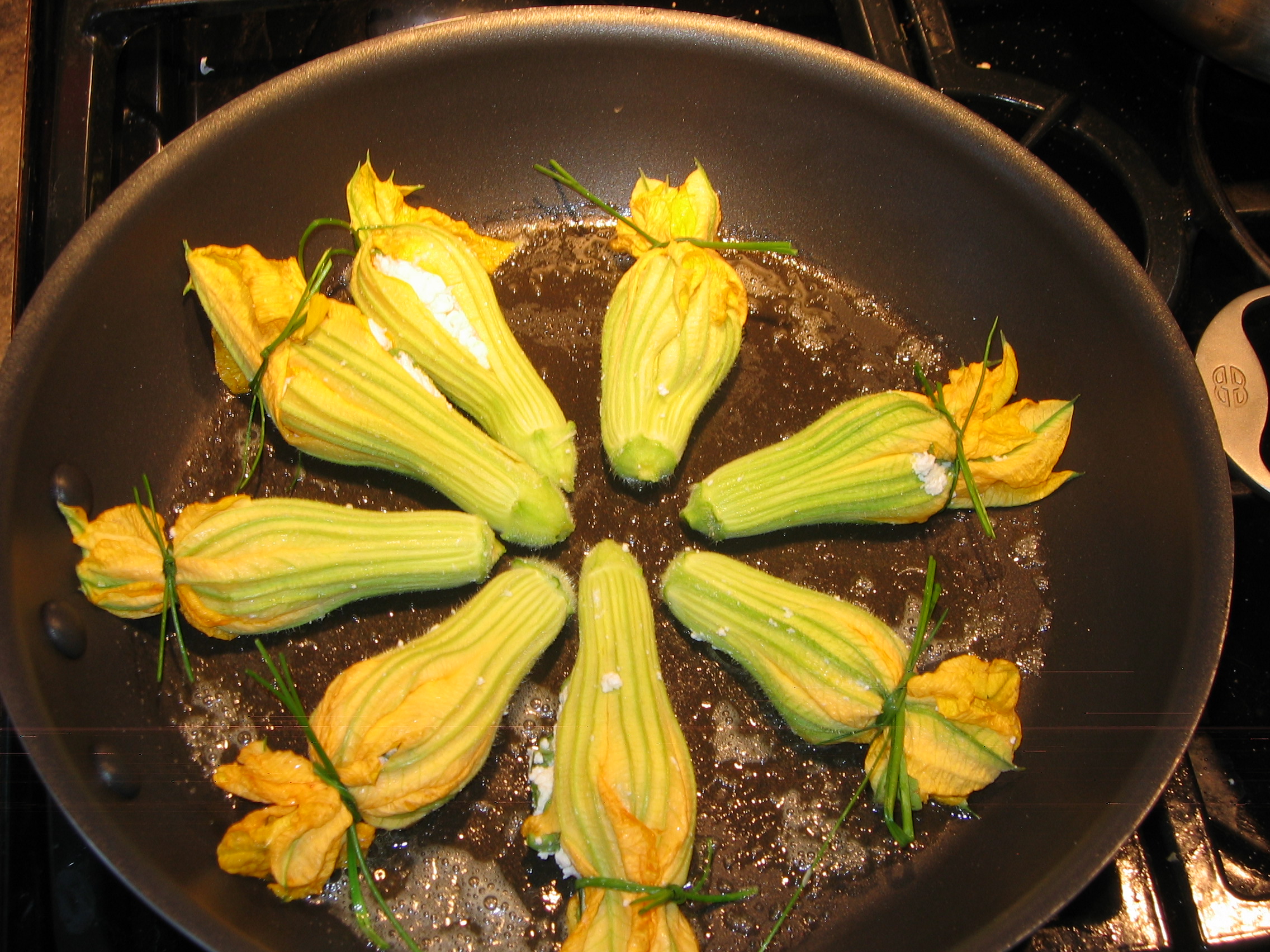
Make sure the ricotta is very fresh and free of bitterness. In a bowl, mix it with the Parmesan, minced scallion, and half the torn basil leaves. Taste the filling and add a little salt if needed, but don’t overpower the delicate flavors. Using your fingers and working very gently, fill each blossom with the cheese mixture. You will need to work a little down into each trumpet, but don’t tear them by pushing too hard. Fill each trumpet about halfway, and don’t overstuff. Now hold two long chive leaves together and tie a square knot at the end of each trumpet, and trim the ends to about 1″ long. I admit that this is a bit fiddly and not completely necessary, but the tied bundles look so attractive that I strongly recommend it. Now heat a skillet over medium heat, melt 3 tablespoons of the butter, and put in the filled blossoms. You will need to turn them about three times to get the blossoms cooked on all sides. Work very carefully with a small spatula and your fingers, so as not to tear them. Let them get slightly browned in spots but not darkened all over. The cooking usually takes me about 15 minutes. Then put them on plates, melt the remaining two tablespoons of butter in the pan and drizzle a little over each plateful, and scatter with the remaining torn basil leaves. Serve with a good baguette, and eat with gratitude for the pleasures of the season.

Beautiful Broccoli


Any honest gardener will admit to a lot of disappointments, small disasters, and unfulfilled ambitions. Heat waves sizzle delicate plants to a crisp. Hail happens. Or, maddeningly, a particular plant that’s supposed to be easy sizes you up and drops dead rather than be bothered with you.
You get hooked, though, because something always does so well that you can hardly believe it. This year, supposedly heat-loving exotics like winged beans and chayote refused to grow, but broccoli, which likes cool weather, is producing better than ever before. I’ve gotten heads almost a foot across and side shoots as big as my fist or bigger. When picked twenty minutes before dinner, broccoli has a delicate flavor and none of the funk that can develop when it sits around. There are hundreds of good ways to cook it, but one of my favorites for a fast healthy meal is a pasta with broccoli cooked in the pasta pot.

For two large servings and good leftovers, you need:
1 large head of broccoli or two smaller ones
8 oz of dry pasta (whole wheat pasta tastes pretty good in this dish)
1/4 cup olive oil
3 large or 5 medium cloves garlic, sliced thinly.
one anchovy fillet, mashed (optional but gives depth)
half a teaspoon (or more) hot red pepper flakes
1/2 cup red wine
half a lemon
1/2 cup toasted pine nuts
a scant cup of best Parmesan cheese, grated

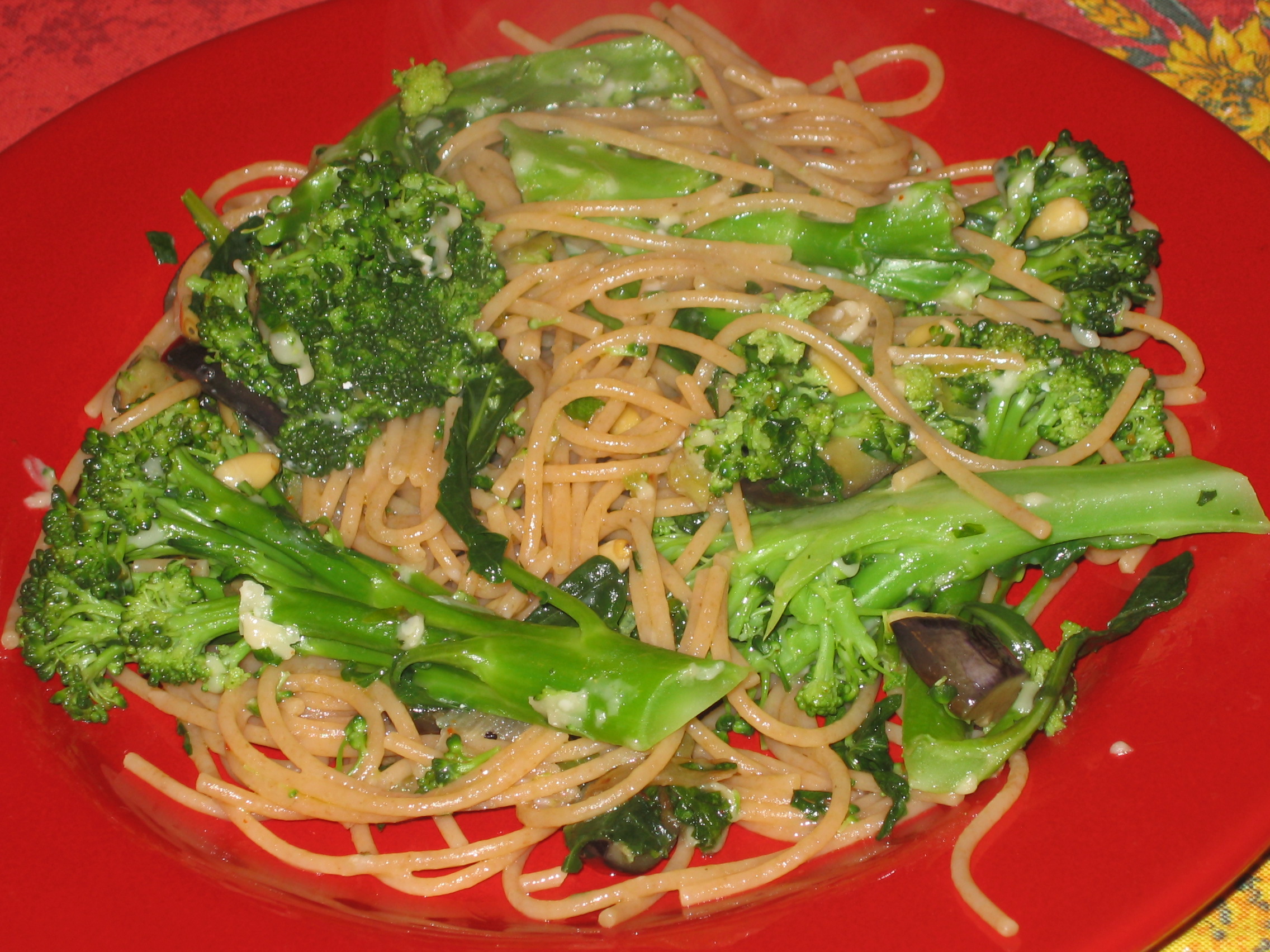
Start a pot of salted water boiling. Cut the broccoli into slender “branches” by splitting the stems. Slice the garlic cloves. When the water comes to a boil, put in the pasta. Heat half the olive oil in a small skillet and saute’ the garlic cloves until cooked through over medium heat. Add the anchovy and red pepper, saute’ another minute, then add the red wine and boil until it’s reduced to half. Add salt to taste. Keep checking the pasta, and about 3 minutes before it’s done, put the broccoli in the pot. Make sure it’s submerged and the water returns to a boil, then check the pasta in 2-3 minutes, and as soon as it’s perfectly done, drain the pot and return the drained noodles and broc to the pot. Toss in the remaining olive oil, then the skillet contents, then toss in all but a little of the cheese and promptly plate the pasta, remembering to leave enough in the pot for lunch the next day. Squeeze a little fresh lemon juice over each serving. Toss the pine nuts over the top along with the remaining cheese, and eat while hot. Elapsed time: about 15 minutes from the time the water comes to a boil to the table, if you’re reasonably quick and deft about splitting up the broccoli.

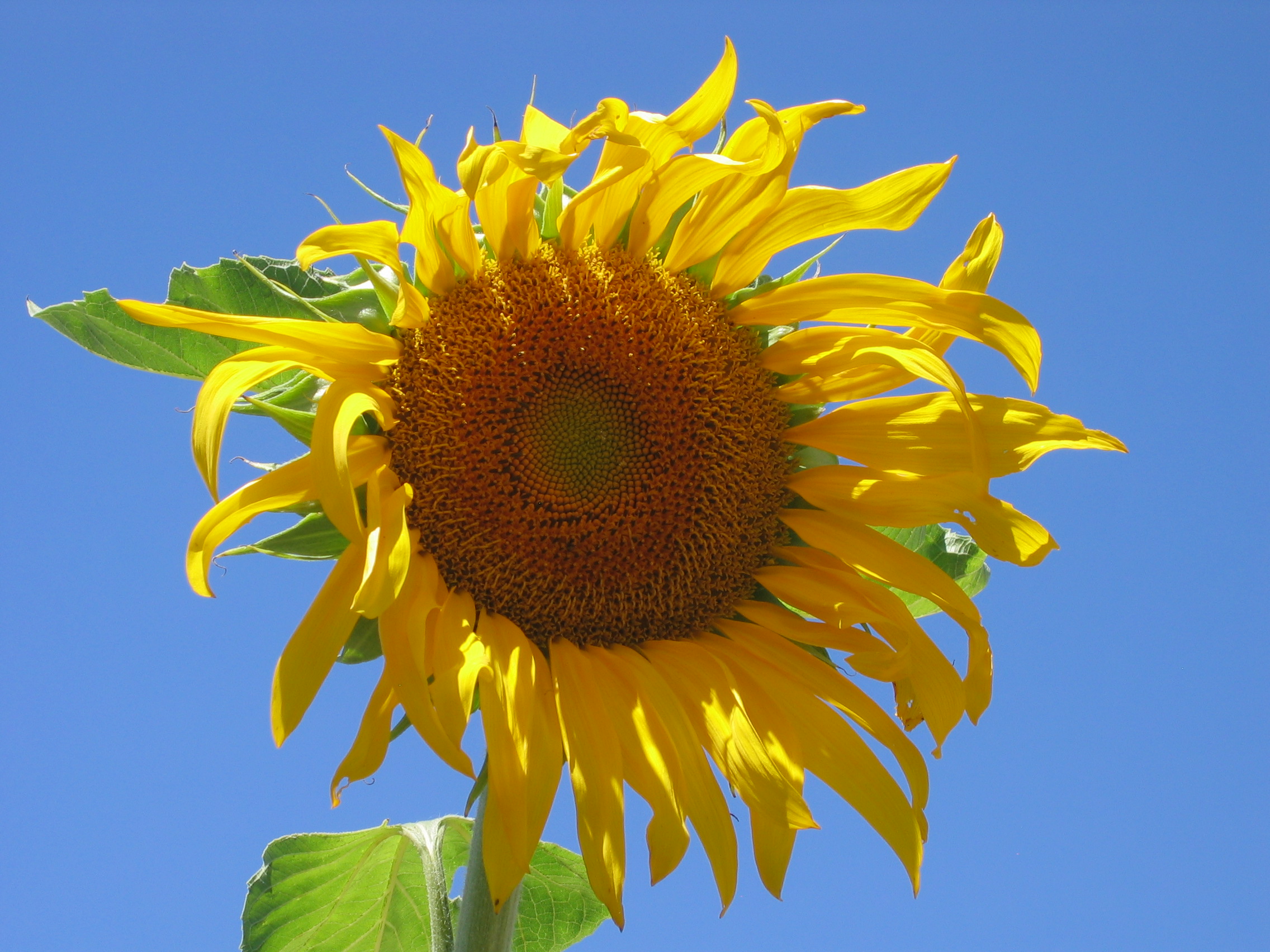
Don’t forget to scatter your vegetable garden with some flowers. It benefits the bees and it benefits your spirits.

The Greens of Summer: greens bruschetta

If you’re interested in making leafy greens an enjoyable part of your diet, I highly recommend Paula Wolfert’s book Mediterranean Grains and Greens. My favorite greens recipe, however, does not come from that book but from another of her books, Paul Wolfert’s World of Food. She calls it “marmalade of spring greens,” and it is intended as a spread for bread. I find it wonderful stuff to have tucked in the refrigerator, where it will keep for several days and makes great impromptu lunches and snacks. I have made it so often for so long that my recipe has morphed into something a little different from hers, as tends to happen with recipes that really work for me.

First, catch your greens. See my earlier blog post about greens options and about cleaning them. Right now I am mostly using mixtures of amaranth leaves ( the polite term for common pigweed), lambs quarters, purslane, sweet potato leaves, and New Zealand spinach, because those are the plants that are doing best in our summer heat. Gather about a pound of assorted greens. If you are using store bought, a mixture of Swiss chard or Tuscan kale and spinach will work well. I avoid the baby spinach that comes in cello bags. It doesn’t have enough flavor for use as a cooked green. If you enjoy bitter greens you can add several dandelion leaves (I am referring to the store bought kind, not the wild kind, which are too bitter to use at this time of year.) Or you can add a small bunch of watercress to add a little bit of snap. But don’t worry too much about this, because the seasonings will add the extra kick as long as the greens are good.

1 pound of mixed greens

One Shallot

Two cloves of garlic, fairly large

1/4 cup of olive oil

10 to 12 kalameta olives, finely chopped

2 tablespoons capers, preferably salt packed, washed of salt and soaked in cold water for an hour

Pinch of red pepper flakes

Salt and pepper to taste

Bring a pot of water to a boil, add the greens, and cook uncovered for one minute, just until they are thoroughly wilted. Drain and press out any excess moisture. Turn them out on the chopping board and chop them thoroughly in both directions, so that you retain some texture (you don’t want a paste) but all stems and leaf ribs are cut up into small pieces.

Chop the garlic and shallot quite finely over medium heat in the olive oil until cooked through but not brown. Add the chopped olives and the capers, either chopped or whole as you prefer. Sauté for a few minutes, then add the chopped greens, the red pepper, and a little salt. Cook over low heat, stirring occasionally, for about 15 minutes or until the greens are tender. Taste, season with salt and pepper as needed, and spread thickly on toasted or grilled bread. Top with some grated Parmesan cheese and a handful of toasted pine nuts.

Many variations are possible, and I seldom make this dish the same way twice. I may add several cloves of confited garlic instead of two cloves of fresh for a deep mellow flavor. A mashed filet of anchovy or a dash of colatura added at the saute’ stage give an especially rich flavor- this is very close to the Wolfert original. A generous spoonful of roasted tomato sauce added toward the beginning is a nice touch. A half teaspoon of Spanish smoked paprika, Pimenton de la Vera, gives a faint smoky edge as if you had cooked it over a wood fire.  A good sprinkling of fresh thyme or chopped oregano or marjoram leaves over the top just before serving gives a lovely whiff of its Mediterranean origin.  A poached or fried egg plopped on top makes it a hearty meal. You can serve the greens at room temp on a bed of fresh ricotta, drizzled with your best olive oil, and serve the bread on the side.

I should add that, like so many other things, it seems to taste best if cooked in clay. I tend to use either an unglazed clay bean pot or a Spanish cazuela, after doing the initial blanching of the greens in an ordinary pot. A Chinese sand pot works well too. If you’re curious, do read another of Ms. Wolfert’s books, Clay Pot Cookery, which contains everything you might want to know about cooking with clay.