Archive for the ‘edible landscaping’ Category

Root vegetables Chairoscuro


This time of year, parsnips are your friends. They are sitting patiently out in the garden waiting for you to get to them, never demanding any special attention or winter storage. During hot weather they weren’t worth eating and you tended to forget about them, but while you were catering to the flighty tomatoes and peppers, they were biding their time. When the needier vegetables gave in to the frosts, they started to convert their stored starches to sugars. Now, whenever you can pry them out of the cold ground, they’re ready to meet you halfway with a sweet flavor that repays your labor. I love them roasted, but for whatever reason I’m not big on white vegetables, and I started looking for something to relieve their snowy monotony. Finally I settled on their visual opposite, the deep purple carrots that become almost black when roasted, to create a dish with a little drama.
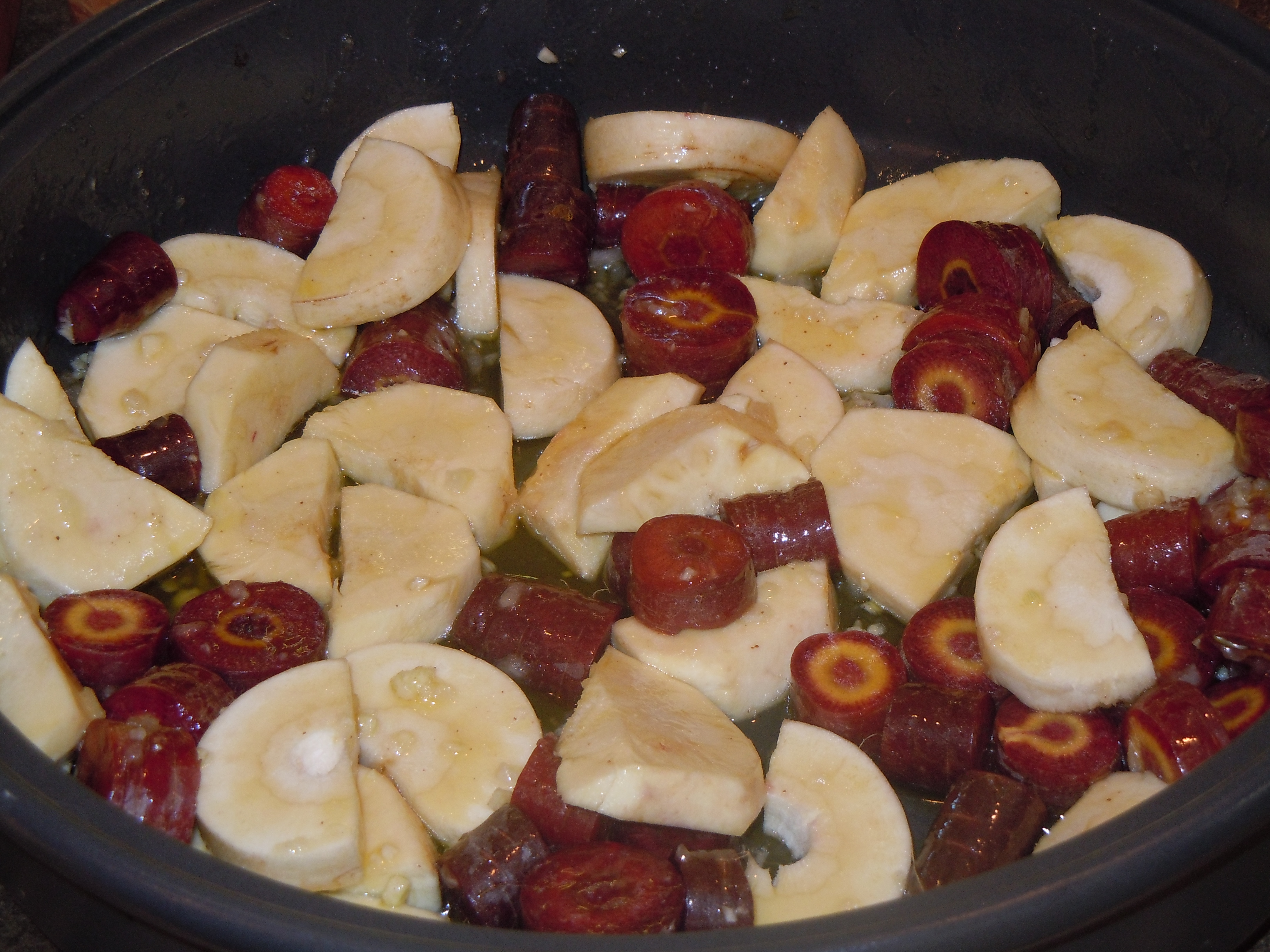
Clean two big parsnips and cut them into chunks no more than an inch on any side. Thoroughly scrub 3 large purple carrots and cut them into chunks somewhat smaller than the parsnips. Combine a quarter cup of good olive oil, a few tablespoons of white wine, half a teaspoon of salt or to taste, and two cloves of chopped garlic. Now this part is important: Put the carrots and the parsnips in two separate bowls and toss each with half the olive oil mixture. Don’t toss them together, because the carrots will “bleed” and stain the parsnips an unattractive magenta in places. If you are using regular orange carrots, separation doesn’t matter. Put the pieces in a cazuela big enough to hold them in one layer, or use a 9X13 heavy pan lined with parchment paper. Roast at 325. Don’t toss them around during roasting, because of the staining problem from the anthocyanins in purple carrots. The timing will vary a lot depending on the tender/tough ratio of the roots and on your personal taste. I like winter root vegetables roasted until they are soft and well caramelized, and it usually takes close to 2 hours at this low heat. If you like yours with some crunch you can stop cooking them sooner, but taste them before turning the oven off. These are not the tender roots of summer, they’re big meaty winter roots, and you may not like the amount of crunch they retain. If necessary, cook longer. Sprinkle a little bit of minced parsley over the top. If you want to be sure they’re done in time for dinner, cook them a little earlier in the day and leave them slightly underdone, then return to the oven for a final 20 minutes before dinner.

A big serving of these “white and black” roots on a red plate makes a great main course with a little piece of something meaty in the center. A few thighs of good pastured chicken seasoned with thyme, garlic, and olive oil can be roasted in the same oven for the last hour or so of cooking and will accent the roots nicely without overwhelming their flavors.
Kitchen Staples: Squash, and further notes on squash varieties


Since reading Carol Deppe’s book The Resilient Gardener, I’ve been thinking more about growing things that are staples rather than side dishes. This does not require that I change what I grow. I need to think in terms of putting my vegetables at the center of the plate rather than letting the “side dish” mentality sneak in. Winter squash is a filling, substantial staple and can easily be the centerpiece of a meal.
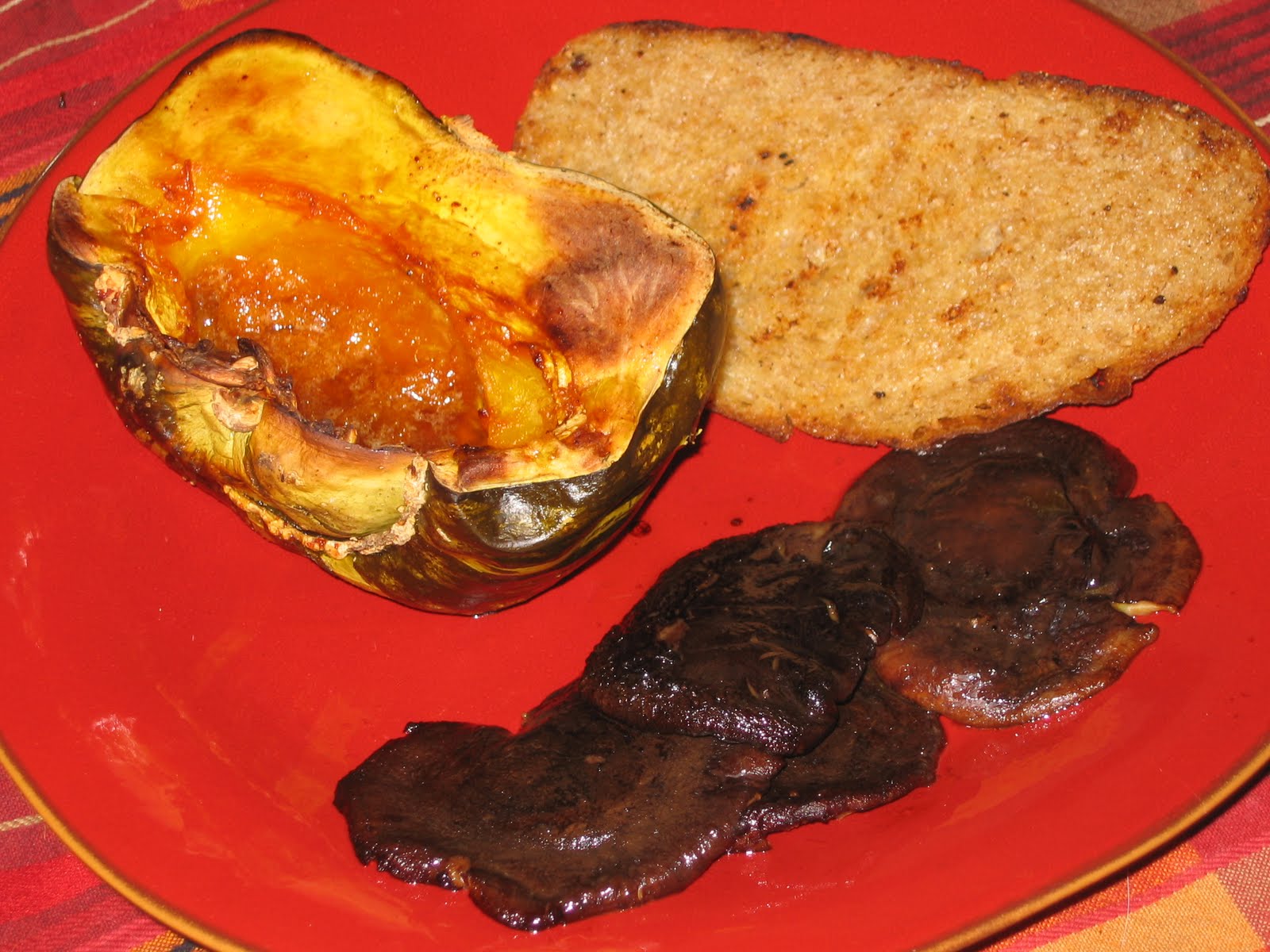
In my opinion, roasting is by far the best way to bring out the flavor of squash. It keeps wonderfully in the refrigerator for a few days once roasted, and can also be mashed, packed tightly into containers, and frozen for later use. Once properly roasted, it can be made into ravioli or lasagna fillings, form the basis of hearty soups, or just be reheated later to eat out of the shell, so I roast plenty at a time. If roasting smaller squash, I cook several, so that the oven heat is efficiently utilized, or I put them on the bottom shelf of the oven when roasting something else. I love to put maple syrup or agave nectar, a pat of butter, and a pinch of salt in the cavity if I will be eating the squash straight, but if I might use it for something else like lasagna or ravioli or one of the impromptu dishes below, I just rub the cut surfaces with olive oil and salt before roasting. In the picture above, a roasted Kukuza half dominates the plate, with a few grilled mushrooms brushed with oil and soy for a meaty touch and a slice of grilled bread with olive oil and garlic. THis is a great substantial meal to share with vegetarians and vegans, or with nearly anyone.

Here I cut a roasted squash half into thick slices, brushed lightly with soy sauce, chili oil, and roasted sesame oil, and broiled for a minute or two to accompany Asian flavors.

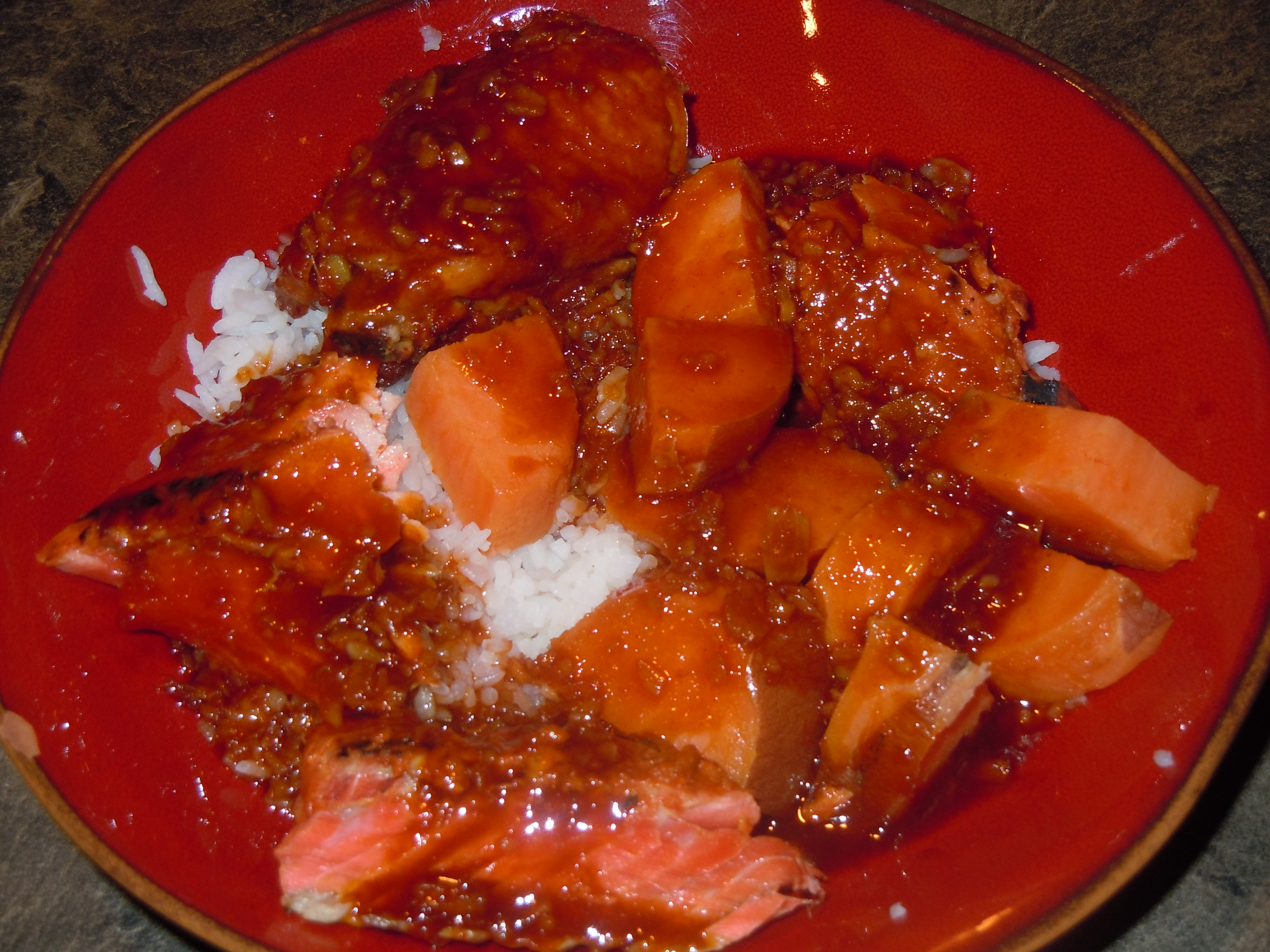
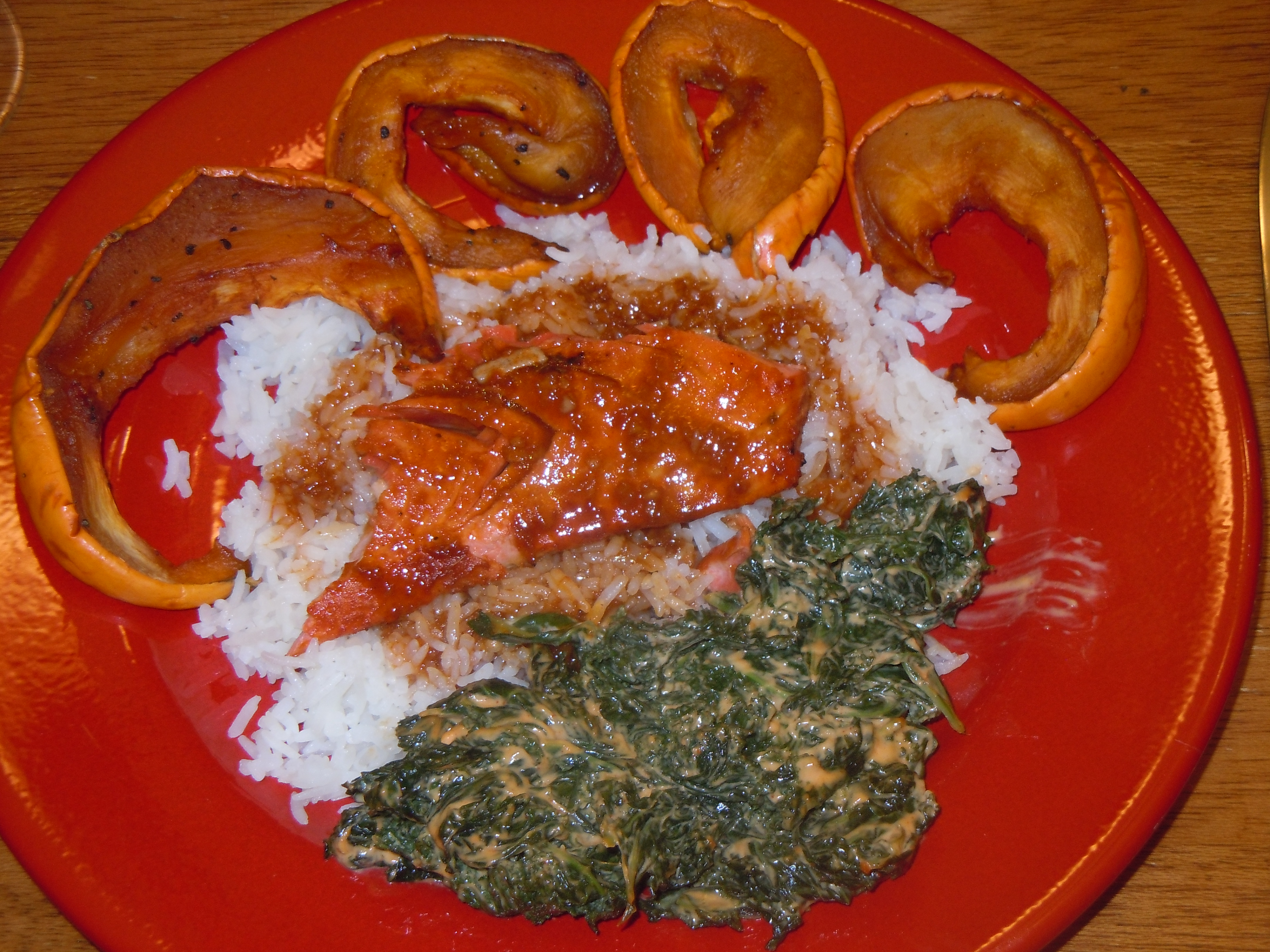
Here chunks of leftover roasted squash join a few chunks of leftover roasted salmon under a cheerfully colored Korean sauce. To make the sauce, chop up 2 cloves of garlic and a 1″ cube of peeled ginger. Heat a couple of tablespoons of oil in a small wok, and when the oil is hot throw in the chopped garlic and chile. As soon as the ginger fragrance comes up, about a minute, put in a tablespoon of gochujang and stir around madly for half a minute, then add half a cup of stock and 2-3 tablespoons of soy sauce. As soon as it comes to a boil, turn off the heat and add a teaspoon of dark sesame oil. Have ready a teaspoon of arrowroot dissolved in a tablespoon of water, and stir in. Let the sauce thicken briefly and serve over a bowl of rice topped with hot chunks of salmon and squash.
If you are going to think of squash as one of your winter staples, you need to find a squash that you can grow well and that you really enjoy eating. A few posts ago, I wrote about the immense harvest of squash that I grew this year because I planted only Cucurbita moschata varieties, which love hot weather and are resistant to squash borers. C. moschata types need a hot summer to do well, and we can certainly provide that here (they are less esteemed in cooler parts of the country). All squash need curing before you eat them in order to taste their best. Needs vary among varieties. In general, I let all squash ripen on the vine and don’t pick it until a frost is expected. Then I set it on shelves to cure. It will cure faster in warmer ambient temperatures but will hold longer in cool places, so I keep some in the house, and some in my cool but nonfreezing garage to eat later. I give the smaller squashes three weeks to cure, and the bigger ones 8 weeks before I sample the first specimen.
Even with the best treatment, squashes vary immensely in quality in flavor. My favorite C. moschata so far is a big turban-shaped beauty called Chiriman. It has moist but not watery flesh, no strings, and a lovely sweet-earthy flavor. The much smaller Kikuza is also delicious, and its small size may be preferable for some. Both are rather shy yielders, and Kikuza has rather thin flesh. Sucrine du berry yielded prolifically, and the flesh is very thick and is a dark and splendid orange-red, but the flavor is poor and the flesh is both stringy and watery, so most of the bounty is going to the chickens. I wrote to the seed company about my experience with it, and they sent back an excerpt from a gardening book explaining that winter squash needs to be vine-ripened and then cured for best flavor. Well, duh. Some squash just isn’t much good no matter how you raise it. If I ever get into hybridizing, though, I’m going to try some crosses of the prolific and bullet-proof Sucrine du berry with better-tasting C. moschatas. I still have splendid 20-lb specimens of Musque de Provence sitting around curing, but I won’t broach those until Christmas, so I’ll report on the flavor and texture after the holidays.
If you save your own seed, remember that squash of the same species interbreed wildly, so consult Ms. Deppe’s book or a good book on seed-saving to learn how to ensure squash that is true to type. It isn’t as easy as just “saving the best one for seed.”

Vegetable dinners: a roasted melange, and notes on gochujang


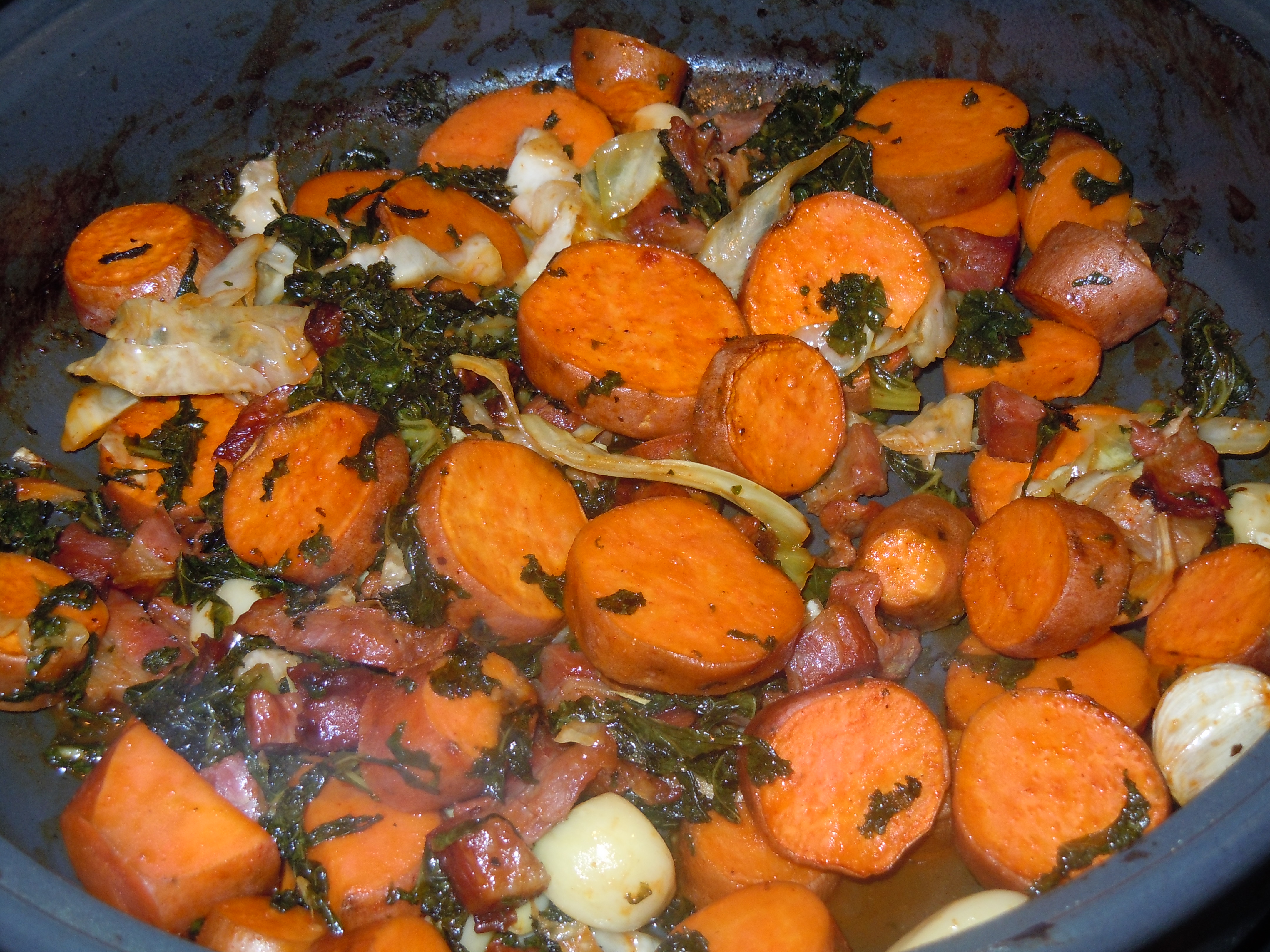
On frazzled days, one way to save time when making dinner is to put food in the oven and pretty much forget about it until it’s done. Many vegetables respond beautifully to this treatment, especially if flavored a little. I have a large clay Spanish cazuela about 14″ in diameter that I use for these impromptu roasts because I’m convinced that the clay improves the flavor, but you can use your standard 9X13 pan if you prefer. I am using a lot of sweet potatoes right now because I dug a lot of them recently, but I’ll include suggestions for substitutions. The idea is to use what you have and like.

You will need:
for the vegetables: 4 medium/large sweet potatoes cut in 1″ chunks (I scrub them well and leave the peel on), or a medium-sized winter squash peeled and cubed, or 6 large carrots scrubbed well and cut in 1/2″ chunks, or some combination of the above. I used sweet potatoes.
For the greens: 1 bunch of kale cleaned and cut in 1″ slices crosswise, or half a small green or red cabbage cut in thin slices, or 3/4 pound of sturdy leafy greens cleaned and cut in 1″ slices, to total about 3/4 pound. I used half Tuscan kale and half sliced green cabbage.
For the seasoning:
a handful of bacon, bacon ends, or pancetta, cut in little cubes. I used the tail end of a bacon slab.
3 large cloves garlic, chopped
3-4 tablespoons of olive oil
1 tablespoon of Korean gochujang paste (see below) or a teaspoon of Tabasco or other red chili sauce, or a teaspoon of red pepper flakes
about half a teaspoon of salt, or to taste
1/2 cup good stock or water

Preheat the oven to 375 degrees. Prepare the vegetables and toss them in the cazuela or pan. Mix the seasoning ingredients and pour over the vegetables, tossing with your hands to distribute. Try to end up with the chunky stuff mostly on top and the green stuff mostly on the bottom. Put the cazuela in the oven. Half an hour later turn the veggies with a spatula, and if the bottom seems dry and things are starting to stick, add a little more stock or water. Again, try to keep the greens mostly below the other stuff, where they won’t dry out. After an hour, check the vegetables for doneness. You don’t want them crisp for this dish; they need to be cooked through, a little soft, and well impregnated with the seasoning ingredients. When done, drizzle a tablespoon or so of your best olive oil over all, bring to the table in the cazuela, and eat with a crusty baguette or toasted whole-wheat bread, as you prefer. It couldn’t be easier or healthier.
You can leave out the bacon or pancetta and have a vegan/vegetarian meal. I don’t recommend it, because the pork has a wonderful alchemy with the sweet winter vegetables and the chili paste, and creates a whole much greater than the sum of its parts.

Now and then we find an ingredient that represents the Platonic ideal of its kind. For me, the Korean chili paste gochujang is the seventh heaven of the chile pepper. There is nothing quite like its deep, intense, fermented flavor, unctuous texture, and exquisite mahogany color, and it has a special affinity with pork and a thousand uses outside of traditional Korean cooking. These days the only gochujang that I will use is the one from Mother-in-law’s Kimchee, which does have some sugar in it but no high-fructose corn syrup and is properly fermented and deep and delicious. If it isn’t available in your area, you can order it online. I like the original one, called “concentrated” on the label.

I talk a lot about making dietary and lifestyle changes slowly and one at a time. This is a great time to start thinking about eating more green leafy vegetables. Salads are great, but cold weather is a perfect time to incorporate more cooked greens as main dishes, side dishes, or soups. If you garden, kale and cabbage will help get you through the winter. If you forage, dock, chicory, and dandelion greens are among the few wild foods available in winter in our area (plan to mix them with milder greens from the garden or store.) If you buy at the store, Tuscan kale is everywhere, and since there is no better leafy green, go for it. I do recommend sticking to organic greens wherever possible. If you always have garlic, olive oil, and a little good bacon or pancetta in the house you are always ready to make a lovely dish of saute’ed greens, and there are lots of variations. Check out my “greens” category on this blog for more recipes. I know I have said this before, but I’ll keep saying it: don’t undercook them. The thicker tougher greens like curly kale are acutely unpleasant to eat when undercooked and tough, so taste before sending to the table, and if chewing requires a ruminant level of effort, cook five minutes longer and taste again. Mark Bittman is now galaxy-famous as the author of many authoritative cookbooks, but few people are aware that his first effort was a little gem called “Leafy Greens.” You can still find it second-hand, and it’s worth tracking down. Read it and use it, and your family’s health will benefit.

Vegetable dinners: add an egg! and notes on feeding chickens


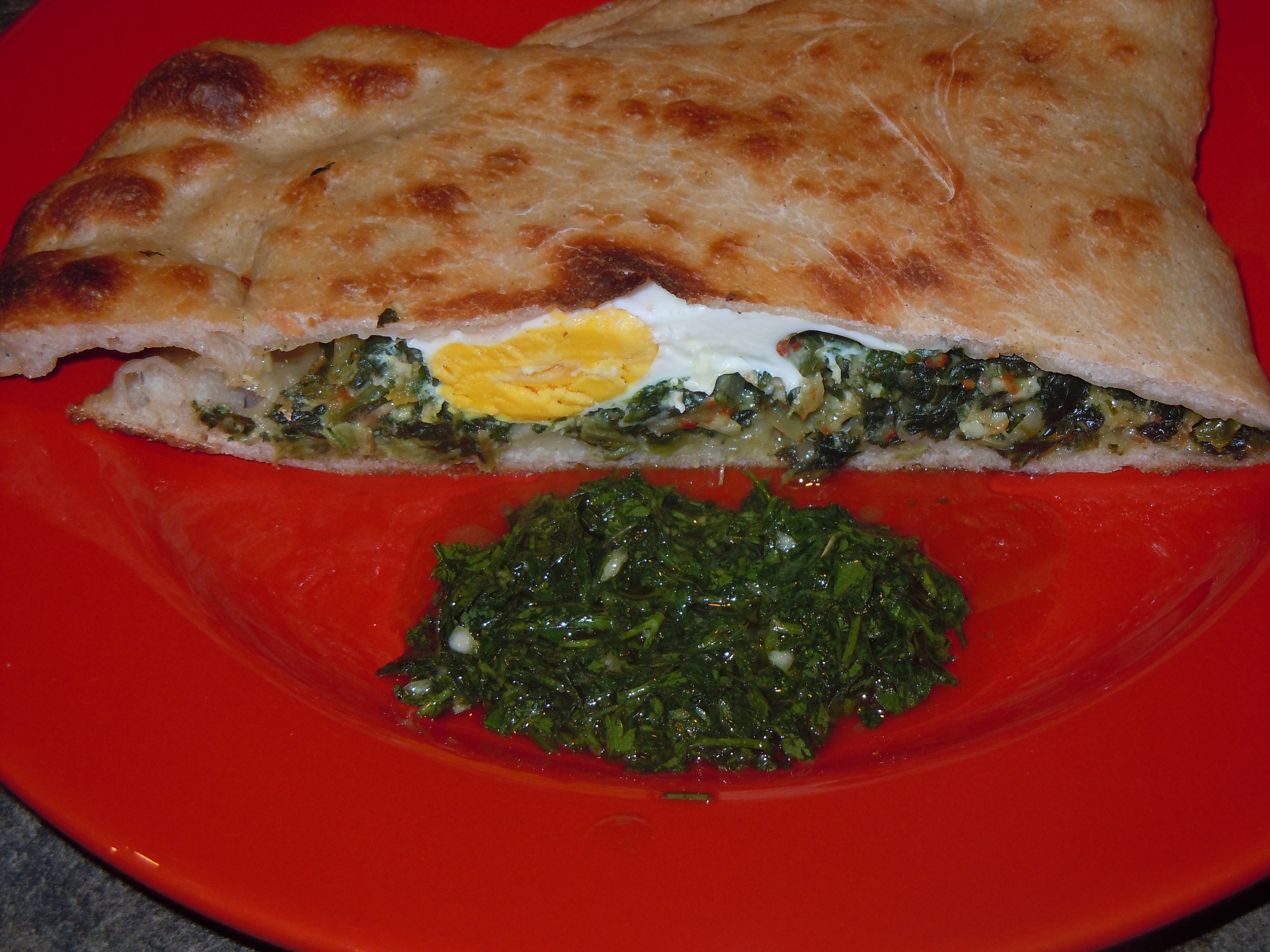
Like the British cookbook writer Nigella Lawson, I am both greedy and lazy, so I’m full of timesaving tricks for making real food in a hurry. Now if I also looked like her, that would be nice, but two out of three isn’t bad. One of my favorite time-saving tricks is to make a small batch of yeast dough and stick it in the refrigerator with no clear idea what I’ll use it for. Most recently, I used it to make a variation on a hortapita, filled with mixed greens. Since my chickens have started to lay, I decided to incorporate eggs. This isn’t really a recipe. This is the sort of thing you throw together by instinct on days when you need the comfort of the kitchen but if you think too much more, your brain will break.

If you don’t happen to keep dough hanging around, you can use ready-made pizza dough from the Co-op, but making your own is a cinch. My basic recipe is 2 cups water, 1 teaspoon sugar, 1/2 teaspoon dry yeast, and 2 teaspoons salt. Mix together, knead on a floured surface for five minutes, form into a ball, pop it into an oiled bowl and cover with plastic wrap, and set in the refrigerator for 1-2 days. On the second or third day, take the bowl out before you leave for work and leave it at room temp for the day. When you come home, it will be ready to use for a homemade pizza or hortapita.
Besides the dough, you will need:
about a pound of mixed greens OR a pound of frozen organic spinach and a handful or two of stronger-flavored greens or herbs to give flavor.
an onion and a couple of cloves of garlic
a packed cup of crumbled feta or shredded parmesan or some flavorful but not stinky cheese. Idiazabal, mild cheddar, or mild gouda would all be reasonable. I used Idiazabal because I usually have some around.
3-4 eggs
some olive oil

Preheat the oven to 425.
For the filling, I took a major shortcut and started with a pound of frozen organic spinach. Then I picked some very mature arugula from the yard to give it that wild strong flavor, but since 6 or 7 big leaves will do the trick, the cleaning time was about 5 minutes for the greens. If I didn’t have arugula in my yard, I’d just chop up a small bunch of parsley or the tops of a few green onions for a different but equally “green” flavor. Chop and saute an onion in olive oil, remembering to stir frequently. Between stirs, shred the arugula or whatever you have into chiffonade and put it in a nonmetal mixing bowl with the frozen spinach. Microwave the mixture on high for two minutes. There may still be some frozen chunks of spinach. Ignore them. Squeeze the mixture over the sink, handful by handful, to get out as much moisture as you can, and return the dry greens to the bowl. At this point the onion should be cooked. Add a couple of cloves of chopped garlic, saute until the garlic is cooked, and add to the greens in the bowl. Add the cheese, toss all together with your hands, and taste. It may need some salt, will surely need some freshly ground pepper, and may cry out for a little thyme (to me, most foods cry out for a little thyme, and so there should always be some in a pot somewhere or in the refrigerator.)
On a large baking sheet, smear around some olive oil and dump the dough on top. Pat it out with your hands, using vigorous stroking motions to spread it out into a big oval without tearing it. When it is about 1/4 inch thick and nearly as large as the pan, pile the greens mixture on half of it and make 3 or 4 depressions in the greens. Crack an egg into each depression, salt the eggs lightly, and fold the other half of the dough over the top and pinch the edges together. Smear a little more olive oil over the surface and stick in the hot oven until done, somewhere between 20 and 30 minutes. Eat with the knowledge that a tough day didn’t get you down. A glass of good strong red wine will help give you the wherewithal to face tomorrow. If you have just a little more energy and half a bunch of parsley, pound a clove of garlic, the parsley chopped, and the juice of half a lemon in your faithful big mortar and pestle. When somewhat pulverized, add enough of your best olive oil to make a chunky puree and salt to taste. I love this simple sauce/dressing/relish beside almost any vegetable or egg dish, but it’s especially good for bringing a makeshift hortapita to life. If you don’t have a big mortar and pestle yet, a food processor is okay.

My eggs come out of my back yard now, and I give a fair amount of thought to feeding my chickens. If you want your eggs to be highly nutritious, you have to give the chickens the nutrients to make good eggs. For maximum security from predators my coop is fixed and nonmobile, so I cut grass and clover from the yard daily to supplement the laying mash. All the vegetable trimmings from garden and kitchen prep go to them, too. Any pumpkin or squash “innards” go to them so that they can eat the seeds. The chickens get oystershell for calcium, and they get any nutritious table scraps that would otherwise be wasted. For example, they will happily devour leftover salad, for which there is no other use, and rice or stale bread or bulgur are right up their alley. If I have leftover oatmeal or yogurt, they wolf it down. Now that we’ve had several frosts there aren’t many green things left in the yard, so I give the chickens some flaxseed every day to keep the omega-3 content of their eggs up (this is how the commercial high-omega 3 eggs are produced.) Flaxseed is expensive, so rather than give it to them dry and permit it to be scratched around and wasted, I mix it into yogurt or chopped vegetable scraps to make a slurry that they can eat out of a small dish.
I also feed their own eggshells back to them for calcium, but I never just throw the shells into the coop, because this trains them to eat their own eggs (yes, healthy chickens with lots of room and food will eat their own eggs if they learn how, and once a flock has learned to eat eggs there’s no good way to stop them.) I set the shells on a plate and microwave them for one minute to dry them thoroughly, then let them cool and set them aside in a bag. When I’ve accumulated a dozen or so, I crumble them roughly by hand and then put them in the blender and grind them to a coarse powder. The powder is added to yogurt or leftover oatmeal and stirred in well. The chickens gobble it up and it helps them make strong eggshells.