Archive for May, 2015

Onion Flowers

imageimage


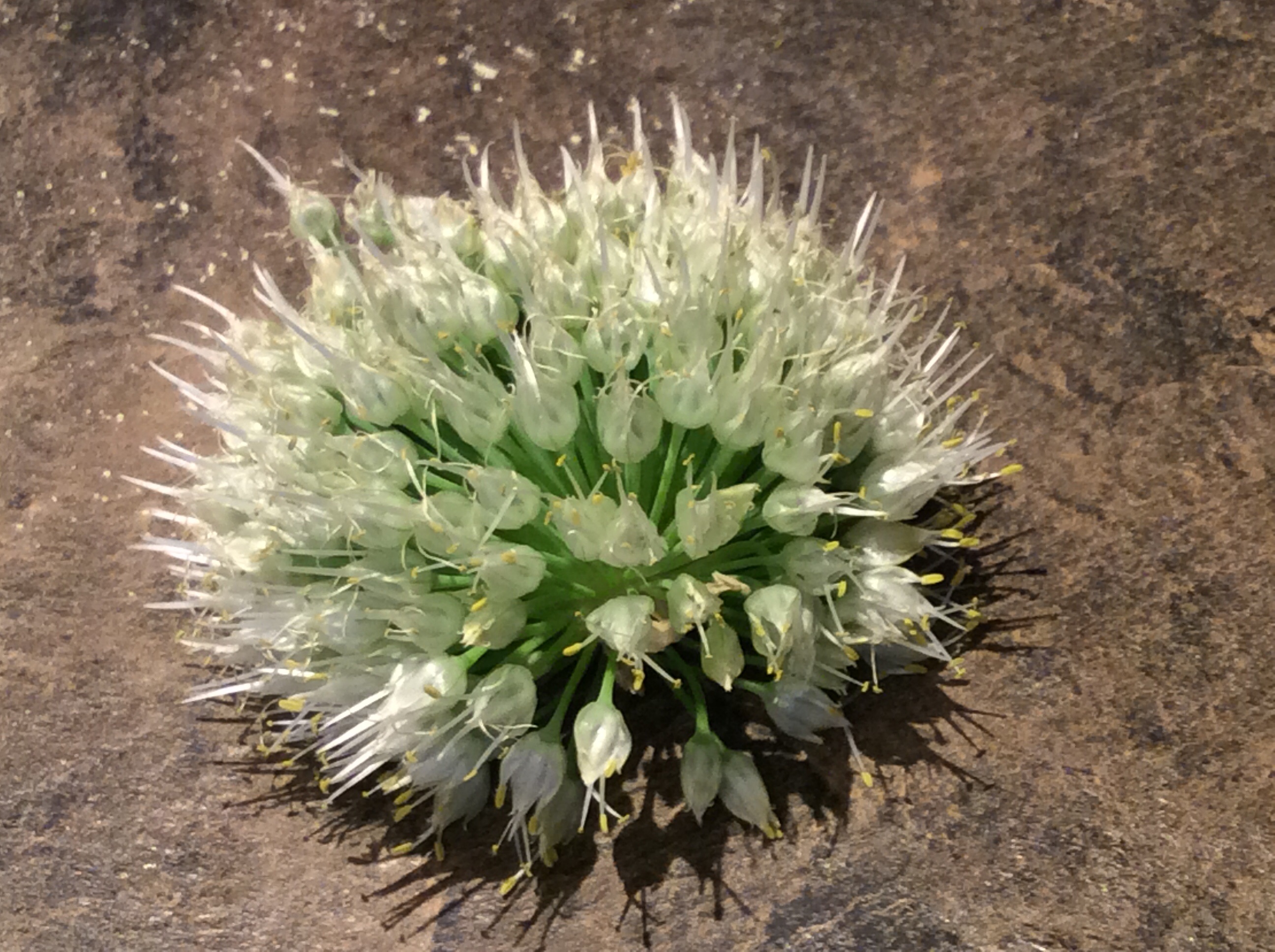
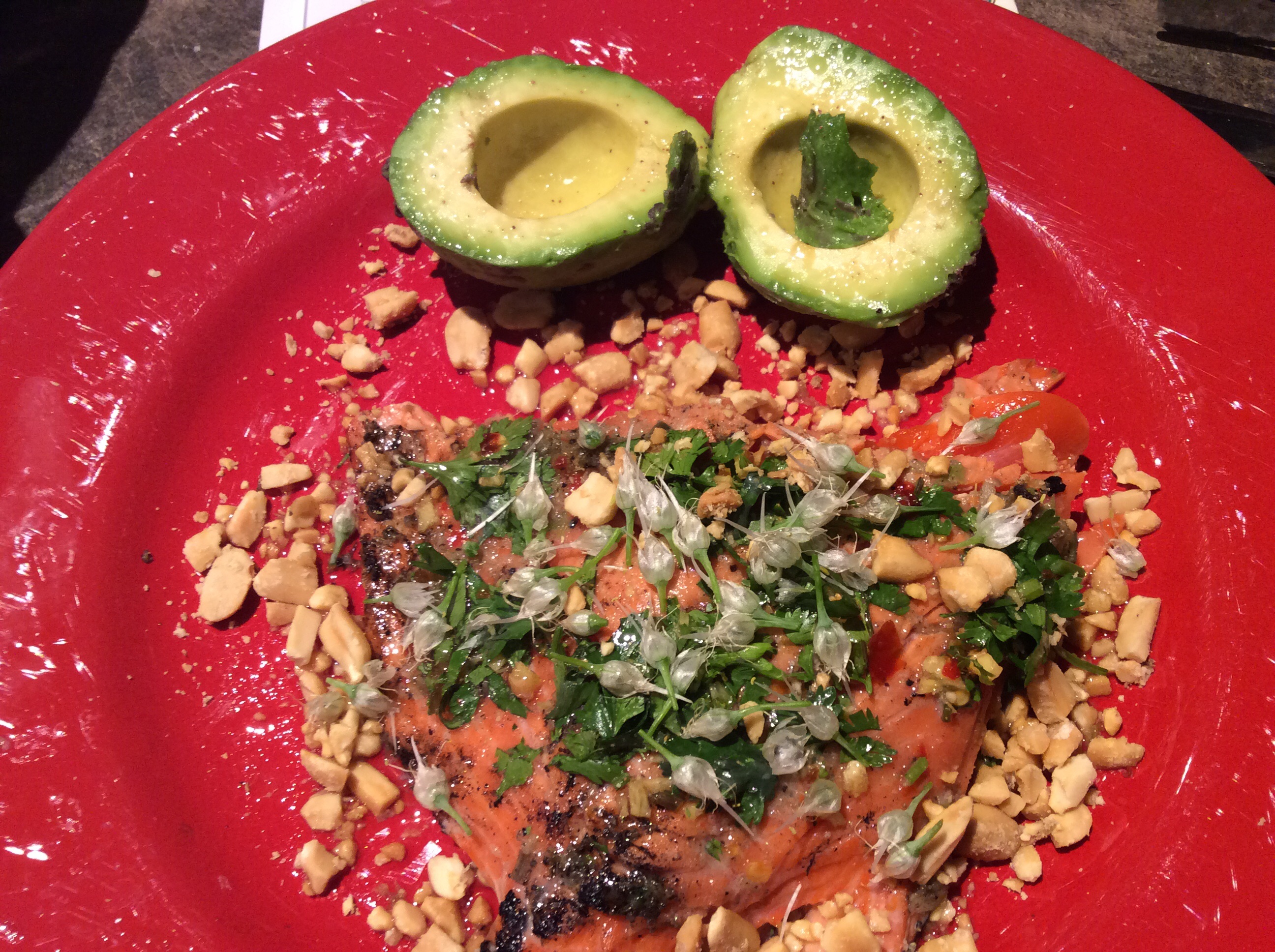
I have written about onions and onion scapes, but what happens when a scape gets past the busy gardener and blooms? Well, then you have onion flowers. Harvested shortly after they open and clipped off the bloomscape with kitchen shears, they taste of onions but light, a bit floral, delicate. They are delicious in salads, and I love them showered over any of the delicious herb-laden southeast Asian dishes. Here, you can see them garnishing Thai-ish grilled salmon. Try them on burgers or steaks, sprinkled lavishly over a dollop of good butter melting on the hot meat. They are a great addition to grilled chicken. Just don’t let them bloom in vain!

This makes onions a true nose-to-tail vegetable, with every part both edible and desirable.


Semi-permaculture

imageimage

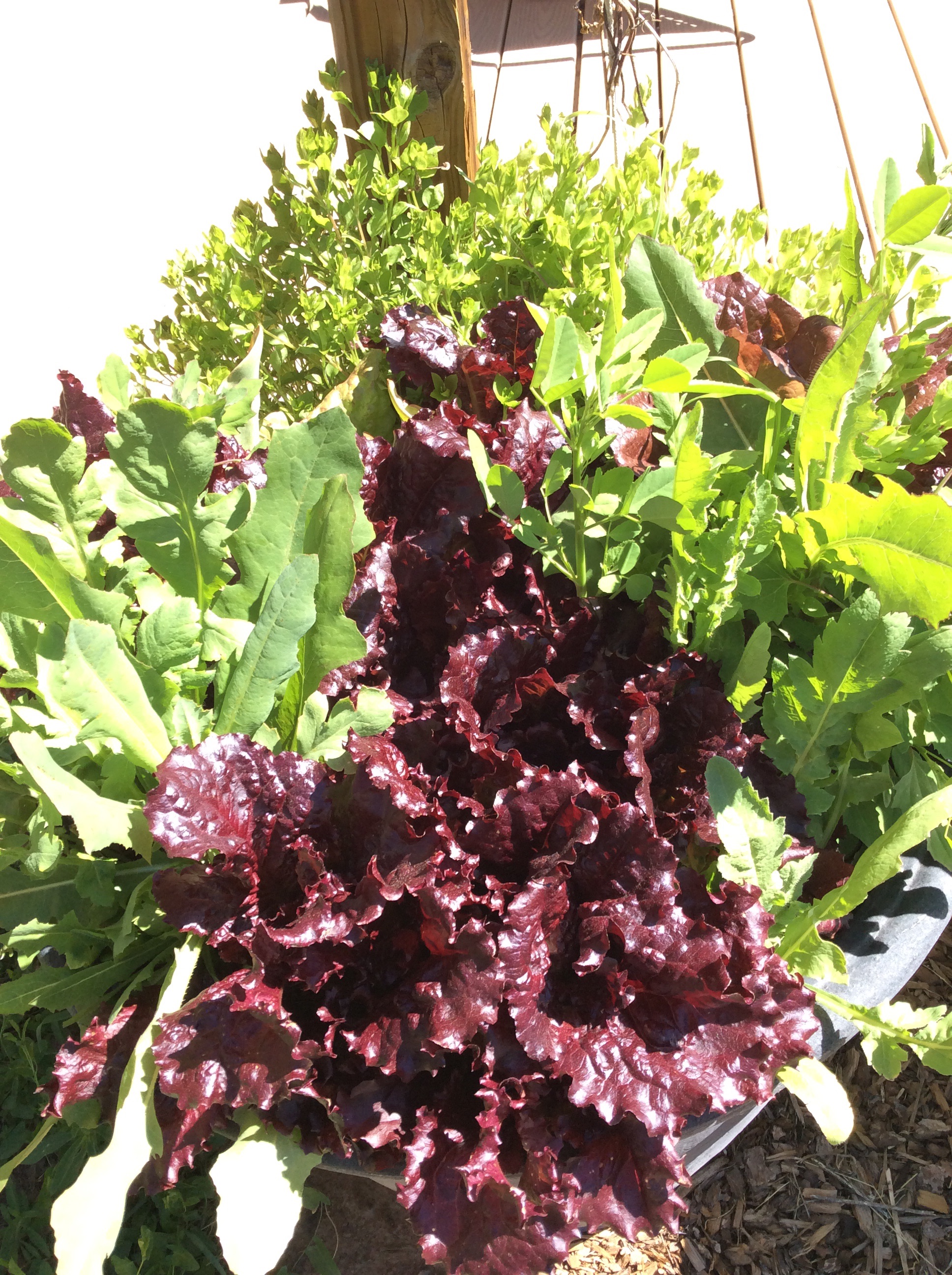
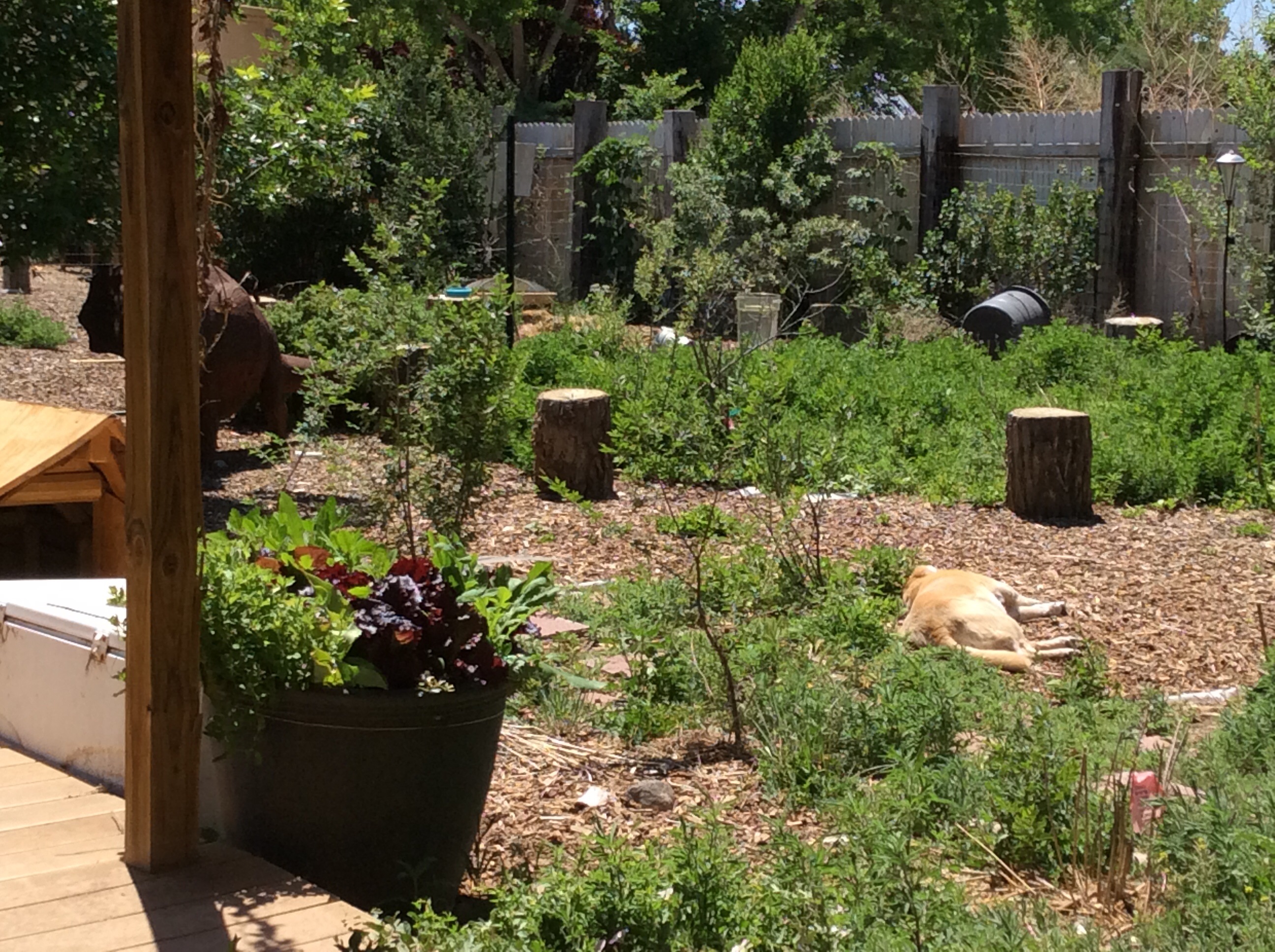
Every now and then I encounter some committed permaculturist who earnestly wishes to educate me about planning guilds (functional plant groups) in my garden. I just don’t think this way. It seems to me that, if you love to grow food, have a fairly high chaos tolerance, and live somewhere  long enough, you will naturally and accidentally discover what thrives in groups in your area, as well as what you really like to eat. Take the large pot above, which has been next to my back patio for four years. It is a microcosm, or micro-cosmos, of my interests over the time since it was placed. In it you can spot the gorgeous leaf lettuce Merlot that I’m growing this year, chickweed that I planted three years ago and which is self-seeding nicely,  moringa that I started experimenting with last year (which, incidentally, wintered over in a pot that isn’t watered in the winter and survived a very cold winter,) Shirley poppies from four years ago when this pot was placed, and wild lettuce which seeds itself all over at my house and which I tolerate because I like it in cooked greens. My planned combinations haven’t come out nearly so well. Everything in this pot is edible; yes, even Shirley poppy leaves are fine in cooked greens. But it all happened through planting things, not weeding too assiduously, and seeing what happened. If you have a poor memory and are prone to planting things in spots where you already planted something else and then forgot about it, some further felicitous combinations will occur.

A linden planted for its edible leaves has a bird-sown wax current bush growing in its shade, bearing more heavily than its siblings in full sun. Bladder campion seeds itself into the shady north corner under the linden. Siberian elms, self-sown all over, can be coppiced for free goat feed. A bird-sown mulberry nearby can be coppiced for tender edible green shoots to use in cooked greens. Stinging nettles, struggling in the baking desert sun, root their way into the shade of the elm and mulberry coppices and begin to flourish. Stems of oyster mushrooms, dug into garden beds in the fall, produce a few nice oyster mushrooms in the shade of lettuce the following year. A single lambs-quarters is allowed to seed, and late-spring crops of mild and nutritious greens show up all around your intentional plantings for years.  A Russian olive that grows smack in the middle of a garden bed despite years of cutting it back and cursing it, can be pruned into a support for climbing snow peas. A really poor clump of garlic at the base of a tree, left by the last owner, turns out to be indestructible through baking summers and perfect for green garlic. Scorzonera and wolfberries make some good food out of baking unimproved spots where you can’t get anything else to grow. A local non-edible legume, the desert bird-of-paradise, springs up and offers light shade to the wolfberry, giving it a new lease on life and more tender leaves that you can toss into greens mixtures.  None of this is especially tidy, and the straight-row sort of gardener would never tolerate it. But for those of us who love a bit of natural mess and take our vegetables and our epiphanies where we can find them, it works.


Salmon in Springtime

image

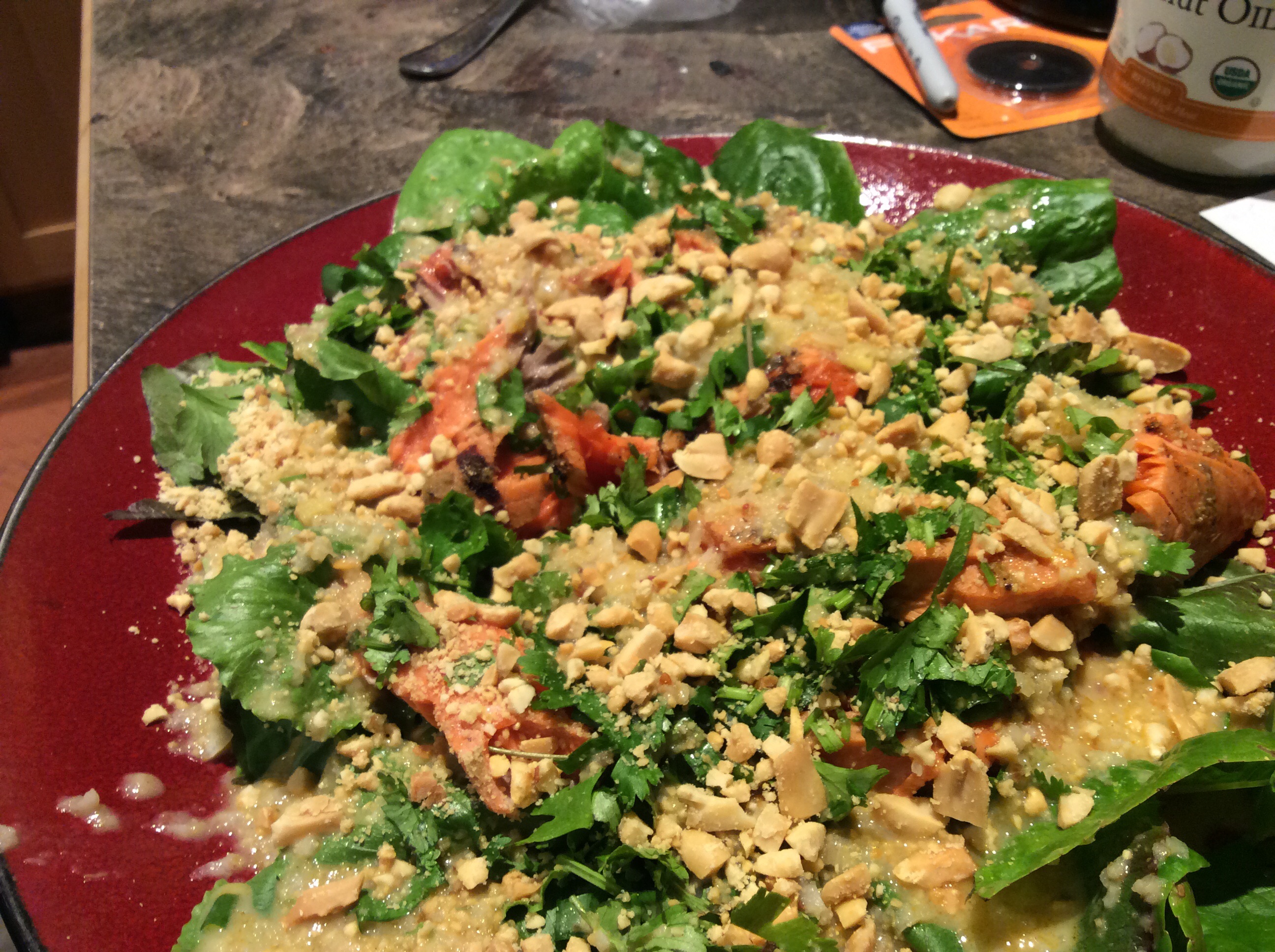
Here in central New Mexico we are enjoying a cool and unusually wet spring, and the romaine lettuce is still in great shape. Our local Fishhuggers are back at the markets with lovely Alaskan sockeye salmon caught by Kenny, and there is no healthier meal. For some reason I like my warm-weather lunches to lean Southeast Asian, and this one is a bit Thai-ish.
I used romaine, green onions, and cilantro from the garden, a fillet of sockeye salmon, crushed peanuts, and the vaguely Thai dressing below, which I keep jars of in the refrigerator in warm weather. Put generous heaps of sliced romaine on plates, rub the fillet with salt, grill quickly ( on a hot Green Egg grill, about 2 1/2 minutes each side will do it,) let cool a bit while you chop the cilantro and green onions ( green part only,)break up the fillet and remove all skin and put chunks of warm salmon on the lettuce, scatter on a handful of chopped cilantro and green onions, dress generously, and sprinkle crushed peanuts over the top. Delicious and very quick as well as insanely healthy.

Sort-of-Thai dressing:
Large chunk of ginger, about 1″ by 3″, peeled and sliced
7-10 large cloves of garlic
1/4 cup coconut fat
1 tablespoon green curry paste
2 tablespoons fish sauce
1 cup water
1 can full-fat coconut milk
Sriracha sauce to taste
Artificial sweetener ( I use liquid stevia,) or sugar, and more fish sauce to taste

Finely chop the ginger and garlic, heat the coconut fat in a saucepan, and stir-fry the garlic and ginger until cooked and fragrant but not browned. Add the green curry paste, stir-fry about another minute, add the fish sauce and water and bring to a boil, add the coconut milk and cook just until it’s all melted and creamy, then remove from heat. Let it cool to lukewarm, taste, and add more fish sauce if indicated. Add some sriracha if you like it hot (I love hot food and use about a tablespoon,) and then add sweetener, if you are ketogenic or low-carb, or sugar if that’s still in your kitchen, slowly, tasting frequently. I like mine on the sweet side, to balance the heat. Let cool all the way and use or keep in the refrigerator for later use.
This makes a perfect lunch to eat outside.
image

Improvisational Cooking: Greens on the Table

imageimage
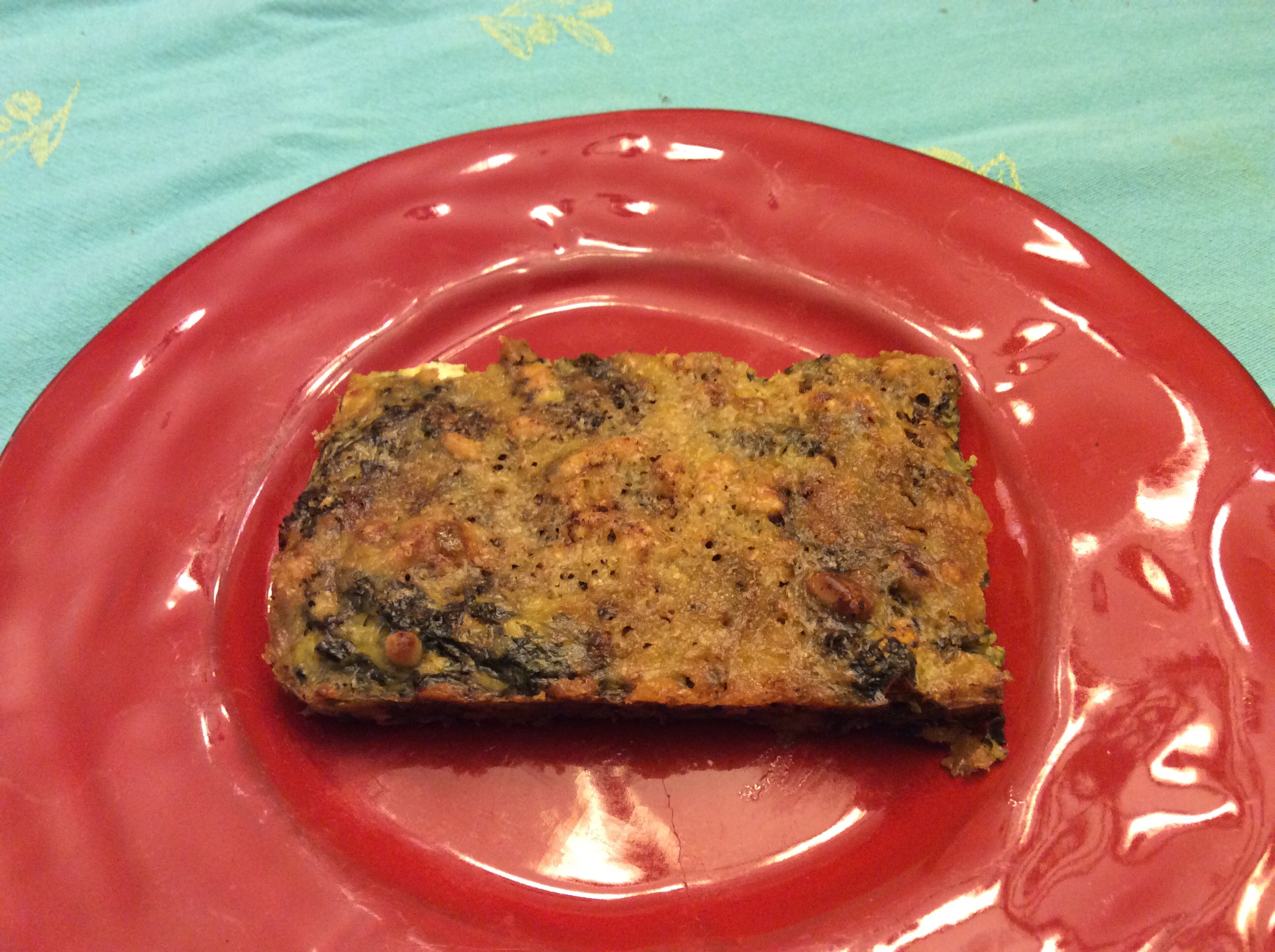
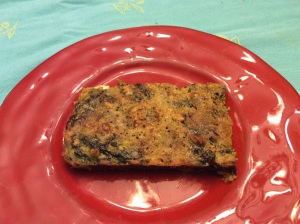
I am always yapping on about eating more leafy greens, and periodically I like to write about how I put leafy greens on my own table. Here is a low-carb recipe that even greens-phobes tend to like, and leftovers make wonderful lunches and snacks. It is improvisational in nature and you can substitute at will: this is a skeleton recipe and you can flesh it out any way you like.

The basic ingredients are greens, alliums, flavoring leaves, oil, cream, eggs, nuts, seasonings, and cheese. The greens, alliums, and flavoring leaves can be varied endlessly, except that the bulk of the greens should be relatively mild.

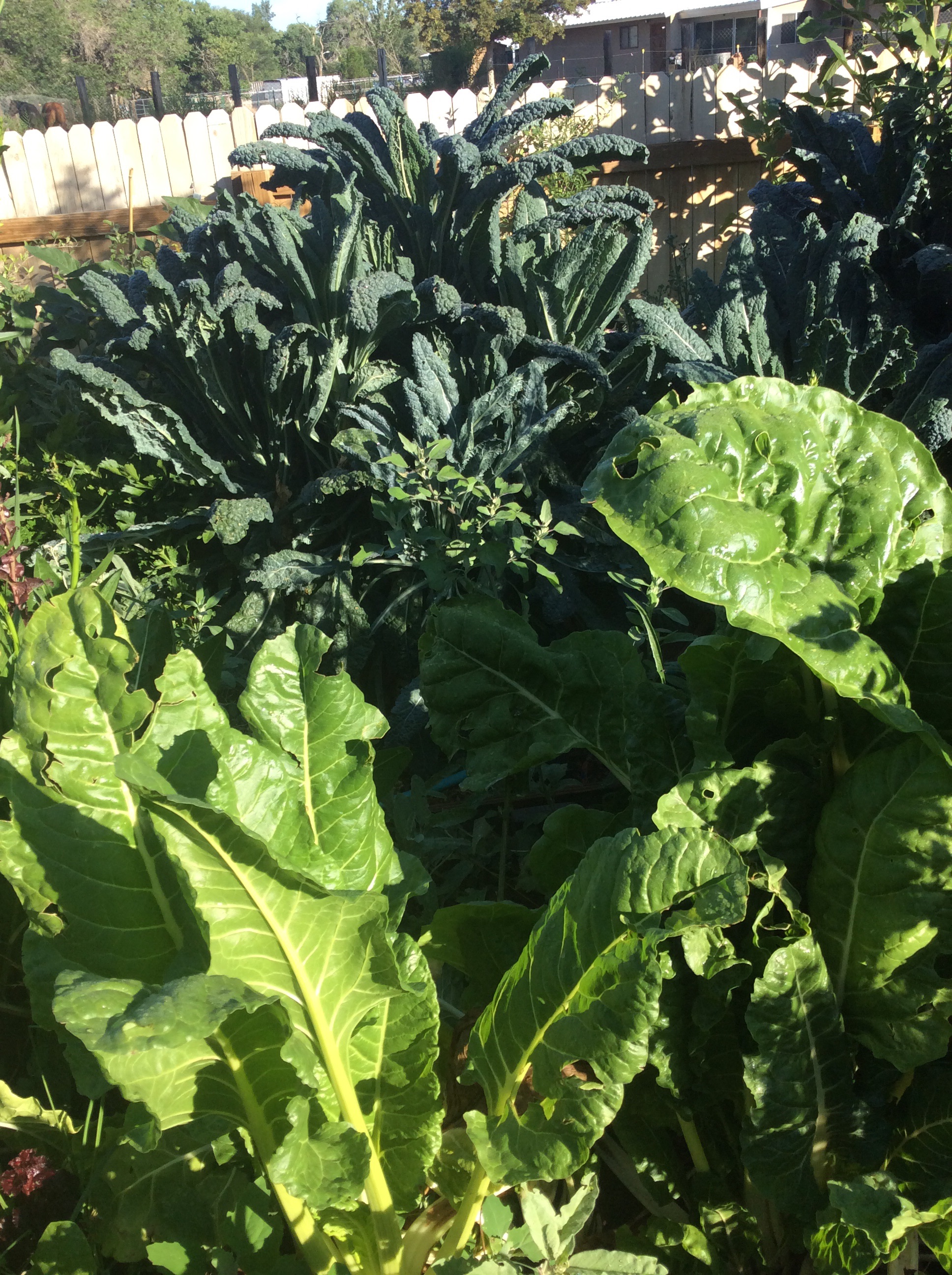
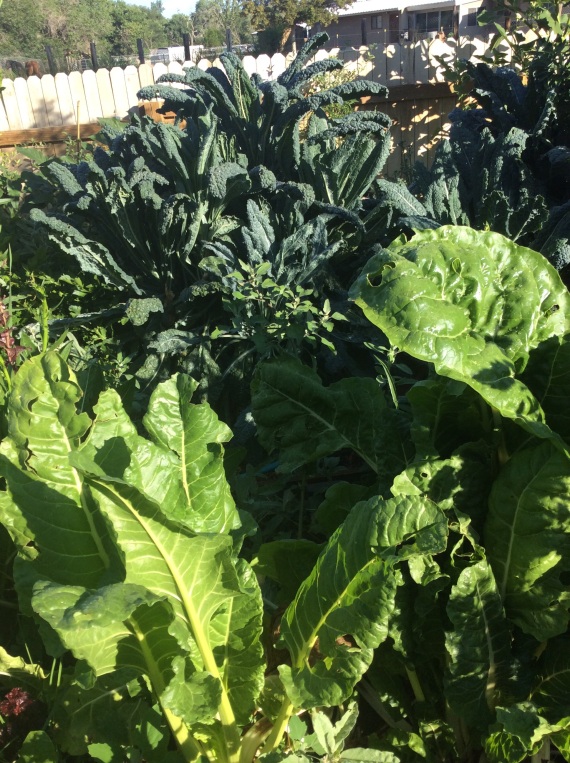
First, catch your greens. I carry a white plastic food-grade 3 gallon bucket out into the garden and pick it full, with the greens loosely thrown in and not packed down. Today I picked mostly lambs-quarters leaves, with some late spinach and early chard. If I was working from the farmer’s market or grocery store, I would choose a very large bunch of chard and Tuscan kale, and would tear out the large central midribs. Wash the greens twice. Grab them by handfuls and, on a BIG cutting board, chop them coarsely.

Second, decide on your alliums. Today I picked two big green onions and a couple of very big stalks of green garlic. If you don’t have a garden, a large onion and three cloves of garlic would work. You could use two cloves of garlic and two bundles of onion scapes from the farmer’s market.  Shallots are good in the winter. Don’t use garlic scapes in this recipe, because the texture doesn’t work.  Chop your alliums finely.

Third, consider your flavoring leaves. Think in terms of adding herbal, sharp, aromatic, and sour flavors. Today I picked several large young wine grape leaves for the sharp-sour note, a few leaves of lovage and a handful of parsley for green-herbal tones, and a few sprigs each of thyme and fennel for aromatic notes. Possibilities are endless. If working from the grocery store shelves, I would often choose a small bunch of parsley and some tarragon and thyme. Chop your flavoring leaves finely.

For the oil, I use top-notch extra virgin olive oil.

For the cream, I chose a can of coconut milk because I had one on hand, but heavy cream would do just as well, and if you insist on almond or cashew milk you can use that. You need a cup or a little more of your cream of choice.

For eggs, I use three whole eggs and nine egg yolks. Do be sure to get the best pastured eggs that you can get.

For nuts, I always use about half a cup of pine nuts. If you choose some other nut, chop them coarsely.

For seasonings, I used about a teaspoon each of red pepper and Urfa pepper flakes. I seldom vary this, just because I love this combination with greens. You may prefer freshly grated black pepper.

For the cheese, I nearly always use 6 ounces of finely grated Parmesan and eight ounces of the wonderful Mt. Vikos feta, crumbled.

Having made your choices and prepared your ingredients, preheat the oven to 375 and generously grease a pan about 10 by 14 with olive oil. Sprinkle the bottom of the pan with some of the Parmesan. Beat the eggs and egg yolks together and salt them a bit.

Heat some olive oil, about a quarter cup, in your largest skillet and sauté the alliums until they are softening. Add the coarsely chopped greens and salt rather generously, and cook turning frequently and carefully as the greens shrink. Cook them 15 minutes or longer, until they taste good when you eat a bite, and then add the flavoring leaves and sauté about two more minutes. Now add the cream. Boil a minute and take them off the heat and let cool 10-15 minutes.

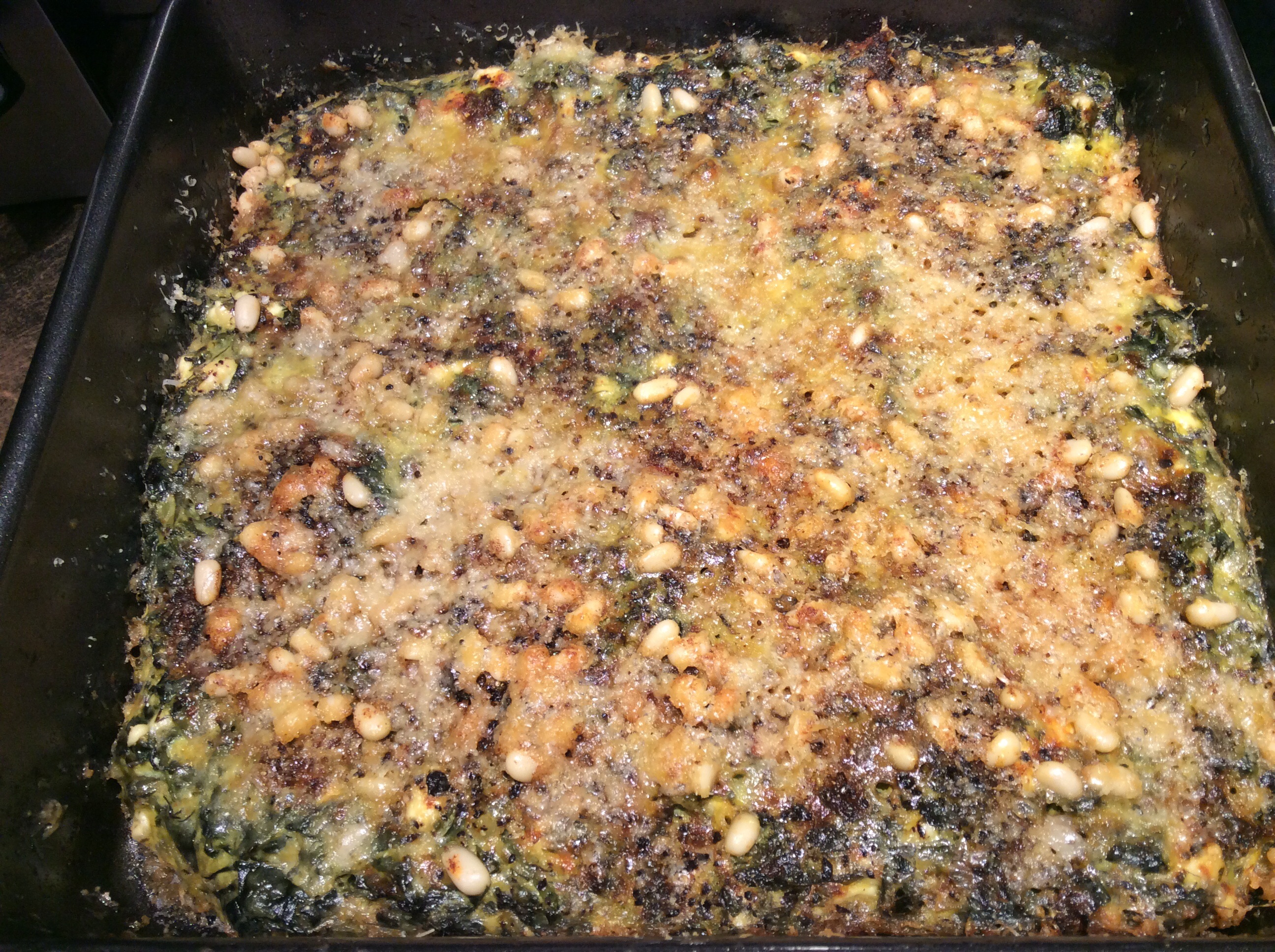
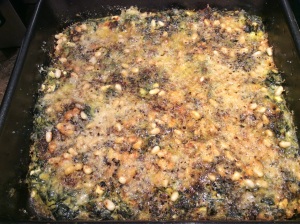
When the greens are just cool enough to handle, stir in the crumbled feta and then the beaten eggs and yolks. Spoon the mixture into the greased cheesed pan, smooth out a bit with a wooden spoon, and sprinkle with the red pepper and Urfa pepper flakes. Then sprinkle on the pine nuts, or whatever nuts you chose.  Top with the rest of the Parmesan (I like to drizzle on a bit more olive oil, too) and bake at 375 until the mixture is firm and a knife tip comes out clean, about 18-20 minutes for me. then, if you like, run under the broiler until the top crisps a bit. Be careful not to burn the nuts. Let it cool a little and serve in generous squares, jam-packed with nutrition. Smaller squares could be used as a finger food.
image