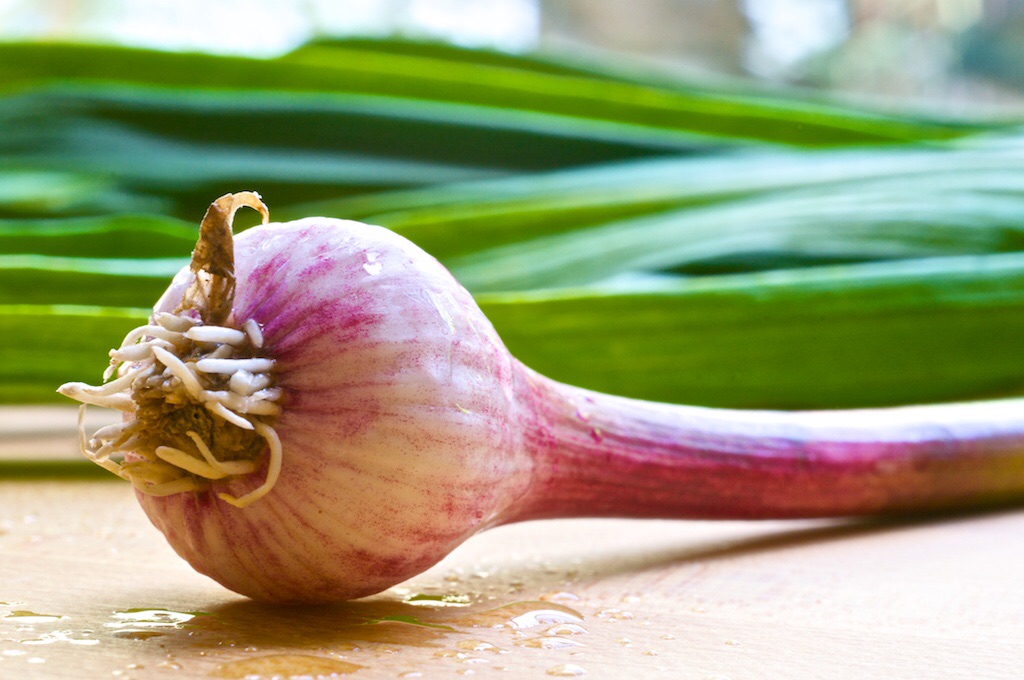
Garlic went through a period of being a fad health supplement for its allicin content. Allicin is an antioxidant to which miracles were ascribed at the time. Now that the fad is long over, maybe we can return to the subject in a more measured way, and eat some delicious food while we’re at it.
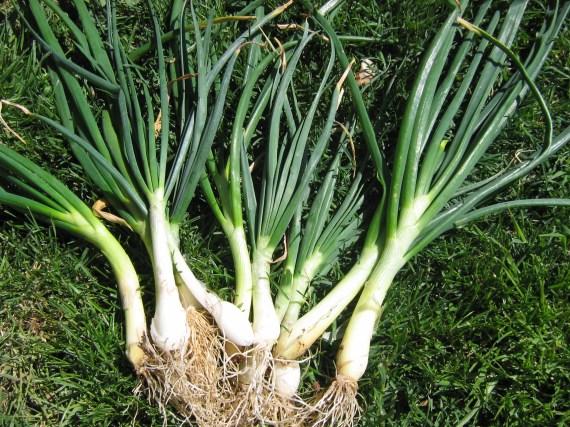
There is relatively little allicin in mature culinary garlic, since it is found mostly in the skin. But there’s a way to eat a lot of it and enjoy it: eat green garlic, which is also a culinary delight. Garlic cloves are planted in early fall, and the greens shoot up in early spring. They vary in size according to variety. They are edible at any stage, from the tiny ramp-like beginning to nearly-mature but still soft-skinned bulbs as shown above. When the stem begins to thin and wither and the leaves look distinctly un-fresh, it is maturing and should be used as bulb garlic rather than green garlic. And here’s how to get your antioxidants in full: in the green garlic stages the whole plant is edible and tasty, and the leaves, shoot, and tender skin contain most of the allicin (reference below). The leaves, stem, and skin( after the outermost layer is peeled off) all go into your sauté pan. Cut the root end off, trim the leaf tips, wash well, slice very thinly the whole length of the nascent bulb, shaft, and leaves, chop finely, and sauté in butter or olive oil with a good punch of salt until tender. Keep the heat medium to medium-low and plan to spend 15 minutes or so on the process, lowering heat as needed. It is done when it tastes rich, garlicky, mellow, and a little sweet. Do note that slicing it very thinly crosswise in the beginning is key to the shoot and leaves being pleasant to eat, since they contain strong lengthwise fiber. They can be used as the basis of any dish that includes garlic, unless the green color would be a problem, in which case just use the bulb and tender inner skin. I also like the whole sautéed plant as a vegetable side dish when it comes from the milder varieties of garlic. If I am going to eat it by itself, I slice thinly crosswise but don’t chop the slices up, so there is some textural interest in the finished dish. Also, make sure to salt to taste during cooking, not when finished, so that the salt can penetrate. This is really good next to a lovely steak.

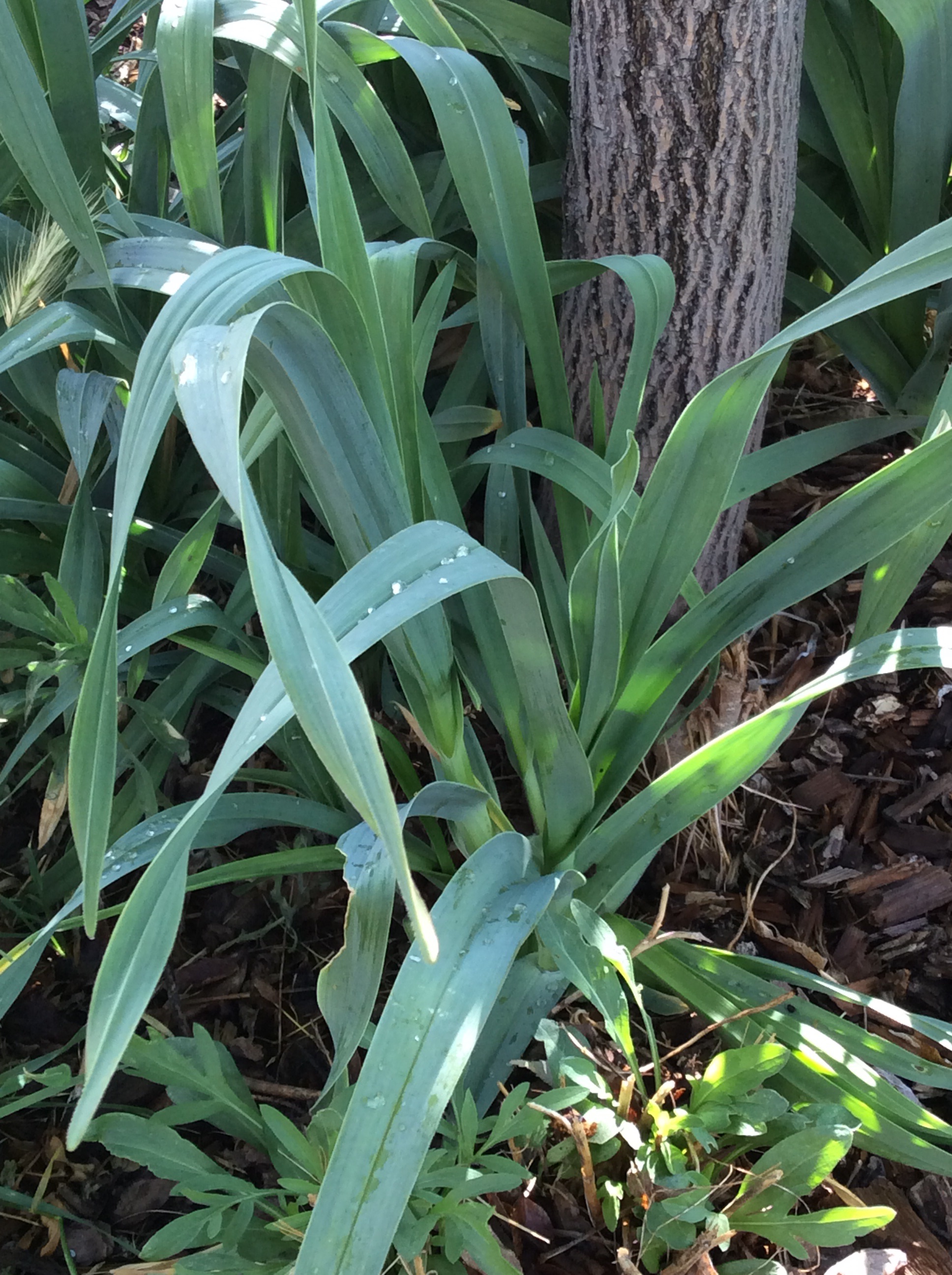
Don’t forget that you can tuck a useful amount of green garlic into flowerbeds and at the bases of trees. Just don’t confuse it with daffodil foliage or other poisonous plants with similar long narrow leaves. If in any doubt, tear a leaf and sniff. Garlic leaves smell like garlic!
I have heard that the leaves can also be dried, powdered, and used as a seasoning, but I’ve never tried it and don’t vouch for it. I go for fresh stuff.
Here’s your reference on the allicin content:
“Department of Pharmacology, School of Medicine, Ardabil University of Medical Sciences, Iran
Food Chemistry (Impact Factor: 3.26). 05/2010; 120(1):179-183. DOI: 10.1016/j.foodchem.2009.10.004
ABSTRACT The presence of allicin in green garlic plant extracts was investigated. Allicin in aqueous extracts from green garlic leaf, shoot and young bulbs were determined by HPLC. Allicin was present at highest level in extracts from whole green garlic plant at 0.48 ± 0.01 mg/mL, followed by that in shoot and leaf extracts at 0.44 ± 0.00 and 0.26 ± 0.01 mg/mL, respectively. The results obtained in this study offer green garlic as a new source of allicin, as green garlic plant is used as a favourite vegetable in many countries.”
Posts Tagged ‘green garlic’
10 May
Eat Your Allicin! Notes on Green Garlic
6 Mar
Spring in the food garden
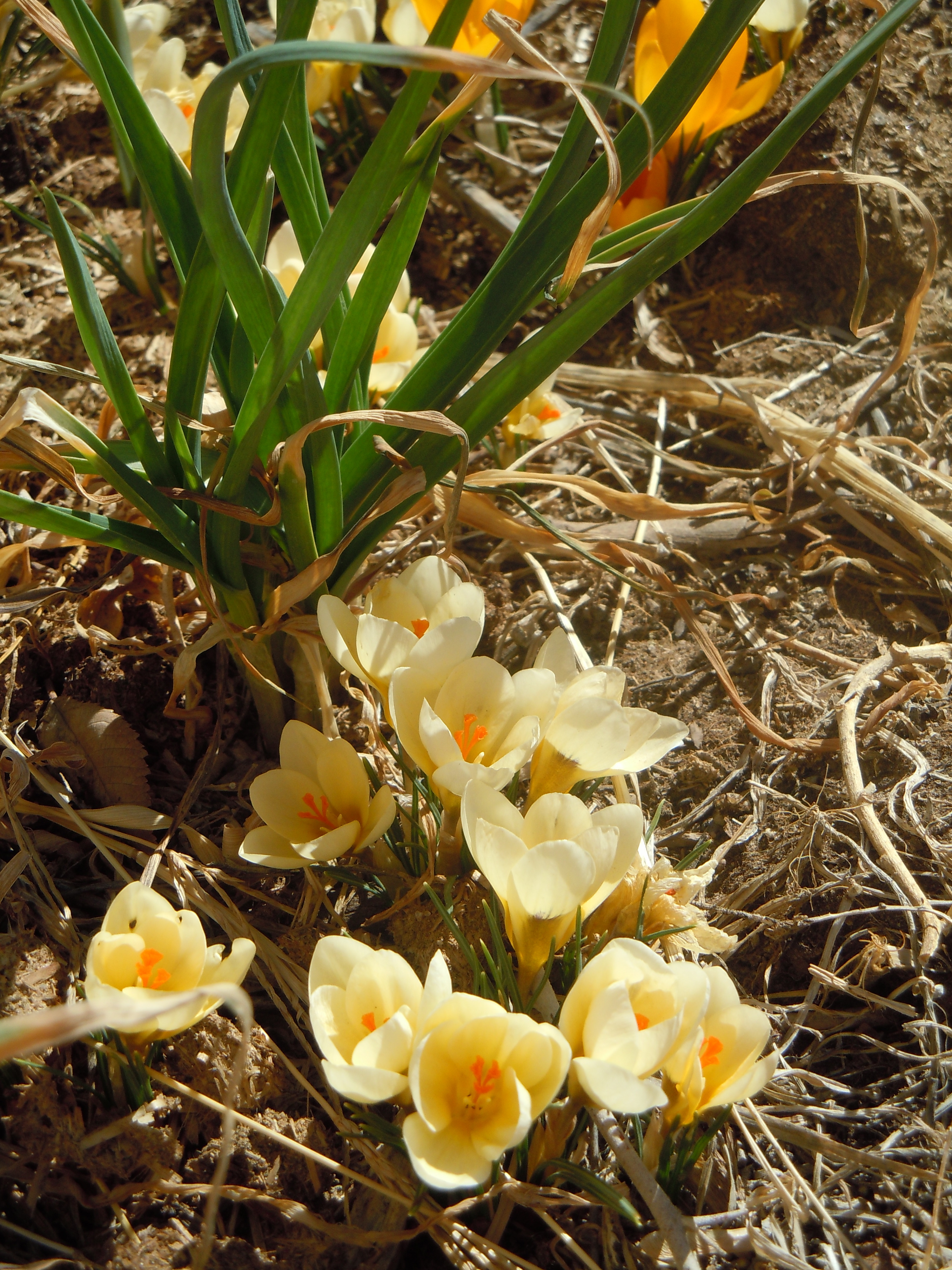
I’m not a winter person, so wherever I move, I always plant a patch of the early little species crocus “Cream Beauty” in my garden. When I see the first glowing blooms, I’ve officially survived another winter.
“Cream Beauty” is also a kind of floral nag, reminding me that there’s no time to hang around luxuriating in the sunlight; I need to be prepping and planting furiously. It’s one of the ironies of garden writing that, just when you actually have something to say, you have no time in which to say it. So here are a few spring tidbits in no particular order:
Last fall I coated all my “greens” beds thickly with horse manure, and dug it in as soon as the ground thawed in early February. Fresh manure needs to go on in the fall, but you can apply well-aged manure or finished compost now. Now the beds are ready to plant, and I put in three kinds of lettuce, several types of mustard, two kinds of spinach, snap and shelling peas, and a wide assortment of chicories, both leaf and heading. It’s important to get them in early so that they don’t fry in overly hot summer sunlight. Chard, parsley, and potatoes will be planted within the next week or two. Leeks and scallions were started in seed trays last month, and the multiplier onions, garlic, and shallots planted last fall are sprouting. I planted grey shallots once and didn’t find the bulbs useful- too small and too much work to peel- but they provide generous cuttings of sharp shallot greens every spring to season salads and soups. They are like chives but with a distinctly stronger flavor.
Every year I try a few things that are completely new to me, and one of my newbies this year is bladder campion, which, according to the catalog, provides young greens that taste something like green peas. It’s a common weed in wetter parts of the country, but here it needs some shelter and encouragement. Bear in mind that many plants which need full sun elsewhere prefer some shade from our high-desert sun. If you fail the first time, as I did with bladder campion last year, try giving a little afternoon shade.
Don’t forget to plant more peas than you need so that you can cut the sweet young greens for spring stir-fries.
If you’re going to try chickens this year, build the coop and make a brooder set-up now, BEFORE you buy the adorable baby chicks. I’m going to try a few meat chickens this year, so I’m building a large open-bottom cage to keep them in. It’s my first effort at carpentry, and I don’t think that there is a perfect 90 degree angle anywhere in it, but the chickens are unlikely to care. Make your chicken construction sturdy and raccoon-proof, not beautiful.
Gardening is a natural process, with all the entropy of any other natural process. Success does not pile upon success in an automatic fashion. Our freakishly cold snap is likely to result in some garden disappointments. My artichokes all seem to be dead, a sad event because they are offshoots of the first plants I grew from seed, many years ago. But that’s a reminder that nature is under no obligation to respect our sentiments. If you are very fond of getting your own way, gardening might not be for you. Nature offers some consolations too, like the glut of big brown eggs with deep orange yolks flowing out of the henhouse. There are a million ways to enjoy them, but while I’m waiting for the spring bulbs to bloom I enjoy eating what I think of as Daffodil Salad. The name comes from the colors, which remind me of the exquisite Poet’s Narcissus. Please know your edible flowers if you use them, and remember that daffodils are NOT edible.
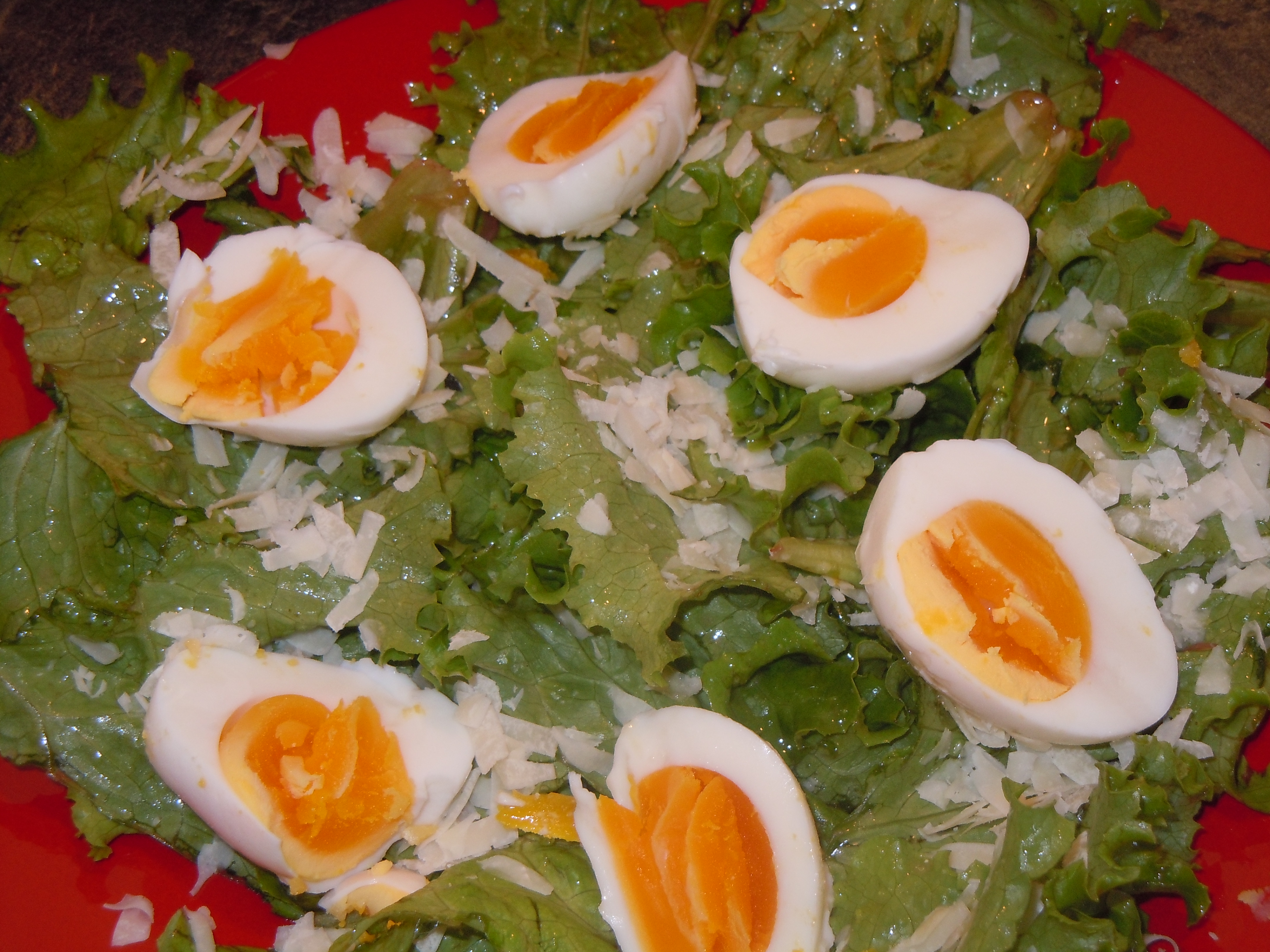
To make a main dish, put three eggs per person in cold water, bring to a boil, simmer 10 minutes, and cool quickly in cold water. If you have your own hens, the eggs need to be at least a week old to peel cleanly. With store eggs this is seldom a problem. The ten-minute simmer gives yolks as shown, just barely solid in the center and a rich orange. Peel the eggs and cut them in half. Put the amount of salad greens you prefer in a big bowl; I use about three good-sized single handfuls per person. Toss with the dressing below or your own favorite vinaigrette. Pile on plates, top with the egg halves, and drizzle a little more dressing over the eggs. Scatter on some thin shavings of your best Parmesan and enjoy.
Spring dressing
1 small shallot or the white part of one scallion or the white part of one stalk of green garlic
juice of one lemon
1/2 cup best olive oil
2 tablespoons roasted hazelnut oil
half a teaspoon of salt, or to taste.
fresh pepper, about 15 turns of the mill
a small handful of chopped chives or about 2 tablespoons very thinly sliced shallot greens
Chop the shallot bulb, scallion, or green garlic bulb very finely and marinate in the lemon juice for fifteen minutes, with the salt added. Don’t skip the marinating step. After fifteen minutes stir in the other ingredients, shake in a jar, taste for seasoning, and use. Any not used immediately will last a day or two in the refrigerator.
3 May
The Greens of Spring: Alliums
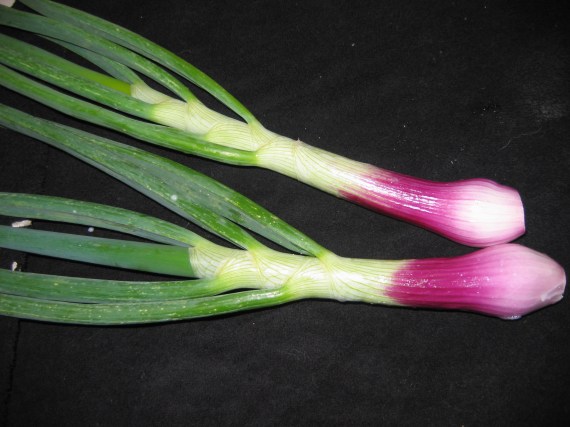
Onions and garlic are among the most common and useful seasonings worldwide, as well as in my kitchen. In spring my garden is full of green fresh forms of these lovely vegetables, and this is the time to plan for the green onions you’ll want later in the year. Start now, because they won’t be ready for a while. I suggest starting some long red onions from seed. They are available under several names. At Gourmet Seeds International in Tatum, New Mexico, they’re sold as Rossa lunga de Firenze. Also get a packet of the lovely Japanese green onions. My favorite is Shimonata. Don’t worry about the late start; you’re planting for the future. Start them now, and plant them out in fertile soil when they’re big enough to take care of themselves. I plant mine in clusters of 3-5 plants, with at least 8″ between clusters. They will grow slowly through the summer, and some of the Shimonata will be big enough to eat in the fall. In early fall the red onions will seem to mature and die at a small size. Don’t panic. Leave them in place. Both types will sit motionless, sulking, through the winter and will burst into lively growth in early spring. Usually the red onions will divide, and you will get two or even three beautiful mother-of-pearl-colored spring onions like the ones below from each. The shafts of both types will be thick, sometimes an inch in diameter. Harvest them as soon as they’re big enough to be usable, and keep harvesting until the flowerscapes appear.
They are useful in all kinds of cooking, and I love the shafts trimmed, rubbed with olive oil, and grilled slowly until sweet and softened. Slice up with a good sharp knife (very messy eating if you skip this step) and serve with sea salt and a little of your best olive oil.
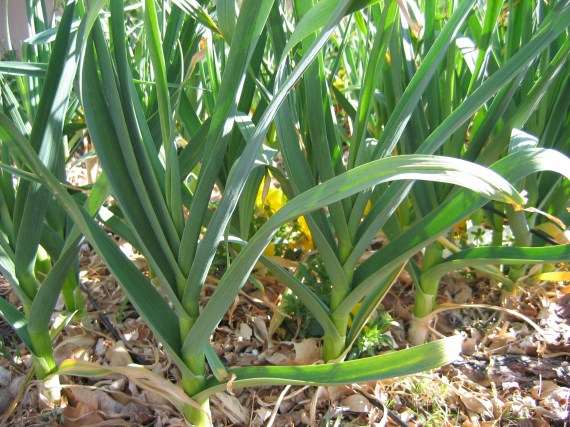
To have green garlic next spring, stick cloves in the ground about 6″ apart in the fall. For this purpose, any good organic garlic from the store is fine. Harvest when they just begin to form a bulb swelling, trim the roots and peel, slice finely, saute in good butter, and season with sea salt. Good with pasta, on good toasted sourdough bread, or as a sauce for fish.
A few years ago I ordered some “French gray shallots,” which the catalog claimed were the only real shallot to use in French cooking. I was unimpressed: the shallots were strong-flavored, garlicky, small, and maddening to peel. I left a lot of them in place out of disinterest, and discovered that in late winter and spring their foliage makes great greens. Cut and use like chives, but they are significantly stronger in flavor. They add zip scattered in a salad, or add them to greens dishes for the last few minutes of cooking.
Sauteed green onions are a great addition to hortapita fillings and other greens dishes, so please check out my “greens” category on the sidebar for more recipes. Or, for a recipe in which green onions are the stars, click here!
 My urban homestead