Posts Tagged ‘antioxidants’

Vegetable Dinners: Black Bean Cakes, and notes on cornmeal


The famous nutritionist Marion Nestle once claimed that she could tell anyone in a sentence how to improve their health and nutritional status: “Eat less, move more, eat more fruits and vegetables.” Around my house we love to fill our plates with vegetables, so no problem there, but lately I’ve been experimenting with ways to add more dried beans to our diet. This coincides with my aquisition of a solar oven, but in this recipe the beans don’t even have to be cooked. You can soak them for 24 hours, or you can use drained cooked black beans if you have some handy. These patties make a substantial main course and are a good main dish for occasions when you have vegetarians and/or vegans over for dinner.

Black Bean Cakes

Start with one cup dried black beans. Soak in a quart of soft or filtered water at room temperature for 24 hours. If you can’t give them the full soaking time, use 2 cups of cooked drained black beans instead.
About a cup of fine cornmeal (I like finely ground blue cornmeal, which helps keep the color dark)
1 small bunch each of epazote and cilantro, or 1 large bunch cilantro
1 teaspoon lightly roasted ground cumin
2 medium or three small shallots, very finely chopped
2 limes, one juiced, one cut in wedges or slices
salt to taste
1 teaspoon ground chipotle chiles
1/2 teaspoon baking powder
about half a cup of olive oil

Drain the soaked beans very thoroughly. They should now be about 2 cups in volume. If using cooked beans, drain very thoroughly. Whichever kind of beans you are using, let them sit in the strainer for at least half an hour, because you want them as dry as you can get them. Now grind them finely in a food processor. MIx in a small handful of chopped epazote or, if you couldn’t find epazote, a large handful of chopped cilantro. Mix in the chopped shallots, cumin, chipotle, the juice of one lime, and about half a teaspoon of salt, and taste for salt. Add more if needed to make the mixture taste properly seasoned. Make it a little tiny bit on the salty side, because you are still going to add more dry ingredients. Heat about a quarter cup of olive oil in a skillet over medium heat. When almost ready to cook, process in half a cup of cornmeal mixed with the baking powder. Check the consistency; if it’s possible to mold it into cakes, you’re ready to go. Otherwise, add more cornmeal until it can be molded (with difficulty) but is still very soft. Sprinkle cornmeal on a piece of waxed paper and scoop out heaping tablespoonfuls of the mixture onto the paper. When the oil is good and hot, carefully lay the cakes in the hot oil, patting a little with fingers or a spatula to make them no more than 1/2 inch in diameter. Be careful, they’re fragile, but you don’t want to add more cornmeal unless strictly necessary because they can get dry and tough if you add too much. You can also skip the waxed-paper step and spoon the mixture directly into the hot skillet, spreading it out with the back of a damp spoon to make the cakes about 3/8″ thick. Let them sizzle at least 3-4 minutes, then when you’re sure that a good brown crust has formed on the bottom side to hold them together, carefully turn with a narrow spatula and cook on the other side until done. You can keep them warm in a 200 degree oven while you fry the second batch. The main “secrets” are to keep the dough on the moist and fragile side, get the oil hot enough, don’t omit the baking powder because it does improve the texture, and wield your spatula with caution to turn them without breaking the cakes around them. .

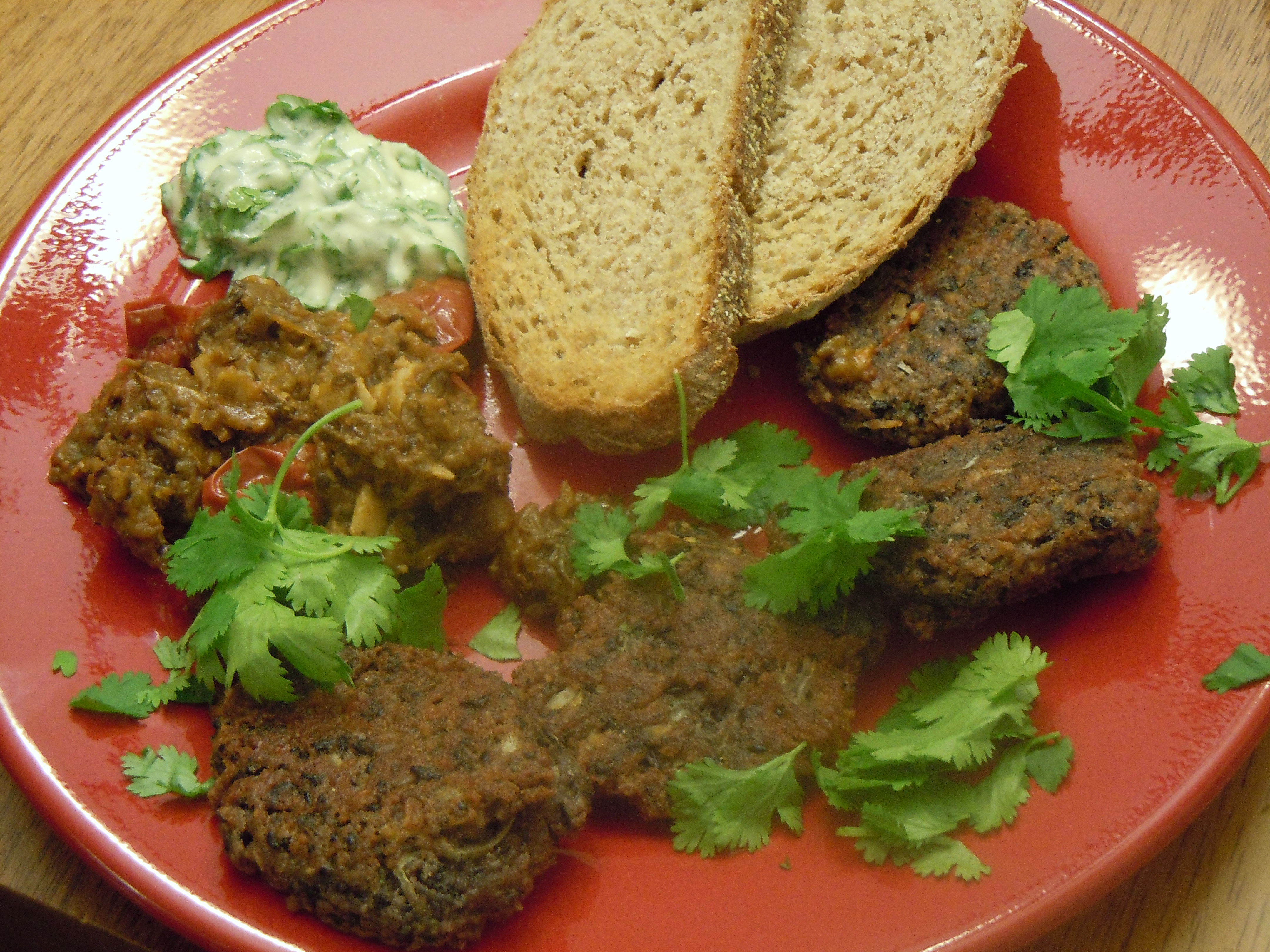
Once cooked, you can decide how to serve them. They are fine naked on a warmed platter, garnished with a large handful of cilantro leaves and wedges of lime as shown above. A squeeze of the fresh lime juice is important to the flavor, in my opinion, and I pick up a few cilantro leaves to add to each bite. My favorite garnish (vegetarian but not vegan) is some very good olive oil mayonnaise with a little extra lime juice and a lot of chopped cilantro stirred in. They can also be served with warmed small corn tortillas and guacamole, and a little heap of crumbled cotija cheese on top is a delicious tangy addition; the vegans at the table can just omit it.

The beans and blue cornmeal are both full of antioxidants, blue cornmeal is a whole-grain product, and beans have beneficial phytosterols as well as lots of fiber and other desirable nutritional factors. But I only eat things that taste good, and these cakes taste good.

Notes on cornmeal: a lot of cornmeal on the market is very uneven in grind, and any meal containing large particles will leave unpleasant hard fragments in your finished cakes. I buy a blue cornmeal made locally and ground to flour fineness. If you buy yours at the store, I suggest sifting it to get the largest chunks out, or whir it in the blender for a few minutes to grind it more finely. I would avoid the Bob’s Red Mill “medium grind” cornmeal: it seems to be a mix of the company’s fine grind and polenta grind, and can leave tooth-cracking particles in your bean cakes or cornbread. Seek out a better product.
Passing Pleasures: Blood Orange Marmalade, and notes on sharp knives


In my last post I discussed the virtues of freshly squeezed blood orange juice, and encouraged you to eat them up during the few short weeks that we can get them. In this post I’ll talk about how to preserve them so that you can spread your morning whole wheat toast with exquisite marmalade long after the season is over.
First, the disclaimer: nearly all my ideas about marmalade came from John Thorne, a remarkably quirky, idiosyncratic, and interesting food writer. I strongly advise getting his book Mouth Wide Open and reading the chapter “Maximum Marmalade,” because you’ll learn good marmalade-making technique, get all the comments and asides of a working cook in his element, and have a great time. I happened to reread his book at a time when I was thinking about the concentration of beneficial flavanoids such as naringenin, hesperidin, and rutin in citrus peel, and wondering how to make them taste good. Naturally, a chunky and delicious marmalade was the way to go.
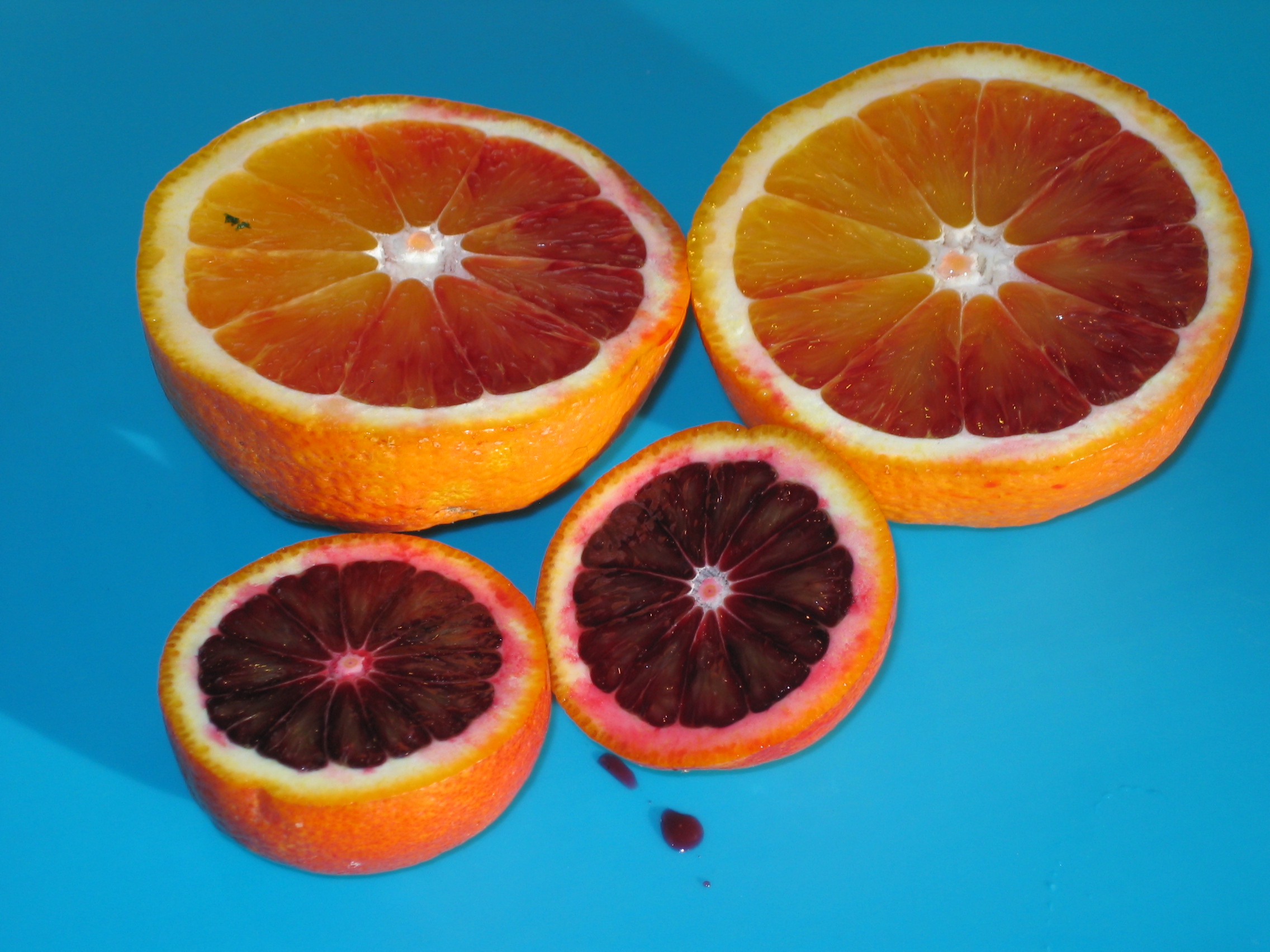
First, catch your blood oranges. There are two basic types on the market right now, one the size of a lemon or a little bigger, deep red inside, and filled with tart juice with a definite note of raspberry. The other is the size of a navel orange and only lightly blushed inside, and the juice is sweet. The former type is best for marmalade. I have only found it at the Nob Hill branch of La Montanita Co-op this week, so act fast if you want to get some. If all you can find is the other kind, you can still make a great marmalade, but it won’t be quite the same. Buy about 15 of the small ones or 7-8 of the big ones. The two types are shown below:

Next, get a really sharp knife. For my local readers I advise a trip to the Santa Fe Farmers’ Market with all your knives in hand. Look for Pat Romero’s sharpening booth, and he will sharpen them to lethality while you shop. Please let him know that Local Food Albuquerque sent you, and be damn careful when you unwrap them at home, because a knife sharpened by Pat has no margin for error.
Now wash the 4 prettiest small oranges, or the one best if using the larger sort. Cut off the two ends enough to reveal the flesh, cut in half lengthwise, and slice each half crosswise into the finest slices that you can manage. Remove any seeds, but keep everything else. Put your slices in a bowl, and juice the remaining oranges until you have enough juice to cover the slices. Cover the bowl tightly and let the slices macerate in juice overnight at room temperature.
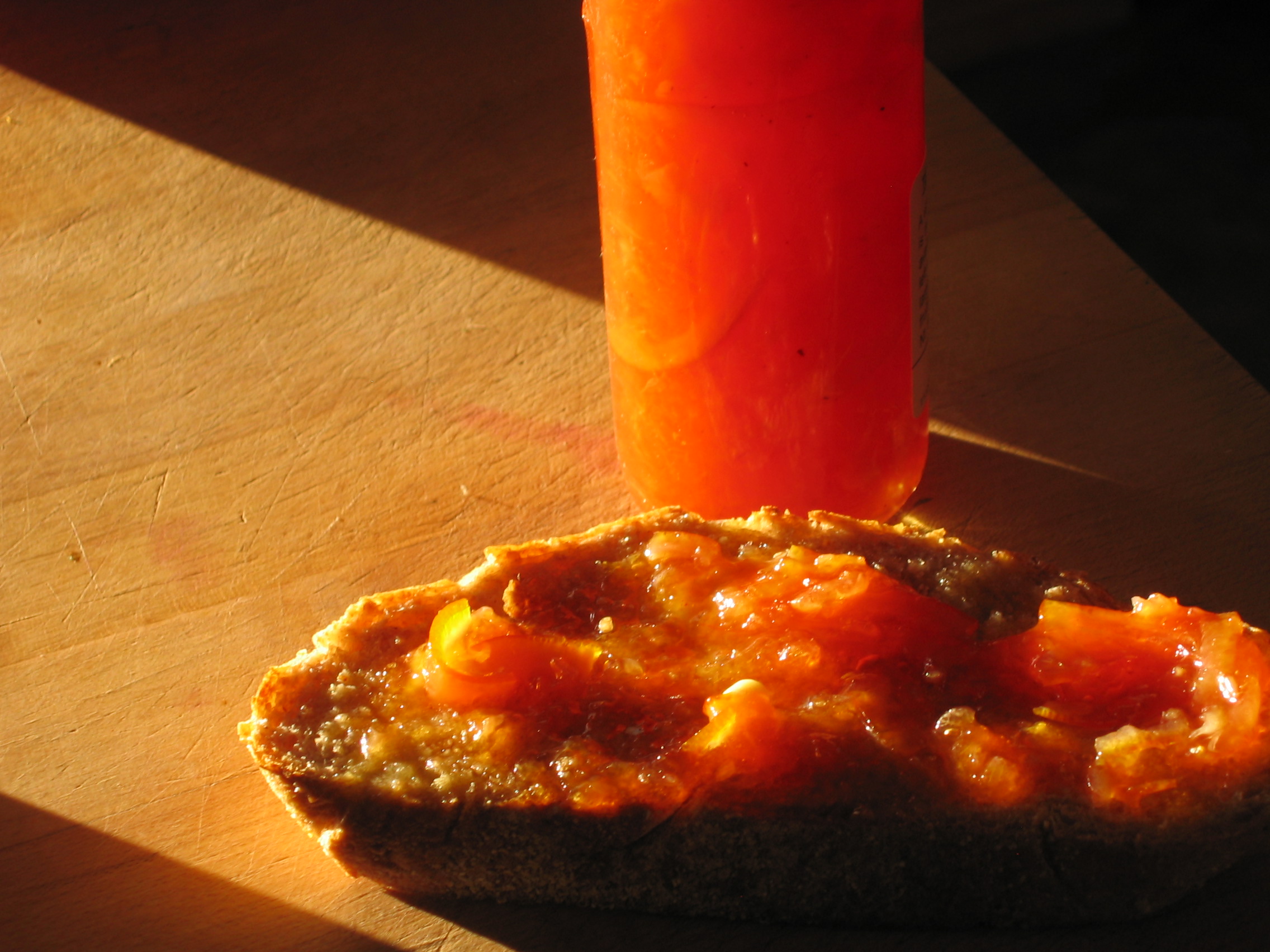
The next day, put the entire contents of the bowl in a saucepan of at least twice the volume of the mixture, bring to a boil briefly, and simmer gently until the peel is as tender as you like, remembering that it will firm up some when cooked with sugar. When the peel is softened to your preference, measure how much orange goop you have and add 3/4 that much sugar. I recommend white sugar only, to avoid distorting the wonderful orange taste. Now bring to a boil briefly again, and cook at a fast simmer until it’s ready to gel. John’s test, which is the best one I’ve come across, is to put a heavy plate in the freezer before you start cooking. After cooking the orange-sugar mixture for 15 minutes, start putting a half teaspoon or so on the cold rim of the plate. Return to the freezer for a minute and then prod the dribble with your finger. When it softly holds its new prodded shape, it’s done. Pour it into clean jars, let cool, cover tightly, and store in the refrigerator, or see the Ball Blue Book for directions on how to heat-process so that it can be stored in the pantry until opened. In the morning, toast and butter a piece of very good bread, spread it with butter and marmalade, and eat. Oh my.
Incidentally, cooking any sugar syrup requires a watchful cook hovering over the stove to stir and prevent boil-overs. This is not a forget-it-until-it’s-done recipe. The result is worth it.

Kitchen Staples: Broth


Few things will improve your cooking as much as getting rid of all commercial broth products and making your own. On my website I have extensive notes about broth-making, and you can read them here. In this post, I’ll just add a few notes about broth and its uses, and refer you to that site for the details.

Use very good materials to begin with. You can get lovely flavorful pastured chicken necks and backs from Pollo Real at the Santa Fe farmer’s market, and there is no better basis for chicken broth. Give the roasting step the time it needs, and the pay-off in flavor will be considerable. Don’t salt your broth, because you may want to reduce it later which will concentrate it manyfold. I pressure-can mine for later use, but if you have room in your freezer, that’s an easier alternative.

Once you have good broth on hand, you can use it to reduce waste and pick up some goodness from all kinds of things that you might otherwise discard. If I buy a pound of oyster mushrooms or shitake mushrooms to roast for a winter dinner, I put the stems and trimmings in a quart of broth to simmer for an hour, building the foundation for a great mushroom sauce or mushroom soup on another day. Chicken bones left over after dinner? Pop them in a quart or two of broth to simmer and enrich the flavor. Onion skins and ends on your cutting board? A slow simmer in broth will improve its flavor and give it a lovely gold color, and the rawness of the onions is lost en route.Many people save their bones and vegetable trimmings in plastic bags in the freezer, but I think the flavor is better if you simmer them while they’re fresh. The broth can be frozen more successfully than the ingredients.

Fish and seafood broths need to be cooked separately from other meats, naturally, and don’t include any salmon trimmings. I love salmon, but it does ruin fish fume’. But if you buy a few mild fish heads to start fish broth, then every time you have shrimp shells, crab shells, or any other flavorful but inedible seafood bits available, you can extract its flavor in broth and save the broth for a great paella or gumbo when you’re in the mood.

Once some good enriched broth is hanging out in your kitchen, what do you do with it? There is almost no pan-grilled or roasted meat that can’t be improved by a simple reduction sauce. Remove the meat from the pan, pour a cup of good broth into the pan over high heat, boil hard and scrape all the lovely browned bits into the broth, and when it’s reduced to a few tablespoons and has a syrupy consistency, swirl in a tablespoon of butter and serve immediately. A glug of good red or white wine, depending on the meat and seasoning, can be added to the pan for the initial deglazing, then add the stock and boil down. If you want to get fancier, most of the sauces of classic French Cuisine are at your command when you have really good broth to start with, and you can check out Glorious French Food or another cookbook to consider your options. Grains like rice and bulgur are delicious when ccoked in broth. If you’re a fan of Mexican cooking, you’ll want to try Zarela Martinez’s trick of toasting dried chiles of various kinds and then soaking them in broth rather than water before grinding them into a mole’ paste or other flavoring paste. Great stews like coq au vin are within your reach, although they will use up a lot of broth, which is why you make a lot in the first place. A paprikash like the one above requires little more than a meaty main ingredient, top-notch paprika, and really good broth (my own far-from-conventional recipe is below.)When I’m feeling dispirited and glum I revert to my Louisiana roots and make gumbo, and it invariably cheers me up, and usually cheers some other people too.

I advise avoiding strong-flavored vegetables of the cabbage family, such as broccoli and kale, for general-purpose broth. If you use leafy greens, they will color the broth, so don’t use them unless you’re willing to have green broth. Onions, carrots, celery, shallots, and leeks are aromatic staples that improve any broth. If you want to make all-vegetable broth, my favorite way is to roast the vegetables to bring out their flavor via the lovely Maillard reactions, and add a few mushrooms for the base note; dried shitakes are especially good for this, and as long as you don’t use too many, the flavor will not be identifiably Asian. .

If we can grasp some positive principle from the wretched ecomony, it should be to get the best value we can from everything we use. Nothing does that better or more gracefully than broth.
Continue reading

Passing Pleasures: Prickly Pear Tepache

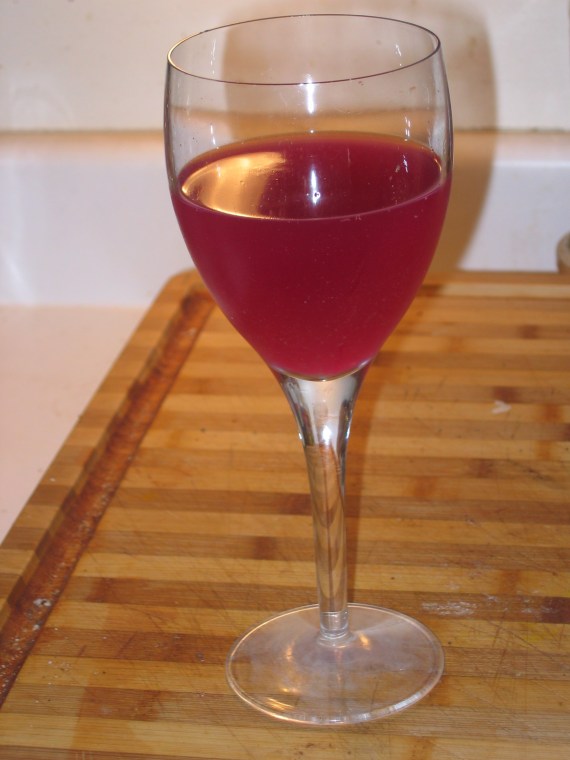
september 2009 039

This fizzy, festive fuschia drink gets its color and flavor from a really local fruit, the tuna, or prickly pear fruit. Here in New Mexico you probably have some in your yard, and if you don’t, a neighbor probably does.

The basic directions are the same as for plain tepache. Pick, beg, or borrow eight tunas the size of an egg or bigger. Handle them with respect, because the wicked little prickles will make you itch and burn for days if you let them at your skin. Handle them with gloves. If you already know how to peel them with pliers or have someone to show you how, then peel them. Otherwise, throw them in the blender whole and crush to a puree, adding a little water if you have to in order to get the blender going. Pour the puree into a strainer lined with several layers of cheesecloth. Now, twist the cheesecloth closed and press it with a spatula or wooden spoon to release the juice. Don’t omit the cheesecloth, since the strainer alone won’t get the prickles out, and don’t squeeze the cheesecloth with your hands. You should end up with 1.5 to 2 cups of prickly pear juice. Now make tepache according to the directions I gave earlier in the summer (click here to get the directions) but add the prickly pear juice to the fermenting jar with the other ingredients. The other quantities stay the same, including the pineapple rind, which provides the wild yeasts that do the fermenting. Ferment according to the directions. The flavor of the tunas is accentuated by the fermenting process and will be dominant in the finished drink. Pour and toast the exhilarating autumn weather.


According to an article from Texas A&M, the antioxidants quercetin and kaempherol were found in prickly pear fruit, as well as other antioxidants. The link is below if you want to read more.  Personally, I think the important thing about antioxidants is to get a lot of different ones, not by taking pills but by eating more fruits and vegetables (or, in this case, drinking them.)

http://www.sciencedirect.com/science?_ob=ArticleURL&_udi=B6T6R-4BG8TR7-3&_user=6865397&_rdoc=1&_fmt=&_orig=search&_sort=d&_docanchor=&view=c&_searchStrId=1027331814&_rerunOrigin=google&_acct=C000050221&_version=1&_urlVersion=0&_userid=6865397&md5=67b4ea1bcff5a8121ec6c61beea769b7.