Archive for the ‘vegetable gardening’ Category

The Fall Summation IV: Perennials

I am beginning to plan for those future years  when digging in the garden is not such a pleasure. For that matter, there are already days when digging feels less like a hobby, pleasure, and form of worship and more like a chore, and so I am trying to have patches of perennials around that would carry me through a time when I did not feel able to dig.  I am also trying to create deep mulched beds that would make it possible to grow annuals with less work, but more about that in another post.

Some of the perennials that I have experimented with:

Stinging nettles are a real success. They have to be sited in a place where people and animals do not have to be exposed to them and get stung, but once established the only care they need is some water in my desert area, and cutting back in the winter so that the spring greens can be easily harvested. From now on, I will also cut back the withered stalks at the peak of late summer heat, so that when new shoots come up in the fall they can be gathered without much trouble.  They are delicious when cooked, and there is no more nutritious green, so I am even thinking of starting a second patch in another out-of-the-way corner of the yard. I have written about their kitchen uses in a number of past posts,  and I guess all I will say here about their flavor is that it is mild but somehow more intensely green than almost anything else that I’ve tasted.  They have to be handled cautiously and with gloves to avoid stings, but I have read with fascination that some people believe in putting the raw greens into smoothies, and apparently they are edible raw in that form. There are also contests in some places in Europe in which raw nettles are eaten in large quantities. Bizarre, but then, people are. Suit yourself.

Scorzonera  is a favorite of mine for its delicious stalks topped with tightly packed flower buds, and I have also learned to appreciate the leaves as a substantial but mild flavored addition to salads. It produces a small but useful second crop of leaves in late fall.   It tolerates drought  exceptionally well once established. I will be planting a lot more of this one. Be aware that I am talking about Scorzonera hispanica. There are other members of genus Scorzonera that have thready and insubstantial leaves. I don’t find the root to be worth the trouble of digging it up, and I leave it in the ground to make more leaves and stalks year after year with no labor on my part.

Salsify  produces long thin leaves which, in the spring, are tender and reasonably tasty.  The buds are probably the best part of the plant, although they are tiny and you would need a fair sized patch to have enough to be worth eating.  I have planted a new larger patch of it because I read somewhere that the long thin early spring leaves, when blanched for just a minute in boiling water, make a kind of “vegetable spaghetti“ that some people enjoy. I haven’t had a chance to try this yet but it would be a useful addition to my low-carb diet, which is “deficient “ in things to toss with butter and good Parmesan. Salsify  is often grown for the roots, but I find the root fairly bland and not that interesting. I would certainly eat it if I were hungry, though.

Asparagus  is one of my favorite vegetables, and this coming spring I will be planting more of the purple kind, which I find most delicious.  There is just nothing better. If only it were available in the garden for more of the year, I might not bother to grow anything else.

Turkish Rocket  makes delicious buds when harvested at exactly the right phase, with a bitter-nutty flavor very much like broccoli rabe. The season for it is short but pleasurable. I have never found any culinary use for the leaves or older buds.

Sorrel  makes one of my favorite simple sauces when chiffonaded and stewed briefly in butter with a little salt. Salmon was born to be grilled and eaten with sorrel butter. In addition to a healthy large clump of spring leaves, it makes another, even better clump in late fall. Very deserving of garden space. Above, you see the chiffonaded leaves used raw in salmon salad. It takes a surprising amount to make a good flavor impression, so think of sorrel as an ingredient, not a seasoning.
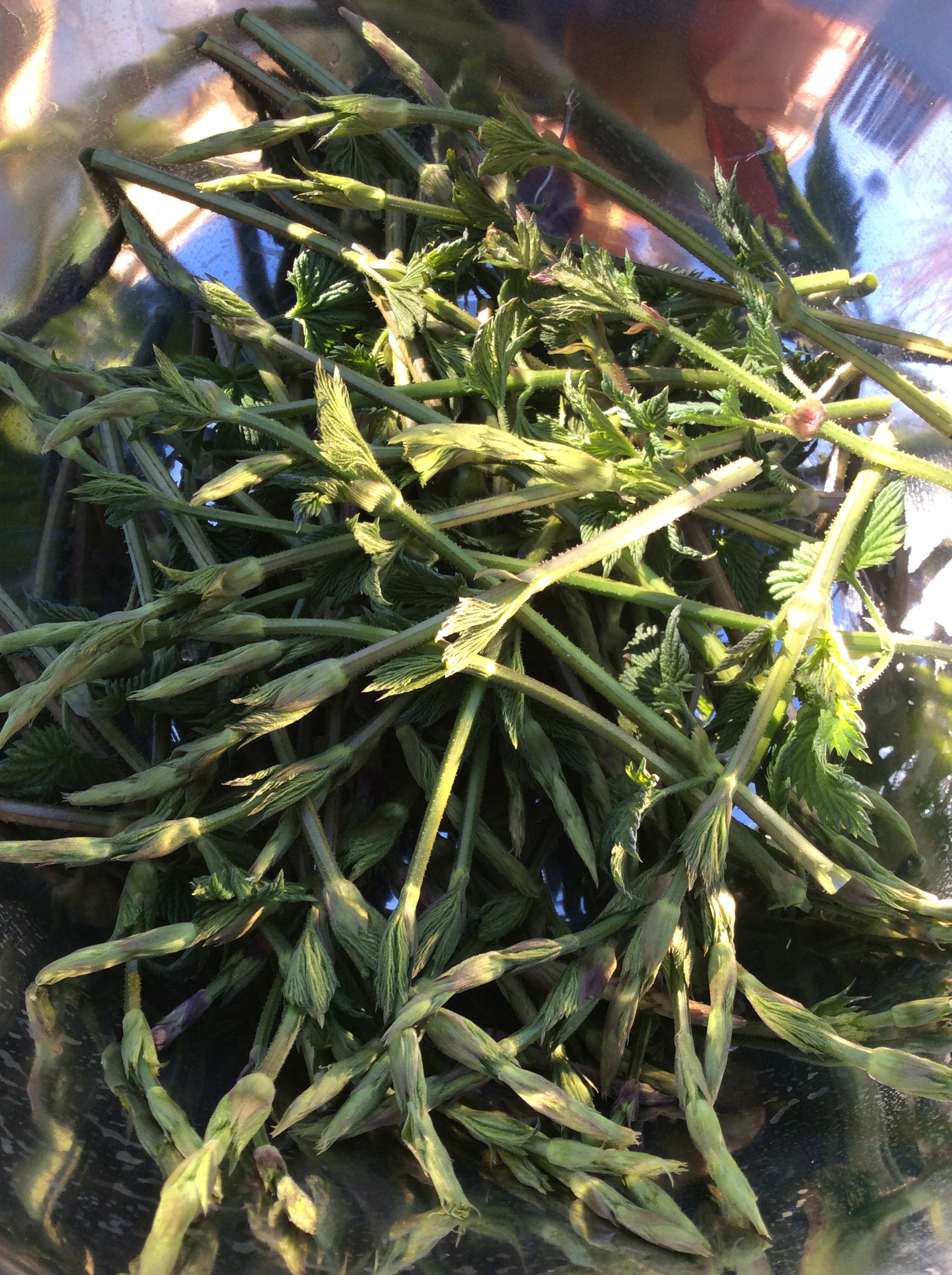
Hops  were planted all along my fences back when I used to brew beer. I don’t brew very  much anymore, but hops shoots are a lovely wild-bitter tasty treat that I look forward to every spring.  I am convinced that fancy preparation is a bad idea. Just rinse them, chop a bunch of them in 1 inch lengths, and fry quickly in olive oil with a generous pinch of salt. Nothing else. Be sure to let them form some browned crispy areas so they can taste their best.

Mulberry  can be kept tightly pruned or coppiced for an excellent harvest of small tender young leaves and shootsat the twig tips.  Don’t try the leathery older leaves, and stems should be tender enough to easily nip off with your thumbnail. It matters which mulberry you get, since some have perfectly good leaves and some are awful. I surreptitiously tasted at the organic nursery where I bought mine, to get leaves that had no unusual toughness or off flavors.  Mulberries have a good amount of resveratrol, but I have no idea about the resveratrol content of the leaves. I would guess, however, that it’s probably in there.  Once you have a mulberry tree you have it forever, and the only problem is keeping it pruned tightly enough that you can reach the leaf tips.  I recently learned from Samuel Thayer‘s newest book that the flowers can also be eaten in salads. I will be trying this next spring.  If you have a yard goat, goats adore mulberry branches above almost anything else, and will happily eat up your prunings. There are some wild food books  that claim that the leaves are hallucinogenic, and others that say the leaves are not hallucinogenic but the water in which they are cooked is. I call nonsense on all of this. Young tender mulberry leaves are one of my favorite greens, and I eat a lot of them, and drink the water that they were cooked in, and nothing remotely interesting has ever happened as a result.  Mulberry leaf tea is also widely used in Asian and given to children and old people, with absolutely no concerns.  I don’t know where this stuff comes from.  I am happy to say that Samuel Thayer, a profound expert on wild foods if ever there was one, talks about culinary  use of the leaves and does not mention this at all. A tightly pruned or coppiced mulberry can be kept in any front yard, since if you keep cutting it back it doesn’t bloom, and after the first few years  will provide a  surprising amount of greens.

Linden  is in all the permaculture books as a tree with edible leaves that can be used in salads or cooked. I have two small Linden trees, and I love the scent when they bloom, but to my taste the leaves are a little bit bland and I prefer good Mulberry leaves.  Still, they make a nice substantial addition to a salad with a good flavorful dressing, and are tenderest and best when gathered just as they emerge from their bracts.

To my immense pleasure, I find that I have more perennial veggies of interest than I thought I had, so I will put the rest in a second post.



The Fall Summation II: Mushrooms

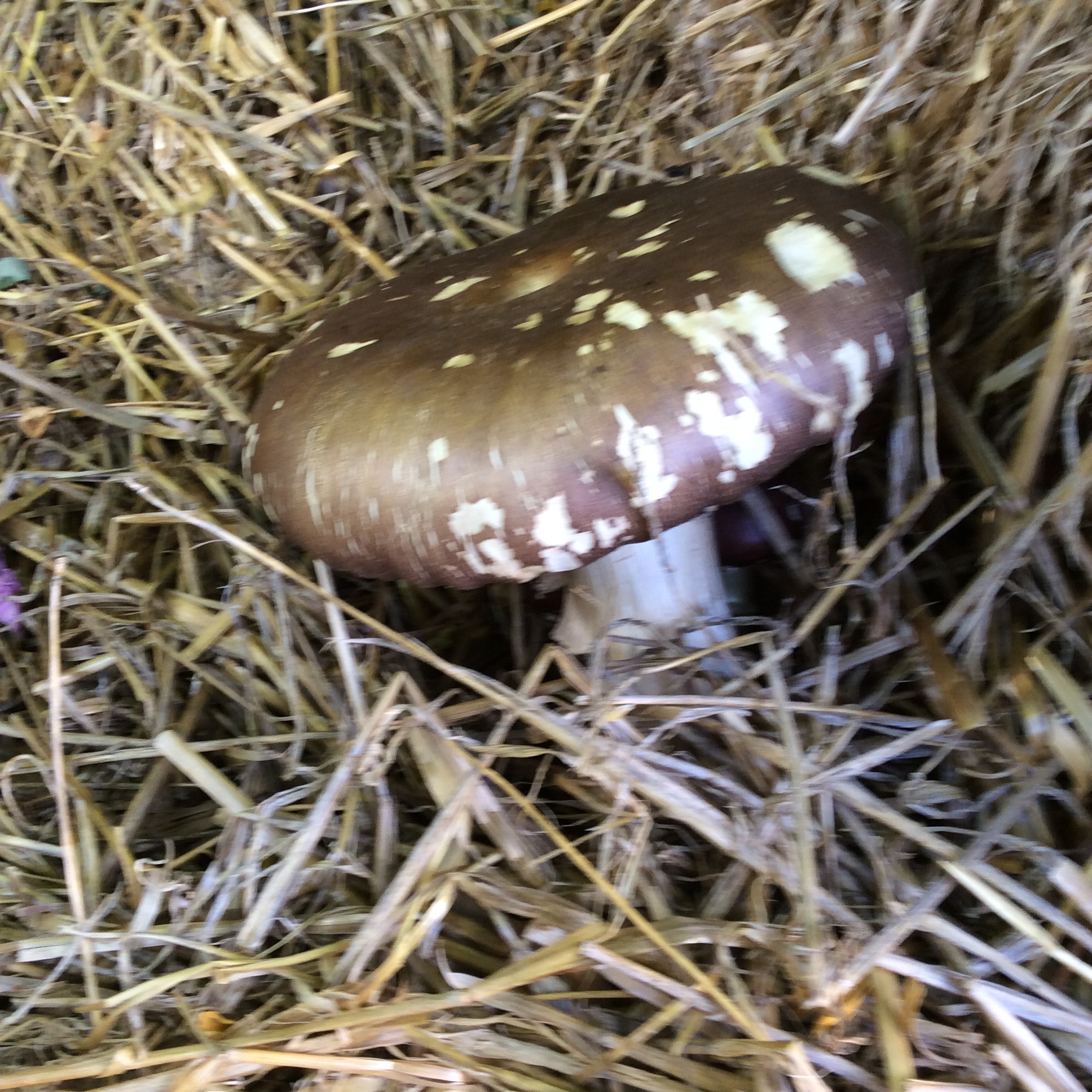
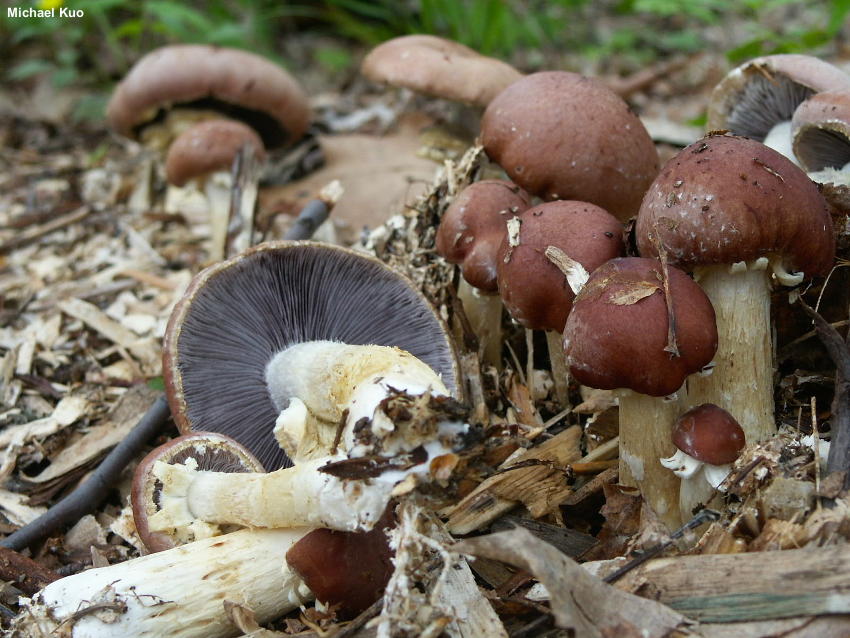
I always felt that if I could grow mushrooms outdoors among my garden plants,  I would have a fully functioning little ecosystem even here in the desert.  This year, I finally achieved exactly that, and it’s one of the highlights of my gardening year. I should add that anybody who gardens is growing all kinds of soil fungi, but I wanted the edible kind. Three species came through for me. The first was the almond agaricus, shown above.  They are compost lovers, and I buried chunks of the spawn in a bed of compost that I was about to plant squash into. Unfortunately, the squash overran the bed and I only got a few mushrooms from around the edges, but they were very delicious.  This species really does have an intense flavor of almonds, and if you don’t love almonds you probably won’t want this mushroom, but if you do it is a special treat sautéed in butter and served alongside a nutty beefy piece of dry aged meat.

DCF 1.0

Stropharia rugosa-annulata, the wine-cap mushroom,  grows freely in mulched garden paths.  It will grow in pure straw mulch, and that is how I grew it at first, but there is no question that it tastes better if you incorporate some hardwood chips or sawdust in with the straw.  Even when grown in straw alone it tastes as good as a store-bought cremini or better, but once I incorporated some hardwood it became a treat. The picture  above shows how it should ideally look at harvest. The button stage, shown to the right, is tastiest but I can never resist letting one or two get huge. The picture below shows how it is more likely to look in my garden, because for some reason there are tiny little slugs that only seem to chew on this one mushroom species. But no problem, I just brush them off, and once it is washed and sautéed in butter you can’t tell that they were ever there.

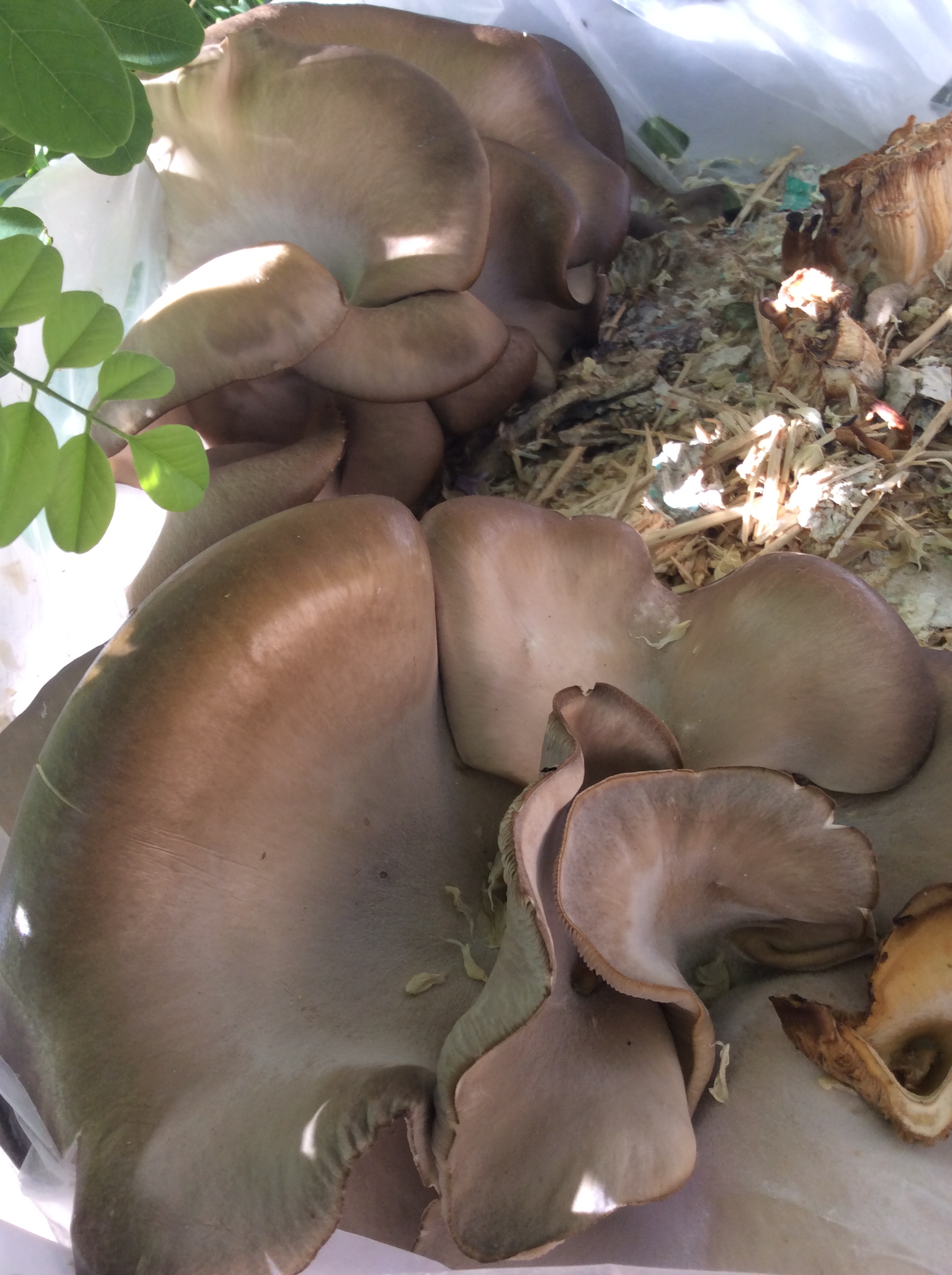
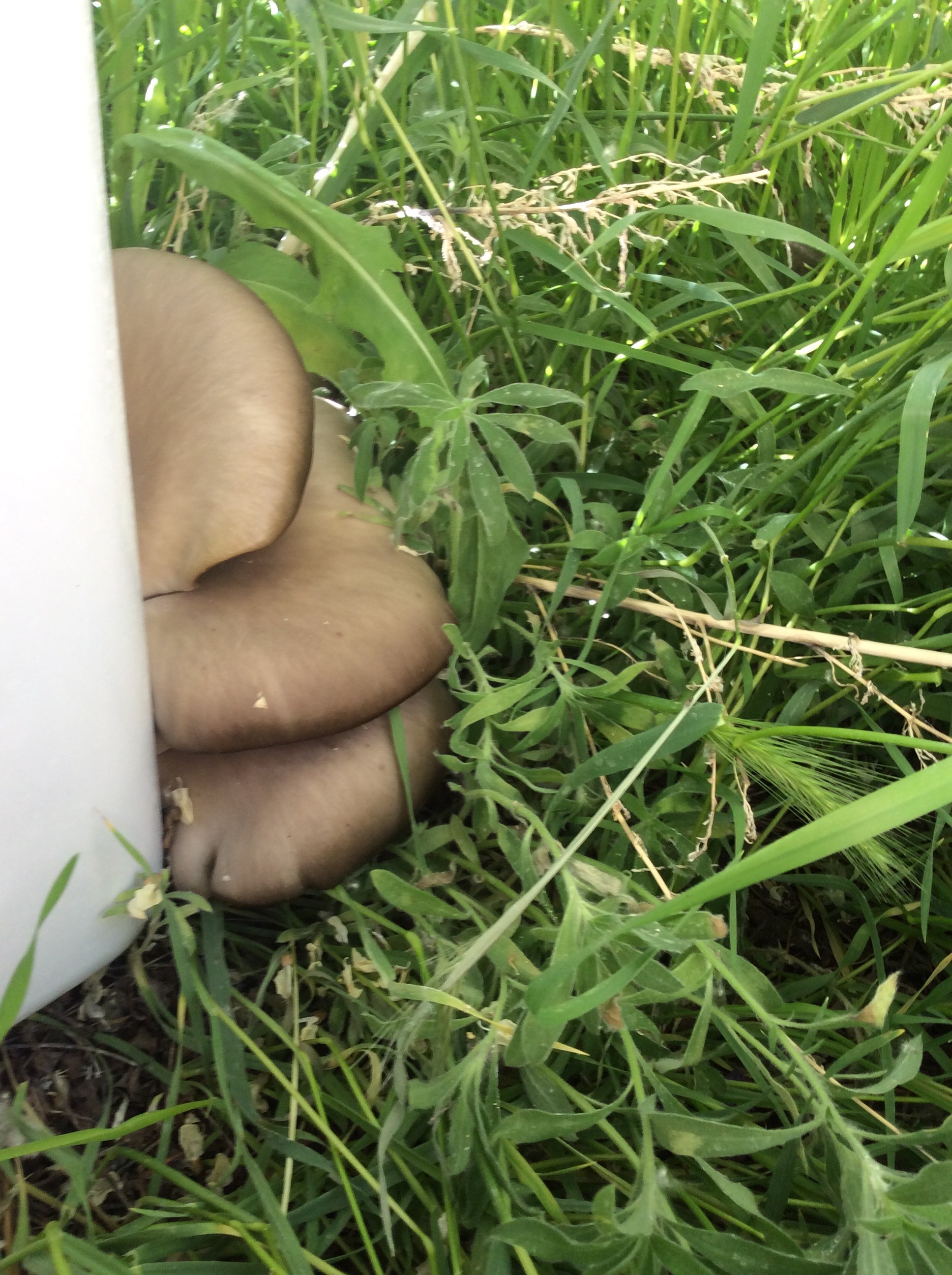
Then there are oyster mushrooms, my favorite cultivated mushroom to eat and one of the easiest to grow.  I grow them in the shade in almost whatever receptacle comes to hand, usually laundry baskets lined with clear plastic bags.  For the growing medium I use a mixture of straw and hardwood sawdust, sterilized sufficiently with hydrogen peroxide solution, with a little alfalfa shake included to nourish the mushrooms.  I stick the whole rig under a dense shade tree in late spring, in an area where water from the sprinkler will hit it when I water, but I don’t make any other effort to keep it wet. I like to let oyster mushrooms get big, to the point that they are really meaty.  After cleaning them and cutting away the tough stem area I slice them in quarter inch strips and sauté  them in olive oil with salt until they have some nice brown spots, adding a little chopped garlic toward the end of the cooking.  They are more tender when small, but not nearly as umami and tasty. It’s the difference between veal and beef, and I have never been a fan of veal. Of course, if you want a milder flavor and softer texture, pick them smaller.

Today I finished “planting” several baskets and bags with the blue oyster mushroom, a subspecies of the common oyster mushroom that fruits at a lower temperature.  They are going in an unheated shed, and might fruit during the winter. Remains to be seen if this will work, but anything that prolongs the mushroom season is worth a try.

Oyster mushrooms are determined to grow. Recently I broke up a spent basket and put the mycelium in lumps under straw mulch, and today I found tiny infant oyster mushrooms poking out. I threw a frost blanket over the area and weighted it down with pavers, and maybe I’ll get a late outdoor crop.

Nothing fills me with quite as much satisfaction as seeing one of my mushroom projects cooked and on the table.  I am not sure why this is, except that their biology is so unique and fascinating and they are so essential, in one form or another, to life on earth.  They have some interesting medicinal qualities, but I don’t feel any great need for medicine and prefer to eat them because they are fascinating  and delicious.

I’m enjoying a book called Radical Mycology, which is a compendium of nearly everything that you can imagine about mushrooms, including a heap of medical advice which, in my opinion, should be taken with a very large grain of salt.  But it is addictive reading and will get you through many a long winter evening and give you ideas for new projects.

The Fall Summation I: Crosnes

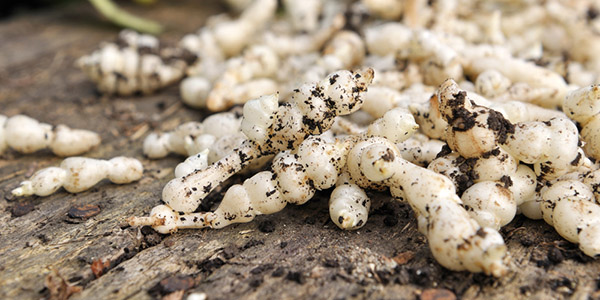
In late fall, I begin reflecting on the gardening year and what worked and what didn’t. Some things are in between. This is the first year that I experimented with crosnes, Stachys  affinis, sometimes called Chinese artichokes.  This is a small tuber-forming perennial plant, growing perhaps a foot high in a somewhat sprawling fashion. It produces tubers that, as you see above, look strikingly like grubs.

Pros:

They are perennial, although you do need to dig over the patch every year so that they don’t choke themselves out. If you are moving toward permaculture, this is appealing.

They can grow as a ground cover around other plants, although not if the necessary digging will disturb the larger plant.

The tubers have a very smooth surface and are a lot easier to clean then they look. I found that a soak in cold water, followed by a rinse with a strong stream of water, did the trick.

They are quite tasty. I was seeking a substitute for water chestnuts that I could grow at home, and I will point out quickly that they do not have the exquisite perfect crunch, the sweetness, and the flavor of fresh water chestnuts, although they are a long way above canned water chestnuts.  They lose a significant amount of their charm when cooked. I harvested a small double handful, chopped them coarsely, and put them in hot and sour soup, and although they were quite good, they had lost their crunch after a 15 minute simmer. Next time, I will throw them in just a minute before serving.  I can also imagine them being very good in salads, in steamed Chinese meatballs or dumplings, and in a lot of other places.

Cons:

I dug over a 2 square foot area to harvest a small double handful.  This was in a good patch of soil that got a fair amount of water. So I can’t imagine that they will ever be a very productive crop, although I will need to look into the  yields that other people get.

They can be hard to find. I got mine from Food Forest Farm.

So overall, for me, crosnes are not a stunning success but certainly a minor pleasure and a plant that I’m glad to have around. If you are gardening intensively, and want to get a lot of food from every square foot, they might not be for you. But if you have a patch of nice dirt that isn’t doing anything in particular, they might be just the ticket.


Fall and Winter Leaves II: Nettles

Nettles are one of my favorite greens, and one of the most nutritious plants around, so treating them with the respect and care that helps you avoid stings is definitely worth the trouble. I have a thriving nettle patch in a corner of my yard that I don’t routinely have to visit, so I have always harvested the new greens in the spring and then assiduously ignored the nettle patch for the rest of the year.  This is partly because I get interested in other things, but mostly because as a child, when I first started foraging to the intense dismay of my parents, my mother wisely bought me a set of Euell Gibbons books so that I would not poison myself.  Mr. Gibbons wrote eulogistically about nettles, but cautioned his readers that after the spring flush they develop oxalate crystals and are gritty and inedible.  I believed every word he wrote, and so I never tried them after they were about a foot high.

Here in the desert, in the unwatered spot where they have to live in my yard, nettles die back beginning in July, and the stems look dead by September.  But this year we got an uncharacteristic long heavy rainstorm in late September, and to my surprise the dead nettle stems began to leaf out again.  This week I noticed a mat of fresh nettle leaves, and told myself that no doubt they would be gritty, exactly as Euell had predicted.  But I did gather a couple of quarts (using leather gloves) of nettle sprigs and tried cooking them. They were exactly as verdant tasting as the spring greens, and neither gritty nor tough.  Now that I know this, I will try to remember to cut my nettle patch back when it dies in the hottest late summer weather, and begin to water in September so that the late fall shoots will be easier to pick.

Cooked greens in the refrigerator are an appetizing snack or light meal waiting to happen.  Today I didn’t particularly feel like eating a heavy lunch, but I did want something, and I wanted it to be healthy. I had a cup of blanched nettle greens hanging out in the refrigerator, and half a cup or so of leftover cooked cauliflower rice, so I grabbed two large scallions out of the walking onion patch and picked three large carrot leaves off the last remaining carrots.  The garlic that I planted in late summer is sprouting, so I picked one stalk that was about 6 inches high  to use as green garlic.  The fresh green stuff was chopped and sautéed in butter until cooked through, then the cooked nettles and cooked cauliflower rice were added along with about 2 cups of canned chicken broth and half a cup of heavy cream.  You could certainly leave this as a chunky soup, but I decided that I wanted a cream soup, and put the little potful in my Vitamix blender. About a minute later, it was completely creamy and thickened. I poured it back in the cooking pan, added a little water to thin it to a good consistency, simmered for 10 minutes, salted to taste, and ate it with a spoon full of drained yogurt on top to supply a subtle acidic element.  The entire process, including grabbing the green stuff from the yard, took about 15 minutes. This is a pretty small time investment for something as absurdly healthy as nettle soup.

Needless to say, vary to suit your own taste. Cooked cauliflower is a surprisingly good creamy thickening agent, and if you are vegan you could use olive oil for the initial sauté  and vegetable broth for the cooking liquid, and leave the cream out or substitute nut milk. It could be finished with a few drops of lemon juice instead of drained yogurt. Vegetarians can change the broth and leave everything else the same. As written it is a delicately flavored and very comforting soup, perfect for days when fate is being unkind, but if you want something more emphatic  you can start playing with herbs.  If you don’t happen to have a nettle patch, use some other leafy green. Have fun in your kitchen and make the result work for you.  My mother objects to my greens soups on the undeniable grounds that they are green, but if you have a prejudice against the color green in food I do hope that you will get over it, because it is the marker for some of the healthiest food that you can possibly eat.

And by the way, Euell Gibbons wasn’t right about everything, but his foraging books are still well worth reading for their palpable joy in the outdoors.  In one plant essay he says that wild foods are his way of taking communion with nature and the Author of nature, and I think this sums it up.