Archive for the ‘Uncategorized’ Category

Living in Interesting Times: Some Time to Experiment

Living out of my garden, pantry, and freezer hasn’t exactly been a hardship and is how I usually live this time of year anyway, and I’ve had a little extra time to think about how to use some of my pantry ingredients in a more interesting way. I have been doing a lot of Sichuan cooking lately, but to go with a lovely steak raised in my area, I did not want the strong flavors of Sichuan. However, I have become very intrigued, almost obsessed, with good Chinese oyster sauce made from real oysters. There’s nothing quite like it, and a dab of it goes in most of my Chinese cooking for an indefinable umami that wafts through the other ingredients. There’s no actual oyster flavor when used in small amounts, just a subtle richness that you can’t quite put your finger on.

While thinking about where oyster sauce could fit into western cooking, I found myself thinking about another combination that I first encountered in Hawaii many years ago: soy sauce and butter. They go amazingly well together and don’t taste Asian, just good.

Another taste that I thought might translate to a western treatment of asparagus is wok hei, the indefinable “breath” that hovers over food cooked quickly in a really hot wok.

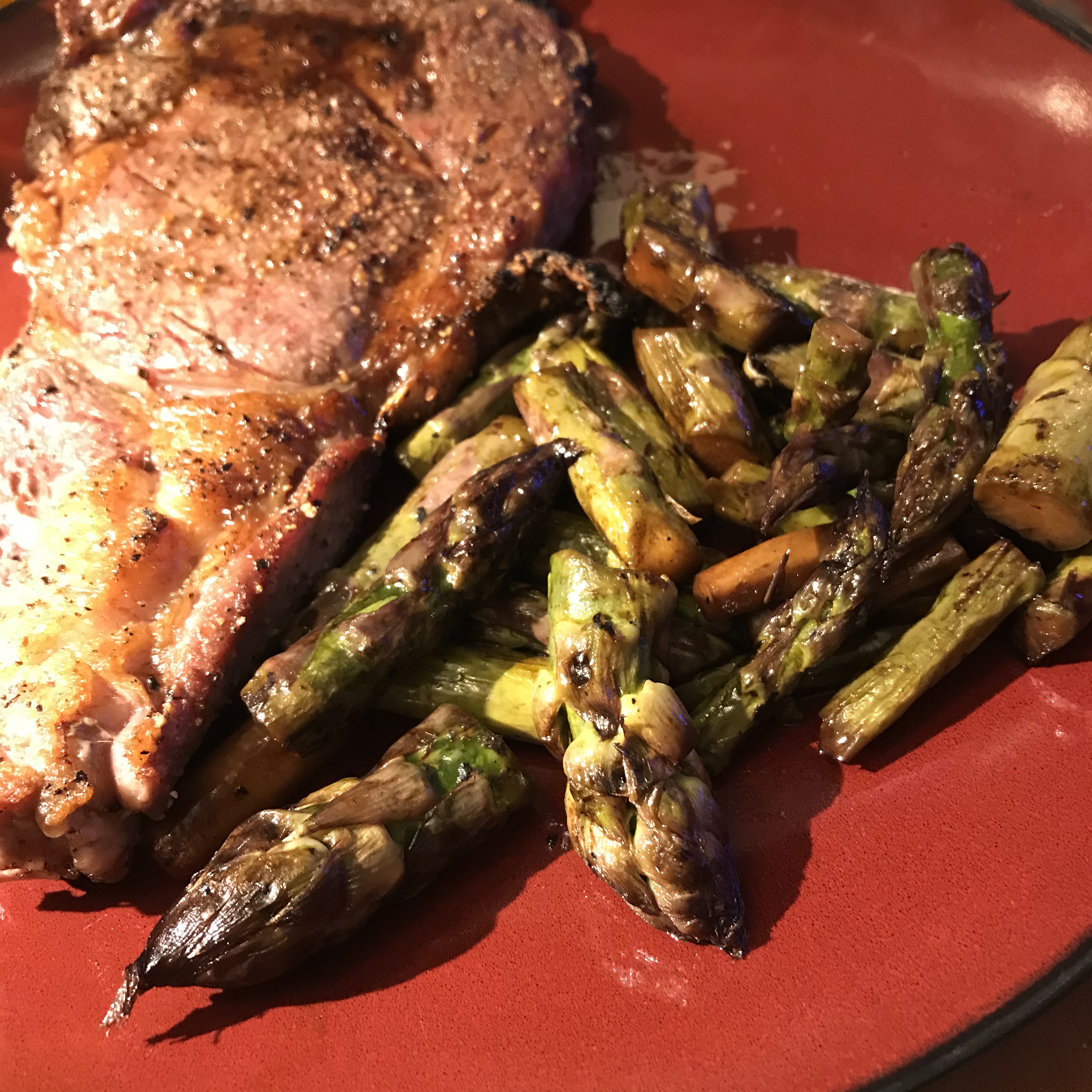
So here it is, a hot wok dish that goes well next to a western steak. I started with a large bunch of purple asparagus, almost two pounds, and the asparagus itself was very large, with some spears close to an inch in diameter. I snapped off the tough ends, then snapped the remainder into pieces about an inch and a half long. There were some slender spears, and I kept them separate. My cooking “juice” was 1/3 cup of white wine with about two teaspoons of oyster sauce and a tablespoon of good white wine vinegar added. I had two tablespoons of butter ready, and good naturally fermented soy sauce next to the stove. My calculated time was seven minutes, because of the thickness of the spears. For normal spears of asparagus, five would be more like it.

First my carbon steel wok was heated to blazing heat on my most powerful burner. I poured in a good glug of avocado oil; I didn’t measure, but I would guess it was about 3 tablespoons. Then the thick spear sections went in with a huge hiss and sputter. I cooked them for four minutes, sprinkling in soy sauce. Then the thin spear pieces were added, the fluid stirred in, and boiled furiously for two minutes.  At this point the liquid should be evaporated down to a glaze, if you didn’t falter with the heat. Turn off the heat, toss in the butter, and it goes to the plate. The centers of the spears will still be a bit crisp, but chewable, while the outside is seared. Yum. The soy and oyster sauce are pretty salty, so taste before you add salt at the table.

The same treatment could be used for a lot of other vegetables, varying the cooking time as needed. I’ve noticed that the intense heat of a wok does good things for kale, so I plan to try that next.

The steak was from a local rancher. Those folks are having a hard time with restaurants closed and meat processors losing capacity, so please, patronize the hell  out of your local meat growers if you are lucky enough to have them.


Living in Interesting Times: Using What You Have II


This weekend I was corresponding with a friend about marinated tofu, and it caused me to think about the importance  (especially now) of using what I produce. On a half-acre suburban lot, I won’t be growing my own staples or raising large meat animals. Nor is growing grain rice or soybeans feasible. But I do have chickens, and in season they lay like crazy and the eggs start to pile up. I started to wonder if I could make a proteinaceous food somewhat akin to tofu out of eggs or egg yolks.
My concentration is on yolks because they are the most nutritious and delicious part of the egg. So if you have any belief that yolks aren’t good for you, this post won’t be for you. But to me, a wasted yolk is truly unfortunate.

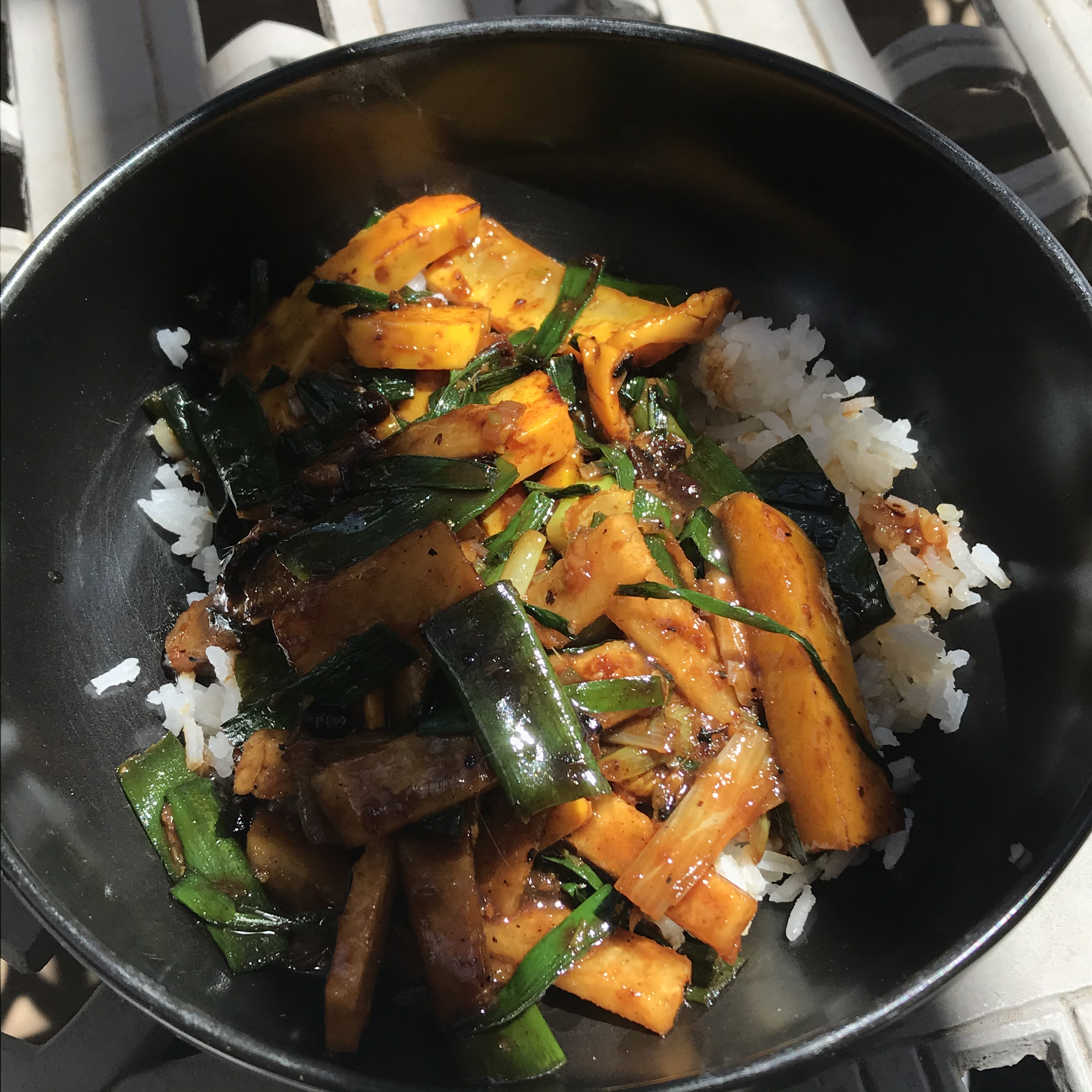
My first attempt was to beat up 20 egg yolks with a little salt and bake them in an oiled loaf pan at 225 degrees until set. After cooling, I sliced pieces off the resulting yolk cake and used them like tofu in a stir-fry, seen at the top of this post. The result was a little bland and chewy, in my opinion, but my husband liked it okay. He is very polite. The problem is that yolk cake is very dense and seasonings don’t penetrate it well. If the yolk mixture was preseasoned in some way I might like it better, but I decided to experiment with other cooking methods.

Currently, I’m using an omelette  method. I beat up 10 yolks and one whole egg with a pinch of salt and heat up my 12” nonstick skillet over medium-high heat. When the skillet is hot I put in a glug of avocado oil, stir it around, and pour in the yolk mixture. I turn the heat to medium, let it cook until partially set, and flip it over with a spatula. Cook on the other side for a minute or two until just set in the middle and turn it out onto a plate to cool. When cool, I cut it into strips about 2”long and a quarter inch wide. They can be stored in a ziplock in the refrigerator for a few days. They are a good size to add to a stir-fry in the same way that you would use meat, or to add to a fried noodle dish like this one. I especially like them with thin noodles, and if I plan to cook them with broader noodles I cut the yolk strips to match the width of the noodles. Put them in a soy marinade the same way you would treat meat, and add at the same stage of cooking that you would add pork strips but cook them for a shorter time. They absorb flavors better that the yolk cake described above.

Any leftover yolk strips that are still good and unspoiled make great dog treats.

The whites aren’t wasted when I use yolks, and neither are the shells. I put them in a microwave-safe bowl, chop them up some with a stick blender, and cook them a few minutes in the microwave to make a concoction that we call “chicken cake.” The hens gobble it up and get back some of the protein and minerals that they put into making eggs.

Living in Interesting Times: Using What You Have

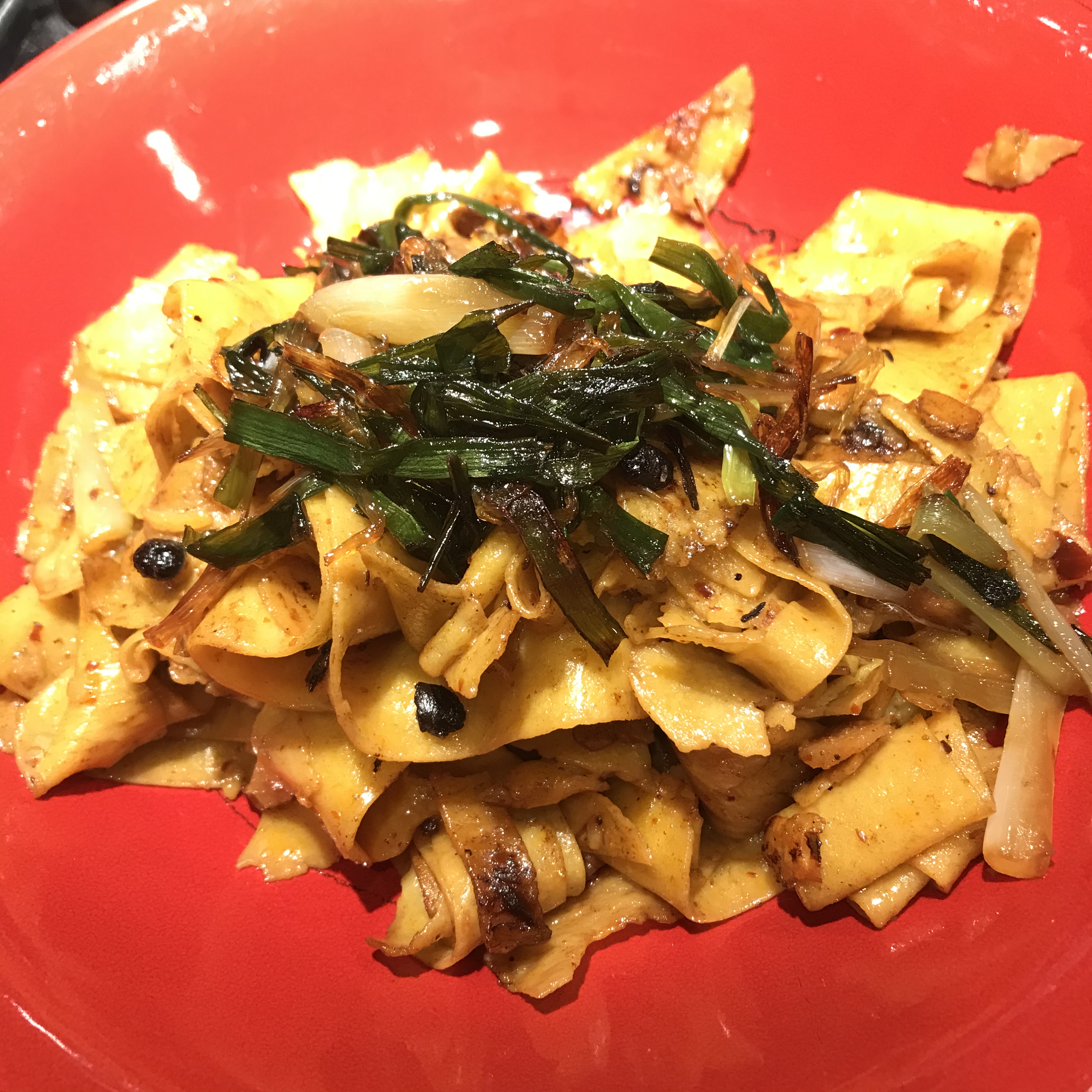
A big part of public safety right now is staying on your own property whenever possible, so I’m trying to use my own supplies rather than shopping. As you see above, it’s been no hardship. In the past I’ve enjoyed a dish of noodles with roasted scallions at Chinese restaurants, and decided to make something like it (but better if possible) at home.

If you have perennial green onions you will have them forever, and they spread so efficiently that they become quite a weed in time. For this dish I pulled four very large fat green onions, cleaned them, and cut them in 2” lengths, then cut each chunk in fine lengthwise slivers, keeping the white parts and green parts in two separate piles. If you’re using commercial scallions, 8-10 of them is probably equivalent.

Eggs are a home ground food for me, since I have chickens, so egg noodles are a natural and can be used in both Italian and Asian dishes. I make the noodles at home with flour and egg yolks only, and for this dish I used the “bad cuts” that always happen when you process a large batch of noodle dough; sheets that didn’t feed well into the rollers and got distorted or torn. When done with the properly cut noodles, I stack the distorted sheets up and cut them diagonally into broad noodles about 3/4” wide, rather like pappardelle. They look messy but remain delicious. Blanched for one to two minutes in salted water and tossed with a bit of oil so that they don’t stick together, they are ready to finish in the wok. I estimate that I used half a pound, cooked. You could use any egg noodle available, cooked until done but not mushy and tossed with a bit of oil. Of course, if you have fresh Chinese-style egg noodles, use those. For quantity, estimate whatever is two generous servings to you.

Frying noodles is one of the few jobs for which I use a restaurant-quality nonstick wok. If your regular wok is very well-seasoned, you may want to use it.

The third ingredient is soy sauce, and the fourth ingredient is hot oil and its goop. Commercial hot oil is all made with inferior oil and offers little except a belt of heat. Make your own. Start with 1 and 1/2 cups of good fairly flavorless oil (I prefer avocado oil) and heat it gently in a saucepan. Add 1/2 cup fresh pungent red chile flakes, 10 “coins” of ginger chopped, half a cup of unrinsed fermented black beans, and 10 cloves of garlic chopped. Simmer the mixture for 15-20 minutes over medium-low heat. It should bubble continually but not wildly. Turn off the heat and the oil is ready to use. Always store it in the refrigerator, and the cooked flavorings that fall to the bottom are the goop. I almost always use both oil and goop in seasoning a dish. The ingredients are available by mail or on Amazon (although they are a lot more expensive that way) if you don’t happen to keep these things in your kitchen.

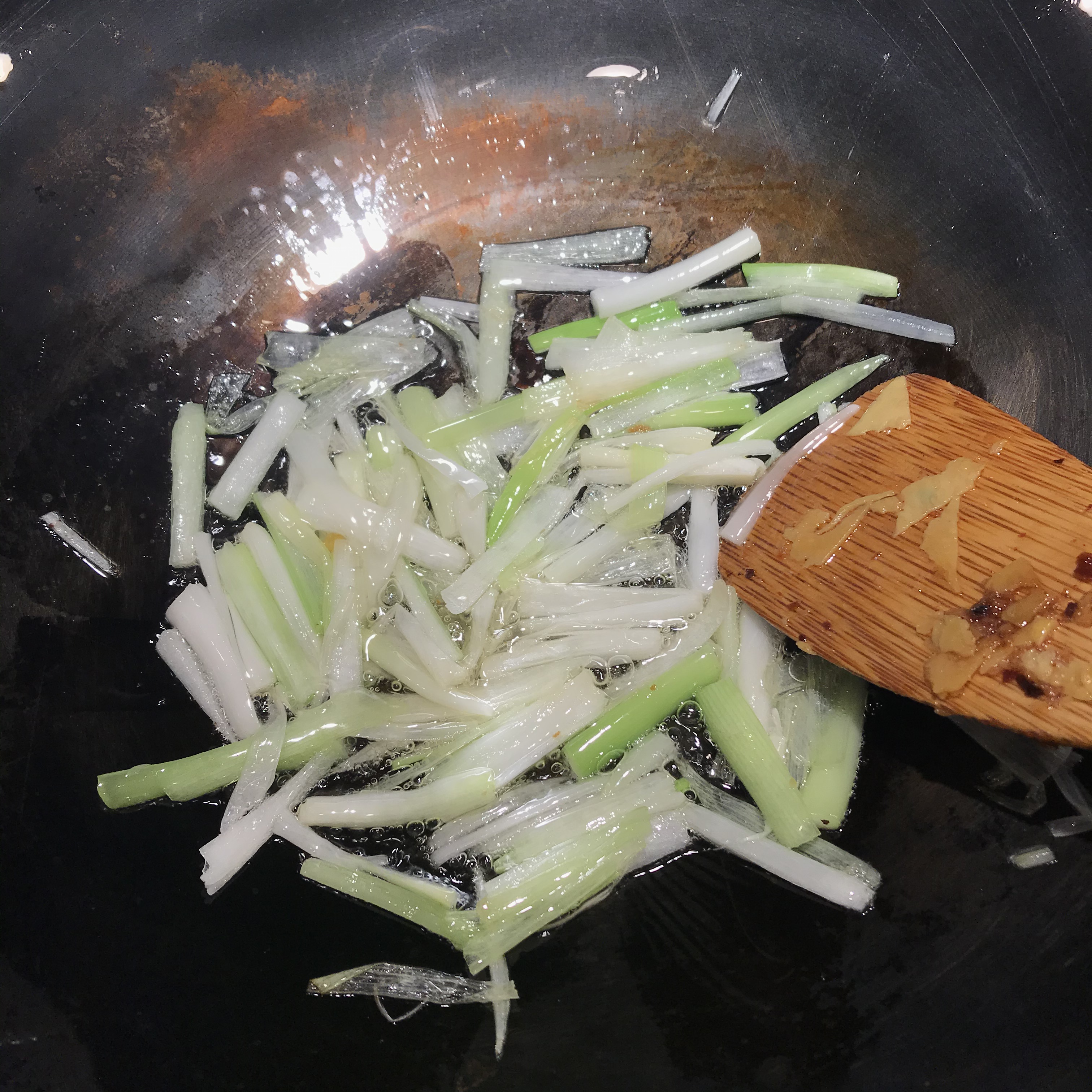
Once you have slivered scallions, cooked noodles, and hot oil with goop, making this dish takes less than 15 minutes. Put a quarter cup of oil in the heated wok over high heat and swirl it around well. Add the white part of the scallions and stir-fry for about two minutes, then add the slivered green parts and a good pinch of salt. How far to cook them is your call. Personally, I prefer them when some of the ends are browning a bit but they are still rather soft and sweet, as shown in the photo at the top. Use a slotted spatula to remove the scallions to a bowl, add the noodles to the scallion oil remaining in the hot wok, sprinkle generously with soy sauce, and add about a tablespoon each of hot oil and goop. Fry vigorously for several minutes, adding more soy as needed and turning rather delicately with a spatula so as not to cut up the noodles. When done to your taste (I like mine a bit browned and crisp in spots,) serve up and pile the roasted green onions on top. The diner stirs them in and adds more soy sauce if desired.

As you can imagine, this is a wonderfully improvisational dish. Use what you have. If the only pasta you have in the house is dried spaghetti, cook that and use it; you can bet that a provident Chinese grandmother would do the same if that’s what she had to work with. Stir-fried shitake mushrooms are terrific fried in with the noodles. Slivers of egg cake (upcoming post) can be fried in. Finely sliced kale or chard can be fried a few minutes in the scallion oil before the noodles are added. Other vegetables, appropriately cooked, find a wonderful home here. The roasted scallion topping is good on fried rice or on wok-fried eggs or, for that matter, regular fried or scrambled eggs or on any rather plain vegetable dish. If you don’t have green onions but do have young tender green garlic, use that instead, for a different but equally good flavor. If using green garlic I prefer fine cross sections to lengthwise slivers, to avoid any stringiness in the green leaves.  Have fun and enjoy the thrill of feeling frugal while really enjoying yourself. There is a lot of tragedy in the world right now, but no harm in lifting yourself above grim reality for an hour or two.

Living in Interesting Times: Unexpected Perennial Vegetables


I’ve written a lot about the perennial “weeds” around my place that keep me in greens,  but there are also some veggies that aren’t known as perennials but can be managed that way for good eating with very little work.

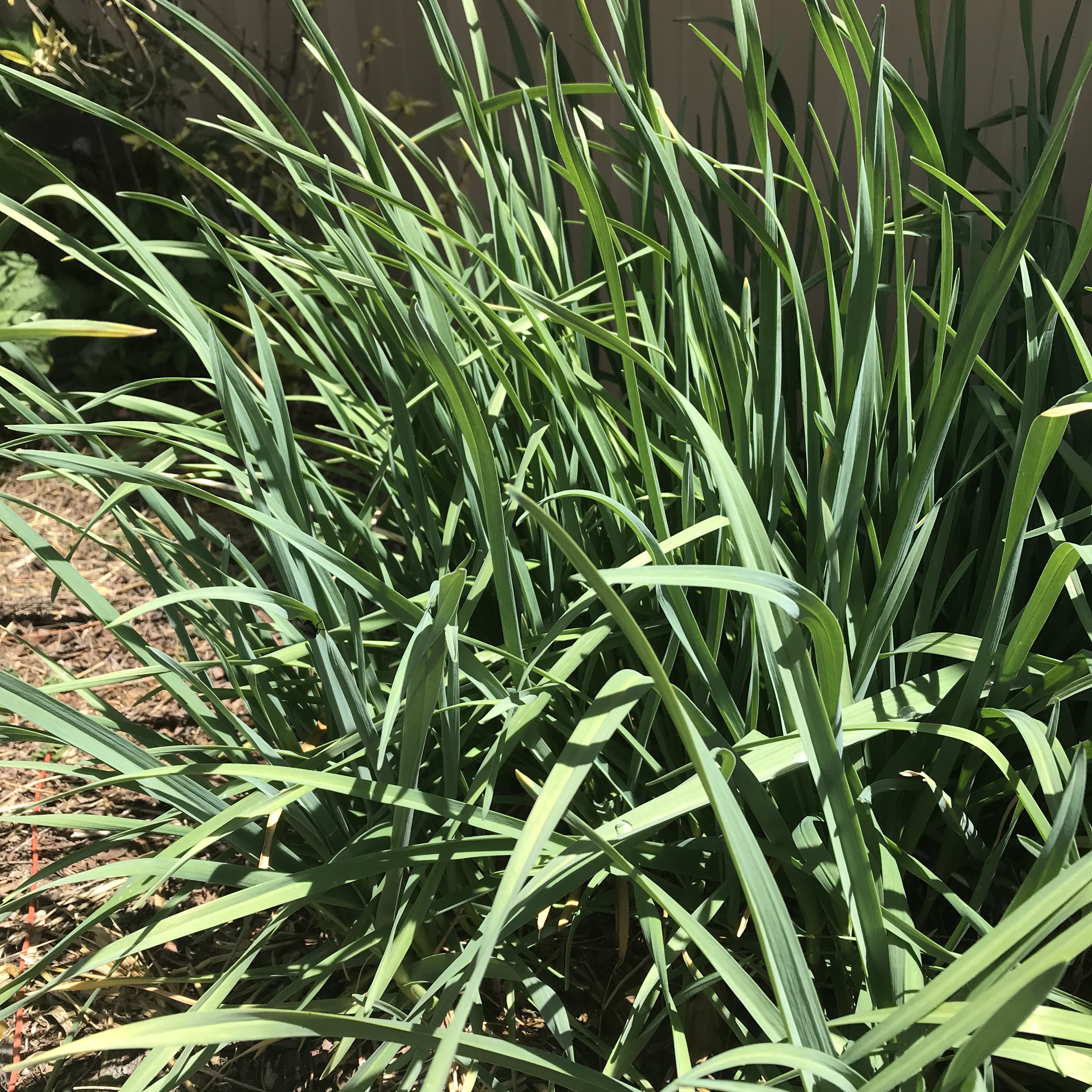
Surprisingly, garlic can be managed that way. I plant a lot of garlic because I use huge amounts as green garlic before it ever matures a bulb. In one area I forgot to harvest, and by year three I had a thick clump of fine grassy leaves in the spring that were tender and delicately scented of garlic. Of course you won’t get any bulbs if you manage garlic this way. It’s strictly a leafy herb. In early spring I start cutting bunches of the leaves thinly, like chives,  to float on soups and toss decoratively on top of other dishes. By late spring the leaves are tougher and I use handfuls of them chopped into stir-fries where they will get at least a few minutes of cooking. In midsummer the leaves brown and die back, and new leaves come up in the fall.

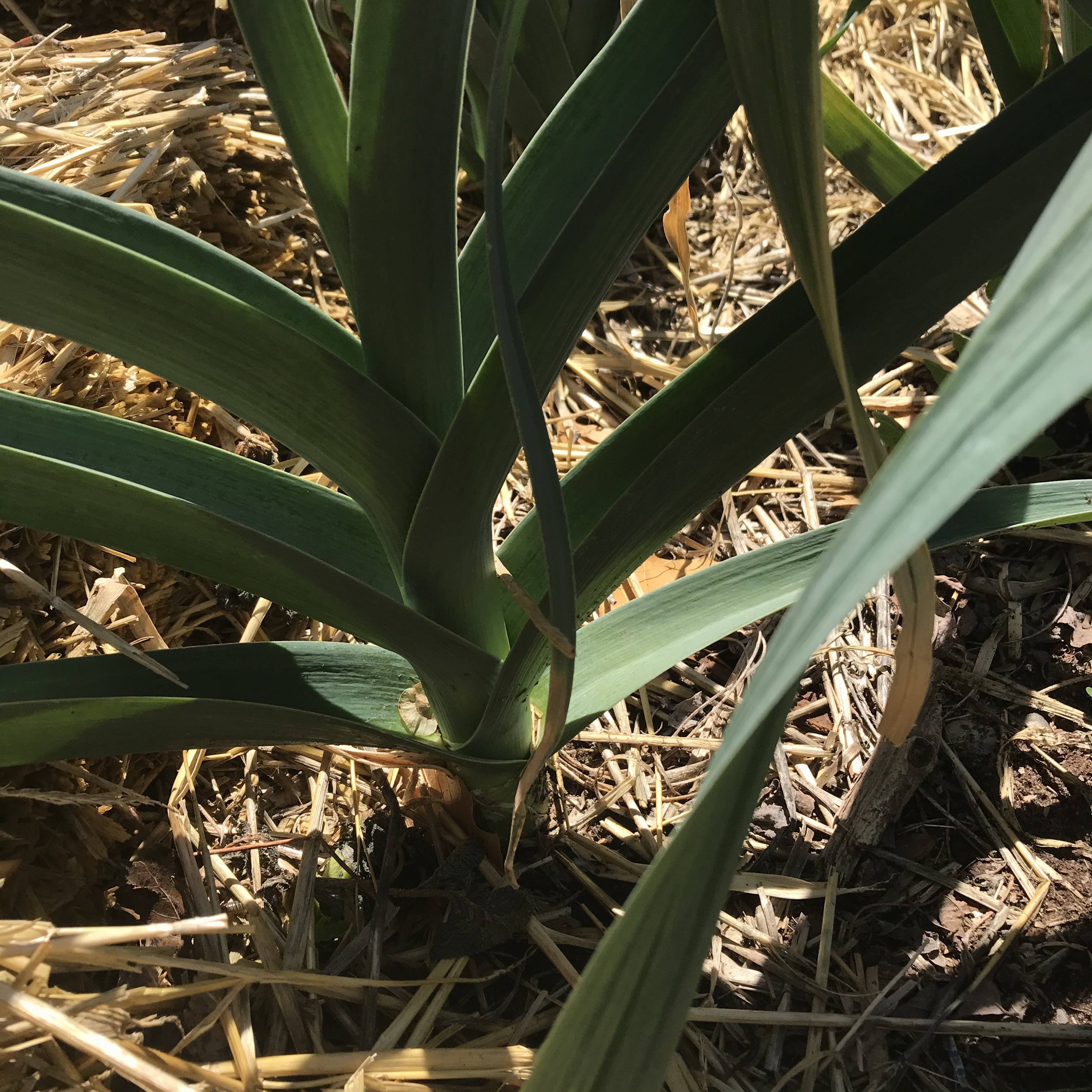
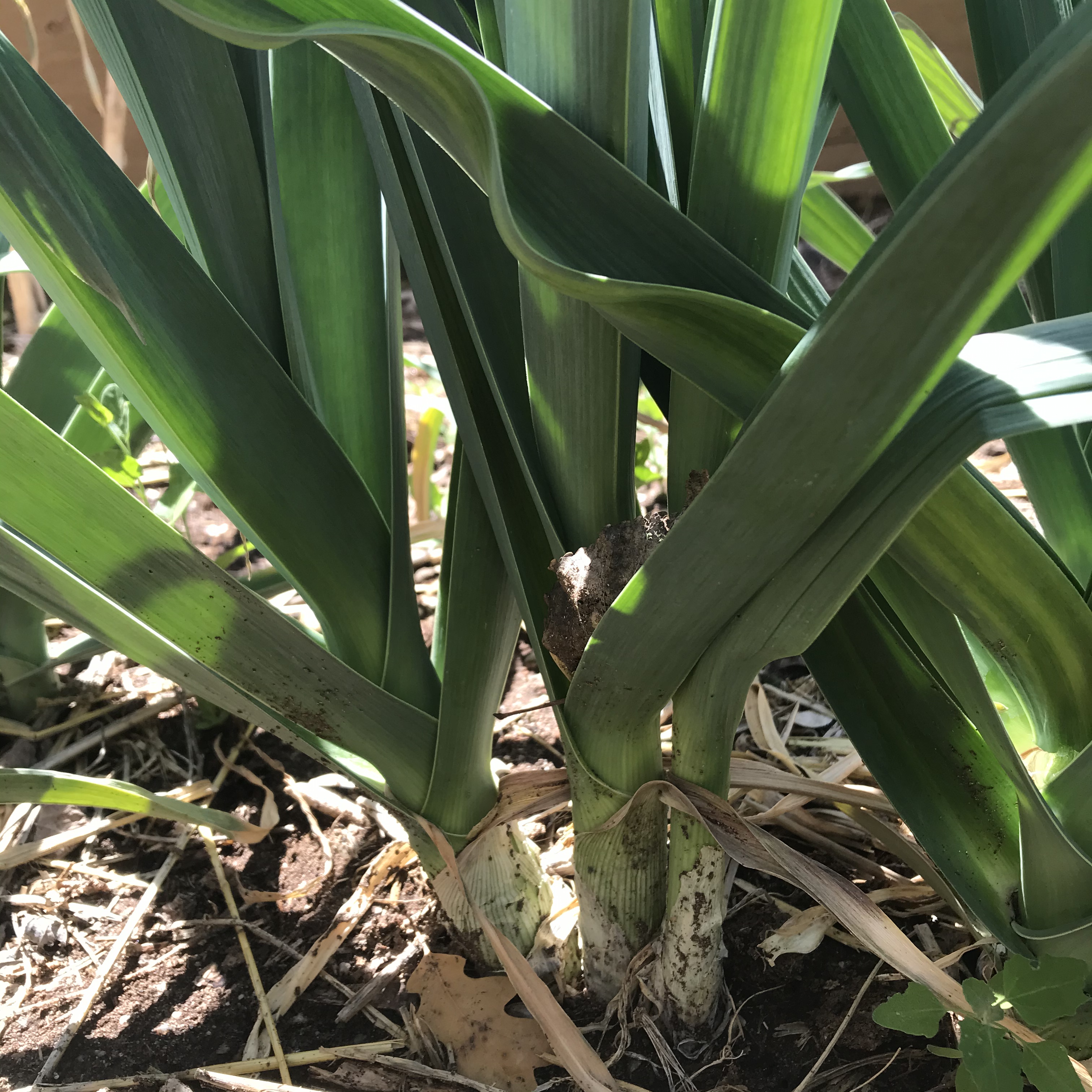
I’m also experimenting with managing ordinary leeks in a perennial bed. So far I’ve only been at this for a couple of years, so I don’t know how it will work out in the long run. The first year I planted deeply in the normal way, then when I was ready to harvest the leeks in late summer, I carefully dug away the dirt next to them and cut the edible shaft off, leaving the base and roots in place. Naturally you get a bit of dirt on the cut and have to trim away another 1/4 inch to clean them up for the kitchen. The following spring each base sent up between 2 and 5 “daughters.” I dug some out by the roots to thin the bed, using the thinnings  chopped up in greens dishes. I left some by themselves and some as smaller clumps of two or three.

At this point in late spring all are of useable size, although of course the singletons are larger. I’ll harvest some as described above and leave some in place to throw up a bloomscape. Leek scapes  are one of my favorite garden treats. The tough outer skin needs to be peeled off but the interior is delicious, sweet, crisp, and gently oniony. It’s a wonderful element in Chinese dishes, having both flavor and texture.
I’ll plan to dig out enough by the roots to leave just one base in each planting position, so that (I hope) each will again make good-sized useable leeks the following year.

Keep in mind that your own leeks, harvested young, can often be used up to the tips. Cut the leaves in cross sections about 1/4” wide and use in cooked greens dishes or stew them gently in butter or olive oil with a little salt until tender. They need cooking to get tender even in early spring, and get tougher as the weather warms and are no longer useable except to cook in broth for flavoring. Don’t try cooking the leaves of leeks from the store, which have been in storage and are tough as nails.

When managing anything as a perennial, don’t forget to keep the soil fed. I sprinkle some chicken manure around in fall, then mulch with alfalfa hay, and the soil is black and rich now, a far remove from  the tan adobe clay that I started with.