Archive for the ‘recipe’ Category

Vegetable dinners: things to wrap in a pita


My new category, Vegetable Dinners, will be a collection of meals based on vegetables. Some are vegetarian and some aren’t, but where meat is used, it’s a small amount and is used more as a seasoning than as the bulk of the meal. Where relevant, notes on how to make them vegetarian or vegan are included, but many of them taste best with a little meat or fish included, and my recipes note this. My kitchen mantra is “Eat less meat, eat better meat,” and the same goes for eggs and dairy products. Since you aren’t using much, you can afford the best and most sustainable.
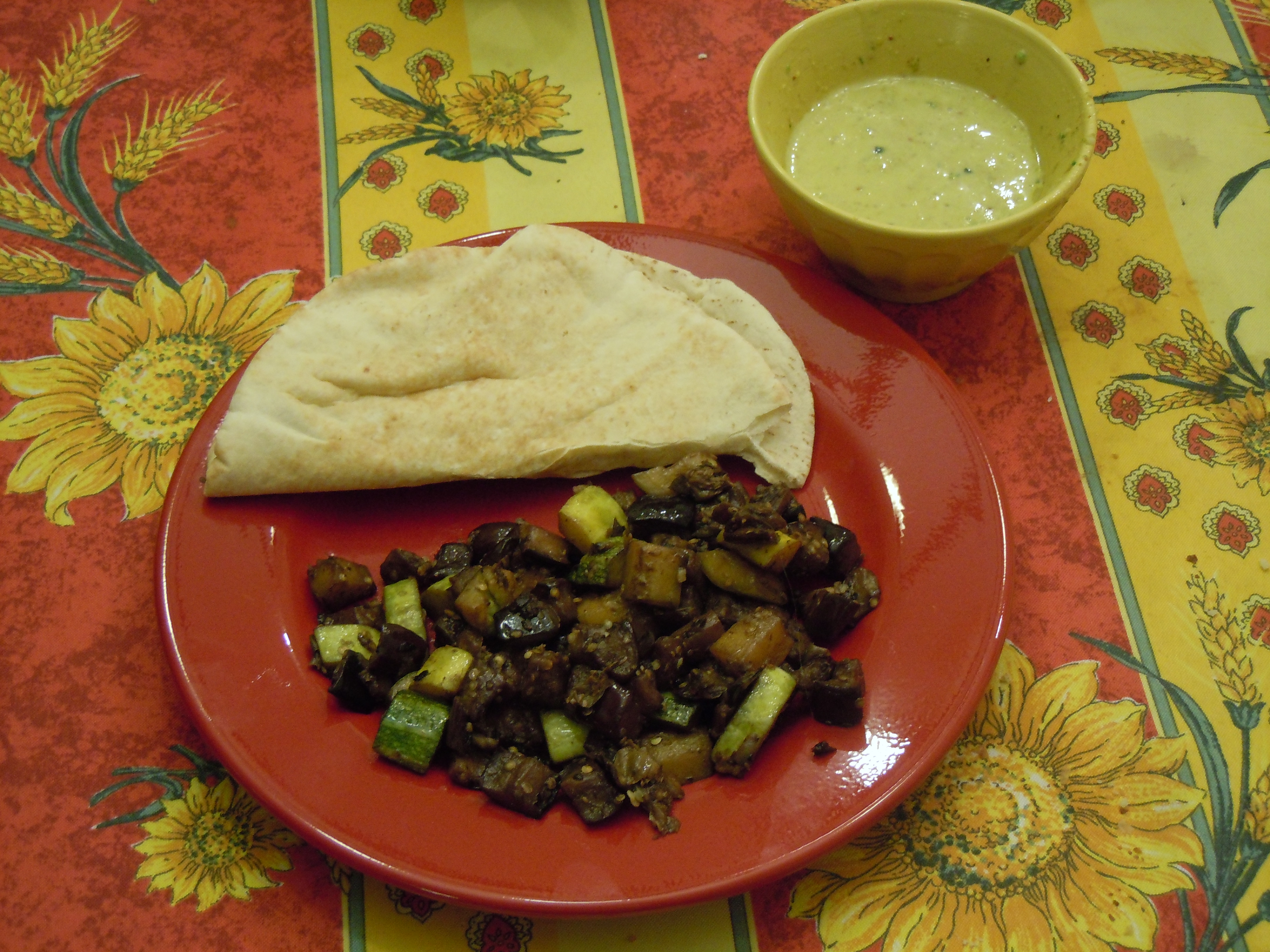
Summer vegetables are at their peak now, and in my home most of our meals are based on them. Mixtures that can be wrapped in a pita make a light easy meal on hot days. The filling can be made ahead, and keeps a few days in the refrigerator. OIl-cured black olives are used to add a meaty savor to eggplant and zucchini, and capers add an herbal note. This meal is vegetarian, and can be made vegan if you alter the sauce recipe a little.

Eggplant and Zucchini with olive paste

2 small or one large eggplant, fresh and firm
2 small zucchini
12-20 oil-cured black olives depending on your taste for them (no other kind of olive will do here)
3 tablespoons salted capers, rinsed and then soaked in cold water for an hour and squeezed dry
1/4 cup good olive oil
2 large or 3 medium cloves garlic
chopped parsley to taste, probably a couple of tablespoons

Cut the eggplant in cubes 1/2 inch or a little larger on a side. Whether you peel it first is up to you. The finished dish has a more tender texture if the eggplant is peeled, but less fiber and fewer antioxidants, so take your pick. Personally, I leave the peel on for this dish as long as the eggplants are young and tender. Cut the zucchini in quarters and slice each quarter into segments on the small side of 1/2 inch. Toss the vegetable cubes together in a bowl with 2 teaspoons of salt and let sit at least 1 hour, tossing occasionally. This step is important for this dish and shouldn’t be shortened. Don’t worry about the quantity of salt; if you do the squeezing step well, most of it will be removed with the liquid. You can soak the capers at the same time. Pit the olives and chop them coarsely, and chop the garlic finely. At the end of an hour, drain off exuded liquid and squeeze the veggie chunks in a clean kitchen towel, a few handfuls at a time, until as much liquid as possible has been squeezed out. Squeeze the capers dry and chop them coarsely. In a clay cazuela or 10″ skillet, heat a few tablespoons of the olive oil and add the garlic. Cook until opaque and cooked but do not allow it to start to brown even a little. Now add the olives, capers, and veggie chunks, toss to coat with the oil, and cook over low heat for about an hour, tossing occasionally and making sure it doesn’t burn on the bottom. Add a little water if needed to prevent burning.
Texture is very important. Start tasting a little after 45 minutes or even 30 if it looks like it’s cooking quickly. When the zucchini is just tender but not mushy, and the eggplant is melting in texture, it’s done. Also check for salt, but the seasonings are salty and you are unlikely to need any. Stir in the parsley just before serving. Serve with good pita bread, lightly warmed, and the sauce below.

Lemon-garlic sauce
This sauce is like an aioli but looser and less rich. The egg yolk just binds it and thickens it a little. If you leave out the egg yolk the whole dish is vegan, and the flavor doesn’t suffer at all but the texture will be liquid, not thick, and it will need to be stirred up by each diner before taking any.

1 egg yolk
1 large clove garlic
juice of half a lemon
1 Jalapeno pepper
olive oil as needed, usually about 1/4 cup.
salt to taste
1-2 teaspoons fresh thyme leaves

In a small food processor, chop the garlic clove and the chile pepper. I always mince fresh chiles before putting them in the processor to make sure that big chunks don’t startle diners. Add the egg yolk and lemon juice, process briefly, and slowly drip in the olive oil until it’s as thick as you want. I like it to be liquid and spoonable, but velvety. Taste and salt as needed. Add the thyme leaves and stir in. For the vegan version, proceed the same way except leave out the egg yolk, and be aware that it won’t thicken in the same way but will be more like a vinaigrette.
Don’t save leftover sauce more than a day in the refrigerator, because of the egg yolk, but I like to spread leftover sauce on a warmed pita for lunch the next day.

Still more greens, and notes on solar cooking


Since I got a solar oven, I no longer find it difficult to cook chickpeas, and so I’m looking for new ways to use them. I especially like combinations of greens and beans, partly because these primal and earthy dishes are found all over the world wherever people need healthy cheap food, and partly because they taste good. I’m cooking my way through a huge patch of lambs-quarters and amaranth (common pigweed) in my back yard, and getting healthy food from weedy places always satisfies my sense of economy. If you’re not a weed-eater, just use Swiss chard. I like a little smoked meat with greens, but if you don’t eat meat, just leave off the final garnish of bacon. This makes two large main-course servings with leftovers.

One pound young leaves and tender tips of lambs-quarters and amaranth, OR one large bunch of swiss chard, stems removed, chopped coarsely.
One pint cooked chickpeas, with just enough of the cooking liquid to cover them (see Solar Beans, below.)
3-4 tablespoons good flavorful olive oil
1 large onion, finely sliced
2 large cloves garlic, chopped finely
1 tablespoon of fresh thyme leaves
2 teaspoons Spanish Pimenton de la Vera, or smoked paprika
1/2 teaspoon red chile flakes
salt and pepper to taste
a little of your best olive oil for drizzling
1 thick slice bacon, fried crisp and crumbled (optional)
Wash the greens very well, make sure to remove any remaining large stems, and blanch them in boiling water for 1 minute. Drain, press out extra water, and turn out on a cutting board and chop coarsely in both directions. Meanwhile, heat a heavy pot (I like an unglazed clay 3 quart pot) over medium heat, warm the olive oil, and saute the onions in the oil until translucent and cooked through but not browned more than a little. Add the chopped garlic and saute until garlic is cooked. Add the smoked paprika, thyme leaves, and chile flakes, saute a minute but no more, and promptly add the chickpeas and their liquid. When this mixture comes to a boil, add the blanched and chopped greens, salt to taste, turn the heat to low, and let it all mellow together for 10-15 minutes. Check the seasoning, add pepper to taste, and serve with a good drizzle of very good olive oil on each serving and the crumbled bacon on top if you’re using it. With a hunk of good baguette and a glass of full-bodied straightforward red wine, it couldn’t be better or healthier. Without its bacon topping it’s vegan and can be served to people of that persuasion, with the bacon fillip for the carnivores at the table. People who are vegetarian but not vegan will enjoy a pat of butter melted on top to give a little richness. Hedonists will like both a little butter and a little bacon.

Solar cooking is a natural here in New Mexico, where we have more sunlight than we know what to do with.
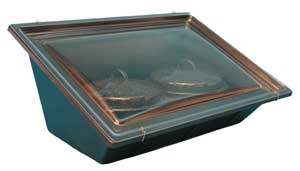
So, how do you cook solar beans? Fist you catch your solar oven. There are lots of easy plans on the internet for making them, but I chose to buy mine from the Solar Oven Society. Their solar ovens are capacious, lightweight, and every one you buy helps the society provide solar ovens to the third world, which avoids some deforestation and greenhouse gases from cooking fires. Their ovens are cleverly designed with two potential bases to provide a summer sun-catching angle and a winter sun-catching angle. Optional reflectors are available to achieve higher temperatures. You may want the optional reflectors for other purposes, but for cooking beans you won’t need them. Two graniteware pots are included with the oven, and you can put a pint of dry chickpeas in each one, cover with cold water by at least 2″, and set the oven up facing south in the morning with the two full pots inside. Then employ my special cooking technique: walk away, laughing a carefree laugh, and go to work or just get on with your life. On a reasonably sunny day, the oven without reflectors attached will reach a peak temperature of about 250 degrees and will stay in that range for much of the day. When you get home eight or nine hours later, you will find two steaming pots of perfectly cooked chickpeas, and you can salt them to taste, let them cool, and use immediately or freeze in pint containers with enough of their pot-liquor to cover. I love the oddly meaty-tasting cooking liquid and often use it as the broth for the finished dish, as I do above.
The directions that come with the oven imply that you need to turn it a few times to keep it facing the sun, but at least in summer I just point mine due south and forget about it. Other types of beans are also naturals for this solar slow-cooking, but they take less time, so I do them on weekends when I can check the oven in 4 hours or so to see how they’re coming along. For readers at lower altitudes than our 5500 feet, cooking times would tend to be much shorter. If the day clouds over, you may need to finish inside, or just put the pots in the refrigerator overnight and try again the next day. Don’t forget and leave the beans in the cool solar oven overnight, since some very nasty bacteria including botulinum could grow in room-temperature aqueous solutions. Cool them and pop them in the fridge or freezer when they’re cooked. Eat in the knowledge that you’re taking in all sorts of nutritive and cholesterol-lowering compounds that cost you no energy and very little trouble to cook. Beats canned, doesn’t it?

Passing Pleasures: Squash Blossoms


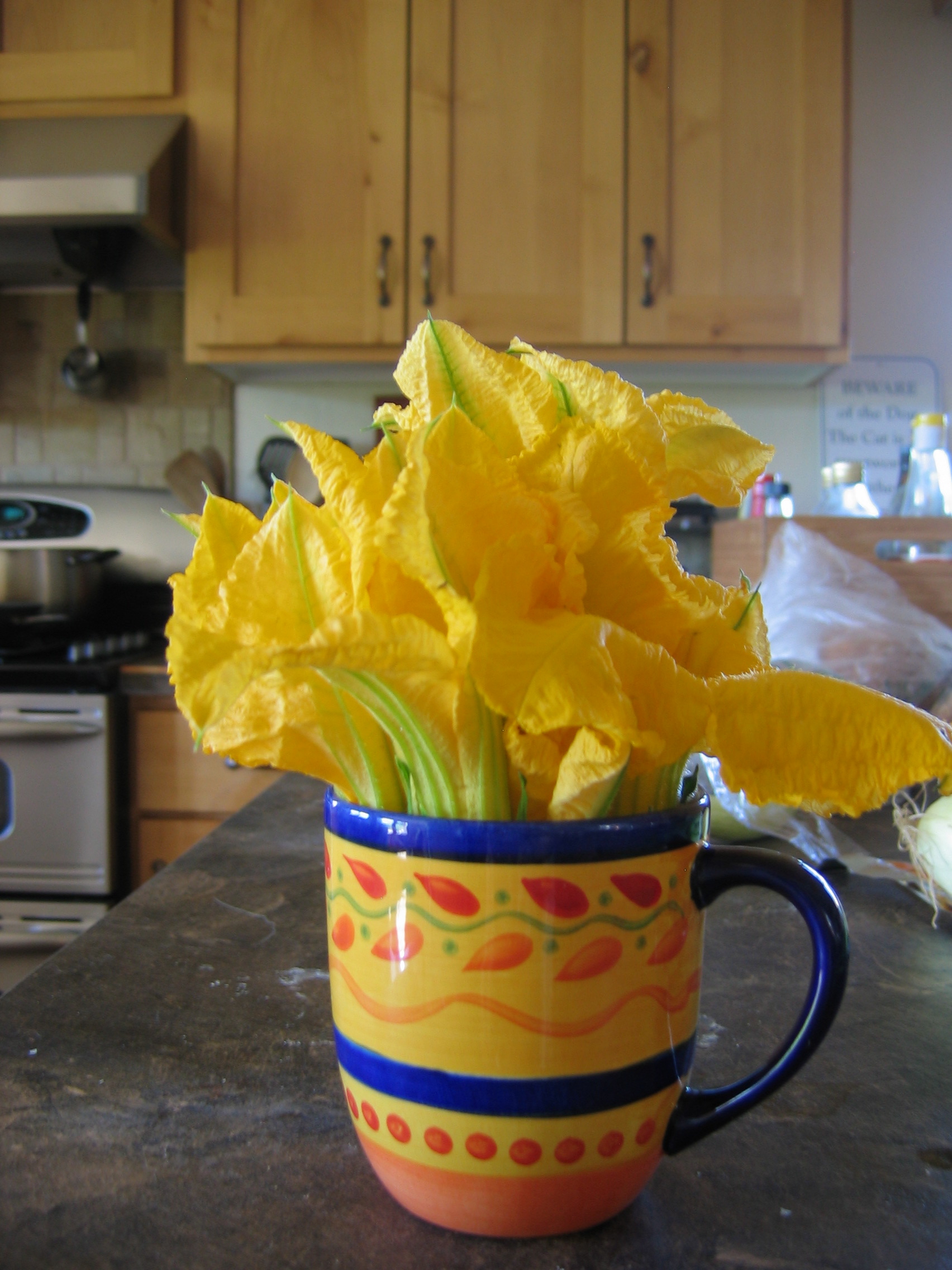
There are a lot of edible flowers, but no flower expresses the joy of summer as well as the resplendent squash blossom. The sheer exuberance of them in the garden on a July morning lifts the heart of anyone who sees them, and they are a delicious edible. They’re fragile, and your best chance of getting good ones is to grow them yourself. I like the flowers of winter squash and pumpkins best for eating. They are huge gold trumpets six or seven inches long. You can use the smaller flowers of zucchinis, but you’ll need almost twice as many. There are lots of ways to cook them, but my favorite method is to stuff them with a delicate ricotta and basil filling.
I pick only the male flowers, making sure to leave at least one male blossom in the squash patch every day for pollination purposes. You can also use the female flowers, which have embryonic little squash between the stem and the flower, but of course you won’t get as many squash if you pick females. These flowers are wildly attractive to bees, so check for bees inside before you pick the flower, and give them a chance to escape safely out in the garden. I rinse them well and place them trumpet-down on a dish towel to drain. Some sources tell you to pick out the stamens or pistol, but I don’t think this is necessary. Just get them clean and fairly dry. Then carefully pull or snip off the six long green sepals that stick up from the base outside the petals. These have a coarse texture and detract from the delicacy of the finished dish. The blooms need to be cooked the day they are picked. To keep them from morning to evening, wrap them gently in the damp towel that they drained on, put the bundle in a plastic bag, and refrigerate until dinnertime. It’s better to use them for lunch, though.

Stuffed Squash Blossoms
A dozen large squash blossoms or 20-24 small ones, rinsed and drained, stems trimmed off level with the base of the flower
1 pound of very fresh ricotta
1/2 cup very finely grated best quality Parmesan, loosely packed
6 large sprigs of basil, leaves picked off the stem and torn (NOT cut) into large chunks
White part of one large or 2 small scallions, very finely minced.
Long chive leaves, twice as many as the number of blossoms
5 tablespoons butter
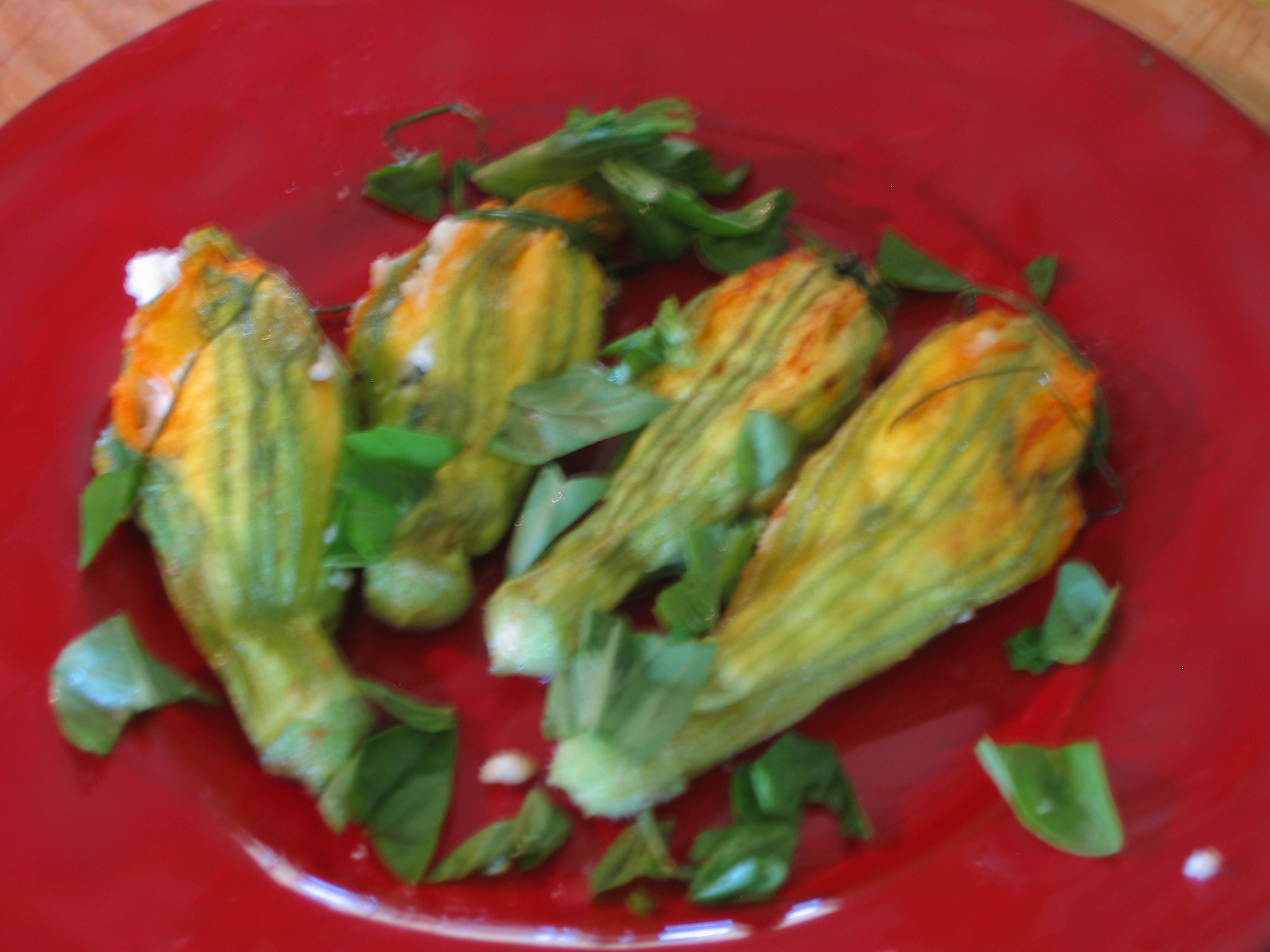
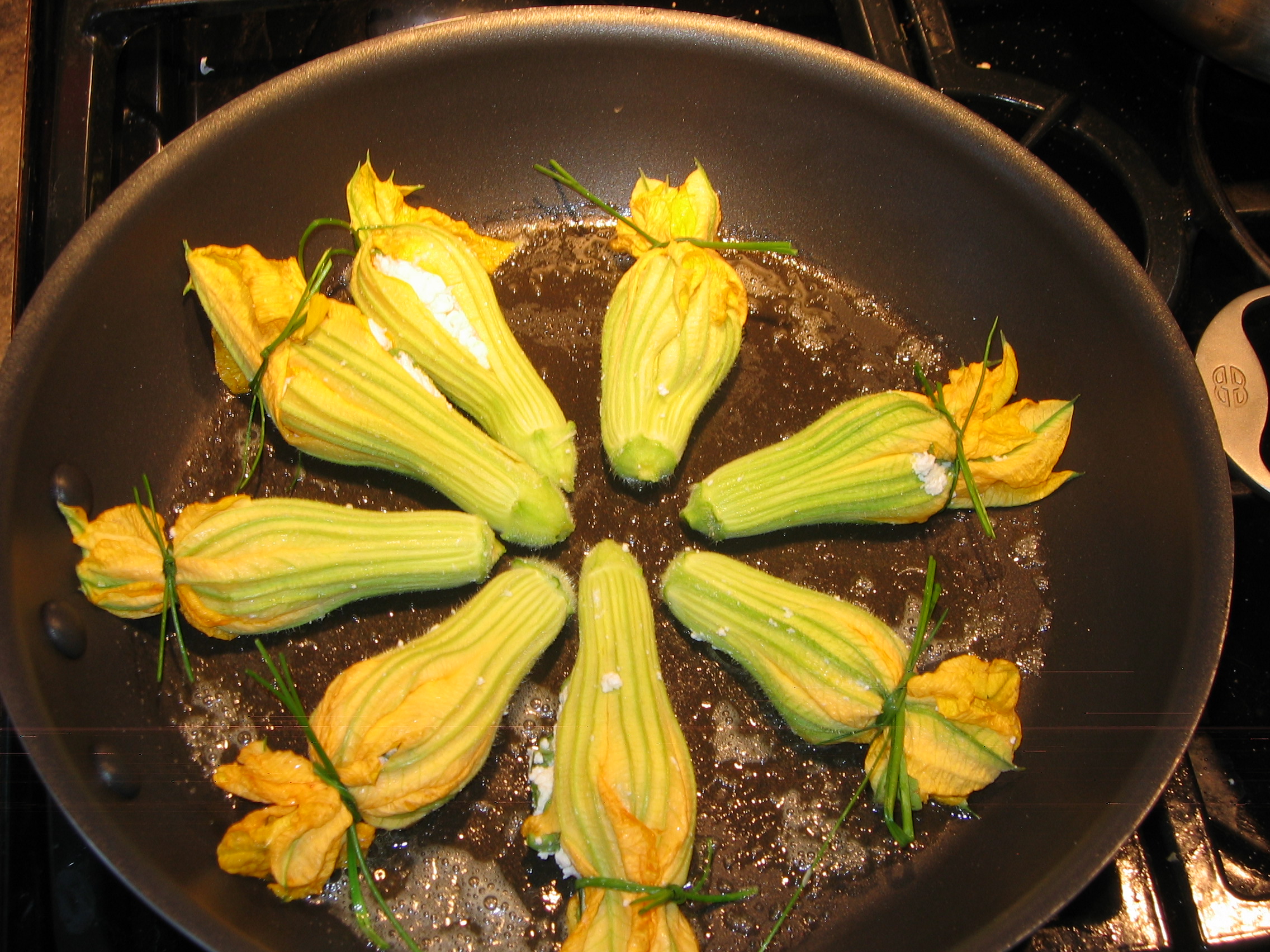
Make sure the ricotta is very fresh and free of bitterness. In a bowl, mix it with the Parmesan, minced scallion, and half the torn basil leaves. Taste the filling and add a little salt if needed, but don’t overpower the delicate flavors. Using your fingers and working very gently, fill each blossom with the cheese mixture. You will need to work a little down into each trumpet, but don’t tear them by pushing too hard. Fill each trumpet about halfway, and don’t overstuff. Now hold two long chive leaves together and tie a square knot at the end of each trumpet, and trim the ends to about 1″ long. I admit that this is a bit fiddly and not completely necessary, but the tied bundles look so attractive that I strongly recommend it. Now heat a skillet over medium heat, melt 3 tablespoons of the butter, and put in the filled blossoms. You will need to turn them about three times to get the blossoms cooked on all sides. Work very carefully with a small spatula and your fingers, so as not to tear them. Let them get slightly browned in spots but not darkened all over. The cooking usually takes me about 15 minutes. Then put them on plates, melt the remaining two tablespoons of butter in the pan and drizzle a little over each plateful, and scatter with the remaining torn basil leaves. Serve with a good baguette, and eat with gratitude for the pleasures of the season.

Kitchen Staples: Blue Corn Pancakes


I’ve written before about the wonderful blue cornmeal that’s available at the Los Ranchos Farmers’ Market on Saturday mornings. A local couple, the Molinas, grow the blue corn, shell the kernels off the ear, then (this is the important part) roast the kernels to bring out their flavor before grinding them to a flour-fine meal. I feel rather proud of having discovered this cornmeal because you can’t tell from any distance that they have it. Their small and unassuming booth is recognizable by the display of rocks that Oracio has picked up over the years. If you try to use another blue cornmeal, make sure it’s ground very finely, and if it has chunky bits in it, grind it again in the blender. Then toast the meal lightly in the oven until it has a light toasty smell, making sure not to burn it or let it darken. Personally, I buy it at the market and let Oracio and Lourdes do the work. It makes pancakes that will light up your weekend morning.

1 cup blue cornmeal, very finely ground
1 cup all-purpose flour
1 teaspoon salt
1 tablespoon agave nectar or light brown sugar
1 teaspoon baking powder
1-2 cups buttermilk
1/4 cup melted butter
3 real free-range eggs
clarified butter for frying (I seldom bother to clarify mine, but you have to fry more carefully with unclarified)
butter and maple syrup

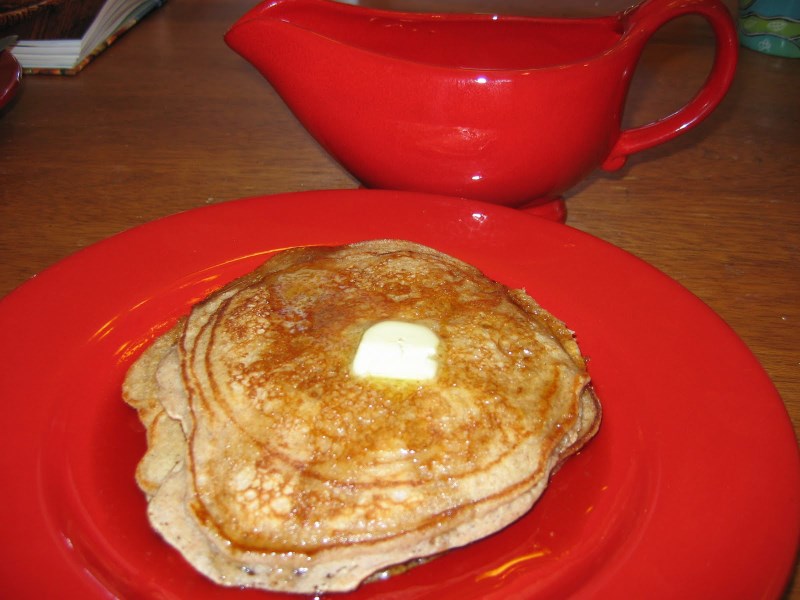
Mix the cornmeal, flour, baking powder, salt, and sugar if using together in a mixing bowl. Get your cast-iron skillet or other big heavy skillet heating over medium heat at least 5 minutes before you want to start cooking. Beat the eggs, the melted butter, and 1 cup of buttermilk together lightly. If using agave nectar instead of sugar, add it to the egg mixture. When the skillet is hot, mix the wet ingredients quickly and roughly into the dry ingredients, and add enough of the second cup of buttermilk to make a pourable batter. Film the skillet with clarified butter, pour in about a third of a cup of batter, and spread it out a little to make a pancake. Cook on the first side until the upper side shows little holes from the leavening, then flip skillfully and cook the other side until done. Slather with the best butter you can get, repeat to make a stack, and serve with real maple syrup.
A pancake is a very personal thing, and any recipe will need adjusting to your preference. I like the batter a little on the thick side and I can only judge this by eye, so I don’t measure the buttermilk after the first cup, I just mix enough in to make the texture right. I cook the first side until it’s lightly browned, as shown above, and then cook the second side to about the same color. I prod them a little with my finger to test for any uncooked dough in the center, but if you haven’t been doing this for a few decades, you may need to cut the first one open to make sure you’re cooking them through. I don’t cook over high heat because the outside gets too brown before the inside cooks through. I hate chunky inclusions of any kind, like berries and fruit. I like real maple syrup and don’t eat any other type. Other cooks say that thin batter is good, that browner is better, that oil or lard or bacon grease are the best cooking mediums, that honey is better than syrup, and I understand that some people are so lost to decency as to put cheese, chocolate chips, or big hunks of fruit in pancakes. Suit yourself. That’s the joy of cooking at home.
By the way, it is possible and even fun to cook with two skillets, or with a big griddle, and get pancakes on the table more quickly.