Archive for the ‘kitchen staples’ Category

The Greens of Spring: Green Herb Pasta

march-2009-001
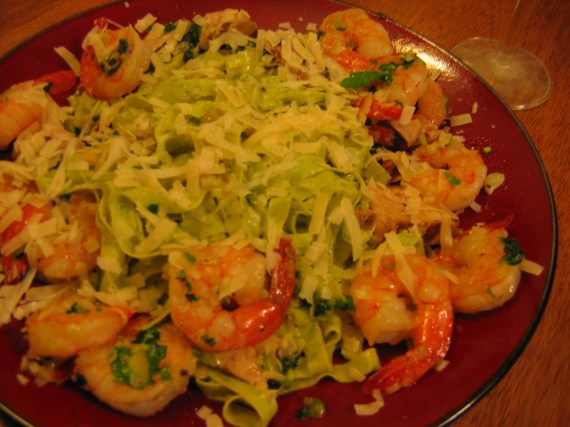
One of the great pleasures of gardening is commemorating each new emergence in spring, and in  food gardening, one tends to commemorate them by eating them. Here, the herbs that are springing up everywhere make a pasta dish that is wonderfully tasty and varies every time you make it. If this doesn’t inspire you to plant your own herbs, probably nothing will.
My instructions will be relatively brief, so if you aren’t familiar with pasta-making, consult a good Italian cookbook such as The Splendid Table by Lynn Rosseto Kaspar. This is one of the few times when I use a food processor to start pasta dough.
This amount serves at least six as a first course, four as a main course, or two real pasta-pigs with lots of leftovers to take to work for lunches.

First, gather your herbs. Aim for a generous bunch. About half should be parsley. For the other half, see what’s springing up outside and decide what you plan to serve with the pasta. I like a good big handful each of chives and cutting celery leaves, the leaves of one small twig of rosemary (more if you plan to serve the noodles with lamb,) a few leaves of arugula, and about a tablespoon of thyme leaves. Later in the season, basil or marjoram might figure prominently. In the winter, green onions (green part only) and chervil might predominate, with some winter savory for oomph. You get the general feel of the thing.
Chop all the herbs coarsely. Put three cups of flour in the food processor, add the herbs, and process until they’re well distributed and finely chopped. Have five very good eggs handy. Add them one at a time, processing for at least 30 seconds after each one. Probably you will only need four of the eggs. When the “crumbs” in the processor bowl just start to come together into a dough, stop and finish by hand. Sorry about the work, but it’s much better that way. Turn out onto a lightly floured cutting board and knead until the dough comes together, adding a little water if necessary, or more flour if that’s what’s needed to make a nonsticky dough. Now knead for ten minutes, until smooth and elastic. Dust the dough ball with a little flour, cover with plastic wrap, and let sit half an hour.
When the dough has rested, roll it into sheets and cut into noodles by your favorite method. If you roll pasta by hand, you will go to Heaven. But if you use your handy machine, either powered or hand-cranked, you will eat fresh pasta a lot more often, and that’s a kind of heaven too. Take your pick.
Either way, when the noodles are ready, you can pack them in plastic bags and store in the refrigerator for two days, or in the freezer for a month. When ready to proceed, bring a large pot of well-salted water to a boil, and dump in the noodles. As soon as the water returns to a boil, start testing them for doneness. The cooking should take about a minute, but may take longer if you let the dough dry out a lot after rolling.  Be very careful not to overcook. You do want then al dente
Drain the noodles and toss with a good-sized knob of butter or a half cup of heavy cream or both (note to self: stop revealing your spirit of wretched excess) and about a cup of the best Parmesan you can find, grated. Grind a little black pepper over the top, garnish with a little more grated Parmesan, and serve.
If you’d like to add some herbed shrimp to the plate, click here
The Greens of Spring: Hortapitas

march-2009-005
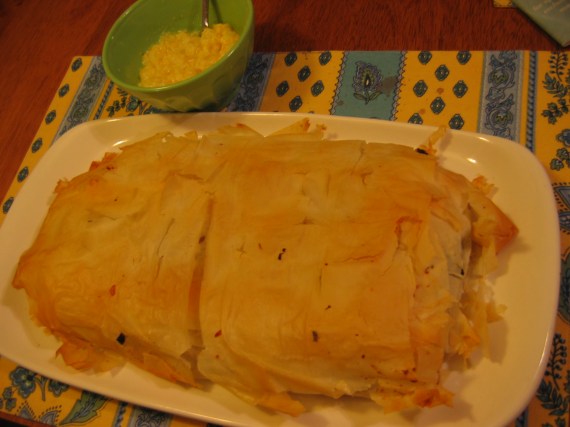
We’re eating meatless until Easter, and with an active vegetable garden that’s no hardship. This is a great time of year for greens, and one of my favorite ways to eat a lot of greens is in a hortapita, or borek, a wild-greens pie found under various names throughout the Mediterranean. For a complete and scholarly exploration of the borek, see Paula Wolfert’s Mediterranean Grains and Greens, which is full of delicious recipes. My own method is rough and unscholarly (surprise!) , but produces tasty greens pies thoughout the season with a minimum of fuss.
First, catch your greens. You need somewhere between 1.5 and 2 pounds of them. My most recent borek was made with chard, nettles, bolted arugula, mustard greens, chicory, green onions, and herbs because that’s what I had a lot of at the moment. I try for a ratio of about half strong-flavored and half mild-flavored greens, but many people may prefer more mild greens. Chard and nettles are mild, while mustard, chicory, and bolted arugula are strong-tasting, so I was careful not to let strong exceed mild in bulk. If you’re buying your greens, a bunch each of chard, dandelion (which is actually chicory) and some zippy green like aruguloa or watercress should come out to the right amount. For flavoring, fennel fronds are a necessity in my book. A handful of the nonbulbing kind, or two handfuls of the relatively weak-flavored fronds of bulb fennel, plus a handful of parsley is always a good start. If you can’t get fennel fronds, use a small handful of dill. Then add other herbs to taste. A tablespoon each of thyme leaves and oregano leaves is my go-to addition, but savory, marjoram, shallot greens, sage (in very small quantities) and tarragon are all possibilities. Just make sure to taste the finished greens mixture carefully for any needed adjustments.
First, chop 2-4 cloves of garlic depending on your taste for garlic, and the white parts of 6-7 green onions (chop the green parts separately and reserve them for later.) Saute the garlic and onion bottoms over low/medium heat in olive oil (about a quarter cup) in a very large skillet or a large flat-bottomed saucepan. Meanwhile, lay all your well-washed greens on a cutting board, one bundle or large handful at a time, and slice them crosswise into thin strips. When the garlic is cooked but not colored at all, add the greens. It will make a huge pile, and this is why you need a big skillet. Continue to cook, turning every few minutes, until the greens are thoroughly wilted. Now add the herbs, finely chopped, and the chopped onion greens. Cook and stir for another few minutes. Now remove from the heat, and either proceed with your borek or refrigerate until later. You can keep the greens mixture for up to two days refrigerated.
When you’re ready to proceed, thaw a package of phyllo pastry and put some olive oil in a bowl at your workspace. Keep the phyllo covered with a barely-damp towel when you aren’t working with it. Taste your greens mixture, salt to taste, add a few more herbs if needed, and decide whether you want to add cheese. Crumbled feta is good, as is nearly any grated cheese if it has no added flavorings. Consult Ms. Wolfert if you are a stickler for authenticity. If not, think about what would taste good to you. Some grated Parmesan is a completely inauthentic addition, but quite delicious. The amount to be added depends on the flavor of the cheese. Add a little to the greens, mix in well, taste, add a little more, taste again. No set amount will work, since you’ll be using a different greens mixture every time you make this dish. If you prefer not to add cheese, a handful of toasted pine nuts is very tasty.
Lay out one sheet on a large baking sheet, brush it lightly with olive oil, lay another sheet on top, brush with oil, repeat. When you have six sheets in place, put the greens mixture in the center and spread it out until it’s about an inch thick. Turn the excess phyllo around the sides over the top. Now brush another sheet with oil, roughly fold it in half, and layer it over the top. Continue until your top “crust” is six layers thick, and tuck the overhang under the edges of the borek. Bake at 350 degrees until gold and crisp on top. Eat hot, warm, or at room temperature. A little bowl of Lemon Oregano Jam, which will be posted soon on my recipe page, is a lovely addition and freshens the flavor wonderfully.
The variations are endless: bread dough crust rather than pastry, different greens, different herbs, different cheeses, and additions of cooked grains like bulgur are all possibilities. I recommend against adding very strong-flavored greens like kale or turnip greens, but if you’re very fond of those greens, be my guest. Green leafy vegetables are among the very healthiest foods that you can eat, packed full of vitamins, minerals, and antioxidants, and anything that induces you to eat more of them is on the side of the angels.
For more about greens for hortapitas, click here!