
Archive for the ‘greens’ Category

The Greens of Spring: Greens Enchiladas

march-2009-056
This recipe makes no claims to be authentic Mexican, but it’s healthy and delicious, so enjoy it for what it is. It’s certainly in the Mexican spirit of making use of what comes along. I should mention that the idea came from Rick Bayless’s famous “greens tacos,” so thanks, Rick. I used mild and velvety blanched nettles for the greens . See my earlier post on nettles if you aren’t familiar with them.

For two servings:
6 corn tortillas
A little oil for pan-frying the tortillas
1 cup blanched mild greens; Swiss chard, spinach, mallow, nettles, or a combination.
1 pint Roasted Tomato and Tomatillo Salsa; see my  website Recipes page under “tomatoes,” or substitute your own favorite cooked salsa. Raw salsas like Pico de Gallo won’t work here.
¼ pound grated Monterey Jack cheese
¼ pound Cotija cheese (or use extra Monterey Jack for a milder flavor)
½ cup chopped cilantro

Fry the tortillas briefly, or cook them on a comal if you prefer. Set them aside. Chop the greens well, mix with 1 cup of the salsa, and heat to a full simmer, stirring frequently. Spread ¼ of the greens mixture on each of two tortillas, and scatter a bit of cilantro over. Top each with another tortilla, and spread with the rest of the greens mixture and sprinkle on a little more cilantro. Top each stack with one of the remaining tortillas, spread the tops and any exposed edges of the stacks with the rest of the salsa, and top with a mixture of the two cheeses or just with shredded Monterey Jack. Bake at 400 degrees until hot and the cheese is melted. You can brown it briefly under the broiler, if you wish. Serve garnished with the remaining cilantro.
This makes a wonderful lunch or light supper. For a more filling dinner, top each stack with a fried egg. Good with beer.
In the picture above, some calendula petals are scattered around with the cilantro. They don’t have much flavor, but add a lovely sunny color.
The Greens of Spring: a meal on a pita

february-09-008
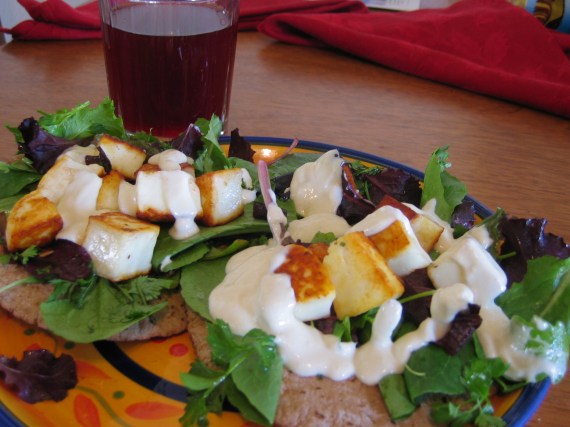
Halloumi cheese from Cyprus grills beautifully, and make a wonderful meatless “barbecue” to combine with your garden produce. It’s a great way to reduce your meat intake, if you want to do that, or just have a lovely and healthy meal.
First, catch your salad. You need a goodly quantity of the freshest salad greens, and it tastes best if some sharp flavors like young mustard, arugula, and herbs are included. My choice for this meal is a smallish bunch each of young mustard and arugula, with a few baby lettuce leaves (preferably red, for contrast,) about a quarter cup of a finely chopped combination of parsley and cilantro, a few fronds of fennel chopped, and about a teaspoon of thyme leaves. If I were using store-bought greens, I’d use half young letture and half watercress, plus the herbs, for a sharp but not aggressive taste. Commercial mustard greens are too mature and strong to use in salads. A handful of chopped chives or shallot greens is a great addition. Remember, herbs are loaded with antioxidants, and they taste great. For two people, you need about a quart of mixed salad greens, tightly packed.

Now locate your Halloumi. La Montanita Co-op and Whole Foods both have it in our area. Then you can proceed with the cooking part:

Dressing:
¾ cup extra virgin olive oil
5 tablespoons chopped fresh parsley
5 teaspoons grated lemon zest
1 teaspoon salt (or to taste)
1 teaspoon freshly ground pepper
¼ cup lemon juice
6 teaspoons chopped cilantro
4 cloves garlic, chopped
¼ cup capers (rinsed and soaked if salt-cured)

Make the dressing by combining all ingredients in your mortar and pestle (see my recipe page under Herbs for more about this) Pound until nicely amalgamated. Set aside. If you use the food processor instead, be careful to leave it with a vigorous texture. Avoid processing to mush.

2 ¼ pounds Cypriot Halloumi cheese, cut into 16 cubes
A few tablespoons of olive oil

Preheat a gas barbecue to medium heat, or let a coal barbecue heat until all coals are mostly white. Coat the cheese lightly with the olive oil. Grill the cheese cubes until they have caramelized on at least two sides. If you don’t feel like grilling, cook them on the stove in a heavy, hot skillet.

Meanwhile, lightly toast two or four whole wheat pitas, depending on appetite.

While the cheese finishes browning lightly, put the hot pitas on plates, two to a plate if you’re really hungry. Toss the greens and herbs with some of the sauce, pile them on the pitas, and distribute the hot cheese cubes on top. Drizzle with more of the sauce and eat. Even an avid carnivore is unlikely to feel shortchanged.

You will probably have a good bit of leftover sauce, and can use it to dress a little pasta for a quick one-person meal. Crumble on a little feta or Kefalotyri if you like.

A delicious variation is to hard-boil two or three eggs per person and slice them. Spread the slices over the dressed greens, and dribble on the sauce. It makes a nice post-Easter lunch, when you’re sick of looking at those eggs.

ADDENDUM: A friend who follows my blog gently pointed out that the sauce in the picture couldn’t be the one in the recipe. Major oops: I posted the wrong picture. But the pictured dressing is delicious on grilled halloumi too, so I decided to leave the picture and add the recipe for Tahini Dressing. Crush a clove of garlic in a mortar and pestle with half a teaspoon of salt. Add the juice of half a lemon and two tablespoons of tahini. Stir untilwell amalgamated, and add enough olive oil to give the consistency of thick cream. I usually use about 3 tablespoons, or a little more. Use a little plain olive oil to dress your greens, arrange them on a pita, and scatter the Halloumi cubes on top. Drizzle over the dressed greens and grilled Halloumi.

The Greens of Spring: Hortapitas

march-2009-005
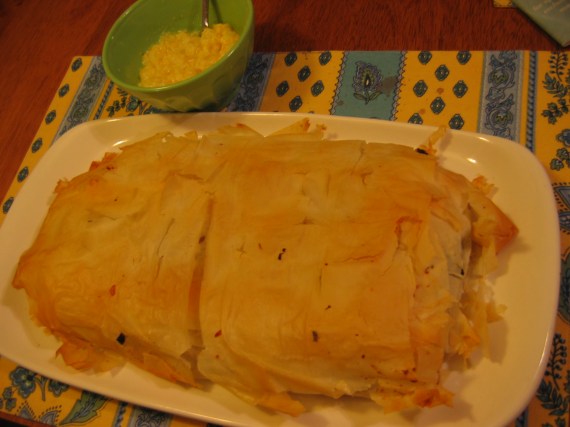
We’re eating meatless until Easter, and with an active vegetable garden that’s no hardship. This is a great time of year for greens, and one of my favorite ways to eat a lot of greens is in a hortapita, or borek, a wild-greens pie found under various names throughout the Mediterranean. For a complete and scholarly exploration of the borek, see Paula Wolfert’s Mediterranean Grains and Greens, which is full of delicious recipes. My own method is rough and unscholarly (surprise!) , but produces tasty greens pies thoughout the season with a minimum of fuss.
First, catch your greens. You need somewhere between 1.5 and 2 pounds of them. My most recent borek was made with chard, nettles, bolted arugula, mustard greens, chicory, green onions, and herbs because that’s what I had a lot of at the moment. I try for a ratio of about half strong-flavored and half mild-flavored greens, but many people may prefer more mild greens. Chard and nettles are mild, while mustard, chicory, and bolted arugula are strong-tasting, so I was careful not to let strong exceed mild in bulk. If you’re buying your greens, a bunch each of chard, dandelion (which is actually chicory) and some zippy green like aruguloa or watercress should come out to the right amount. For flavoring, fennel fronds are a necessity in my book. A handful of the nonbulbing kind, or two handfuls of the relatively weak-flavored fronds of bulb fennel, plus a handful of parsley is always a good start. If you can’t get fennel fronds, use a small handful of dill. Then add other herbs to taste. A tablespoon each of thyme leaves and oregano leaves is my go-to addition, but savory, marjoram, shallot greens, sage (in very small quantities) and tarragon are all possibilities. Just make sure to taste the finished greens mixture carefully for any needed adjustments.
First, chop 2-4 cloves of garlic depending on your taste for garlic, and the white parts of 6-7 green onions (chop the green parts separately and reserve them for later.) Saute the garlic and onion bottoms over low/medium heat in olive oil (about a quarter cup) in a very large skillet or a large flat-bottomed saucepan. Meanwhile, lay all your well-washed greens on a cutting board, one bundle or large handful at a time, and slice them crosswise into thin strips. When the garlic is cooked but not colored at all, add the greens. It will make a huge pile, and this is why you need a big skillet. Continue to cook, turning every few minutes, until the greens are thoroughly wilted. Now add the herbs, finely chopped, and the chopped onion greens. Cook and stir for another few minutes. Now remove from the heat, and either proceed with your borek or refrigerate until later. You can keep the greens mixture for up to two days refrigerated.
When you’re ready to proceed, thaw a package of phyllo pastry and put some olive oil in a bowl at your workspace. Keep the phyllo covered with a barely-damp towel when you aren’t working with it. Taste your greens mixture, salt to taste, add a few more herbs if needed, and decide whether you want to add cheese. Crumbled feta is good, as is nearly any grated cheese if it has no added flavorings. Consult Ms. Wolfert if you are a stickler for authenticity. If not, think about what would taste good to you. Some grated Parmesan is a completely inauthentic addition, but quite delicious. The amount to be added depends on the flavor of the cheese. Add a little to the greens, mix in well, taste, add a little more, taste again. No set amount will work, since you’ll be using a different greens mixture every time you make this dish. If you prefer not to add cheese, a handful of toasted pine nuts is very tasty.
Lay out one sheet on a large baking sheet, brush it lightly with olive oil, lay another sheet on top, brush with oil, repeat. When you have six sheets in place, put the greens mixture in the center and spread it out until it’s about an inch thick. Turn the excess phyllo around the sides over the top. Now brush another sheet with oil, roughly fold it in half, and layer it over the top. Continue until your top “crust” is six layers thick, and tuck the overhang under the edges of the borek. Bake at 350 degrees until gold and crisp on top. Eat hot, warm, or at room temperature. A little bowl of Lemon Oregano Jam, which will be posted soon on my recipe page, is a lovely addition and freshens the flavor wonderfully.
The variations are endless: bread dough crust rather than pastry, different greens, different herbs, different cheeses, and additions of cooked grains like bulgur are all possibilities. I recommend against adding very strong-flavored greens like kale or turnip greens, but if you’re very fond of those greens, be my guest. Green leafy vegetables are among the very healthiest foods that you can eat, packed full of vitamins, minerals, and antioxidants, and anything that induces you to eat more of them is on the side of the angels.
For more about greens for hortapitas, click here!

The Greens of Spring: Stinging Nettles

march-09
Stinging nettles are a pernicious weed in damp parts of the country. The sting is painful and the plant is weedy-looking. So why did I make an effort to have them here in New Mexico? Well, because the greens are delicious and extremely nutritious and they come up with no effort once established.
I had no luck starting from seed, and bought plants from Richter’s in Canada. They are a wonderful source for rare herbs, and well worth knowing about. The plants arrived last spring. I put them in a piece of waste ground where nothing much would grow and where they would be prevented from excessive spreading by walls and mown paths . This is very important, because once established, they turn their forces toward world domination. I watered them deeply once a week and mulched them heavily.
This spring, each little plant from last year is surrounded by dozens of offspring. They sting fiercely, so don’t go near them without gloves and long pants. When they’re about six inches high, use heavy gloves and a pair of scissors to harvest them. Wash in a few changes of water, using wooden spoons to swirl them in the water and lift them out to avoid the thousand tiny painful injections of formic acid that they are trying to give you. Until they are cooked well, they can sting. Now cook them any way you like. My favorite way to cook the first batch of spring is to put them in a hot skillet with some water still clinging to them, add a knob of good butter and a little salt, turn the heat down, and saute’ until cooked. Turn out on a cutting board, chop well (I hate long stringy stems in greens, and since nettles have stringy stems, I strongly recommend that you don’t skip this step) and serve with a little more butter on top. They are a startling deep iron-green and very, very good. Later in the season, I use them in greens mixtures and boreks and all the ways I love to eat greens. For more of my favorite greens recipes, visit my website’s recipe page.
Within six weeks of the first picking, they will be coarse and no longer taste good, and their texture will become gritty and unpleasant. This is why you want them in an obscure spot. Control their spread, avoid being stung, let them do their weedy thing, and turn your attention to other vegetables. Early next spring, when you’re sick of cold winds and desperate to reconnect with the awakening earth,they’ll be there.