Garlic went through a period of being a fad health supplement for its allicin content. Allicin is an antioxidant to which miracles were ascribed at the time. Now that the fad is long over, maybe we can return to the subject in a more measured way, and eat some delicious food while we’re at it.
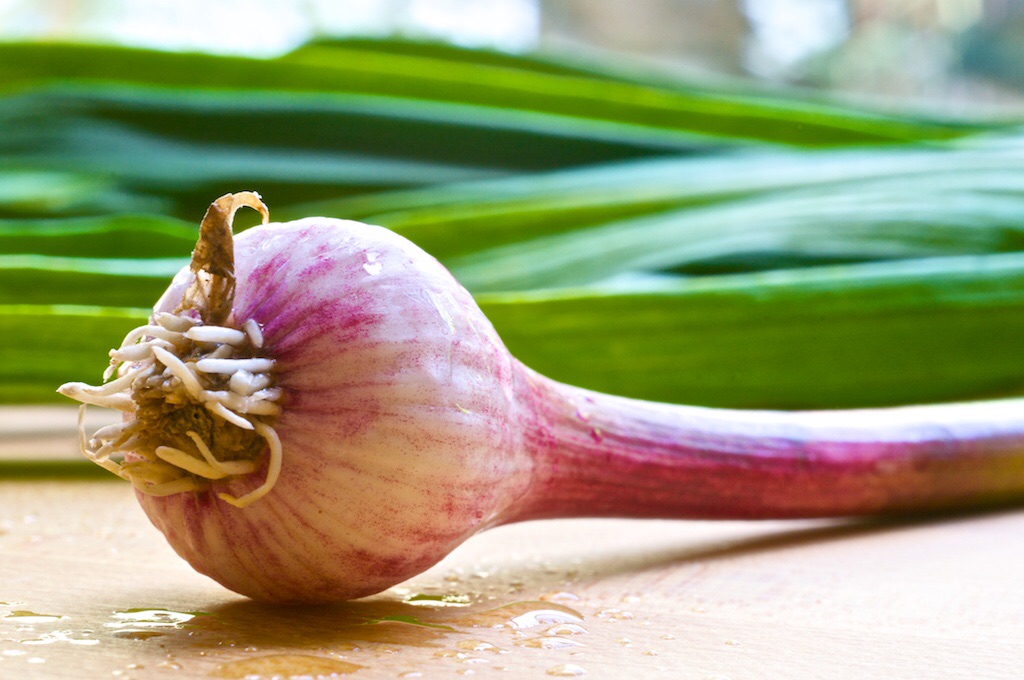
There is relatively little allicin in mature culinary garlic, since it is found mostly in the skin. But there’s a way to eat a lot of it and enjoy it: eat green garlic, which is also a culinary delight. Garlic cloves are planted in early fall, and the greens shoot up in early spring. They vary in size according to variety. They are edible at any stage, from the tiny ramp-like beginning to nearly-mature but still soft-skinned bulbs as shown above. When the stem begins to thin and wither and the leaves look distinctly un-fresh, it is maturing and should be used as bulb garlic rather than green garlic. And here’s how to get your antioxidants in full: in the green garlic stages the whole plant is edible and tasty, and the leaves, shoot, and tender skin contain most of the allicin (reference below). The leaves, stem, and skin( after the outermost layer is peeled off) all go into your sauté pan. Cut the root end off, trim the leaf tips, wash well, slice very thinly the whole length of the nascent bulb, shaft, and leaves, chop finely, and sauté in butter or olive oil with a good punch of salt until tender. Keep the heat medium to medium-low and plan to spend 15 minutes or so on the process, lowering heat as needed. It is done when it tastes rich, garlicky, mellow, and a little sweet. Do note that slicing it very thinly crosswise in the beginning is key to the shoot and leaves being pleasant to eat, since they contain strong lengthwise fiber. They can be used as the basis of any dish that includes garlic, unless the green color would be a problem, in which case just use the bulb and tender inner skin. I also like the whole sautéed plant as a vegetable side dish when it comes from the milder varieties of garlic. If I am going to eat it by itself, I slice thinly crosswise but don’t chop the slices up, so there is some textural interest in the finished dish. Also, make sure to salt to taste during cooking, not when finished, so that the salt can penetrate. This is really good next to a lovely steak.

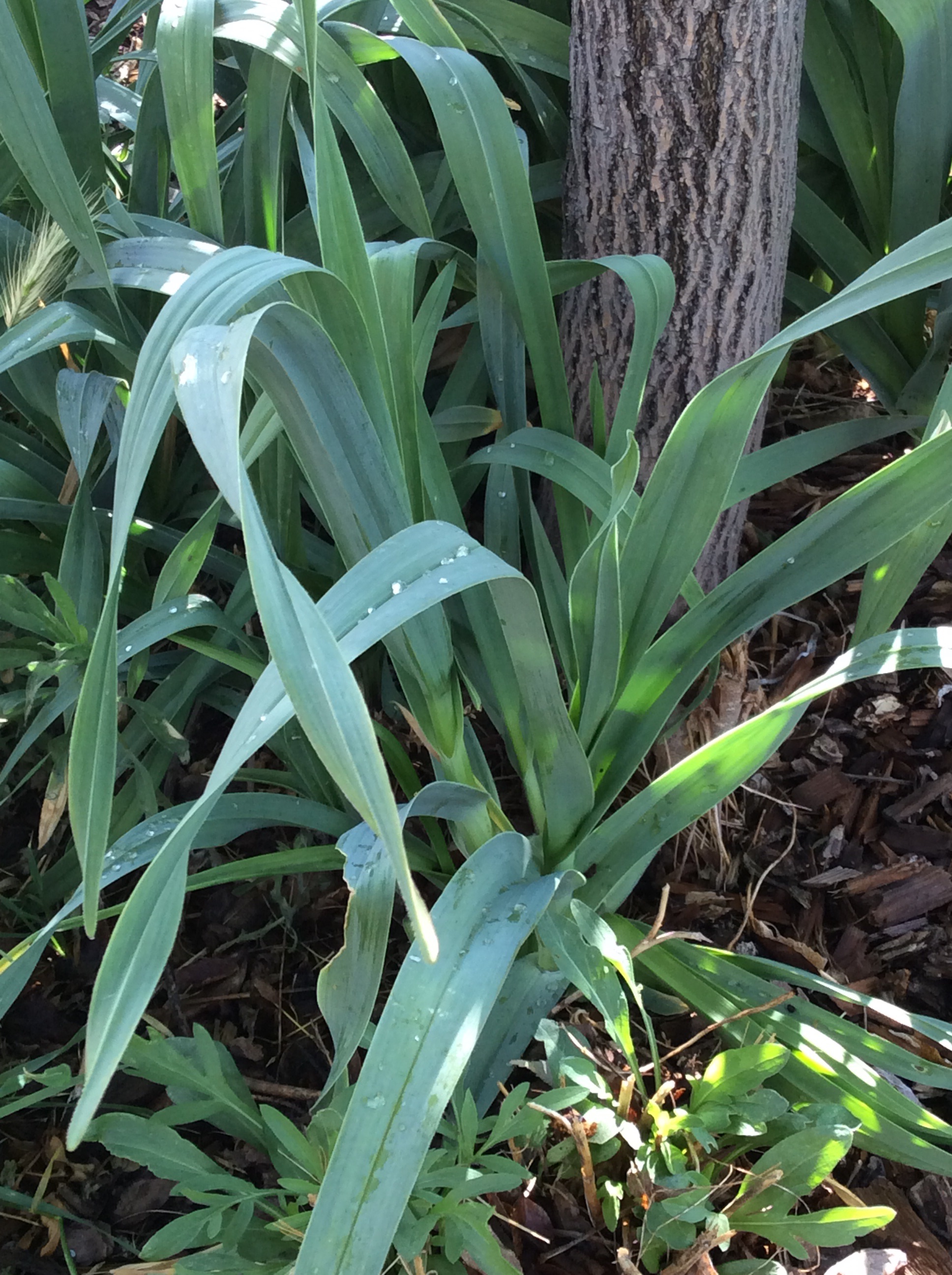
Don’t forget that you can tuck a useful amount of green garlic into flowerbeds and at the bases of trees. Just don’t confuse it with daffodil foliage or other poisonous plants with similar long narrow leaves. If in any doubt, tear a leaf and sniff. Garlic leaves smell like garlic!
I have heard that the leaves can also be dried, powdered, and used as a seasoning, but I’ve never tried it and don’t vouch for it. I go for fresh stuff.
Here’s your reference on the allicin content:
“Department of Pharmacology, School of Medicine, Ardabil University of Medical Sciences, Iran
Food Chemistry (Impact Factor: 3.26). 05/2010; 120(1):179-183. DOI: 10.1016/j.foodchem.2009.10.004
ABSTRACT The presence of allicin in green garlic plant extracts was investigated. Allicin in aqueous extracts from green garlic leaf, shoot and young bulbs were determined by HPLC. Allicin was present at highest level in extracts from whole green garlic plant at 0.48 ± 0.01 mg/mL, followed by that in shoot and leaf extracts at 0.44 ± 0.00 and 0.26 ± 0.01 mg/mL, respectively. The results obtained in this study offer green garlic as a new source of allicin, as green garlic plant is used as a favourite vegetable in many countries.”
Archive for the ‘greens’ Category
10 May
Eat Your Allicin! Notes on Green Garlic
9 May
The Offbeat “Broccolis:” brocolettas in the spring garden
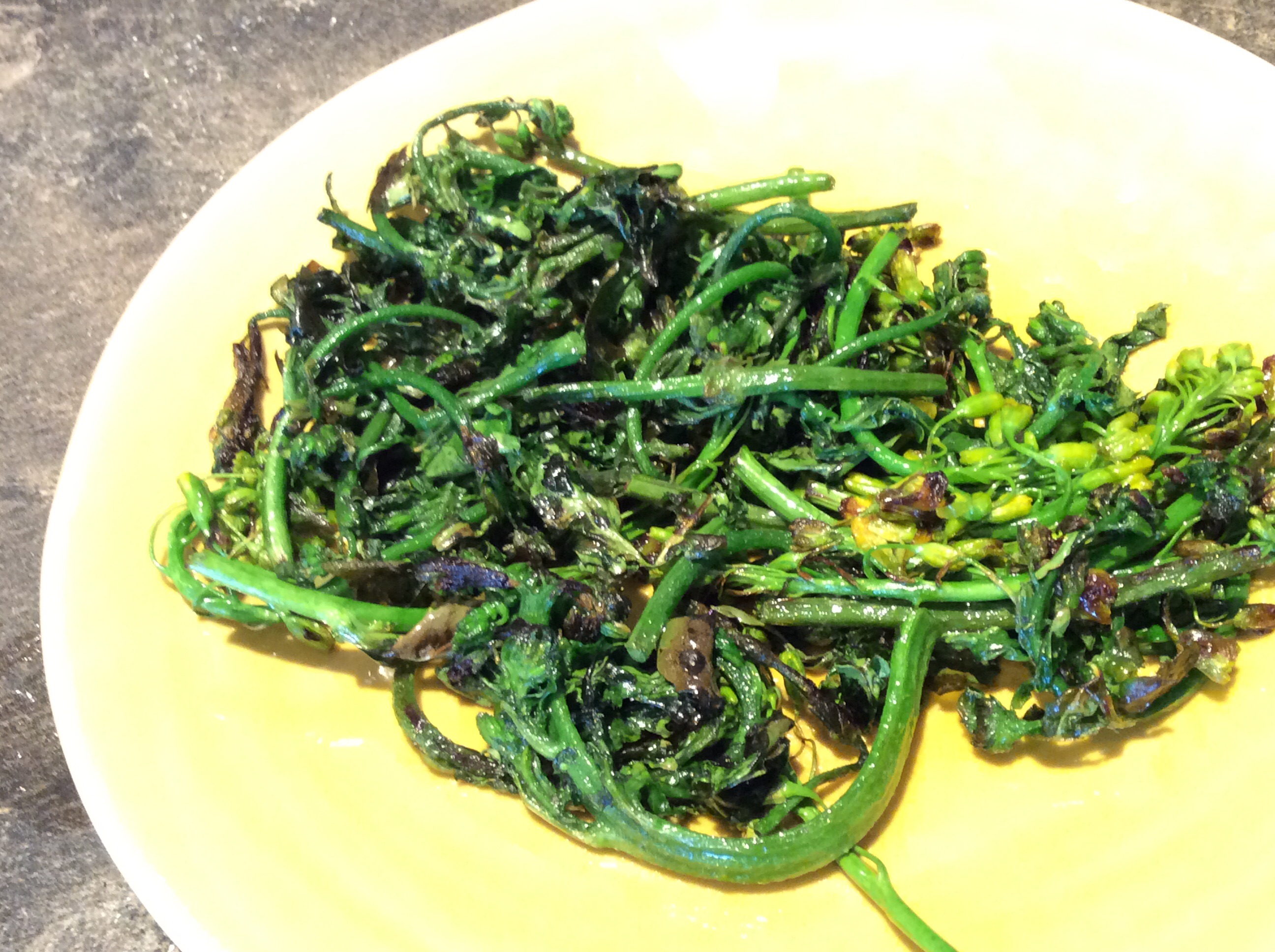
Broccoli is widely touted for its nutritional content and culinary versatility, and my garden beds are full of broccoli-in-waiting, but there is also “broccoli” to be had right now. All the common garden crucifers produce bud clusters when they shoot to seed, and all of them are good to eat when snapped off before the flowers open. Some go to seed the first year, and some have to go through a winter before they bolt. I try to use cover crops that will be edible as greens and also offer me a “second harvest” of bud clusters. Currently I am harvesting bud clusters from arugula, daikon, and the collards that I over-wintered for seed production (they make a huge amount of buds, and a few clusters will never be missed). Arugula is especially good for this purpose, because first you get those exquisite nutty-peppery salad greens, second the top-bud harvest with its wild, unimproved, bitter-edged flavor, then the remaining buds open and are wildly attractive to bees, and finally the remainder of the plant enriches your soil when chopped and dug in, all in the span of a few months. I buy the seed in bulk and cover-crop it whenever a piece of garden bed is going to be empty for a little while. You can also harvest buds from bolted radishes and wintered-over kale, and probably a lot of things that I haven’t tried yet. Be aware that they are tiny, and you need a lot of plants to have enough to cook. I have heard these offbeat buds referred to as “broccolini” or “brocoletta.” I call them brocolettas, because “broccolini” really refers to a form of domestic broccoli with long, small stems.
When I call the flavor “unimproved,” I am referring to the fact that our common domestic vegetables are bred for the mildest flavor possible. The things that I grow and forage for are not. They have very pronounced flavors from their protective phytochemicals, and can stand assertive seasoning. Think garlic, red pepper, thyme, and other strong flavors.
My favorite way of cooking the washed bud clusters is to throw them in a hot pan of very good olive oil with a little washing water still clinging to them, salt them, turn frequently and keep the heat fairly high, and serve them when the green parts are crisp-tender and there are crisp brown areas but no blackened spots, and eat them in their feral glory with some extra olive oil on top and a twist or two of the pepper-mill. They can be a “hot salad” on their own, or complement a flavorful entree. Take that, flavorless baby spinach!
Nose-to-tail vegetable eating stretches over each vegetable’s growing season, in my view, rather than meaning that every single part of the vegetable is edible and choice. Arugula’s leaves and buds are very desirable eating, the flowers are excellent bee forage, and then the remaining plant offers biomass for mulch and compost, or you can let them self-seed first and have your next crop planted. Now that’s multi-purpose.
4 May
Books Worth Reading: Eat Your Greens!
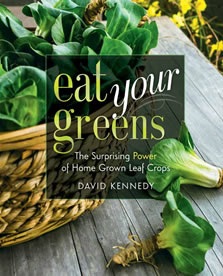
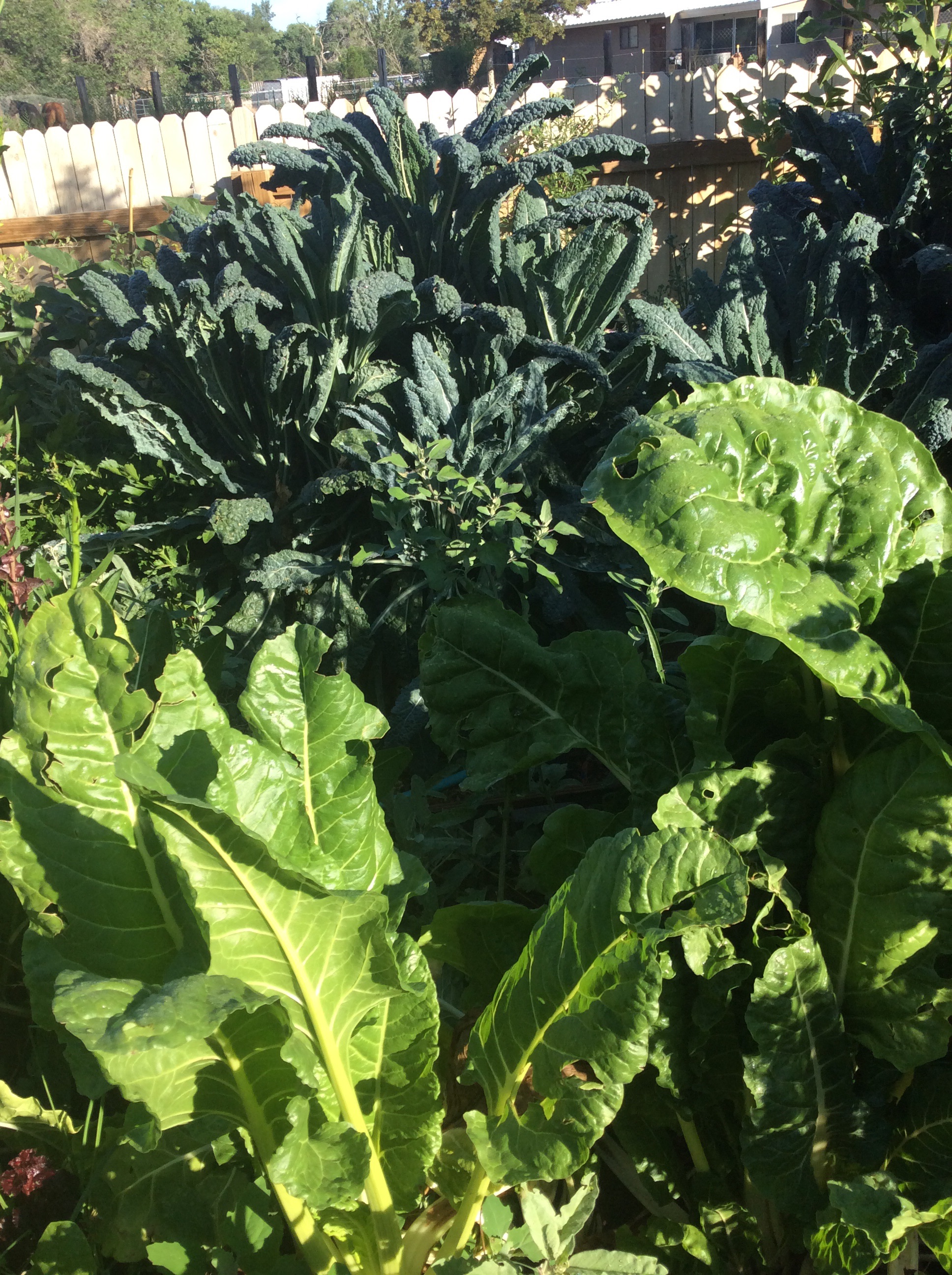
I am a gardener and also a doctor, so I spend a lot of time thinking about what could improve health for individuals and communities. When it comes to simple and practical innovations, I’m firmly convinced of this: there is no better thing that we can do for our own health and our families’ health than cook, serve, and eat more leafy greens. You can take me at my word,or you can read Eat Your Greens, by David Kennedy. Mr. Kennedy has collected a lot of information about why growing and eating more leafy greens is important, and gives information about some obscure greens. He is the founder/director of Leaf for Life and he wants everyone to be healthier.
Whenever I review a book, I want to talk about what it is and what isn’t. This is not a gardening book, and it isn’t a cookbook. It is a book about the importance of leafy greens to improving health worldwide. Lots of plants are given equal importance, no matter how relatively unsuited they are to cultivation in temperate America; this author thinks globally. Read it anyway, if you need to be convinced that the best thing you can do with your home garden plot is to grow a good supply of greens. A plentiful supply of fresh 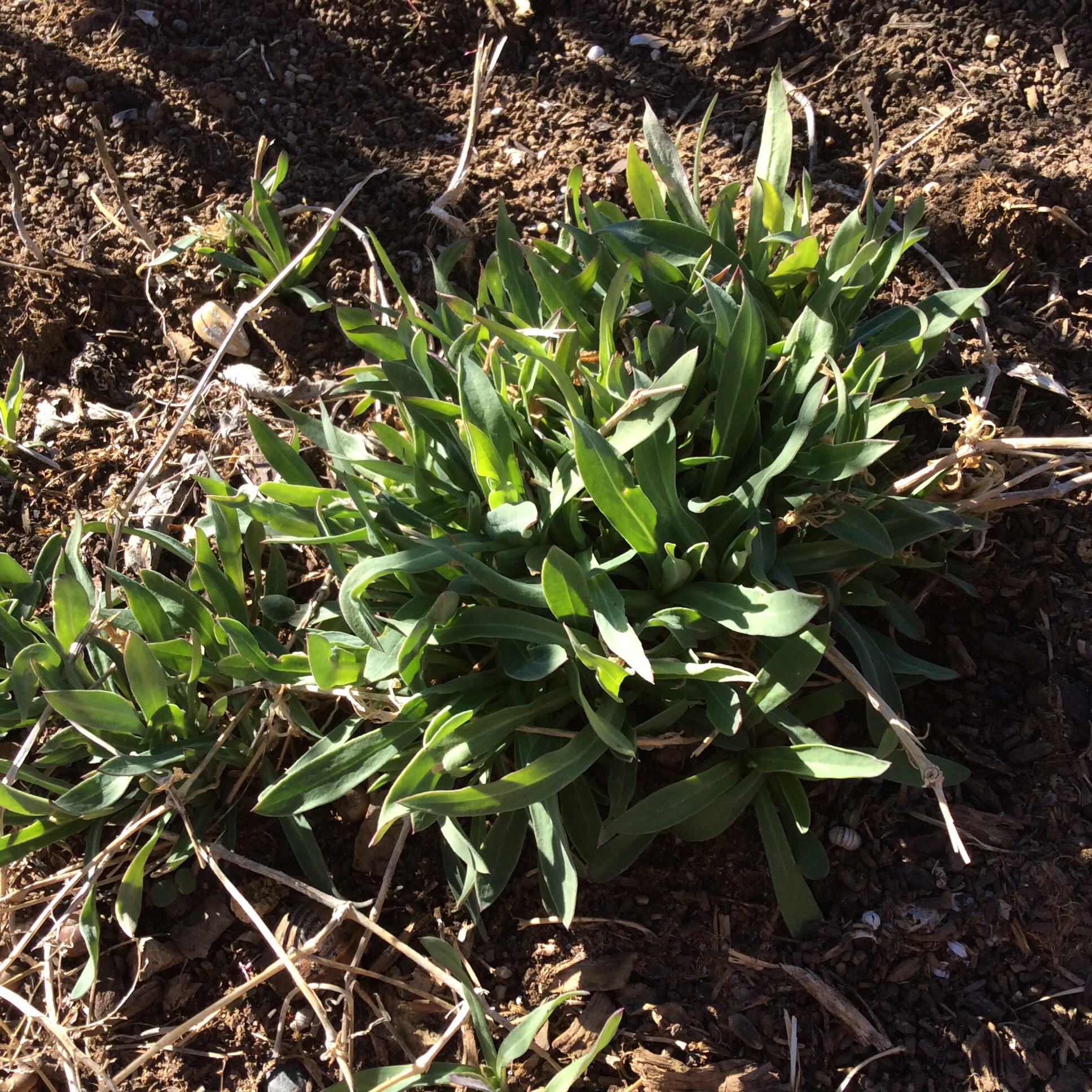 unsprayed greens is just about guaranteed to improve your health and your family’s health. There are some really good books about how to cook your crop. This one is to stretch your thinking in other directions.
Be sure to review the chapter on edible cover crops. If you want to improve your soil and eat some greens at the same time, try the cover crops that Kennedy recommends.
So, my personal opinion, after years of home gardening and given that I have trialed moringa and Chaya and many other chic greens discussed in this book, goes something like this: forget the obscure stuff unless you love to fool with that sort of thing (I do, but that’s not where the bulk of our green veggies come from.) Grow what grows well in your area. Grow kale, lots of kale, and chard and spinach and leaf lettuce, and harvest amaranth and lambs-quarters and purslane from your weedy patch. Grow any green leaves that you like to eat, and then eat them. Lots of them. Use cover crops in your little yard-farm, and feed leafy greens to your chickens and other livestock so that they will enrich you indirectly. Recognize green leaves as the most extraordinary solar collectors in the world, and let them feed you the energy of sun, earth, and water. Think about how to preserve them for winter. Keep them on your table. I will be trialing some of Kennedy’s ideas like Green Tofu, or leaf-juice curd, and I’ll let you know how it comes out for me. But please, eat your greens!
Oh, and please consider buying this book and other great books at your local independent bookstore. This is a genuine case of use it or lose it.
28 Apr
Passing Pleasures: more on hops shoots
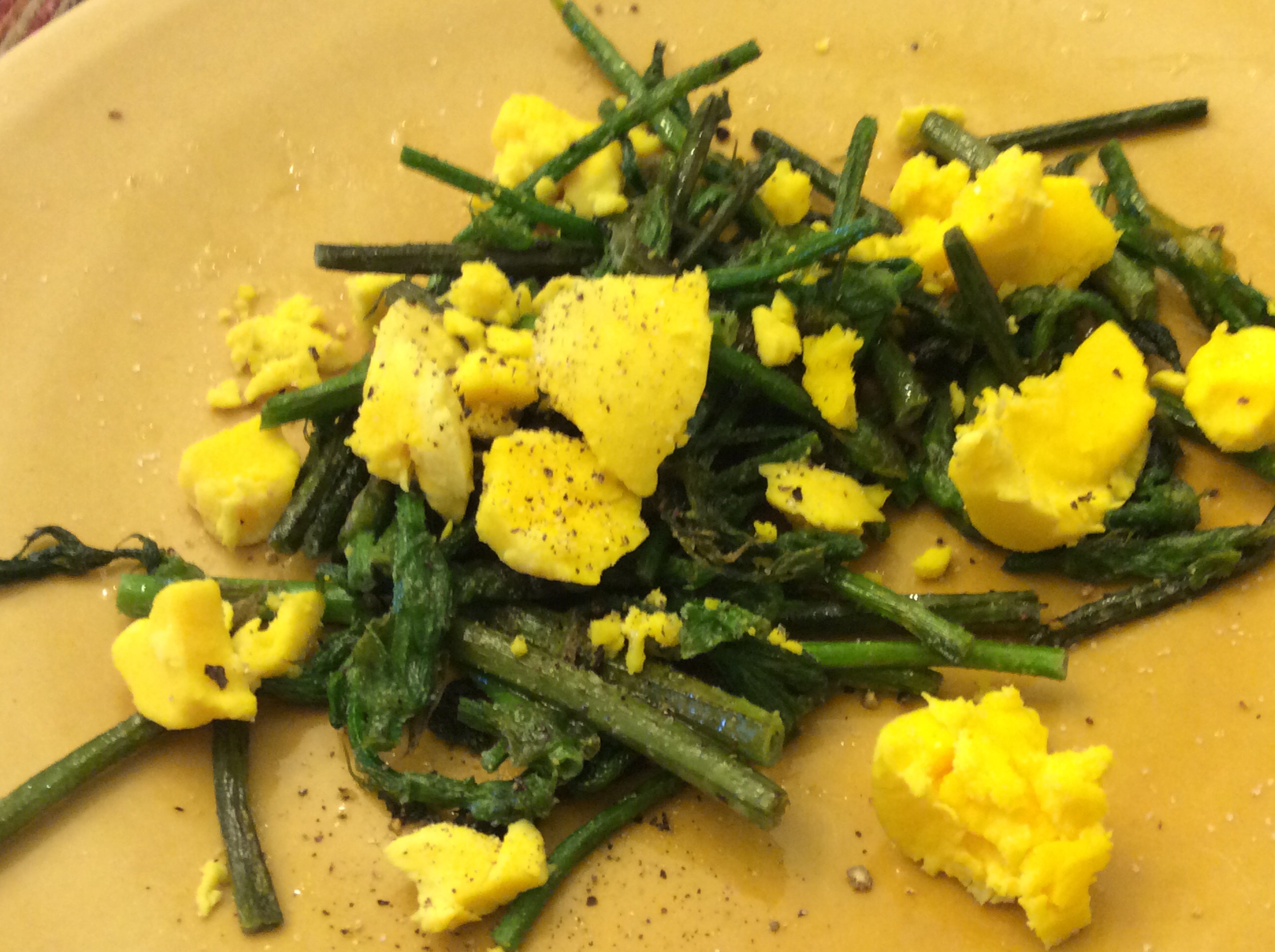
Two posts ago I wrote about learning to use spring hops shoots as a vegetable, and a couple of weeks after my first taste, they are nearly over for the year. I hit a tiny second harvest by breaking off the tips when the vines were as tall as I wanted. These “upper shoots”have even more of the wild, feral, slightly bitter flavor than the first emerging growth has, and are quite addictive. My favorite preparation so far is to cut them into segments about an inch long, sizzle them in butter or olive oil over medium-high Heat until the stems are crisp-tender and the infant leaves are fried crisp, salt to taste, and crumble the yolk of a hard-boiled egg over the top. The egg yolk smoothes the bitterness beautifully. This method works well with bitter greens as well.
Incidentally, the only thing I dislike about hops shoots is that there aren’t all that many of them. I have five large hops hills and only get enough shoots for my husband and I to share them a couple of times. I’m thinking of planting more hills just for the shoots. The vines are fairly handsome and almost indestructible, and will cover an ugly fence ( summer only) within a couple of seasons.
 My urban homestead