Archive for the ‘front yard gardening’ Category

The Greens of Spring: Broccoli Raab, and a brief note on spring flowers

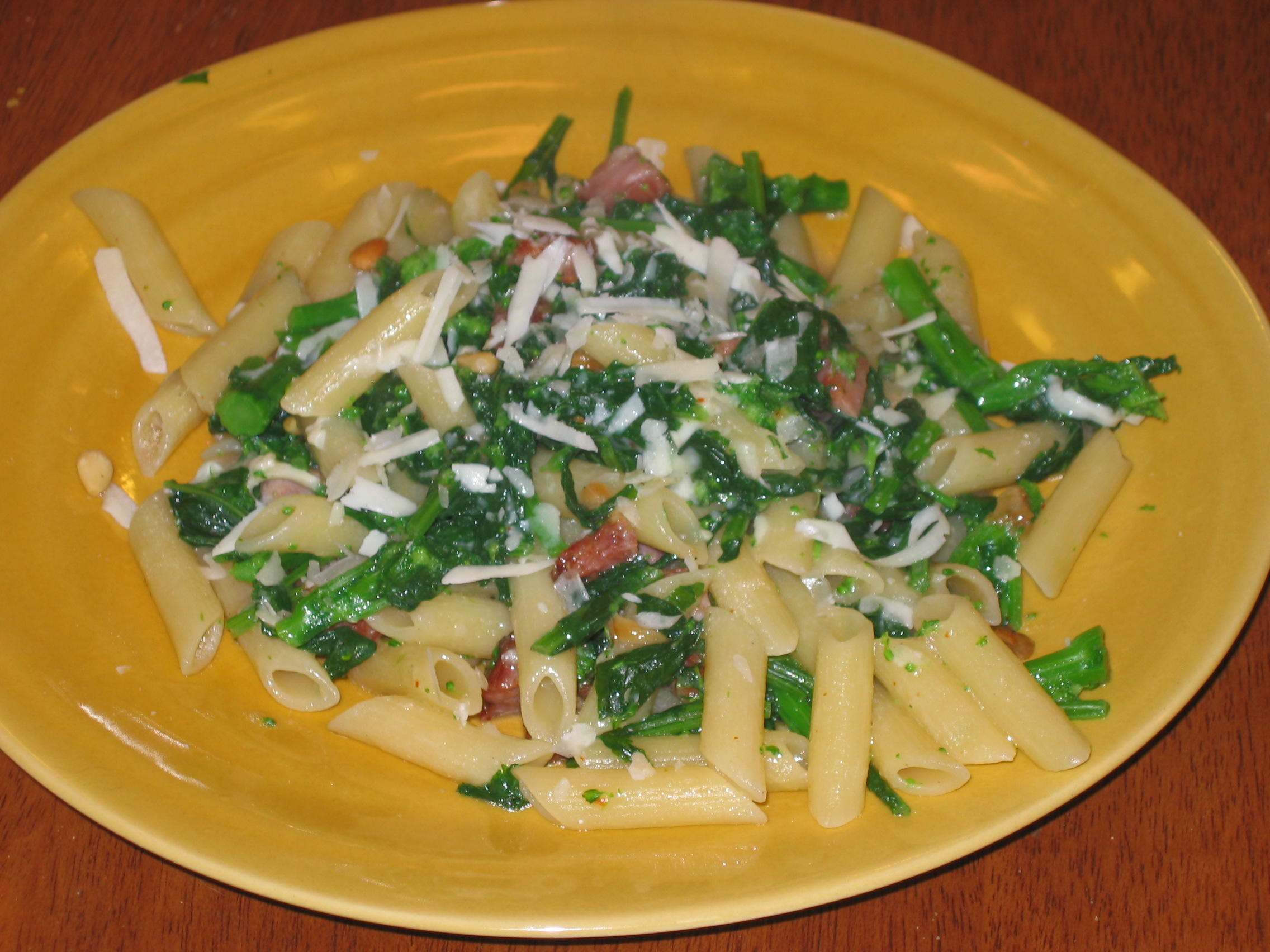
This is a good time of year to eat some broccoli raab from the store, because you may well be convinced to plant your own while there’s still time. You may find the seeds sold as broccoli rabe, broccoli raab, or rapini. This is a vigorous grows-like-a-weed kind of vegetable, but it won’t tolerate hot weather, so get it in the ground now. Direct seeding works well as long as the ground is well prepared and you keep it weeded until it’s big enough to compete. Harvest as soon as it shoots to seed; you’ll notice broccoli-like heads which can vary from the size of a nickel to 3 inches across, depending on variety and weather conditions. Harvest while the buds are still tight, before any blooms appear. Just whack off the top 6-8 inches, leaves and all, compost the rest, and you have time to grow another crop in that space. It’s a close relative of the turnip, but instead of the pronounced (some would say extreme) earthiness of turnip leaves, it has a lovely clean flavor with a slight bitterness that makes it the perfect companion for mellow pasta.

Usually I like greens in mixtures, but I prefer this one by itself. My favorite way to cook it is so simple that it isn’t really a recipe, and it’s on the plate within fifteen minutes of the water coming to a boil. The various steps fit in so well with one another that I prefer to write this as a brief kitchen story rather than a recipe. Read it through before beginning, so that the kitchen logic and logistics will be clear.

You will need: half a pound of good dried pasta, a large bunch of broccoli raab, good olive oil, red pepper flakes, a couple of ounces of good ham, Italian sausage, or pancetta (a small handful when chopped into cubes), an anchovy fillet if you like them, and a few ounces of good cheese, either Parmesan or part Parmesan and part Romano. Toasted pine nuts can be added as a bonus of you have any on hand.

Put on a pot of water to boil for the pasta. Don’t forget to salt it.

While the water is coming to a boil, chop up a small chunk of ham, or some good Italian sausage, or some pancetta, or a little slab bacon if it isn’t too smoky. Chop two large or three small cloves of garlic. Throw them in a small hot skillet with some olive oil, probably 2-3 tablespoons. Stir frequently. As soon as the garlic and meat are cooked, put in half a teaspoon of red pepper flakes and, if you like, a chopped rinsed anchovy fillet or a dash of colatura. Add a tablespoon or two of water, just enough to stop the cooking, and take the skillet off the heat. Wash a bunch of broccoli rabe, using a bunch as big as you can hold in two hands, and set it in a strainer to drain a little.

Meanwhile, the water should have come to a boil. Put in half a pound of good dried pasta. I think penne goes especially well with chunky greens. If you like whole wheat pasta, this is an especially good place to use it. Don’t reduce the heat. Keep it at a hard boil until after you add the greens.

While the pasta is boiling, cut the bunch of rapini in cross section across the bunch, slicing about every half inch. Discard the stem ends if they are more than half an inch in diameter. Five minutes after the pasta went in the water, put the chopped rapini in the water to boil with it. Once the water returns to the boil you can turn it down a little, but be sure to maintain a boil, not a simmer. Grate about 2/3 cup of good Parmesan and 1/3 cup of good Romano, or use all Parmesan if that’s what you have. These measurements refer to loosely packed measuring cups. My trip to Florence convinced me that Americans over-sauce and over-cheese their pasta. Personally I don’t meaure grated cheese in any formal way, and prefer to think in terms of two loose, scant handfuls of grated cheese.

When the pasta is ready, pour out into a strainer, return to the pan, toss with a glug of good olive oil, toss in the meat mixture and half the cheese, plate, sprinkle with the rest of the cheese, and toss some toasted pine nuts on top if you like. Eat and savor this splendid green.

By the way, I estimate that a “glug” is about two tablespoons. But in a dish like this, use kitchen sense rather than measurements. How much olive oil do you need in the skillet to keep the meat and garlic from sticking, and how much olive oil do you need to give a light delicious sheen to your pasta and greens? Your eyes are a better guide than a measuring spoon.

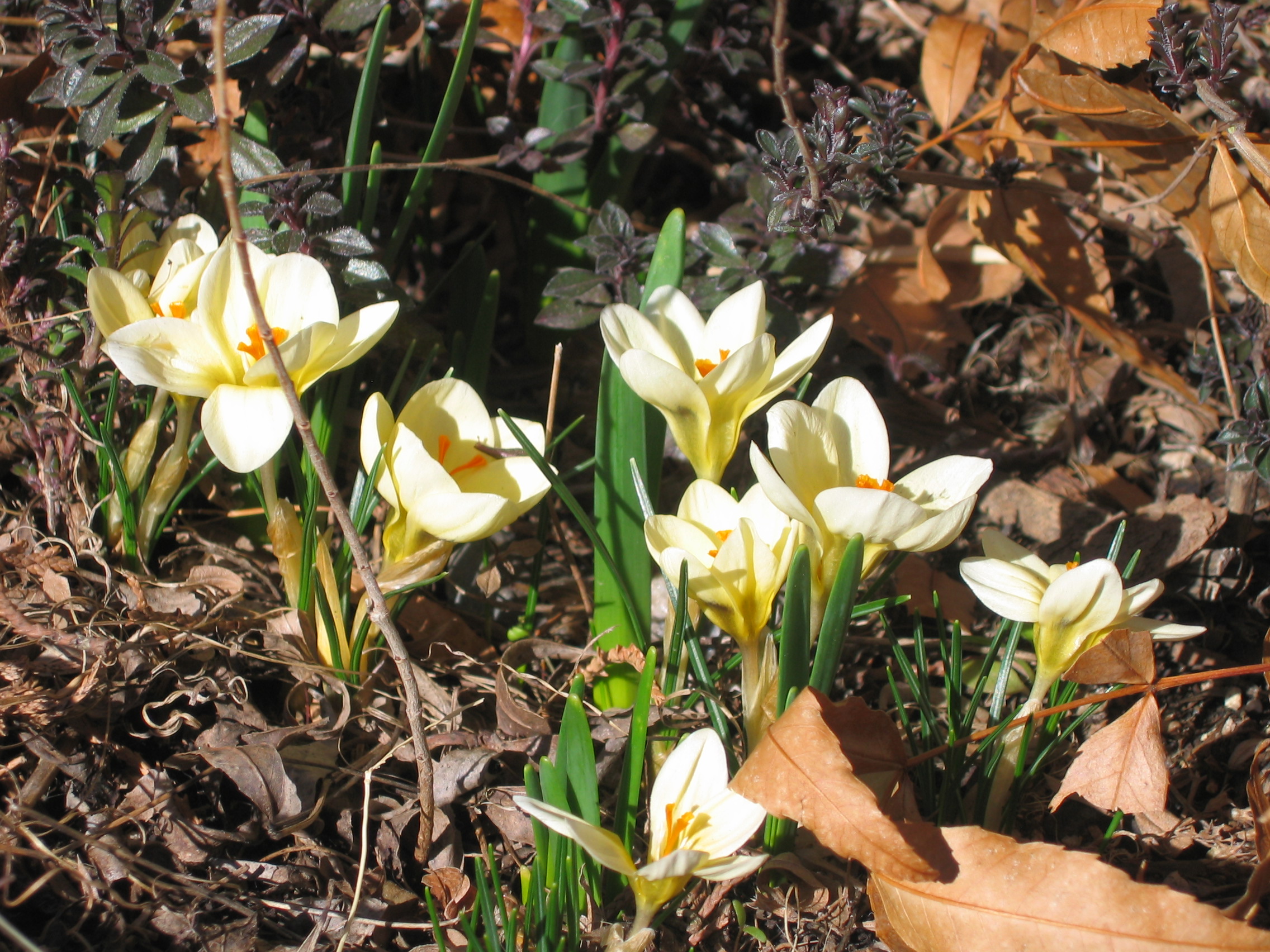
My garden is intended as a food garden, but there’s no reason why it can’t be a treat for the senses as well, and nothing lifts my spirits in late winter like bright crocuses blooming away in whatever appalling circumstances the season hands them. I strongly recommend at least a dozen bulbs of the cream-yellow Crocus crysanthus “Cream Beauty.” It’s always the first to bloom for me, and if you put it in the warmest part of your yard it will bloom in February in the Albuquerque area, a visible harbinger that your garden, like you, has survived another winter.
Tronchuda, and some thoughts on planning urban homesteads


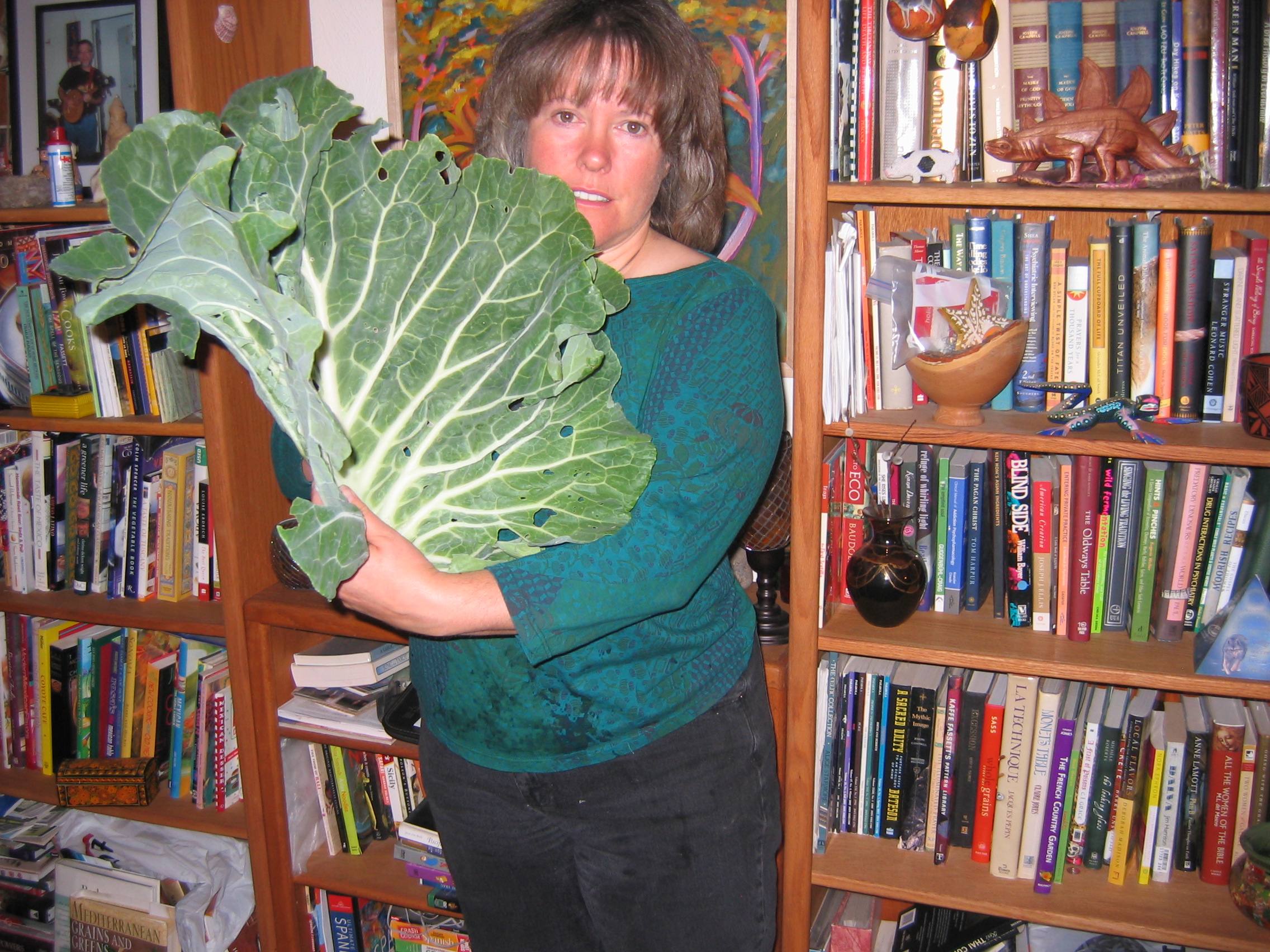
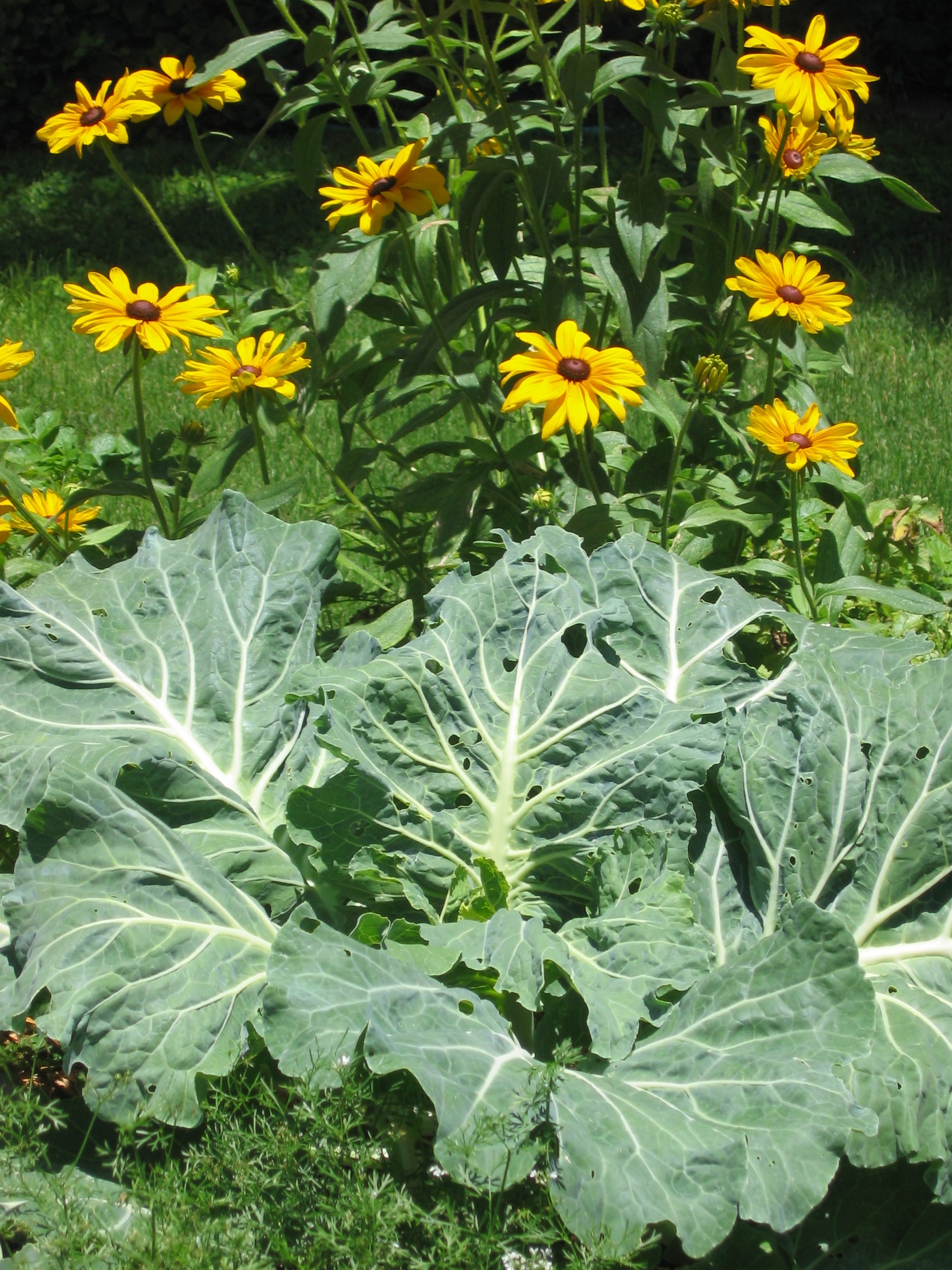
Every year I try a few vegetables that I haven’t tried before, and for 2009 one of the clear winners was Tronchuda, a giant non-heading cabbage from Portugal. I grew only one plant, and it ultimately reached over four feet across, with leaves almost 2 feet from side to side. The leaves were pleasant to eat cooked at any point, but especially good after a few frosts. I used it in the same ways as collards or kale, and also made a soup with sauteed onions and garlic, Spanish chorizo (not the Mexican soft chorizo,) good chicken broth, salt to taste, and chopped tronchuda, all simmered together until the tronchuda tasted good. By the way, this is an overlooked method for determining when green leafies are sufficiently cooked: keep tasting them, and when they start to taste good, they’re done.
I will definitely be growing it again this year, and that’s the real test of any vegetable: is it worth the garden space? Tronchuda delivers. I’ve read that the wide white leaf ribs can be cooked as a vegetable in their own right, but I didn’t care for them and composted them instead, keeping the green parts and the narrow ribs to cook. I recommend it highly for any garden. You can get seeds at Nichols Garden Nursery, a wonderful source for all sorts of odd delights.
Our own New Mexico seed company, Gourmet Seed International, offered seeds for two of my new experiments, rampion (the famous “rapunzel” of the fairy tale) and bladder campion. I’ll keep you posted.
This is the time of year to plan your homestead garden and order what you need. I’m dealing with a brand new property with no planting in place, so I’ll be starting a new mini-orchard, and I would highly recommend dwarf fruit trees for eager would-be urban homesteaders. They produce relatively quickly, look charming, and allow harvesting with feet planted firmly on the ground.
Every yard-farm should reflect what the owner and family like to eat and drink, and with this in mind I’ve decided to plant wine grapes. It will be a few years before I’m making my own wine, but the thought of my very own mini-winery has already given me a lot of pleasure and the vines aren’t even planted yet. In anticipatory value, it’s the best garden bargain I’ve had, and this may be the most overlooked benefit of urban homesteading; you spend so many happy expectant hours. The same applies to my backyard chickens, which are not yet purchased but are already clucking quietly in the back of my mind.
By the way, if you have any interest in adding livestock to your homestead, it’s worth reading Farm City . Author Novella Carpenter created a little squatter farm in Oakland, and it isn’t what most of us would want, but her descriptions of raising and killing animals for meat are accurate and unromantic (but reverent.) If you have never harvested meat animals, this is a test. If you can’t stand to read her descriptions, you probably don’t want to go into livestock. If you do go on to raise a little of your own meat, I can guarantee that you will no longer allow meat to be wasted. Once you really understand where it comes from, waste is not an option. On the other hand, you will understand the fascinated reverence with which good farmers and hunters view meat animals.

Passing Pleasures: Prickly Pear Tepache

september 2009 039

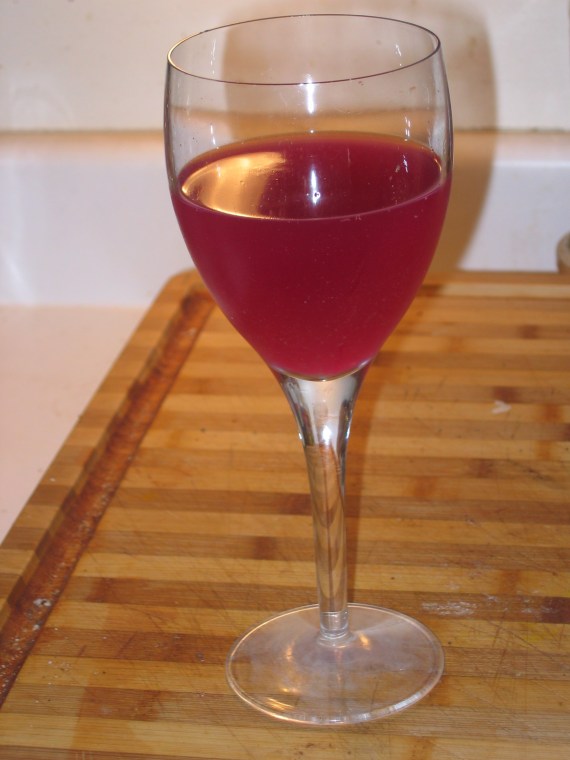
This fizzy, festive fuschia drink gets its color and flavor from a really local fruit, the tuna, or prickly pear fruit. Here in New Mexico you probably have some in your yard, and if you don’t, a neighbor probably does.

The basic directions are the same as for plain tepache. Pick, beg, or borrow eight tunas the size of an egg or bigger. Handle them with respect, because the wicked little prickles will make you itch and burn for days if you let them at your skin. Handle them with gloves. If you already know how to peel them with pliers or have someone to show you how, then peel them. Otherwise, throw them in the blender whole and crush to a puree, adding a little water if you have to in order to get the blender going. Pour the puree into a strainer lined with several layers of cheesecloth. Now, twist the cheesecloth closed and press it with a spatula or wooden spoon to release the juice. Don’t omit the cheesecloth, since the strainer alone won’t get the prickles out, and don’t squeeze the cheesecloth with your hands. You should end up with 1.5 to 2 cups of prickly pear juice. Now make tepache according to the directions I gave earlier in the summer (click here to get the directions) but add the prickly pear juice to the fermenting jar with the other ingredients. The other quantities stay the same, including the pineapple rind, which provides the wild yeasts that do the fermenting. Ferment according to the directions. The flavor of the tunas is accentuated by the fermenting process and will be dominant in the finished drink. Pour and toast the exhilarating autumn weather.


According to an article from Texas A&M, the antioxidants quercetin and kaempherol were found in prickly pear fruit, as well as other antioxidants. The link is below if you want to read more.  Personally, I think the important thing about antioxidants is to get a lot of different ones, not by taking pills but by eating more fruits and vegetables (or, in this case, drinking them.)

http://www.sciencedirect.com/science?_ob=ArticleURL&_udi=B6T6R-4BG8TR7-3&_user=6865397&_rdoc=1&_fmt=&_orig=search&_sort=d&_docanchor=&view=c&_searchStrId=1027331814&_rerunOrigin=google&_acct=C000050221&_version=1&_urlVersion=0&_userid=6865397&md5=67b4ea1bcff5a8121ec6c61beea769b7.

My Southeast Asian Summer: Turmeric

_Media Card_BlackBerry_pictures_IMG00146

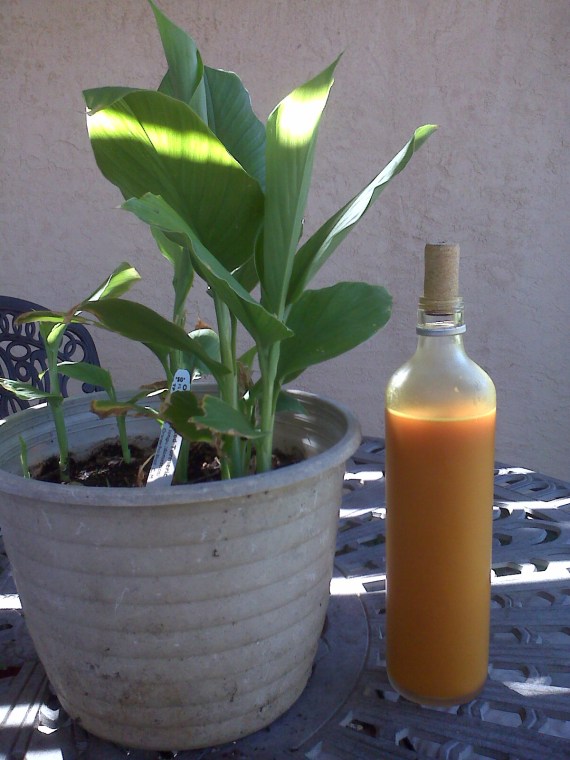
      Turmeric and its constituent components the curcuminoids, a complex of antioxidant and anti-inflammatory compounds, are getting attention and medical research dollars these days. But this blog is not about disease treatment or medical research, it’s about healthy and delicious food, and turmeric is here for its culinary qualities.  Both the roots and the leaves are a common seasoning in many parts of southeast Asia, and the leaves are impossible to buy in this area, which led to my experiments in growing them. It’s a tropical and needs to be brought indoors when the nights start to cool off, and during the summer it needs light shade and plenty of moisture. Initially I bought plants from an herb supplier, but since then have done better with plants I started at home.

       You need some roots from the store to get started. Put them on top of a pot of good organic potting soil and press them into the soil. Put in a warm place (a seed-starting warming mat will really speed things up,) keep moist, and within a month you’ll see small buds growing off the roots. In another month or so, you’ll have turmeric leaves to use.  It will prosper in a sunny window over the winter, but does best if it can go outdoors in the summer. Remember, part shade is important.

     To begin with the root, it can be grown in a pot but you are unlikely to get enough to use it freely. I don’t recommend the dried powder for most applications; to my palate if lacks the fresh vibrancy of the fresh root. I advise buying organic root, and you can often find it among the other fresh vegetables at La Montanita Co-op. Ask the produce manager if you don’t see it. It’s used in a lot of the seasoning pastes that I make for my southeast Asian cooking, so you’ll notice it in several of the recipes on this blog (use the search function to find them). But one of my favorite ways to use it is as a brilliant yellow-orange “juice” concentrate which I keep in a corked bottle in the refrigerator and add to water to make “sun juice.” The color alone is irresistible and cheers me up just to look at it.

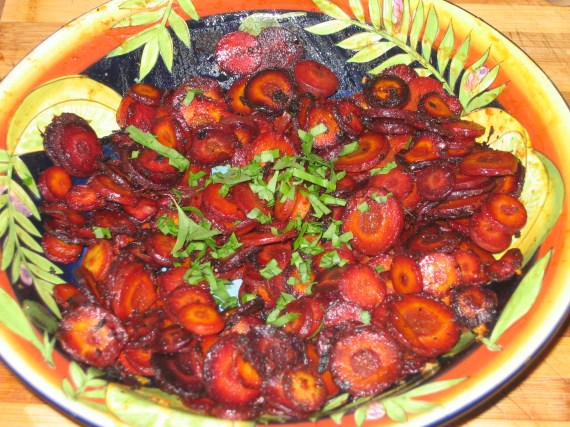
     The leaves are large, glossy and handsome, and look attractive when the pot is brought indoors for the winter, but remember that any plant you’re always snipping at for kitchen use won’t look great for long. When cut they smell very like a fresh, sweet carrot, and I love to season carrots with them. Clich the link below the picture for recipes.

august 09 007

Click here for recipes! Continue reading