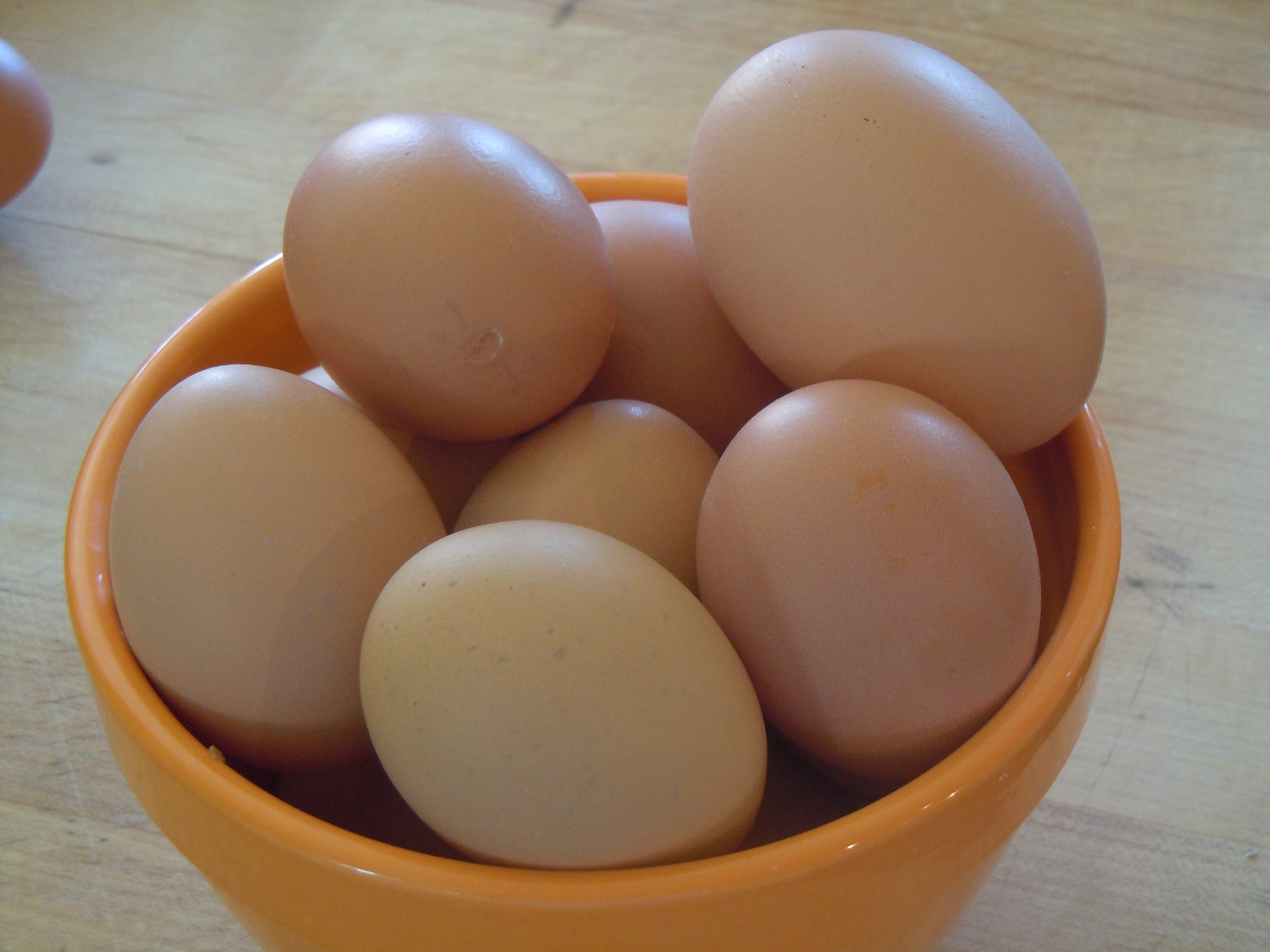
Now that my chickens are laying and I have all these lovely fresh eggs around, I’m trotting out all my recipes that use up eggs. One of my very favorites is fresh pasta, and I can’t think of any kitchen skill more worth acquiring than pasta-making.
I used to make and roll pasta entirely by hand, and so I made it about twice a year. If you want to do it all by hand, you can get directions from any of several excellent cookbooks, and I particularly recommend The Splendid Table or Essentials of classic Italian cooking. My own current method is (surprise!) a lot more rough and ready, and relies on my Kitchenaid mixer. If you have one, get the pasta roller attachment (expensive but it works really well) and you’re all set. I use the Pro 600 mixer. I don’t know if the lighter ones will do the job. This is still a time-consuming undertaking, best suited to those relaxed weekend days that I think of as Domestic Goddess days, but it’s worth investing some time for a really delicious result.
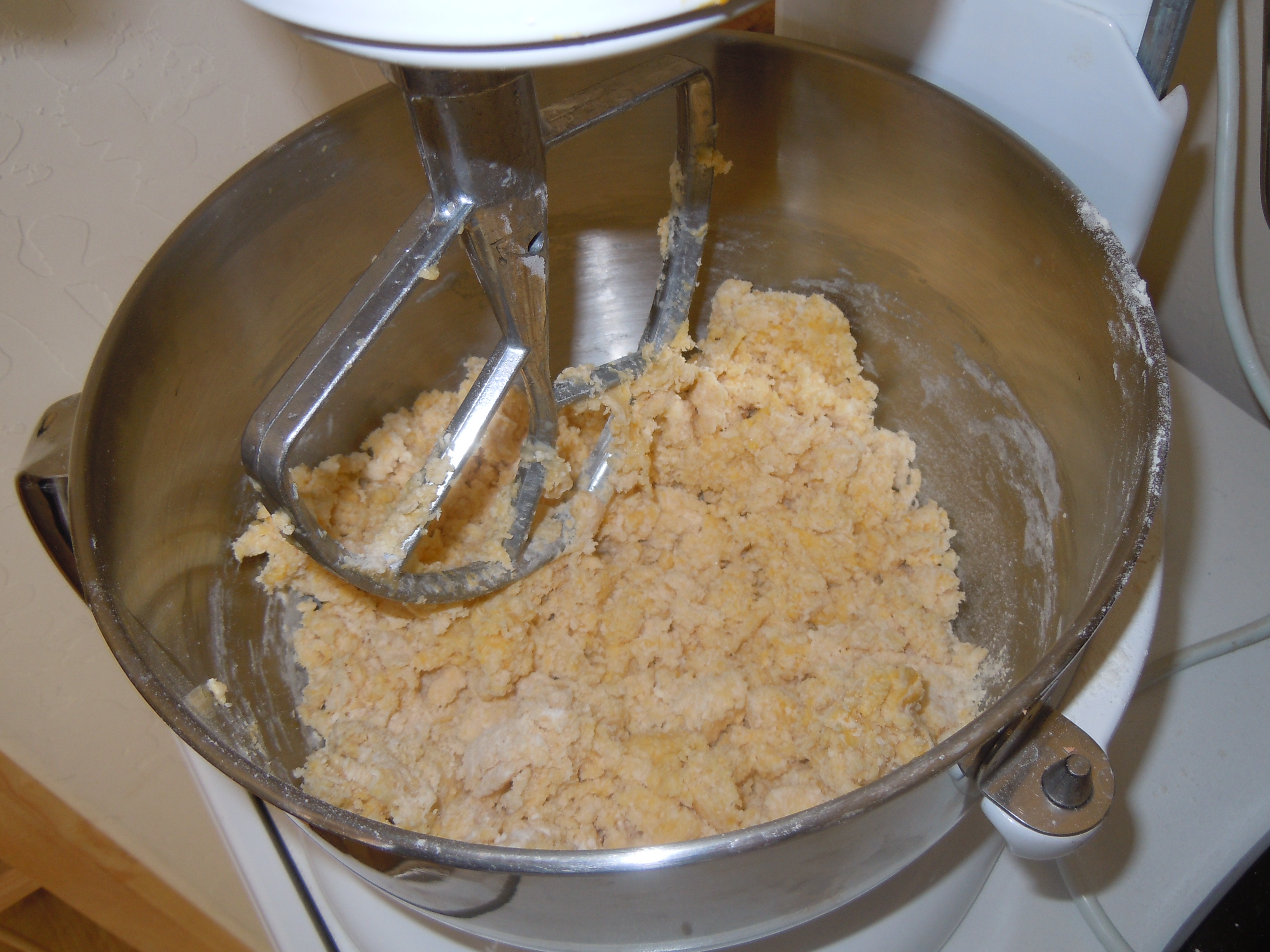
The quality of the eggs is important. If you don’t have your own hens, make an effort to get real free-range eggs (not the supermarket kind.) Start with the bowl in place on the mixer and the regular mixing blade. I usually start with three cups of flour, which makes 4 main-course servings or at least 6 first-course servings. Have about six eggs handy. Put the flour in the bowl, crack one egg into the mixing bowl, and start running the mixer at the lowest speed. After the first egg is incorporated, about half a minute, crack in the next one. Keep adding eggs until you have yellow shreds of moist-looking dough and some dry “crumbs” in the bowl, as shown here. Usually I use five eggs, but a lot depends on the flour, the size of the eggs, and the weather. If the dough won’t come together smoothly when you switch to the dough hook, add another egg and try again.
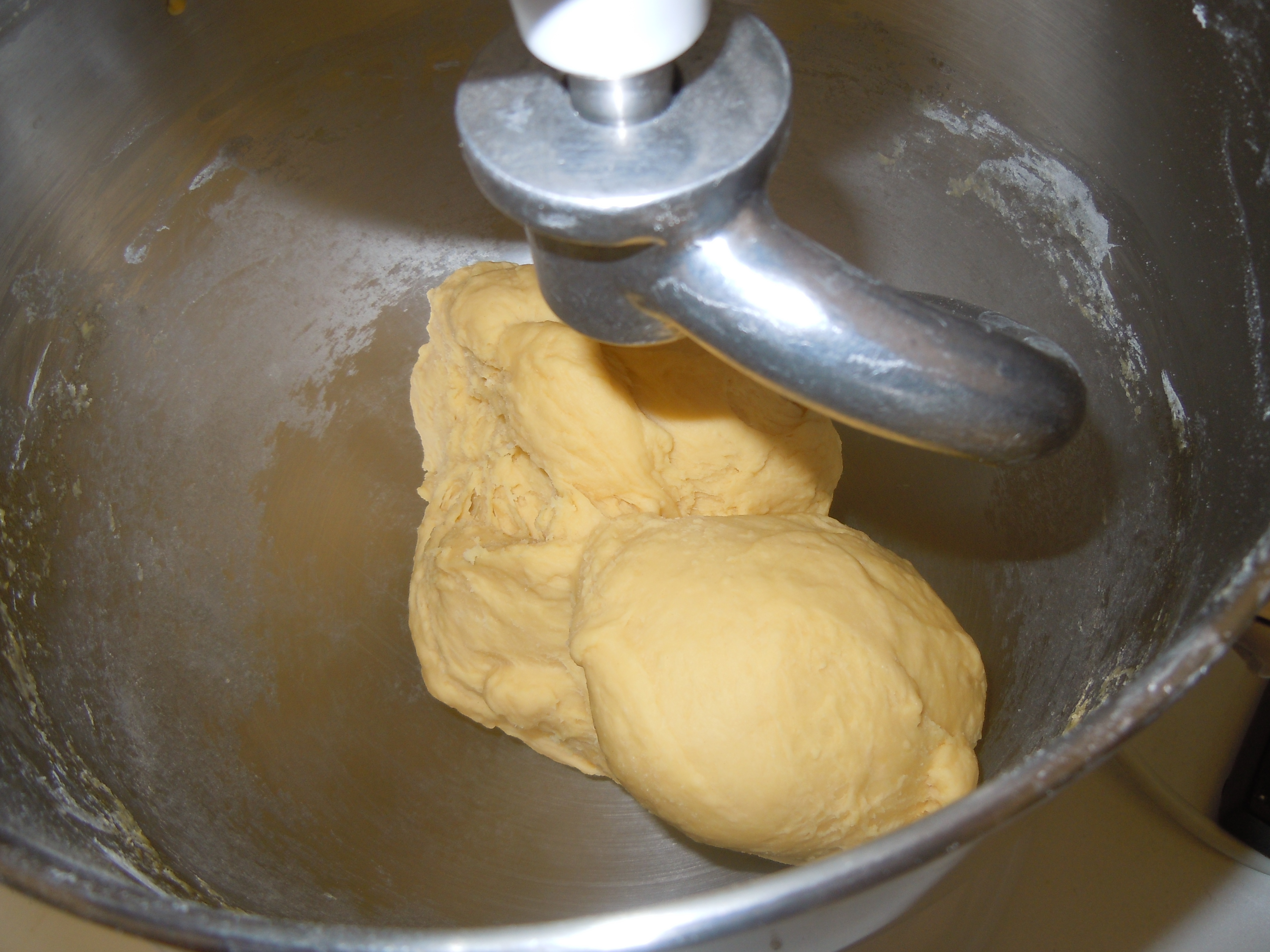
Now switch to the dough hook. Run the mixer at the lowest possible speed until the dough comes together into a ball on the hook, and keep kneading for at least five minutes. This is where I don’t know if the light models will work. Even my pro model strains pretty hard. It’s a stiff dough, much harder to handle than bread dough.
When the dough is smooth and thoroughly kneaded, dust the ball lightly with flour, wrap it in plastic wrap, and put it in the refrigerator for at least an hour and up to eight hours. When ready to roll it out, attach the pasta roller attachment. Cut the ball of dough into pieces about the size of a lemon, and dust each lightly with flour. SEt the rollers as wide as they will go, start the mixer at lowest speed, and start feeding the balls of dough through. I like to do all the balls through the widest setting, then all through the next setting down, etc. Now this is where a trick comes in handy. You are going to need a lot of hanging room for the sheets of dough. Wooden racks are sold for this purpose, but I got a metal laundry-drying rack instead and took the nylon mesh “shelf” off the top. It’s easy to clean due to the smooth surface, HOlds a lot more than most wooden racks, and folds away neatly when not in use. The sheets of pasta look absurdly charming hanging from their rack.
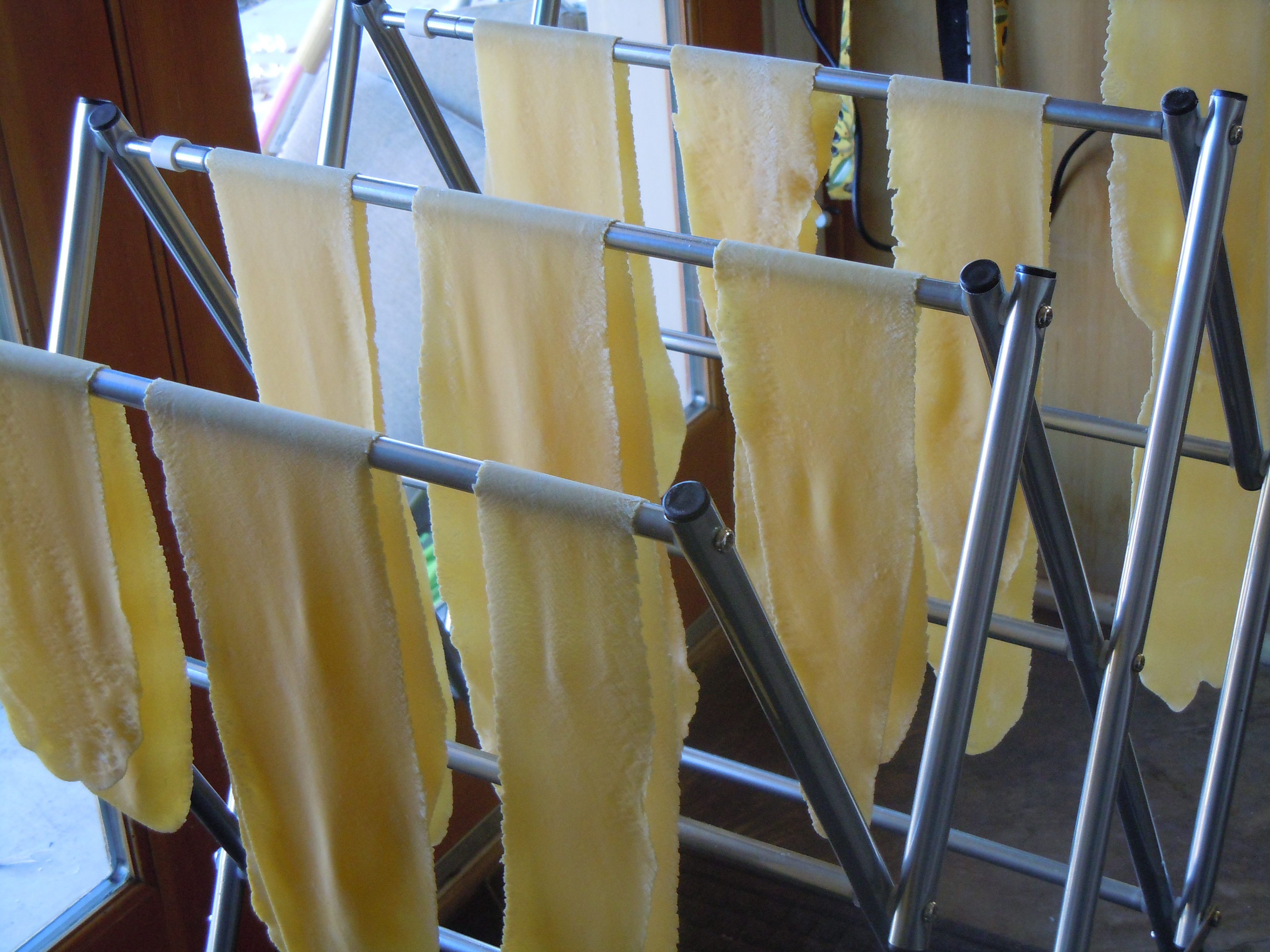
When they are all as thin as you want them, let them hang until somewhat leathery. This may be 15 minutes or may be an hour, depending on humidity, breeze, etc. When they are leathery but can still be folded without cracking, you are ready to cut the sheets into noodles. The pasta roller has an attachment that will do it for you, but I greatly prefer to do this step by hand. I like the unevenness that results, and I can cut anything from thin linguine to very wide papardelle, depending on the meal that I have planned. Work on a lightly floured surface, roll the sheets around your hand to form cylinders, and cut across to make noodles, as wide or thin as you like. Unfold them and lay out on clean dishtowels spread on the counter for the purpose.
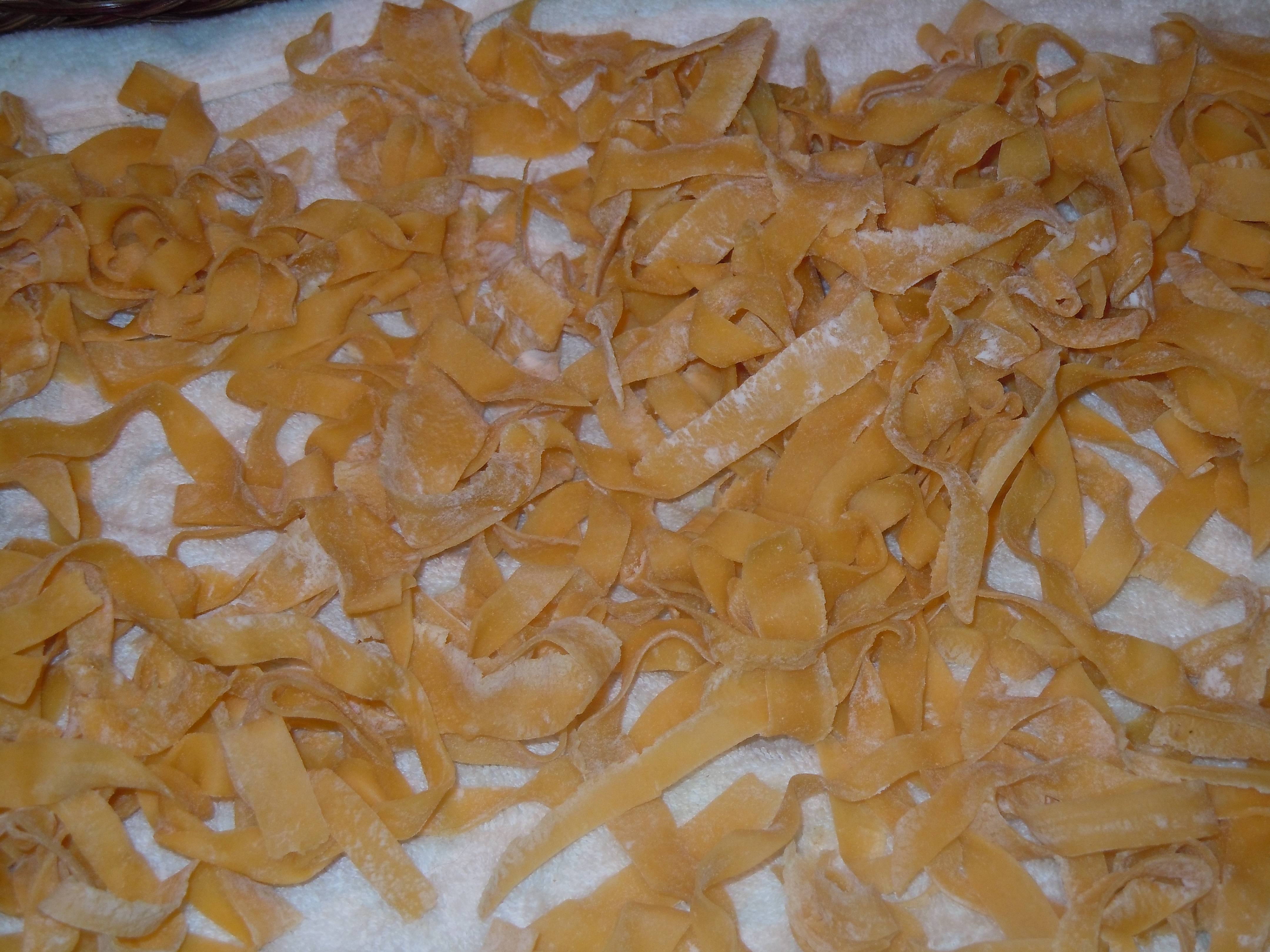
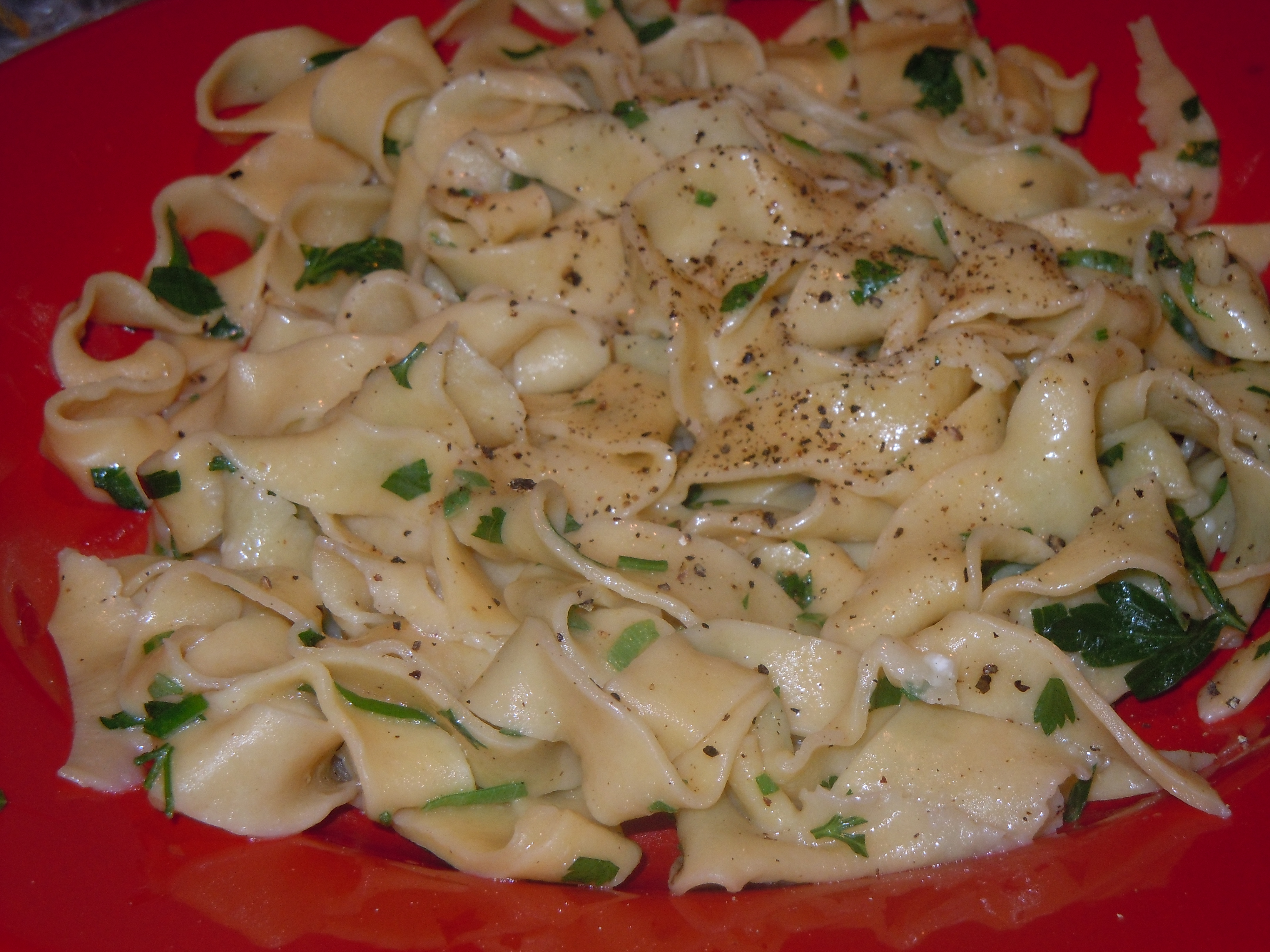
Cook soon for best quality, use plenty of salted water, and start testing for doneness as soon as the water returns to a boil. Sauce them simply to let their quality shine. In the near future I’ll post on my favorite mushroom sauce for fresh pasta, but for your first effort you might want to dress them with butter, cracked pepper, some chopped parsley, and the best Parmesan you can find. There is no simpler, or better, flavor.
Archive for the ‘cooking’ Category
15 Nov
Vegetable dinners: a roasted melange, and notes on gochujang
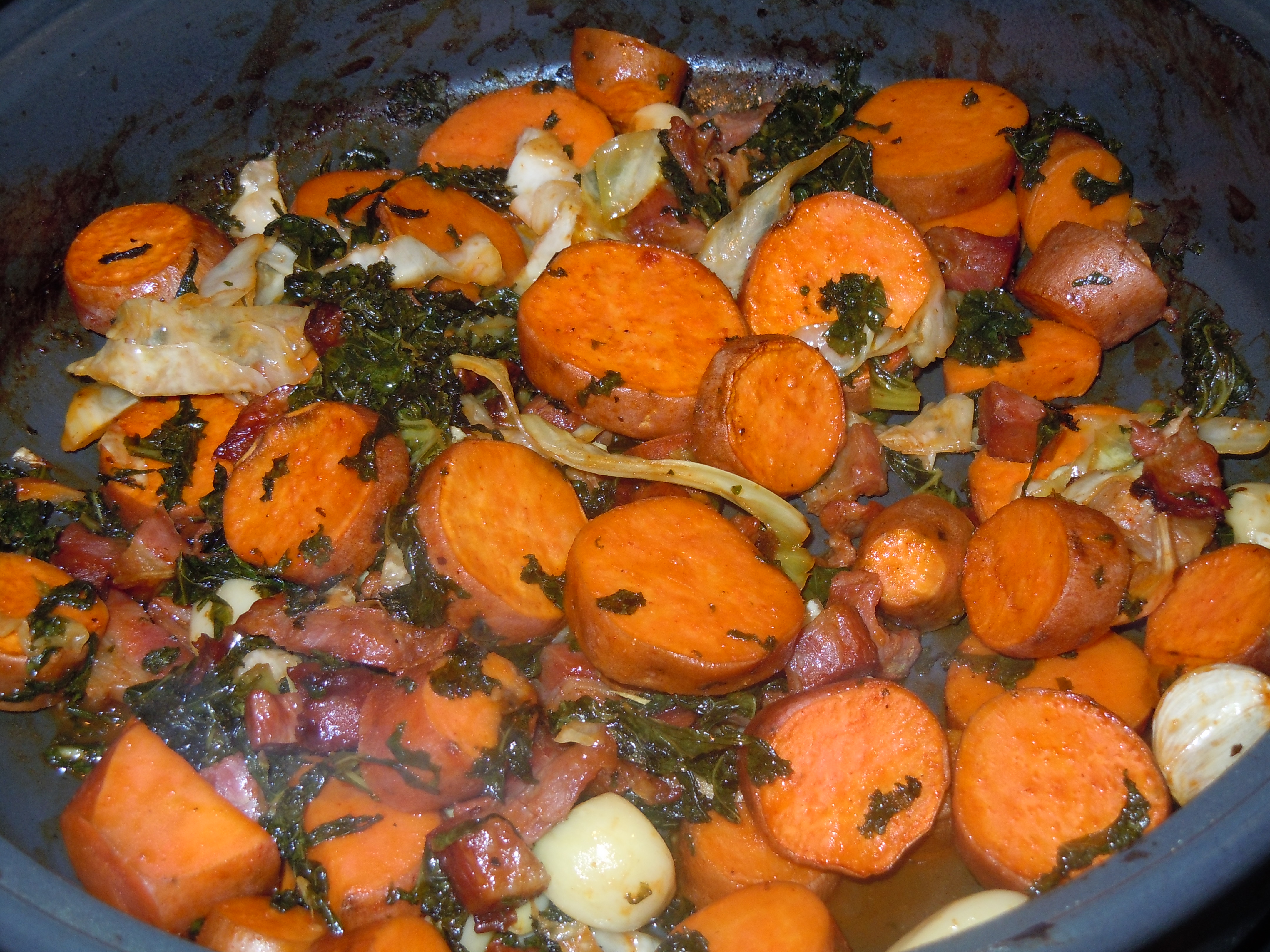
On frazzled days, one way to save time when making dinner is to put food in the oven and pretty much forget about it until it’s done. Many vegetables respond beautifully to this treatment, especially if flavored a little. I have a large clay Spanish cazuela about 14″ in diameter that I use for these impromptu roasts because I’m convinced that the clay improves the flavor, but you can use your standard 9X13 pan if you prefer. I am using a lot of sweet potatoes right now because I dug a lot of them recently, but I’ll include suggestions for substitutions. The idea is to use what you have and like.
You will need:
for the vegetables: 4 medium/large sweet potatoes cut in 1″ chunks (I scrub them well and leave the peel on), or a medium-sized winter squash peeled and cubed, or 6 large carrots scrubbed well and cut in 1/2″ chunks, or some combination of the above. I used sweet potatoes.
For the greens: 1 bunch of kale cleaned and cut in 1″ slices crosswise, or half a small green or red cabbage cut in thin slices, or 3/4 pound of sturdy leafy greens cleaned and cut in 1″ slices, to total about 3/4 pound. I used half Tuscan kale and half sliced green cabbage.
For the seasoning:
a handful of bacon, bacon ends, or pancetta, cut in little cubes. I used the tail end of a bacon slab.
3 large cloves garlic, chopped
3-4 tablespoons of olive oil
1 tablespoon of Korean gochujang paste (see below) or a teaspoon of Tabasco or other red chili sauce, or a teaspoon of red pepper flakes
about half a teaspoon of salt, or to taste
1/2 cup good stock or water
Preheat the oven to 375 degrees. Prepare the vegetables and toss them in the cazuela or pan. Mix the seasoning ingredients and pour over the vegetables, tossing with your hands to distribute. Try to end up with the chunky stuff mostly on top and the green stuff mostly on the bottom. Put the cazuela in the oven. Half an hour later turn the veggies with a spatula, and if the bottom seems dry and things are starting to stick, add a little more stock or water. Again, try to keep the greens mostly below the other stuff, where they won’t dry out. After an hour, check the vegetables for doneness. You don’t want them crisp for this dish; they need to be cooked through, a little soft, and well impregnated with the seasoning ingredients. When done, drizzle a tablespoon or so of your best olive oil over all, bring to the table in the cazuela, and eat with a crusty baguette or toasted whole-wheat bread, as you prefer. It couldn’t be easier or healthier.
You can leave out the bacon or pancetta and have a vegan/vegetarian meal. I don’t recommend it, because the pork has a wonderful alchemy with the sweet winter vegetables and the chili paste, and creates a whole much greater than the sum of its parts.
Now and then we find an ingredient that represents the Platonic ideal of its kind. For me, the Korean chili paste gochujang is the seventh heaven of the chile pepper. There is nothing quite like its deep, intense, fermented flavor, unctuous texture, and exquisite mahogany color, and it has a special affinity with pork and a thousand uses outside of traditional Korean cooking. These days the only gochujang that I will use is the one from Mother-in-law’s Kimchee, which does have some sugar in it but no high-fructose corn syrup and is properly fermented and deep and delicious. If it isn’t available in your area, you can order it online. I like the original one, called “concentrated” on the label.
I talk a lot about making dietary and lifestyle changes slowly and one at a time. This is a great time to start thinking about eating more green leafy vegetables. Salads are great, but cold weather is a perfect time to incorporate more cooked greens as main dishes, side dishes, or soups. If you garden, kale and cabbage will help get you through the winter. If you forage, dock, chicory, and dandelion greens are among the few wild foods available in winter in our area (plan to mix them with milder greens from the garden or store.) If you buy at the store, Tuscan kale is everywhere, and since there is no better leafy green, go for it. I do recommend sticking to organic greens wherever possible. If you always have garlic, olive oil, and a little good bacon or pancetta in the house you are always ready to make a lovely dish of saute’ed greens, and there are lots of variations. Check out my “greens” category on this blog for more recipes. I know I have said this before, but I’ll keep saying it: don’t undercook them. The thicker tougher greens like curly kale are acutely unpleasant to eat when undercooked and tough, so taste before sending to the table, and if chewing requires a ruminant level of effort, cook five minutes longer and taste again. Mark Bittman is now galaxy-famous as the author of many authoritative cookbooks, but few people are aware that his first effort was a little gem called “Leafy Greens.” You can still find it second-hand, and it’s worth tracking down. Read it and use it, and your family’s health will benefit.
8 Nov
Vegetable dinners: add an egg! and notes on feeding chickens

Like the British cookbook writer Nigella Lawson, I am both greedy and lazy, so I’m full of timesaving tricks for making real food in a hurry. Now if I also looked like her, that would be nice, but two out of three isn’t bad. One of my favorite time-saving tricks is to make a small batch of yeast dough and stick it in the refrigerator with no clear idea what I’ll use it for. Most recently, I used it to make a variation on a hortapita, filled with mixed greens. Since my chickens have started to lay, I decided to incorporate eggs. This isn’t really a recipe. This is the sort of thing you throw together by instinct on days when you need the comfort of the kitchen but if you think too much more, your brain will break.

If you don’t happen to keep dough hanging around, you can use ready-made pizza dough from the Co-op, but making your own is a cinch. My basic recipe is 2 cups water, 1 teaspoon sugar, 1/2 teaspoon dry yeast, and 2 teaspoons salt. Mix together, knead on a floured surface for five minutes, form into a ball, pop it into an oiled bowl and cover with plastic wrap, and set in the refrigerator for 1-2 days. On the second or third day, take the bowl out before you leave for work and leave it at room temp for the day. When you come home, it will be ready to use for a homemade pizza or hortapita.
Besides the dough, you will need:
about a pound of mixed greens OR a pound of frozen organic spinach and a handful or two of stronger-flavored greens or herbs to give flavor.
an onion and a couple of cloves of garlic
a packed cup of crumbled feta or shredded parmesan or some flavorful but not stinky cheese. Idiazabal, mild cheddar, or mild gouda would all be reasonable. I used Idiazabal because I usually have some around.
3-4 eggs
some olive oil
Preheat the oven to 425.
For the filling, I took a major shortcut and started with a pound of frozen organic spinach. Then I picked some very mature arugula from the yard to give it that wild strong flavor, but since 6 or 7 big leaves will do the trick, the cleaning time was about 5 minutes for the greens. If I didn’t have arugula in my yard, I’d just chop up a small bunch of parsley or the tops of a few green onions for a different but equally “green” flavor. Chop and saute an onion in olive oil, remembering to stir frequently. Between stirs, shred the arugula or whatever you have into chiffonade and put it in a nonmetal mixing bowl with the frozen spinach. Microwave the mixture on high for two minutes. There may still be some frozen chunks of spinach. Ignore them. Squeeze the mixture over the sink, handful by handful, to get out as much moisture as you can, and return the dry greens to the bowl. At this point the onion should be cooked. Add a couple of cloves of chopped garlic, saute until the garlic is cooked, and add to the greens in the bowl. Add the cheese, toss all together with your hands, and taste. It may need some salt, will surely need some freshly ground pepper, and may cry out for a little thyme (to me, most foods cry out for a little thyme, and so there should always be some in a pot somewhere or in the refrigerator.)
On a large baking sheet, smear around some olive oil and dump the dough on top. Pat it out with your hands, using vigorous stroking motions to spread it out into a big oval without tearing it. When it is about 1/4 inch thick and nearly as large as the pan, pile the greens mixture on half of it and make 3 or 4 depressions in the greens. Crack an egg into each depression, salt the eggs lightly, and fold the other half of the dough over the top and pinch the edges together. Smear a little more olive oil over the surface and stick in the hot oven until done, somewhere between 20 and 30 minutes. Eat with the knowledge that a tough day didn’t get you down. A glass of good strong red wine will help give you the wherewithal to face tomorrow. If you have just a little more energy and half a bunch of parsley, pound a clove of garlic, the parsley chopped, and the juice of half a lemon in your faithful big mortar and pestle. When somewhat pulverized, add enough of your best olive oil to make a chunky puree and salt to taste. I love this simple sauce/dressing/relish beside almost any vegetable or egg dish, but it’s especially good for bringing a makeshift hortapita to life. If you don’t have a big mortar and pestle yet, a food processor is okay.
My eggs come out of my back yard now, and I give a fair amount of thought to feeding my chickens. If you want your eggs to be highly nutritious, you have to give the chickens the nutrients to make good eggs. For maximum security from predators my coop is fixed and nonmobile, so I cut grass and clover from the yard daily to supplement the laying mash. All the vegetable trimmings from garden and kitchen prep go to them, too. Any pumpkin or squash “innards” go to them so that they can eat the seeds. The chickens get oystershell for calcium, and they get any nutritious table scraps that would otherwise be wasted. For example, they will happily devour leftover salad, for which there is no other use, and rice or stale bread or bulgur are right up their alley. If I have leftover oatmeal or yogurt, they wolf it down. Now that we’ve had several frosts there aren’t many green things left in the yard, so I give the chickens some flaxseed every day to keep the omega-3 content of their eggs up (this is how the commercial high-omega 3 eggs are produced.) Flaxseed is expensive, so rather than give it to them dry and permit it to be scratched around and wasted, I mix it into yogurt or chopped vegetable scraps to make a slurry that they can eat out of a small dish.
I also feed their own eggshells back to them for calcium, but I never just throw the shells into the coop, because this trains them to eat their own eggs (yes, healthy chickens with lots of room and food will eat their own eggs if they learn how, and once a flock has learned to eat eggs there’s no good way to stop them.) I set the shells on a plate and microwave them for one minute to dry them thoroughly, then let them cool and set them aside in a bag. When I’ve accumulated a dozen or so, I crumble them roughly by hand and then put them in the blender and grind them to a coarse powder. The powder is added to yogurt or leftover oatmeal and stirred in well. The chickens gobble it up and it helps them make strong eggshells.
23 Oct
Squash without end, amen
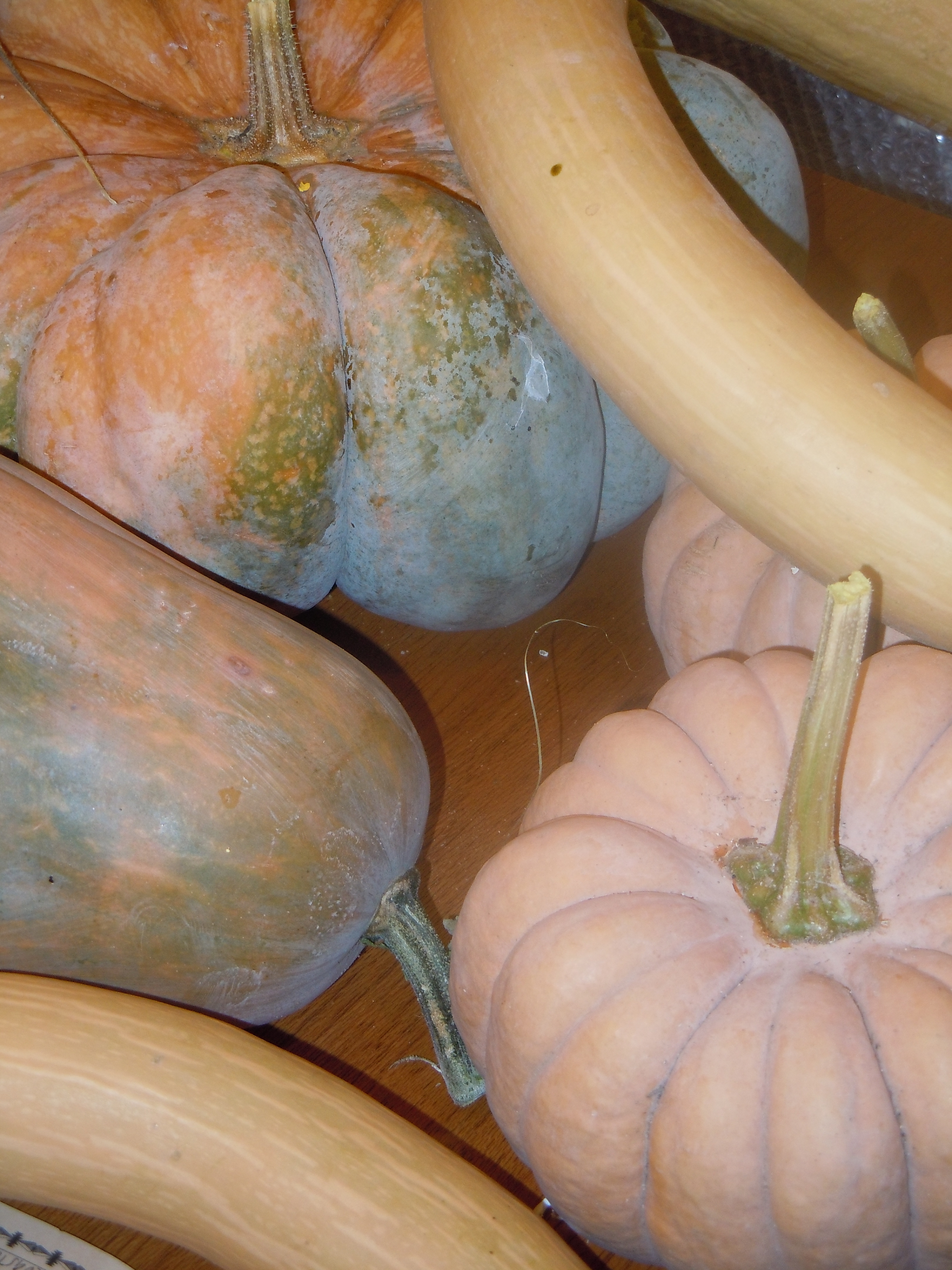
I love winter squash, and they can be hard to grow here in central New Mexico because of our thriving population of squash borers. The vine grows beautifully and sets baby squash in a responsible fashion, then one day it wilts, then it dies. I have tried all the organic “remedies” listed in the books, and don’t think that any of them are worth my time, in that the vine may survive (barely) but the chance of a good crop is nil. So this year I tried to beat the borers genetically. I grew only squash varieties of the species Cucurbita moschata, which is rumored to be borer-resistant. All I can say is, there are no guarantees in gardening, but I didn’t lose a single vine and my garage shelves are heaped with squash.
To use this method, you have to find a catalog that identifies squash by species as well as varietal name. I got mine from Baker Creek Heirloom Seeds. They are a great source for interesting heirlooms. I chose five varieties: Waltham Butternut, Musquee de Provence, Kikuza, Chiriman, and Sucrine du berry. All bore fairly well, although the sucrine du berry were the clear winners in terms of total pounds of squash. So far, the Kikuza are the best in flavor and texture, but I’ve only tasted three of the five varieties so far.
My favorite way to eat squash is halved,seeded, and roasted, with maple syrup or agave nectar and a pat of butter in the hollow. They will roast nicely at any temperature from 350 to 425 degrees, although of course they need more oven time at lower temps. Be sure to roast them long enough, by the way. The flesh should be soft and the syrup well sunken into the flesh. My preference in squash is a sweet dry flesh with no stringiness about it. To let any squash reach its best potential, it’s important to leave them on the vine as long as possible. Often the vines will die back in late fall, signaling harvest time, but if they don’t, harvest the evening that your first frost is predicted. It’s tempting to harvest them earlier when the skin hardens and they look mature, but this is the road to stringy watery flesh. Let the vine do its work. Once harvested, be careful not to bump or bruise them and set them on shelves in a cool place, not touching each other. I like to set several of mine on one end of my dining room table, where they look opulent and festive, but be sure to cook them within a month, since storage conditions in the average dining room are not ideal. The ones kept in a cooler (but not refrigerated) place will often keep well until January or February, but they do lose quality if kept too long. If you suspect that they are past their peak, roast them as described above and freeze the flesh.
I see a lot of recipes for squash that involve steaming the flesh, but I would never bother with them steamed. Roasting brings out the lovely caramelly notes and gives a rich flavor. Whenever I have something baking that doesn’t fill up the whole oven, I roast a split squash in the remaining space, and since the halves keep well in the refrigerator and are even better warmed up a day or two later, I have a handy adjunct to a meal waiting. If you have chickens, don’t forget to give them the stuff you scooped out when preparing the squash. They relish the nutrient-rich seeds. I also give the scooped-out shells to the chickens after dinner, and they enjoy those too.
 My urban homestead