Posts Tagged ‘vegetable gardening’

Spring in the food garden


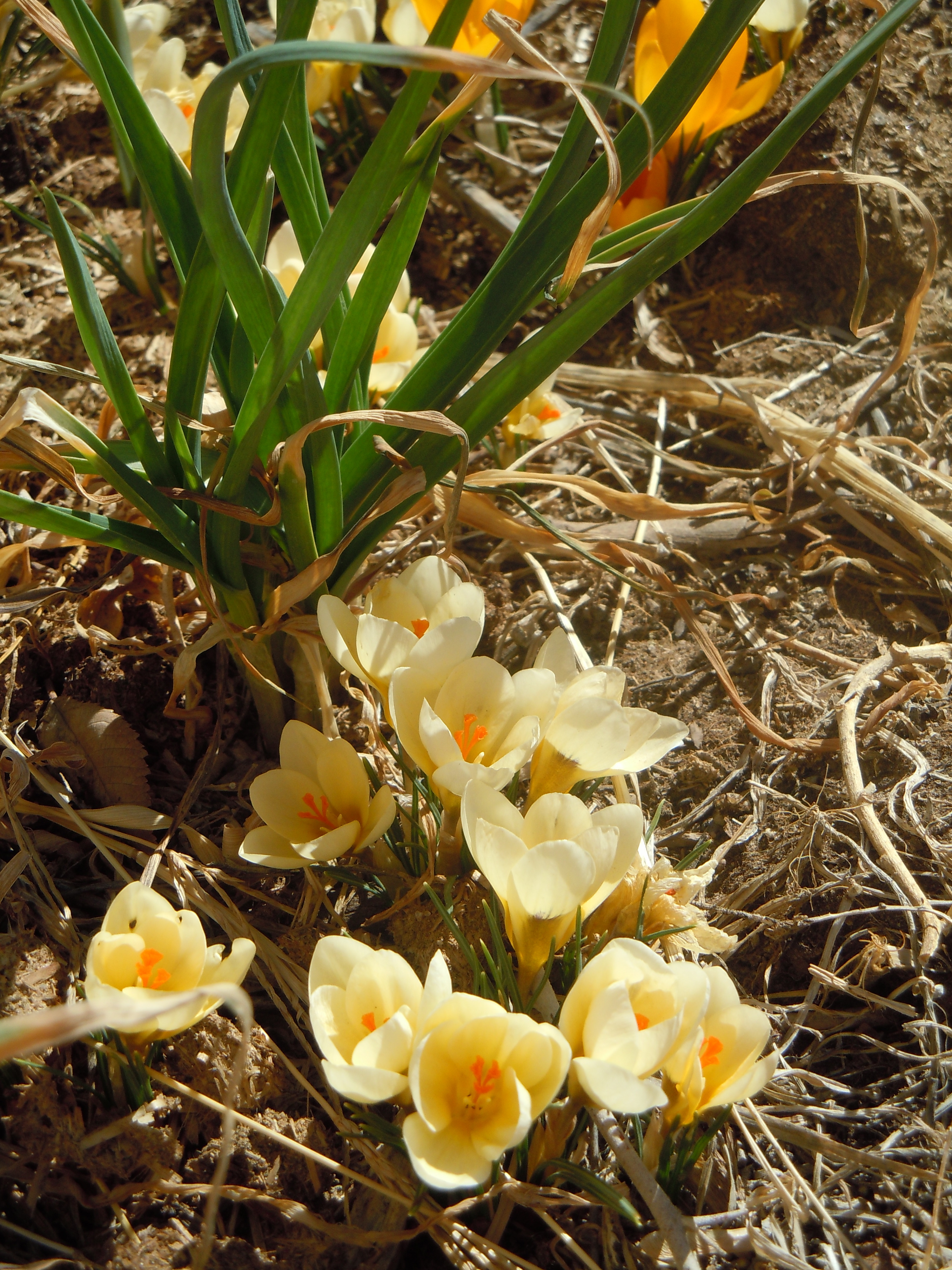
I’m not a winter person, so wherever I move, I always plant a patch of the early little species crocus “Cream Beauty” in my garden. When I see the first glowing blooms, I’ve officially survived another winter.

“Cream Beauty” is also a kind of floral nag, reminding me that there’s no time to hang around luxuriating in the sunlight; I need to be prepping and planting furiously. It’s one of the ironies of garden writing that, just when you actually have something to say, you have no time in which to say it. So here are a few spring tidbits in no particular order:

Last fall I coated all my “greens” beds thickly with horse manure, and dug it in as soon as the ground thawed in early February. Fresh manure needs to go on in the fall, but you can apply well-aged manure or finished compost now. Now the beds are ready to plant, and I put in three kinds of lettuce, several types of mustard, two kinds of spinach, snap and shelling peas, and a wide assortment of chicories, both leaf and heading. It’s important to get them in early so that they don’t fry in overly hot summer sunlight. Chard, parsley, and potatoes will be planted within the next week or two. Leeks and scallions were started in seed trays last month, and the multiplier onions, garlic, and shallots planted last fall are sprouting. I planted grey shallots once and didn’t find the bulbs useful- too small and too much work to peel- but they provide generous cuttings of sharp shallot greens every spring to season salads and soups. They are like chives but with a distinctly stronger flavor.

Every year I try a few things that are completely new to me, and one of my newbies this year is bladder campion, which, according to the catalog, provides young greens that taste something like green peas. It’s a common weed in wetter parts of the country, but here it needs some shelter and encouragement. Bear in mind that many plants which need full sun elsewhere prefer some shade from our high-desert sun. If you fail the first time, as I did with bladder campion last year, try giving a little afternoon shade.

Don’t forget to plant more peas than you need so that you can cut the sweet young greens for spring stir-fries.

If you’re going to try chickens this year, build the coop and make a brooder set-up now, BEFORE you buy the adorable baby chicks. I’m going to try a few meat chickens this year, so I’m building a large open-bottom cage to keep them in. It’s my first effort at carpentry, and I don’t think that there is a perfect 90 degree angle anywhere in it, but the chickens are unlikely to care. Make your chicken construction sturdy and raccoon-proof, not beautiful.

Gardening is a natural process, with all the entropy of any other natural process. Success does not pile upon success in an automatic fashion. Our freakishly cold snap is likely to result in some garden disappointments. My artichokes all seem to be dead, a sad event because they are offshoots of the first plants I grew from seed, many years ago. But that’s a reminder that nature is under no obligation to respect our sentiments. If you are very fond of getting your own way, gardening might not be for you. Nature offers some consolations too, like the glut of big brown eggs with deep orange yolks flowing out of the henhouse. There are a million ways to enjoy them, but while I’m waiting for the spring bulbs to bloom I enjoy eating what I think of as Daffodil Salad. The name comes from the colors, which remind me of the exquisite Poet’s Narcissus. Please know your edible flowers if you use them, and remember that daffodils are NOT edible.
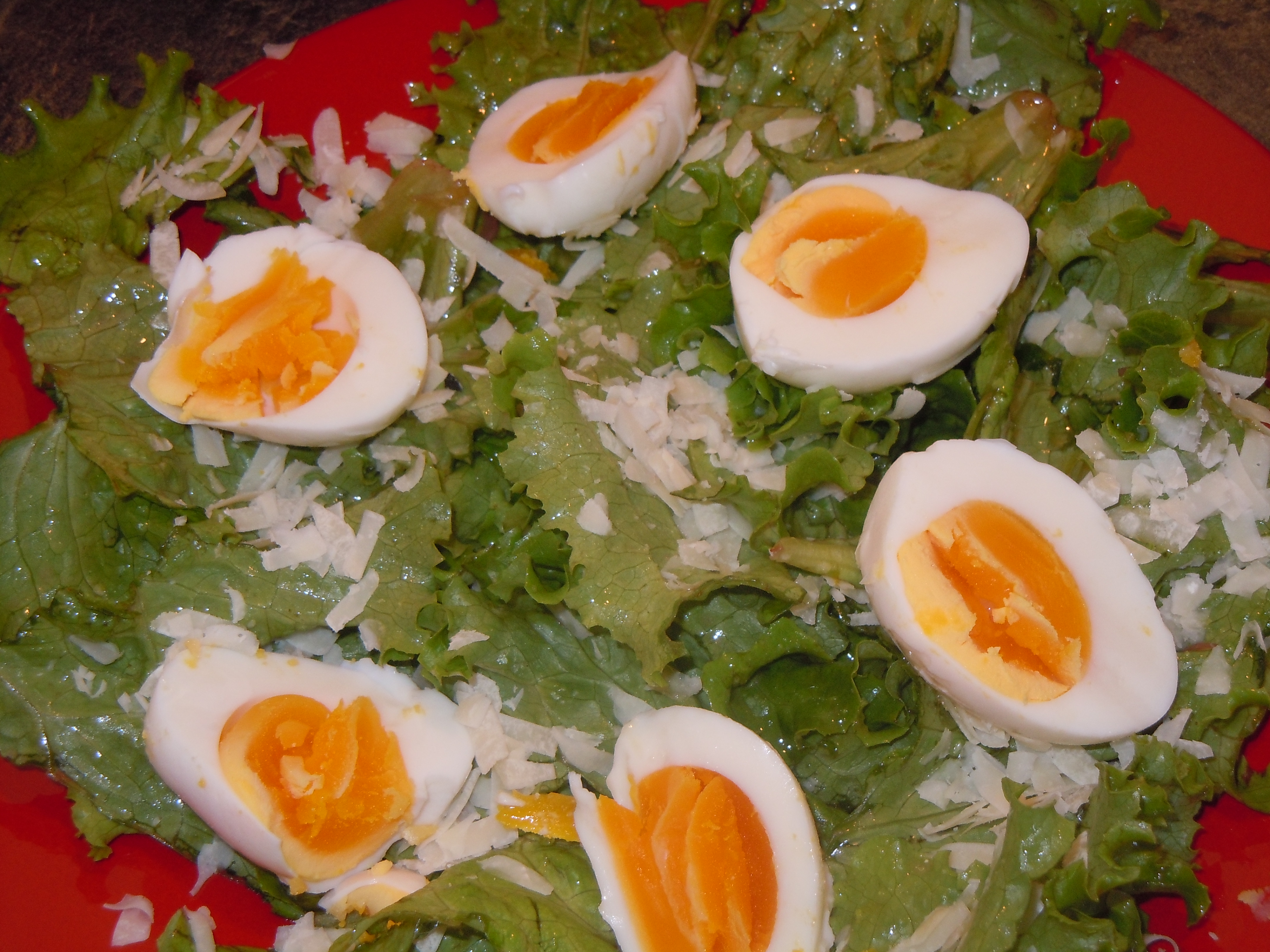
To make a main dish, put three eggs per person in cold water, bring to a boil, simmer 10 minutes, and cool quickly in cold water. If you have your own hens, the eggs need to be at least a week old to peel cleanly. With store eggs this is seldom a problem. The ten-minute simmer gives yolks as shown, just barely solid in the center and a rich orange. Peel the eggs and cut them in half. Put the amount of salad greens you prefer in a big bowl; I use about three good-sized single handfuls per person. Toss with the dressing below or your own favorite vinaigrette. Pile on plates, top with the egg halves, and drizzle a little more dressing over the eggs. Scatter on some thin shavings of your best Parmesan and enjoy.

Spring dressing
1 small shallot or the white part of one scallion or the white part of one stalk of green garlic
juice of one lemon
1/2 cup best olive oil
2 tablespoons roasted hazelnut oil
half a teaspoon of salt, or to taste.
fresh pepper, about 15 turns of the mill
a small handful of chopped chives or about 2 tablespoons very thinly sliced shallot greens

Chop the shallot bulb, scallion, or green garlic bulb very finely and marinate in the lemon juice for fifteen minutes, with the salt added. Don’t skip the marinating step. After fifteen minutes stir in the other ingredients, shake in a jar, taste for seasoning, and use. Any not used immediately will last a day or two in the refrigerator.
My Bookshelf: Efficient Gardening and the foraging gourmet


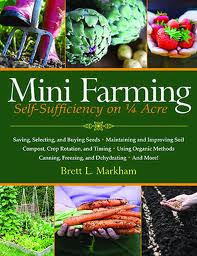
Mini Farming is about producing as much food as possible from as little space as possible. It covers a number of ways to produce food, including vegetable and fruit growing and raising chickens for eggs and meat. It goes into great detail about soil amendment so that your plants will grow. You may not want to garden in this precise fashion, and I’m with you there, since my own gardening methods are more slapdash. But it’s good to know some rules before you start breaking them. It is a very practical book, offering an astounding amount of information per dollar. The author has clearly done these things himself; sadly, this is not always the case in homesteading books. He is careful to tell you what you need to know. A pet peeve of mine is the number of homesteading books that purport to teach you how to raise animals for meat, then when the time comes to harvest the meat they go coy and soft-focus and say “Be sure to have an expert show you how to do the killing.” What nonsense. You may not have anyone available to demonstrate, or a self-elected “expert” may do such an awful job that you think you’ll never eat meat again. A good book can describe the process and ready you for what you will encounter every step of the way. This book tells you exactly how to kill and butcher a chicken as quickly and humanely as possible. If you are going to raise meat birds, read it even if you plan to have a more experienced person help you, so that you understand beforehand what’s going to happen. This is a great value and a good book for the serious “yard farmer.”

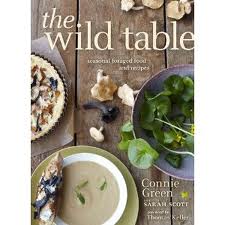
I do not ever accept free review copies of the books that appear on my blog. I buy them at my local independent bookstore, paying the price that you are likely to pay. Books like this make me realize why I set that policy. This is a very beautiful book, and the recipes are top-notch. But if you’re buying it because you are interested in wild foods, you need to know a few things:
1. A lot of the wild foods described are mushrooms, which many foragers prefer to avoid.
2. This is not a book about how to forage. You’ll need a couple of good foraging instructional books for that.
3. If you’re one of my local Albuquerque readers, a lot of the foods described don’t grow wild around here.
In short, this is a great coffee-table book and a fine high-end cookbook, and if you love to spend time in the kitchen trying to find the greatest height to which a foraged food can be brought, you’ll love this book. If you love to gaze upon exquisite (and expensive) glossy photos of resplendent food, you’ll love this book. I love this book. But $40 is a price that makes me stop and think hard about value for money, and I can’t honestly say that it represents great value for money. If I had gotten it free, I might unconsciously gloss over that part. I’m glad I bought it, but if your goal is to learn to forage, this is not the book for you.

Organic Matters

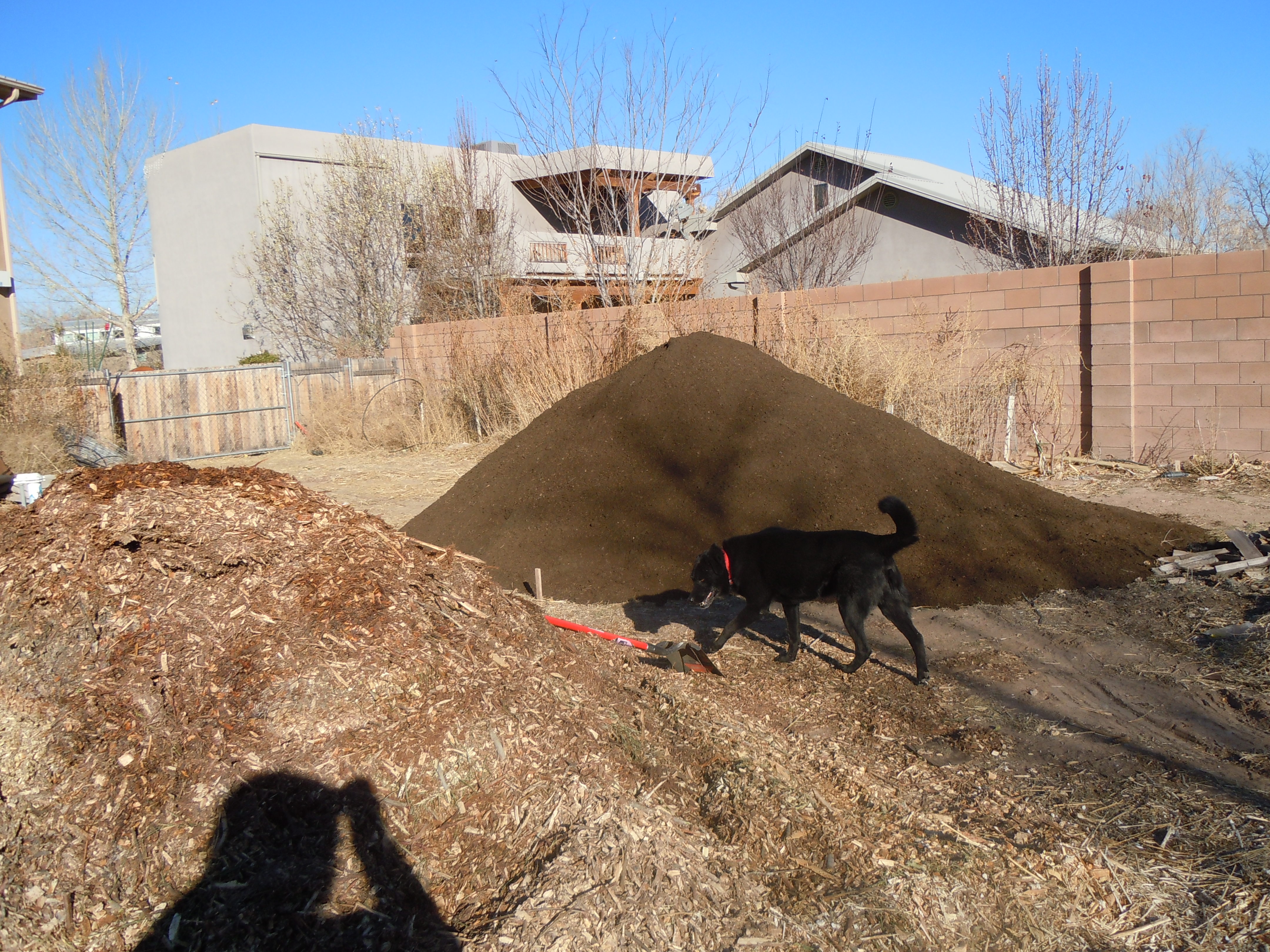
The soil at our new house, like many urban soils, was unpromising at best. Rocky, compacted, and highly alkaline, the only thing that really wanted to grow in it was tumbleweed.  With compost, gypsum,  and sheet-mulching it’s already a lot better and improving steadily. Beginning gardeners may be amazed at the sheer quantities needed. To emphasize the point of using enough, I’m illustrating the winter Grand Tetons of my backyard, Mt. Shredder and Mt. Manure. It might look like a lot, but it will be gone by spring.  Over the winter I’ll gradually spread the compost and work it into the growing areas, and mulch paths with the bark chips.  If you don’t have room for big heaps, you can get compost in bags, but get plenty. Apply gypsum per the results of your soil test, and you’re set for a successful growing season.

Didn’t get a soil test? I have to admit that I didn’t either. On soil that hasn’t been gardened before, I apply gypsum according to the directions on the bag, putting a little more where I’ll be growing calcium-lovers like broccoli and spinach. I also use extra on the potato patch, to get the pH down into a range that the potatoes can tolerate. Where soils are acidic I’d be using lime instead, but our very alkaline high-desert soils usually need a dose of gypsum to make them liveable for vegetables. Then I put on a scientifically determined amount of compost: all I can afford. Unless it’s really well aged, I keep it off the potato area. Instead, I dig all my neighbors’ discarded leaves into that area. No doubt it leads to comment when I remove the leaf bags on the night before green waste pick-up day, but as I see it, worse things could be said about me, so I’m lucky if people are only talking about my leaf-snatching habits. Needless to say, nothing should be touched unless it’s set out by the curb for pick-up. When in doubt, ask. But there’s no reason to pass up free organic matter that others are trying to get rid of.  Think of yourself as the Guerilla Gardener, and you may feel dashing instead of disheveled and a bit silly.

Vegetable dinners: things to wrap in a pita


My new category, Vegetable Dinners, will be a collection of meals based on vegetables. Some are vegetarian and some aren’t, but where meat is used, it’s a small amount and is used more as a seasoning than as the bulk of the meal. Where relevant, notes on how to make them vegetarian or vegan are included, but many of them taste best with a little meat or fish included, and my recipes note this. My kitchen mantra is “Eat less meat, eat better meat,” and the same goes for eggs and dairy products. Since you aren’t using much, you can afford the best and most sustainable.
Summer vegetables are at their peak now, and in my home most of our meals are based on them. Mixtures that can be wrapped in a pita make a light easy meal on hot days. The filling can be made ahead, and keeps a few days in the refrigerator. OIl-cured black olives are used to add a meaty savor to eggplant and zucchini, and capers add an herbal note. This meal is vegetarian, and can be made vegan if you alter the sauce recipe a little.

Eggplant and Zucchini with olive paste

2 small or one large eggplant, fresh and firm
2 small zucchini
12-20 oil-cured black olives depending on your taste for them (no other kind of olive will do here)
3 tablespoons salted capers, rinsed and then soaked in cold water for an hour and squeezed dry
1/4 cup good olive oil
2 large or 3 medium cloves garlic
chopped parsley to taste, probably a couple of tablespoons

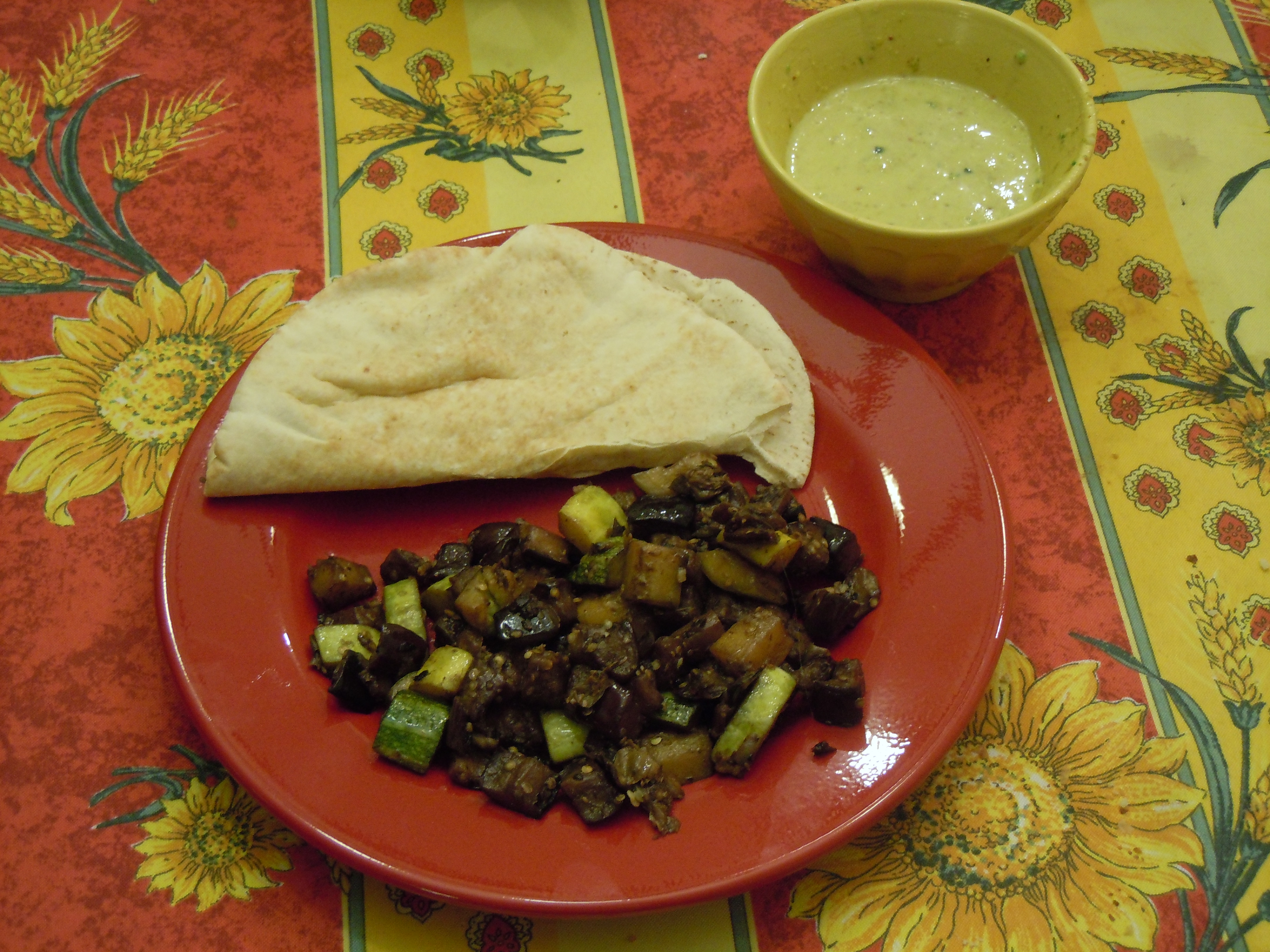
Cut the eggplant in cubes 1/2 inch or a little larger on a side. Whether you peel it first is up to you. The finished dish has a more tender texture if the eggplant is peeled, but less fiber and fewer antioxidants, so take your pick. Personally, I leave the peel on for this dish as long as the eggplants are young and tender. Cut the zucchini in quarters and slice each quarter into segments on the small side of 1/2 inch. Toss the vegetable cubes together in a bowl with 2 teaspoons of salt and let sit at least 1 hour, tossing occasionally. This step is important for this dish and shouldn’t be shortened. Don’t worry about the quantity of salt; if you do the squeezing step well, most of it will be removed with the liquid. You can soak the capers at the same time. Pit the olives and chop them coarsely, and chop the garlic finely. At the end of an hour, drain off exuded liquid and squeeze the veggie chunks in a clean kitchen towel, a few handfuls at a time, until as much liquid as possible has been squeezed out. Squeeze the capers dry and chop them coarsely. In a clay cazuela or 10″ skillet, heat a few tablespoons of the olive oil and add the garlic. Cook until opaque and cooked but do not allow it to start to brown even a little. Now add the olives, capers, and veggie chunks, toss to coat with the oil, and cook over low heat for about an hour, tossing occasionally and making sure it doesn’t burn on the bottom. Add a little water if needed to prevent burning.
Texture is very important. Start tasting a little after 45 minutes or even 30 if it looks like it’s cooking quickly. When the zucchini is just tender but not mushy, and the eggplant is melting in texture, it’s done. Also check for salt, but the seasonings are salty and you are unlikely to need any. Stir in the parsley just before serving. Serve with good pita bread, lightly warmed, and the sauce below.

Lemon-garlic sauce
This sauce is like an aioli but looser and less rich. The egg yolk just binds it and thickens it a little. If you leave out the egg yolk the whole dish is vegan, and the flavor doesn’t suffer at all but the texture will be liquid, not thick, and it will need to be stirred up by each diner before taking any.

1 egg yolk
1 large clove garlic
juice of half a lemon
1 Jalapeno pepper
olive oil as needed, usually about 1/4 cup.
salt to taste
1-2 teaspoons fresh thyme leaves

In a small food processor, chop the garlic clove and the chile pepper. I always mince fresh chiles before putting them in the processor to make sure that big chunks don’t startle diners. Add the egg yolk and lemon juice, process briefly, and slowly drip in the olive oil until it’s as thick as you want. I like it to be liquid and spoonable, but velvety. Taste and salt as needed. Add the thyme leaves and stir in. For the vegan version, proceed the same way except leave out the egg yolk, and be aware that it won’t thicken in the same way but will be more like a vinaigrette.
Don’t save leftover sauce more than a day in the refrigerator, because of the egg yolk, but I like to spread leftover sauce on a warmed pita for lunch the next day.