Posts Tagged ‘fermentation’

For Love of Fermentation

I have often read that restaurant Noma in Copenhagen is the best restaurant in the world now that El Bulli has closed. These all-time-best commendations always annoy me because I always suspect that the real best restaurant in the world is some Thai or Indonesian street stand that makes something out of nearly nothing and does it perfectly. That said, having read Noma’s new guide to fermentation, I am willing to believe that Noma might be the best restaurant in the world, because they have certainly expanded the age-old art of fermentation beyond anything I have previously encountered. The book covers all forms of fermentation except the purely alcoholic ones that produce wines and beers. There are detailed sections on lactic fermentation, kombucha, vinegars, kogi, miso, shoyu, garum, and the enzymatic blackening that produces black garlic and much more if you let it. There are fascinating asides on how to use the resulting liquids and solids in dishes and as seasonings. They observe that, to their own surprise, the variety and depth of flavor produced is so profound that they may become a largely vegetarian restaurant.

Many people think of fermented products largely in health terms, a “gut shot” of probiotics. But playing with the Noma ideas, I’m experimenting with the essences that result when fermented products are cooked down. They are no longer live, but they’ Delicious. I love to keep chicken and beef glacé in the freezer to add depth, body, and a suave finish to even the simplest sauces, and cooked-down ferments may fill a similar role.

There is commentary on things that I will never intentionally try, such as the culinary use of insects. I’m well aware of all the arguments in favor, but I’m too acculturated against it to approach it with an open mind. So, their cricket garum isn’t going to be an item in my diet anytime soon. But less rigid cooks may want to experiment.

Under Noma’s influence, the large insulated but unheated shed that I use for painting has become a busy fermentation facility.  I have so many experiments going that I will never have time to write about most of them, so buy the book.  I don’t accept review copies, and when I review a book, I paid the same price for it that you will pay. There is no other way that I can realistically assess the value/money ratio.  About this one, I can only say that it is very hard to put a price on a book that can invigorate your entire daily cooking routine and open up a new range of flavors.


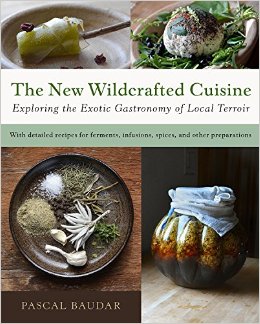
A Cookbook to Make You Think: The New Wildcrafted Cuisine


image

Some cookbooks make you cook. The recipes are smart and well-crafted and will clearly work, and you want to run to the kitchen and get started.

Other cookbooks make you think. They are provocative and, at their best, subversive, and expand your possibilities even if you never cook a single recipe.

Today we have a thinking cookbook. When I first looked at this book a few weeks ago it seemed meant to be weird. In fact, it seemed at first to have a self-consciously outré quality that set my teeth on edge. An example: “lemonade” made, not with citrus, but with 2000 lemon ants, a citrusy-tasting ant found in Southern California, crushed and macerated. Surely juicing a lemon would be quicker and better, although the image of some earnest chef-wannabe counting out 2000 lemon ants is an interesting one that will be with me for a while. The author proposes that some fermentations to make vinegar need to get started from the fruit flies that they naturally attract because the little bugs carry something (Acetobacter presumably) that start the conversion to vinegar. Yech. As I see it, fruit flies are why humans invented cheesecloth, and nothing will convince me that they are better fermented than slurped straight-up just as they land in your wineglass, an ingestion that I avoid if at all possible. There are a series of recipes with “forest floor” seasonings composed of grass and leaves found under trees, and I can’t say that I have ever nibbled on a grass that I would consider potentially useful as a seasoning. There are a lot of recipes for lacto-ferments, and having lived through the last lacto-fermenting craze, I am not very enthusiastic about having another one. Lacto-fermented elderflower “beer” might sound elegant but is nowhere near as good as a well-made wine. The current obsession with local terroir in wine often involves mediocre grapes, inferior bottling practices, and determination to drink bad wine because it somehow tastes of the locale, and I thought that author/forager Baudar’s “primitive brews” would be much like that.

In short, I thought that I would pan this book and get on with other things. Instead, after owning it for a few weeks, I keep going back to it and thinking, and gradually realizing how wrong my first impression was. I have seldom encountered a book that makes me think as creatively about possibilities, and this is after reading, foraging, and cooking for decades. Now the lemon-ant lemonade seems, not tricksy and silly and literally intended, but an invitation to explore the possibilities around you in ways that you might never have thought of on your own. In effect, the recipe tells you “Don’t limit yourself. Think about every possibility.”  Bauder’s practice of letting his gaze light on something familiar and spending some time thinking about its culinary possibilities is infecting me with new pleasures and possibilities. Make wild greens kimchee out of whatever greens suit your fancy, and not only enjoy it as is but dehydrate it to use as a seasoning? Sure. Try cold-infusing the deliciously honey-scented goumi blossoms in my front yard to make a drink, as Baudar does with elder flowers and others? Not until my bushes get bigger, but then I will. Put a few of their blossoms on salads now? Of course. The trash Siberian elms that invade the Rio Grande bosque; have I ever thought about whether their scented cambium (inner bark) had any flavoring possibilities if roasted or smoked and infused? Not until I read this book. I like to make verjus from unripe grapes in the summer and enjoy its clean sourness anywhere that I might use lemon juice, but I’ve never thought of juicing other unripe fruits for the same purpose, and I’ll enjoy testing their range of flavors. I may well try roasting outdoors on a hot stone, or cooking something fast and delicate by arranging pine needles and herbs over the food in question and burning them. It has been a decade since I made flavored vinegars for shrubs, but now I will because this book has excited me all over again about the possibilities. And yes, I will certainly be trying “primitive brews” akin to his and experimenting with my local versions of his SoBeers, fizzy low-alcohol concoctions somewhere in between soda and beer. I’ll be tasting my own local grasses and herbs again to test their flavoring possibilities. I’ll be making vinegar-based and fermented hot sauces. I’ll try vinegars flavored with an assortment of my local seeds to grind into a mustard-like condiment. In short, I will view the familiar things around me, with uses that I think I already know, with new excitement and find new uses for them. Once over my initial dubiousness, I began to think that this is one of the most exciting cookbooks that I have read in a very long time. See where it leads you. Odds are that I will never cook a single recipe from it as written, because that isn’t the point.

I trust that it goes without saying (but here it is anyway): YOUR SAFETY IS YOUR RESPONSIBILITY when foraging. Study, consult guidebooks, and know for certain what you are about to taste. This book is not a guidebook and will not teach you the safety of your own local plants and animals. Don’t wander around tasting things at random, like a feckless innocent in Not-Eden. That kind of thing gives foraging a bad name.

Midsummer Mead


Somewhere I read that it’s traditional to drink mead on Midsummer Eve. Since I love to ferment nearly anything, this is a convenient excuse to try my hand with mead. In this case I’m posting before I know the results, in case you want to brew your own Midsummer Night’s Dream.
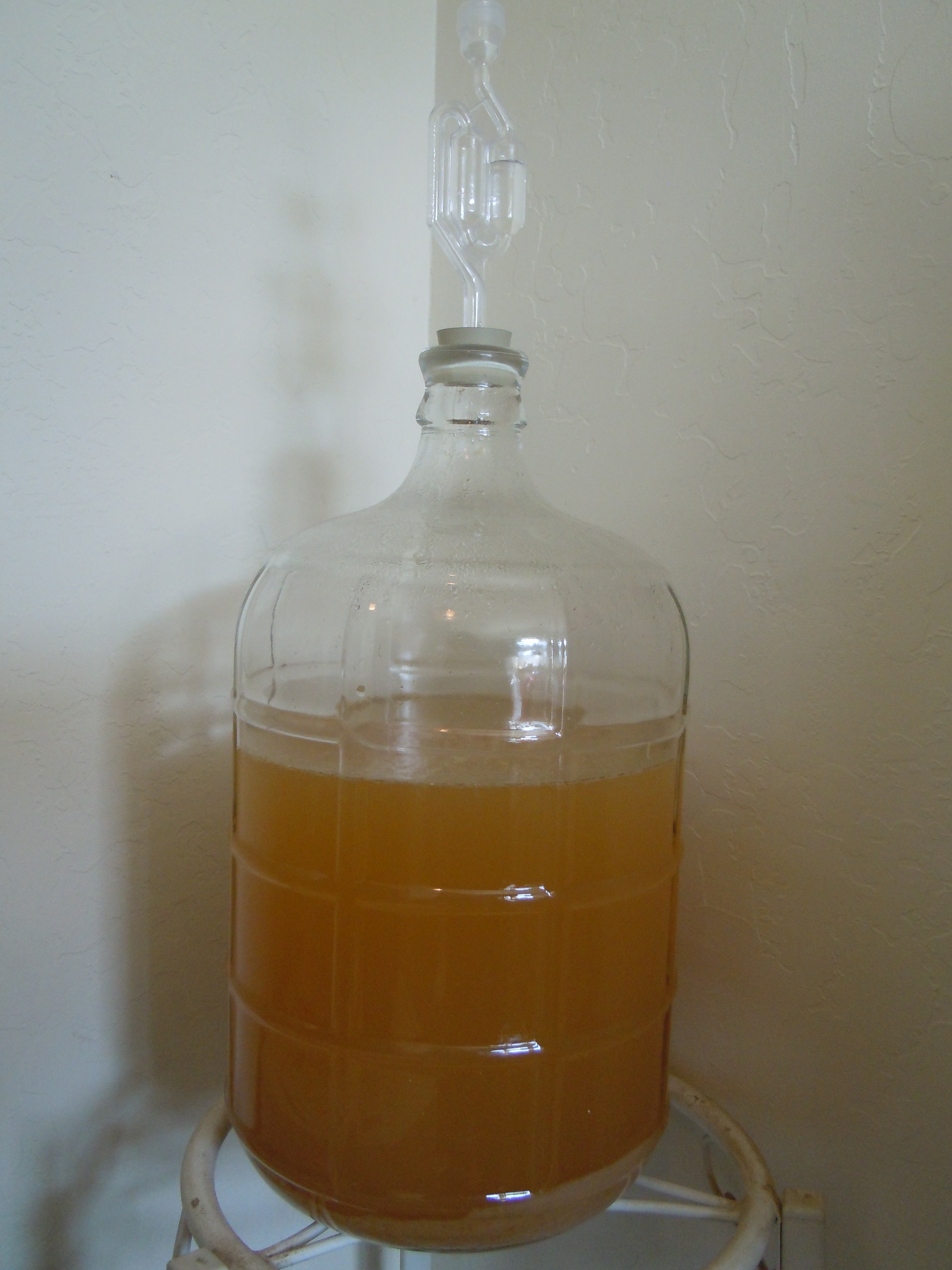
The equipment you will need to brew two gallons is a 3-gallon glass carboy, a drilled stopper that fits it, a fermentation lock, a food-grade plastic tube for siphoning, and 8 quart bottles with sturdy gaskets. You can obtain all of this from Victor’s Grape Arbor in Albuquerque or from any brewing supply house. While you’re there, get a packet of champagne yeast and have the helpful salesperson show you how to set up the fermentation lock, ie where to put the water. From your favorite food co-op, you will need five pounds of wildflower honey, two lemons, and a nutmeg.
After cleaning the carboy, stopper, and fermentation lock, bring two gallons of water and the honey to a boil. Stir until the honey is completely dissolved. While it heats, grate the rind off the lemon, squeeze the lemon juice out, and grate the nutmeg or crush it thoroughly with a mortar and pestle. When the mixture boils, remove from the heat, add the lemon zest and juice and the grated nutmeg, and let it sit uncovered until it cools to 90 degrees. Now pitch the yeast; sprinkle some on the surface, let it moisten a bit, stir it in, and sprinkle more. It should take about 5 minutes to pitch the whole packet. Stir the mixture well, pour it into the carboy, fit the fermentation lock and put some water in it, and set in an inconspicuous place. Within 2 days there will be frequent bubbling of gases through the water in the fermentation lock. Let sit two weeks (it will probably stop bubbling within a week) and then siphon the liquid off the dregs and into the cleaned quart bottles. Seal the gaskets, let sit a week in a cool place, and then chill until the magical evening. If you can drink it in your own garden as the sun sets, so much the better.
I plan to give mine a “dosage,” ie add a teaspoon of a honey-water mixture to each bottle to make it carbonate, but this is not essential.
Needless to say, this is an alcoholic drink, so don’t share it with children or the addicted, and don’t drive. But if you want to cast a beguiling charm on your beloved while you sip mead together, there’s no law against that.

Kitchen Staples: Injera

October 2009 014
Flatbreads are a handy kitchen trick to have up your sleeve for times when you don’t want to bother with raised breads or they won’t suit the meal you have in mind. Since they don’t need to rise, they are not gluten-dependent and make a great vehicle for a variety of whole grains.
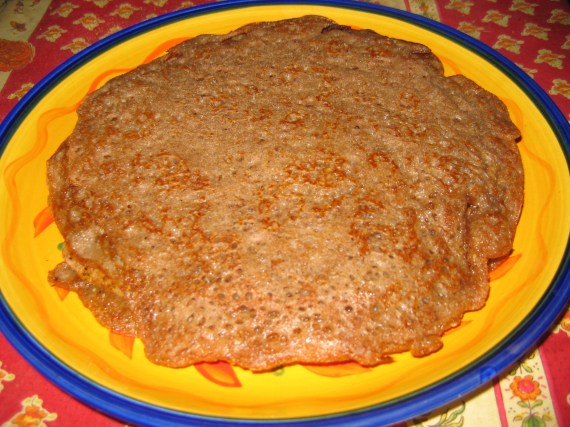
The Ethiopian flatbread called injera is made from a fermented batter that give it a frothy texture and a charming lightly sour flavor. Traditionally it’s made from the tiny grain called Teff. Of course it’s good with Ethiopian food, but I love it with many Indian dals as well as with salads and grilled meats. It serves as your table utensil; pieces are torn off and used to scoop up whatever you’re eating it with.
In this country most recipes are bastardized versions that don’t involve any fermenting. Some add vinegar to get the soured flavor. But why not just do it right? I keep a sourdough culture around and find plenty of uses for it, and it makes injera as well as it makes standard breads. You can always capture your own starter, but I like the South African starter from sourdough fanatic Ed Wood, at Sourdo.com. It does a great job of souring and leavening whole grain flours. You can use commercial yeast instead but the flavor won’t be as good. Every homestead, urban or otherwise, needs a good sourdough starter around, so consider starting one now, but if you don’t want to bother, I include directions for commercial yeast. In my next few posts I’ll include some recipes that are good to eat with your injera.
Click here for the recipe Continue reading