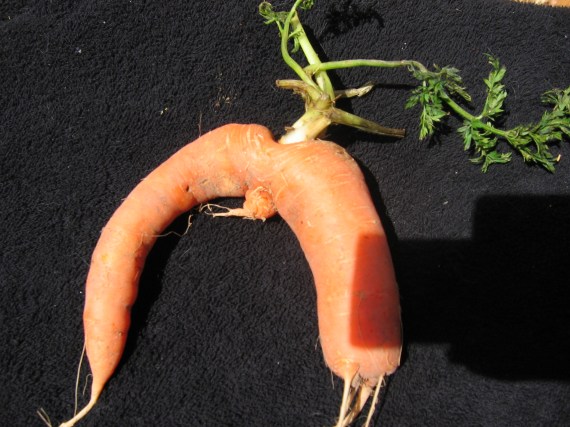
In the relatively mild central New Mexico climate, I leave my carrots in the ground all winter and dig them whenever the ground is thawed enough to get a shovel into. The area that I find it convenient to grow carrots in has some stones, and sometimes the roots hit the stones and are induced to grow in peculiar ways. I offer this piece of natural carrot art without further comment.
Archive for the ‘salads’ Category
22 Feb
The Sensuous Carrot
5 Feb
Foraging: wild mustard
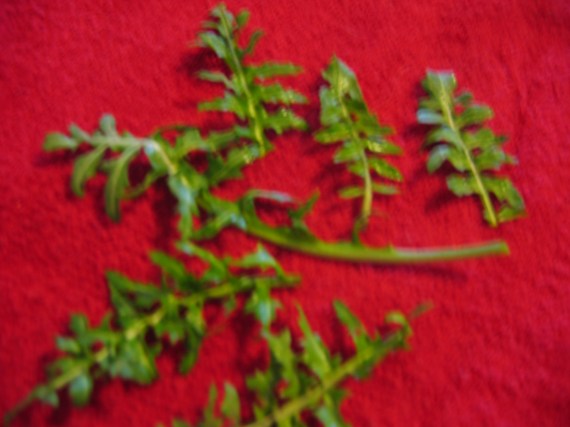
Right now, the wild mustard is free for the picking in our region. I find it in unexpected places in my yard, including the middle of the lawn, and along acequias closer to the river. Needless to say, you don’t want to pick any that’s growing where it’s exposed to walking dogs, or where chemical spraying may have taken place.
When the weather is still very cold and the wild mustard is still young, it’s a great green to spice up a salad, adding a wasabi-like heat when combined with milder greens. Taste it, and if it’s too hot for salads cook it, which lowers the heat. I love to mix it with spinach, chard, or other mild greens about half and half: saute’ some chopped garlic in olive oil in a skillet, add the well-washed greens and a couple of tablespoons of raisins, and braise over medium heat until done. Garnish with toasted pine nuts, and eat.
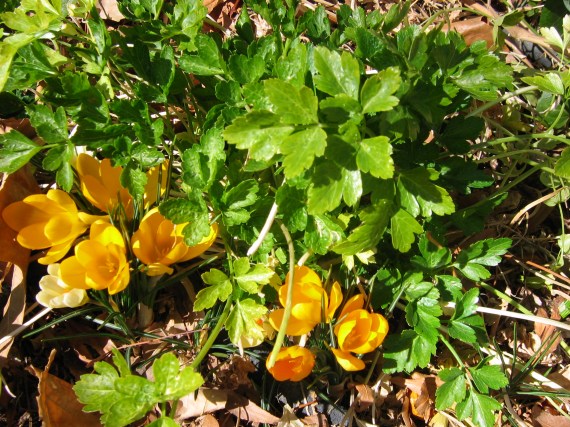
These potent, highly flavorful greens were the “spring tonic” of our ancesters, and today we still need those vitamins, minerals, and antioxidants. We may not be recovering from a winter without fresh vegetables, but we still need the connection with the awakening earth that its first green shoots can provide. If you were thinking ahead last fall, you made sure to have plenty of herbs, and now you can sprinkle your cooked greens with the shoots of parsley and fennel that are coming up from last year’s plants. They’ll shoot to seed soon, so use them up now.
1 Feb
More winter treats: the Peruvian Purple Potato
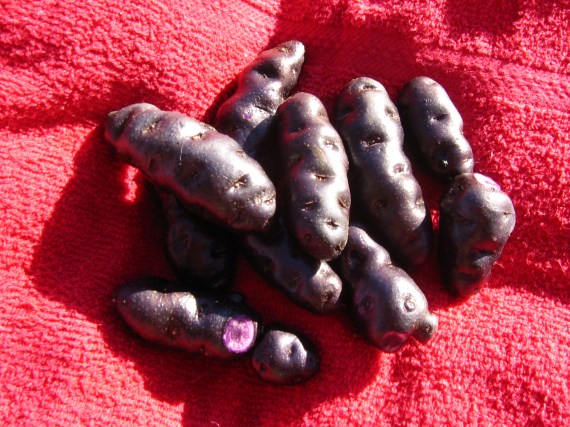
When I first ordered Peruvian Purple seed potatoes, I thought of them more as a curiosity than as a real crop. I was curious about how this native of the Peruvian highlands would adapt to our own high-desert conditions. I was also aware of their very high anthocyanin content, and I’m never one to turn down a good source of antioxidants. I’m still digging them for winter use, and they are one of my most successful crops this year and fill an interesting niche in my household menu: they’re readily available when nearly everything else is dormant.
I planted mine in a strip at the side of my house, which gets very hot in the summer. I did water them but not as much as they might have liked. Even so, they flourished and looked very pretty in their season. Incidentally, this brings up the fact that much gardening information on the Web is clearly written by non-gardeners. Now that edible landscaping is hot, I see recommendations to use the potato as an ornamental, which sounds fine if you don’t know that the vegetative parts die off in late summer and look just awful. So plant them where some other big pretty plant will spill over and fill the empty space in late summer, or put them in an out-of-the-way place where you can admire them in their season and not see them as much when they die back. Do keep them weeded.
When they flowered I scrabbled under themn to look for new potatoes, as I do with all my potatoes, but didn’t find any, and thought they were probably a loss. However, in November when I dug up the space for the winter, I found a treasure trove of earth-amethysts. They were blemish-free and looked very lovely after scrubbing, with deep purple skins that glistened like jewels when wet. I left them in the ground and dug them as I needed them, and on February 1st I’m still digging them and they’re still in perfect condition. They have been completely free of disease and haven’t shown any sprouting yet.
They’re very tasty cut in chunks and roasted in nearly any kind of fat (olive oil and goose fat are probably my favorites) in a 400 degree oven with some coarse salt and a good sprinkling of chopped herbs added near the end of cooking. Chopped garlic added late in the cooking period when it won’t scorch is nice too. A hot potato salad made of chunks of Peruvian Purple boiled in salted water until tender, drained, and dressed with a vinaigrette dressing and a little chopped green onion, parsley, ands celery (plus a good dose of bacon crumbles for non-vegetarians) would be delicious and very decorative. This potato is a survivor, which is probably why it was valued as part of the Peruvian mixed potato patches. It doesn’t demand intensive care and makes do with less water than other potatoes I’ve grown. I recommend it. You can get it at Ronnigers. Formerly I recommended Seed Savers Exchange, and although they don’t have this potato for the 2010 season, I do still recommend them for almost everything else.
For more on growing potatoes. Click here
1 Jan
Red Wine Vinegar
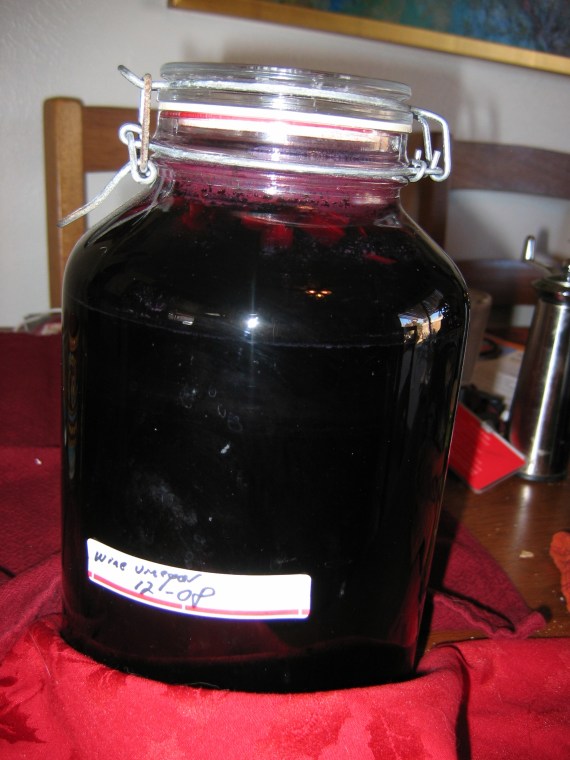
There’s a very good reason to make your own red wine vinegar at home: it will be about twice as good as any you can buy, because the wine you put into it will be twice as good as that in commercial vinegars. If you want a more formal process, you can find excellent directions in Paul Bertolli’s book Chez Panisse Cooking. My own more rough-and-ready process goes something like this:
1. Get a large glass jar (anywhere from quart to gallon-size, depending on how much vinegar you want) with a glass lid and rubber sealing gasket. They are widely sold as canisters. Buy enough good red wine to (eventually) fill it. The wine must be good enough that you would thoroughly enjoy drinking a glass of it. The best vinegar I’ve made so far was made with J. Lohr cabernet, which is widely available.
2. Get some vinegar mother. Some winemaking supply stores sell them, but I got mine from a bottle of Bragg cider vinegar, which is available at La Montanita co-op.
3. Add one bottle of wine to the jar, add the mother or about 1/4 cup of the Bragg vinegar, put the lid of the jar someplace where you can find it later, cover the jar loosely with a dish towel held on tightly by a rubber band, and set it in a dark place. Check it every few days. Somewhere between a week and a month later, depending on temperature and other factors, you will notice light grey wispy streaks on the surface of the wine. This is the developing mother.
4. Once the mother starts to grow, you can add more wine, but it has to be done carefully. You want to leave the surface as undisturbed as possible. I use a short length of clear tubing from our local winemaking supply shop, Victor’s Grape Arbor. I put one end of the tubing below the surface of the developing vinegar and use a funnel to pour wine slowly into the tube. That way, wine can be added without drowning the mother. Be sure not to add too much at once. Adding about two cups every week or two works well, until you have filled the jar that you plan to fill. Be sure to fill it right to the top; I’ll go into the reason for this later.
5. When the jar is full, keep it in the dark place and, every week, taste a little with a spoon, being sure to disturb the surface as little as possible. Keep it tightly covered with the dish towel between tastings. When it tastes like vinegar, you’re ready to proceed to step 6. It will still taste sort of rough and raw. Don’t worry.
6. There is no question that wine vinegar needs oak aging to taste its best. If you want to fill an oak cask that’s fine, but it isn’t necessary. Use a wide spoon to carefully remove all the mother and a little of the vinegar under it. Put this in a small jar. Scrape the bottom of your vinegar jar with a slotted spoon to see if a gelatinous substance has formed. This is a submerged part of the mother. If it’s there, add it to your removed mother in a small jar and store in the refrigerator for the next time you want to make vinegar. Now for the oak aging part. At winemaking supply stores you can get small bags of oak chips. Carefully add the oak chips to your vinegar. You will have lost a little volume removing the mother, so the chips should bring it back up to brimming full. Make sure all the chips are wet (Over the next few weeks, they will gradually absorb vinegar and sink to the bottom.) Now put on the lid, not the dish towel, and seal it. Make sure that the vinegar doesn’t touch the gasket when the jar is sitting level. If it does, remove a little vinegar until it doesn’t.
8. Now let the vinegar age in a dark place for as long as you can stand. It gains mellowness with age. Richard Olney says it needs 2-3 years to reach its best, but I’ve never held out that long. In six months it will be very good.
9. When ready to use it, funnel it into empty wine bottles and cork them tightly. At this point you don’t want it exposed to the air any more than necessary. You can store it in the refrigerator if you have room. I usually keep it on the counter.
10. Start to use it. It will make a great vinaigrette dressing, of course, but you’ll find lots of other uses. Click below for some recipes.
click here for recipes
 My urban homestead