Archive for the ‘recipe’ Category

The Very Composed Salad, and notes on vinaigrette


For the most part I make simple salads when I make salads at all, relying on top-quality greens and a well-made vinaigrette for effect. But the salade composee, or composed salad, will always be dear to me because I can remember when Salade Nicoise was the very height of Manhattan foodie chic and Nocoise olives were hard to find. The urge to make a greater spectacle of my salads comes over me in midwinter, when short days and long nights give me more time to fiddle. In my opinion, this salad is one worth fiddling with.
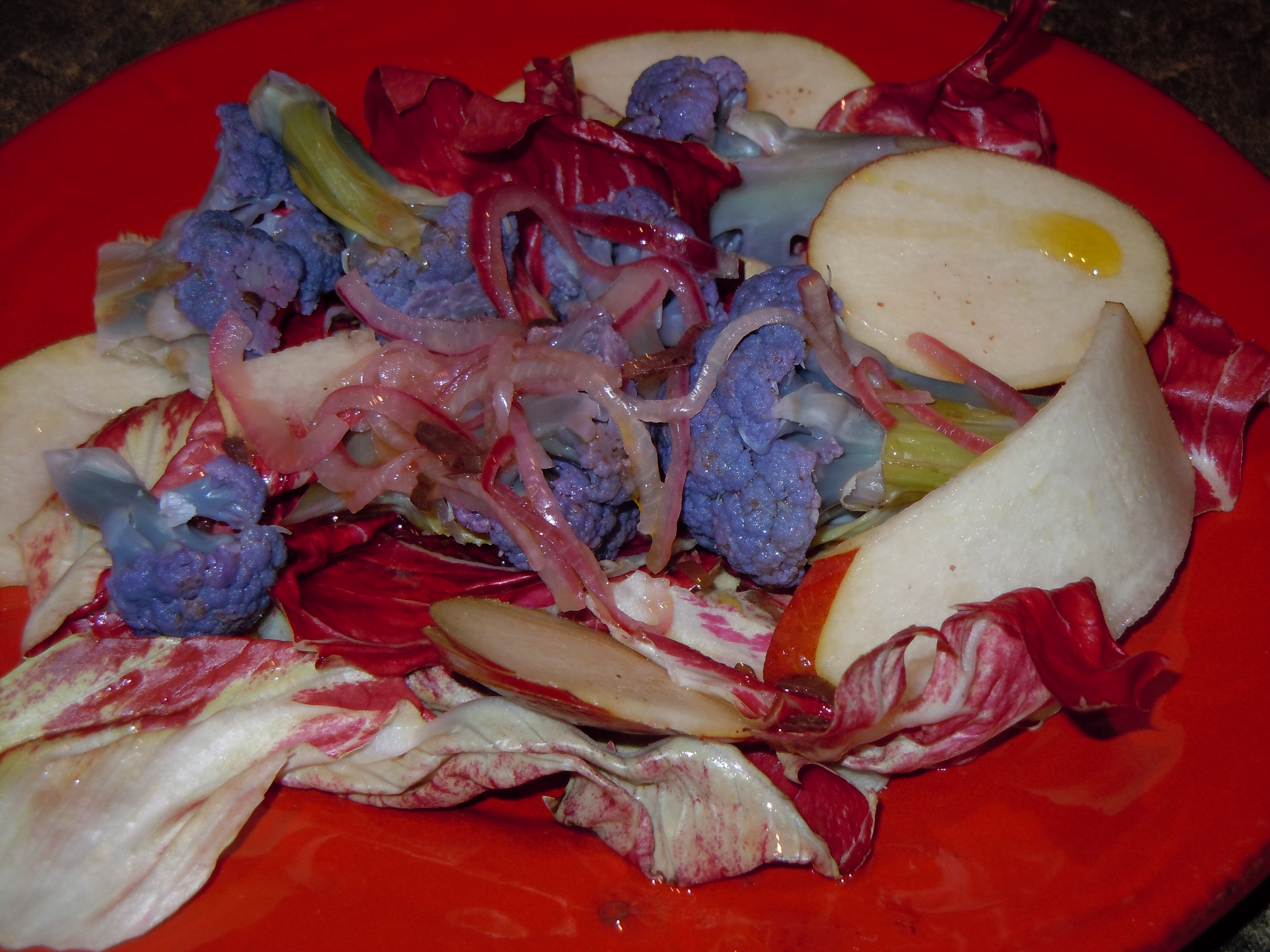
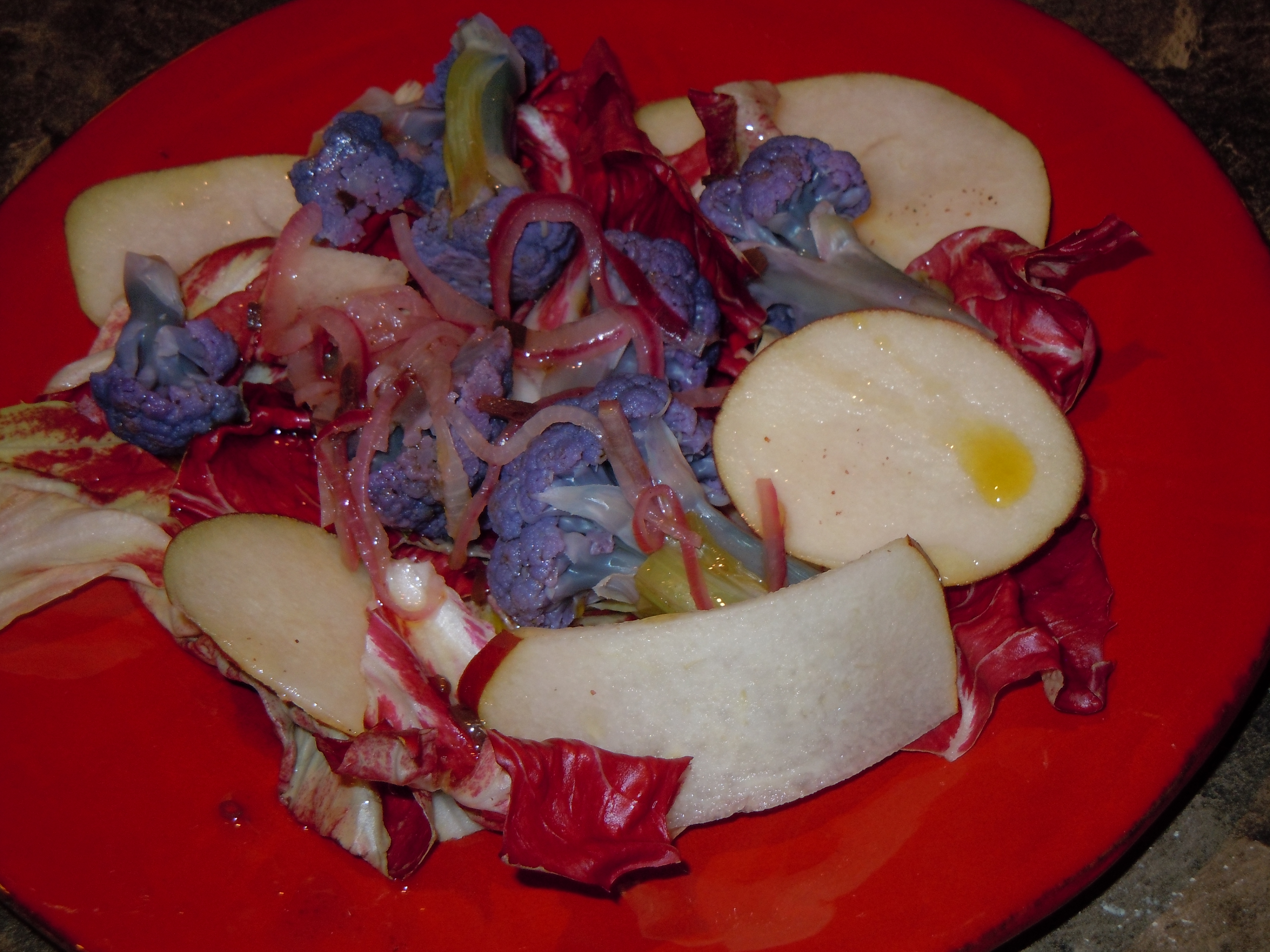
For two people, I started with a small red onion, half a head of purple cauliflower (probably 5-6 ounces, or a heaping cup of trimmed florets) , a very firm red-skinned pear, and a small head of castelfranco raddicchio from the garden. A small head of round or Treviso raddicchio from the store would work just as well. I had on hand a third of a cup or so of red-wine-vinegar vinaigrette (see notes below) and a bottle of truly superb olive oil.
First, heat 1.5 cups of water to boiling, adding a tablespoon of salt and the juice of half a lemon. The lemon juice is essential to keep the red/purple veggies from turning an awful muddy grey. Trim the cauliflower florets neatly, slicing the stems where needed so that all pieces are about the same size. Drop them in the boiling acidulated water, cover tightly and turn the heat down to medium, and poach at a fast simmer for eight minutes. While it cooks,slice half of the onion very finely (save the other half for something else) and put them in a bowl. After eight minutes, drain the cauliflower, pouring its poaching liquid into the bowl with the onion slices. Run cold water over the cauliflower pieces to chill them, and set them aside to drain thoroughly. Stir the onions around a little, then let sit for half an hour. Drain the onion, press out excess moisture but don’t rinse, squeeze on a few more drops of fresh lemon juice, work them through the soft onion strands with your fingers, and set aside. Wash the radicchio thoroughly and spin it dry or whirl it around in a kitchen towel (outdoors, please) until reasonably dry. Put it back in the refrigerator. Rinse the lemon juice off the onion slices and squeeze them dry in a towel. You can do all this up to two hours before dinner. Everything should be at room temperature except the radicchio, which is used cold from the refrigerator.

When ready to eat, use a very sharp knife to cut thin slices off the pear. Choose your salad plates, preferably red ones, but black looks equally good and very dramatic. White will do. Arrange some torn radicchio leaves artistically on two plates. Toss the thin pear slices around over them. Pile half the cauliflower florets on each plate, keeping them toward the center so that the radicchio and pear show clearly. Place some onion slices (which will now be soft and magenta in color) over and around the salad. Drizzle with a tablespoon or two of the vinaigrette, and then drizzle lightly with your very best olive oil, taking care to get some gleaming golden drops on the pear slices. Grind just a touch of pepper over the top. Serve.
Purple cauliflower is widely available in this season. Check your favorite food co-op if it has a good produce section, or try Whole Foods. If you can’t find any, the yellow Cheddar cauliflower will give a different but still nice effect. A light scattering of toasted pine nuts or walnuts would be a great addition to this very autumnal salad. Don’t be tempted to throw in any cheese, no matter how fine a cheese it is. The pure flavors will get muddy, and the result will be undistinguished. Half the art of the composed salad is being able to stop before you ruin it with over-elaboration.

I have strong, even violent, opinions about vinaigrette. Each vinaigrette has to be made to suit the materials it is meant to enhance. In my opinion, this is the right one for this salad. Nothing that came premixed in a bottle is going to work. I have noted the steps that I consider especially important.

Opinionated Red Wine Vinaigrette

Start with really good olive oil and the best red wine vinegar you can lay hands on. I make my own wine vinegar, so I can’t help you with brands, but it’s essential that it be aged in oak and have a full flavor. The steps fit into general kitchen preparation, so you can do lots of other things while marinating the alliums.
Chop allium: 1 clove garlic chopped very finely, or one small shallot sliced finely, or half a small onion sliced finely. Put the prepared allium of your choice in a small bowl and add half a teaspoon of salt and 3 tablespoons of red wine vinegar. Stir around, and let sit at least 15 minutes. The “sit” is essential to get the right flavor. After this brief curing, add a teaspoon of fresh thyme leaves chopped and half a mashed anchovy fillet or a dash of colatura (my preference.) If you are vegan, or an irredeemable anchovy hater, you can substitute one or two pitted oil-cured olives thoroughly mashed in a mortar and pestle to give the meaty-umami undertone that helps tame bitter leaves like radicchio. Grind in fresh pepper, about 6 turns of the mill, and stir in half a cup of really good olive oil and a tablespoon of roasted walnut or roasted hazelnut oil. Taste and check for salt (remember, it should be on the salty side to season the veggies properly) That’s all there is to it. For other uses you may want to add a little Dijon mustard, vary the herb(s), use lemon juice instead of vinegar, or any of a million other variations, but this is the basic. The worst offenses that I taste in vinaigrettes are mediocre olive oil, bad wine vinegar, and a general excess in seasoning. No amount of herbs will make up for poor basic ingredients. I also dislike drippy, overdressed salads. As I see it, if you can’t taste the leaves and florets, why have them on the plate?
Since young adulthood I’ve cherished a story someone told me about seeing Alice Waters dining out in San Francisco; the eager voyeur insisted that she ate a large salad with her fingers, and then licked them. I have no idea whether it’s true, but if it is, more power to her. I’ll bet that was a good vinaigrette.
Goat milk in the morning, and a great goaty book


My goat does Magnolia and Cocoa are out being bred right now, and the back of my property is depressingly silent, with none of the constant cross-talk that occurs as they stand on the roof of their goathouse observing the antics of the rest of us. It makes me realize how much they’ve become part of our daily lives. In their absence, I’ll talk about some things that I do with goat milk.
Of course I make cheese, mostly soft cheese and halloumi. I plan to discuss cheesemaking in some later post, but for now let’s get on to the fresh milk. You will hear it said that goat milk tastes just like cows’ milk, to which I say “Not so fast.” On day 1, goat milk tastes much like cows’ milk but even when impeccably fresh it has a tangier flavor profile. However, it contains lipase that works on the lipids and changes the flavor. On day 2, it’s good but you will know that you’re drinking goat’s milk. On day 3 it’s quite strong and only good for making stronger cheeses, and on day 4, as far as I’m concerned, it’s chicken food (they love it, by the way.) So the goal is to use it up by the end of day 2.

I’m always looking for nutritious, tasty, and interesting things to eat for breakfast. They have to be very quick, because getting to work in the morning is not optional. And they have to hold me for hours so that I’m not tempted to snack.
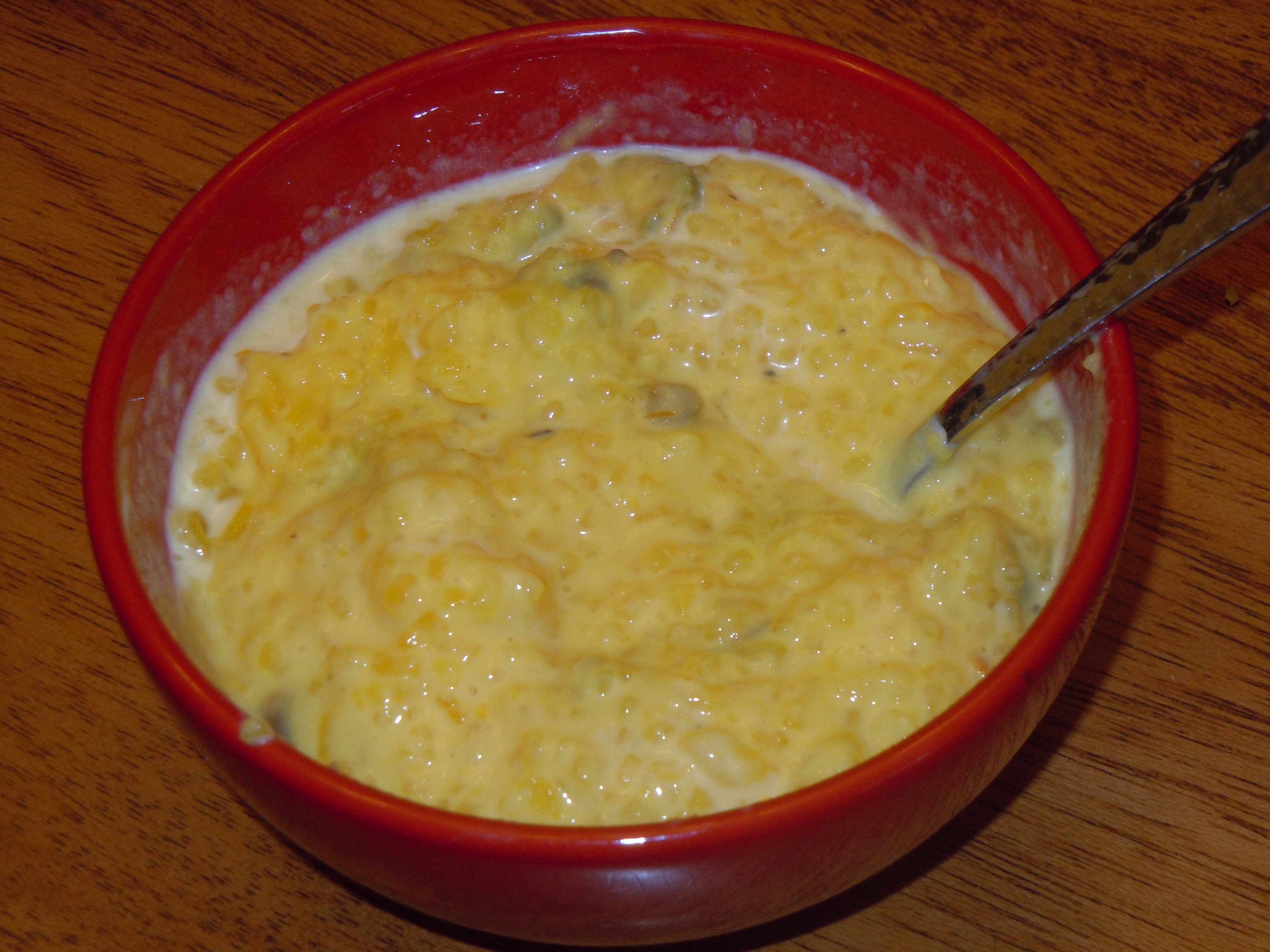
One of my favorite breakfasts is a sort of warm pudding of goat’s milk and rice. The flavors are based on an Indian drink of warm milk sweetened and flavored with saffron that I read about in my early twenties. I recommend cooking this in an unglazed clay pot for the ineffable earthiness it confers, but do use a flame-tamer device or a simmer burner, because scorched milk adheres to clay like stucco. You can make several days’ worth at once and it will keep in a good cold refrigerator for up to a week.
Start with eight cups of fresh goat milk. Add half a cup of unwashed uncooked basmati rice or jasmine rice. Start the burner on low, and as your clay pot warms up, increase the heat gradually to medium. Add half a cup of agave nectar (important for its low glycemic index), a half teaspoon of salt, a teaspoon of saffron crumbled between your fingers, and a half teaspoon of cardamom crushed finely in a mortar and pestle (please don’t use the preground stuff.) For the first half hour you will need to stir frequently, scraping the bottom of the pot well all over with a wooden spoon so that the grains of rice don’t stick and scorch. Once the milk comes to a good simmer, turn the burner down as low as possible and add the flame-tamer under the pot. Add a large handful of raw shelled pistachios or slivered almonds. Let simmer, uncovered, for 4-5 hours. Stir occasionally. When a milk-skin forms on the top, stir it in. The rice will swell and the milk will cook down. You are aiming for something about the consistency of half-and-half, although naturally it will be lumpy with softened rice grains. It will thicken as it cools. Eventually you will have what looks like a cream-soup of a beautiful creamy-gold color. Turn off the burner and let it cool. Taste when cool, and add a little more sweetening if needed, but keep in mind that this is a breakfast, not a dessert. Store in a container in the refrigerator and ladle out into pretty little bowls, heat gently in the microwave (I use two minutes at the defrost setting for two bowls) and eat. I like to pour a tablespoon or so of extra fresh milk across the top for extra gleam and “juice.” It turns breakfast into a little ten-minute island of luxury, and the boost from my own chemical-free hormone-free alfalfa-fed goat milk is considerable.

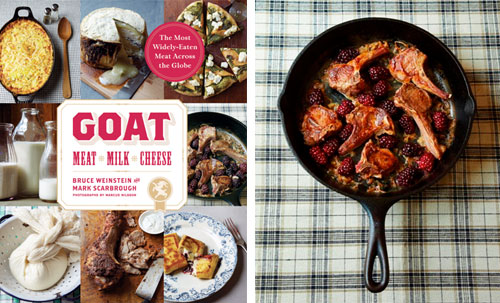
Goats are compact, hardy, and economical, and the amount of milk they produce relative to body size is prodigious. It’s no surprise that they were among the earliest domesticated animals (although well after dogs) and that they still help people eke out a living in marginal circumstances all over the world. They are the ideal dairy/meat animal for small properties. And yet, rarely are the meat or milk seen in American cookbooks. This book changes all that, with scores of carefully composed recipes for the meat, milk, and cheese that goats produce. Buy it if you have goats or access to goat products. If you don’t, it’s still a great read, full of stories about the authors’ interactions with these highly interactive animals.
Also, checl out Mark and Bruce’s marvelous blog about making and eating real food, Real Food Has Curves.

The Hen That Laid the Golden Eggs, and more notes on ethical meat


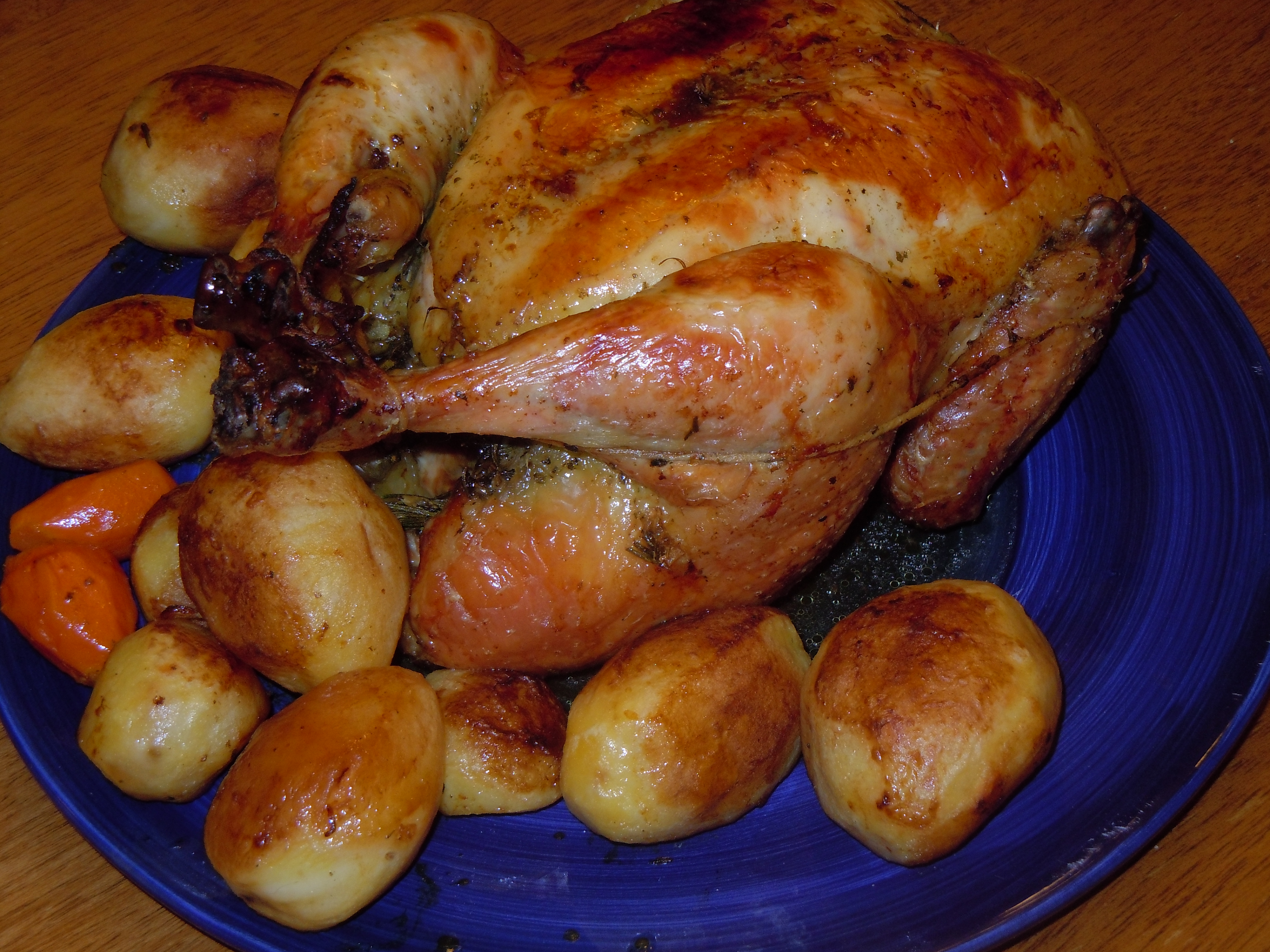
The days are short now, cold nights make a warm stove welcome, and there are longer evenings in which to do my culinary experimenting. Sometimes I like to try unknown ingredients and cuisines that are new to me, and sometimes I like to try slight twists on familiar favorites. Right now I have an abundance of good chicken raised in my own yard, and a simple roast chicken is great when it has real chicken flavor. These birds are big (the one we ate for Thanksgiving had a dressed weight of 14 pounds) and they look quite impressive roasted, but of course a smaller chicken is fine as long as it was raised properly and tastes like a real chicken. Here I followed my usual MO for roasting a chicken (see my post on roast chicken) with a couple of changes.
Twist #1: Since these huge birds have deep breasts which can dry out near the surface by the time the center is cooked properly, I injected the breast with a half-and-half mixture of melted butter and concentrated homemade chicken broth to improve the juiciness. You can buy injectors for this purpose which have big needles that won’t clog up easily. This isn’t as necessary on a smaller chicken, but is still a very tasty touch.
Twist #2: I carved the potatoes into eggs and browned them well in a skillet with some olive oil before putting them in the oven to roast. Keep them in a separate roasting pan and put them in the oven about 50 minutes before the chicken will be done. Be sure to sprinkle them with salt. Baste them regularly with chicken pan juices (you will need to keep adding good broth to the chicken pan to have enough juices.) When you take the chicken out to rest before carving, test the potatoes for doneness and leave them in the oven if needed while the chicken rests. Then pile them around the hen and bear the laden platter to the table. I also carve some chunks of carrot into smaller, goldener eggs to roast in the chicken pan, but I’ll be the first to admit that this is unnecessary fiddling.
If your bird isn’t a hen, it can be the rooster that laid golden eggs, an even rarer phenomenon. I suppose that if you were obsessive enough, you could cut some chard leaves or kale leaves into long, trailing tail feathers to make the phoenix that laid golden eggs, but this is the sort of culinary feat that announces to your friends and loved ones that you spend way too much time thinking about matters unrelated to real life. It will get you talked about, and not in a good way. But if your tastes lean toward culinary fantasy, it’s worth trying anyway. Since you are already lost to reason, consider carving some blue potatoes and purple carrots into colored eggs to add to the general picture of barbaric opulence.

Now, about those notes on ethical meat that I promised you. None of my homesteading ventures have been treated with more dubiousness by others than my decision to raise chickens for meat and harvest them myself. But from a personal standpoint, it’s the best project that I’ve undertaken. The way that commercial chickens are raised is appalling, and fancy labeling about “free range” means very little. If you want details, read the section on chickens in The Omnivore’s Dilemma, and then remind yourself that Pollan is describing a best-case scenario. Then, get real about what you eat. Sometimes I come across writing by others who have participated in the harvest of meat, and today I’d like to share a clip from Mourad Lahlou’s marvelous book New Moroccan. He describes how in his Moroccan home, it was the duty of one adult man to kill meat animals with maximum speed and minimum suffering for the animal, and that it was an activity conducted after prayer and one that the whole family gathered to witness. At thirteen he was taught to do the ritual slaughter by his grandfather. He says “No doubt your reaction to this is that it seems barbaric. But I’m telling you that it’s the opposite, not simply because the slaughter is done in a humane way, but because the act of witnessing it is a reminder that we can never take a life for granted. When you’ve seen an animal give its life for you, you don’t take it lightly. You cook it with care. You eat it with respect. And perhaps the greater barbarism is never coming face to face with that, and pretending that meat comes from a market and not an animal.” Amen to that.
Mourad’s book is one of the best new cookbooks I’ve come across for years, and I recommend it to anyone for the marvelous writing as well as for the recipes.

In the near future I’ll write about exactly how I produce the chickens.

.

How to love Your Carrots


I’m doing a blog series for our local newspaper this month, but some readers had trouble accessing those posts, so I decided to put them on my own blog as well. Here’s the third one:
Eating seasonally is a pleasure for most of the year, and fall is a wonderful time to eat carrots. We all know how healthy carrots are, so I’ll skip over that part and concentrate on how delicious they are. When I cook carrots I make a lot, because they are wonderful for at-your-desk lunching the next day. Usually I retrieve my lunch from the refrigerator at my mid-morning brief break and eat it at room temperature at lunchtime, as long as no egg yolks, mayonnaise, or other extreme perishables are involved. If I plan to eat them at room temperature for lunch I use olive oil instead of butter, since animal fats congeal unattractively when they aren’t hot, but if you prefer to use butter, no problem. Just heat your carrots a little the next day, then carry them back to your desk and eat happily, with the slightly smug glow that comes of doing the right and healthy thing and getting your work done at the same time.

First, catch your carrots. Real carrots come in bunches with the tops on, and if the tops look withered, don’t bother with those carrots. Get some fresh ones instead. Your nearest growers’ market is a great place to shop for them. Here in Albuquerque you can find several colors, including yellow, the standard orange, red, and a glowing royal-purple. I love the purple ones, but any of these techniques can be used for any carrot.

I use the word “technique” with forethought, because it is basic technique that makes it quick and easy to cook and eat lots of vegetables. If you have to read a recipe in the kitchen as you work, you will eventually get fed up, but technique lives in your brain and makes it a snap to blanch, saute’, stir-fry, bake, boil, or grill any veggie that you care to eat. No precise measurements are needed. So here are a couple of basic techniques for carrots:

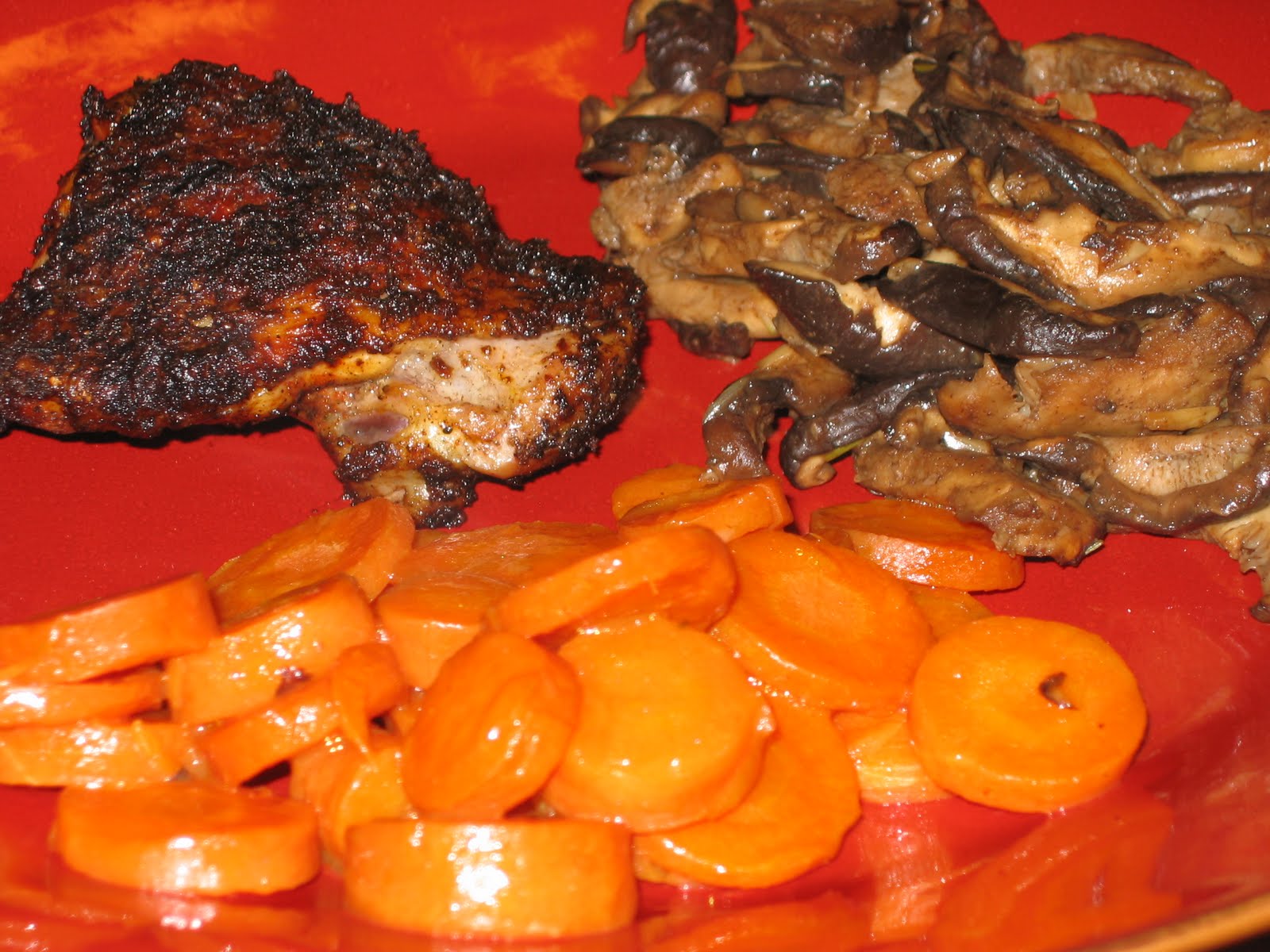
Blanch, then saute’: trim and scrub four large carrots or six smaller ones of any color. Peel if needed (usually I scrub well with a brush instead.) Slice into slices about a quarter inch thick. Fill a large saucepan with about 2 quarts of water, add 2 teaspoons of salt, bring to a boil, toss in the carrots, boil 5 minutes, and drain thoroughly. If you want to, you can hold the drained carrots at room temperature for 2-3 ours, making it easy to do some work ahead of time if needed. Melt two tablespoons of butter in a frying pan, or use olive oil if you prefer. Put in the carrots, 2-3 teaspoons of honey, salt to taste, and a grating of fresh nutmeg. Saute’ over medium heat until the carrots are done to your liking, and serve. The blanching makes sure that the carrots cook evenly, and the saute’ing brings out their flavor. You can vary this infinitely: add herbs in the saute’ stage; thyme or savory are especially good with carrots. Chop a clove of garlic or half a small onion and cook in the butter or oil until just cooked through before adding the carrots. Use a tablespoon of balsamic vinegar instead of honey. Add a squeeze of fresh lemon juice for a very fresh flavor. Add half a teaspoon of grated orange rind with the honey. Add a tablespoon or two of dark rum and cook it off thoroughly before serving. Or, if you have access to some good artisanal root beer (I brew my own. Just don’t use the grocery-store glop) you can add a quarter cup of it when you add the carrots to the butter, and cook over high heat until the root beer is reduced to a syrup that just coats the carrots. A quarter-cup of dark ale produces a malty, ever-so-faintly bitter glaze that’s great with game. You can also cut the carrots into chunks about 2 inches long and then cut those into quarters at the initial prep, for a different texture. When using orange carrots, sometimes I cook a couple of purple potates separaely, slice them, and add them in for the saute’ stage.

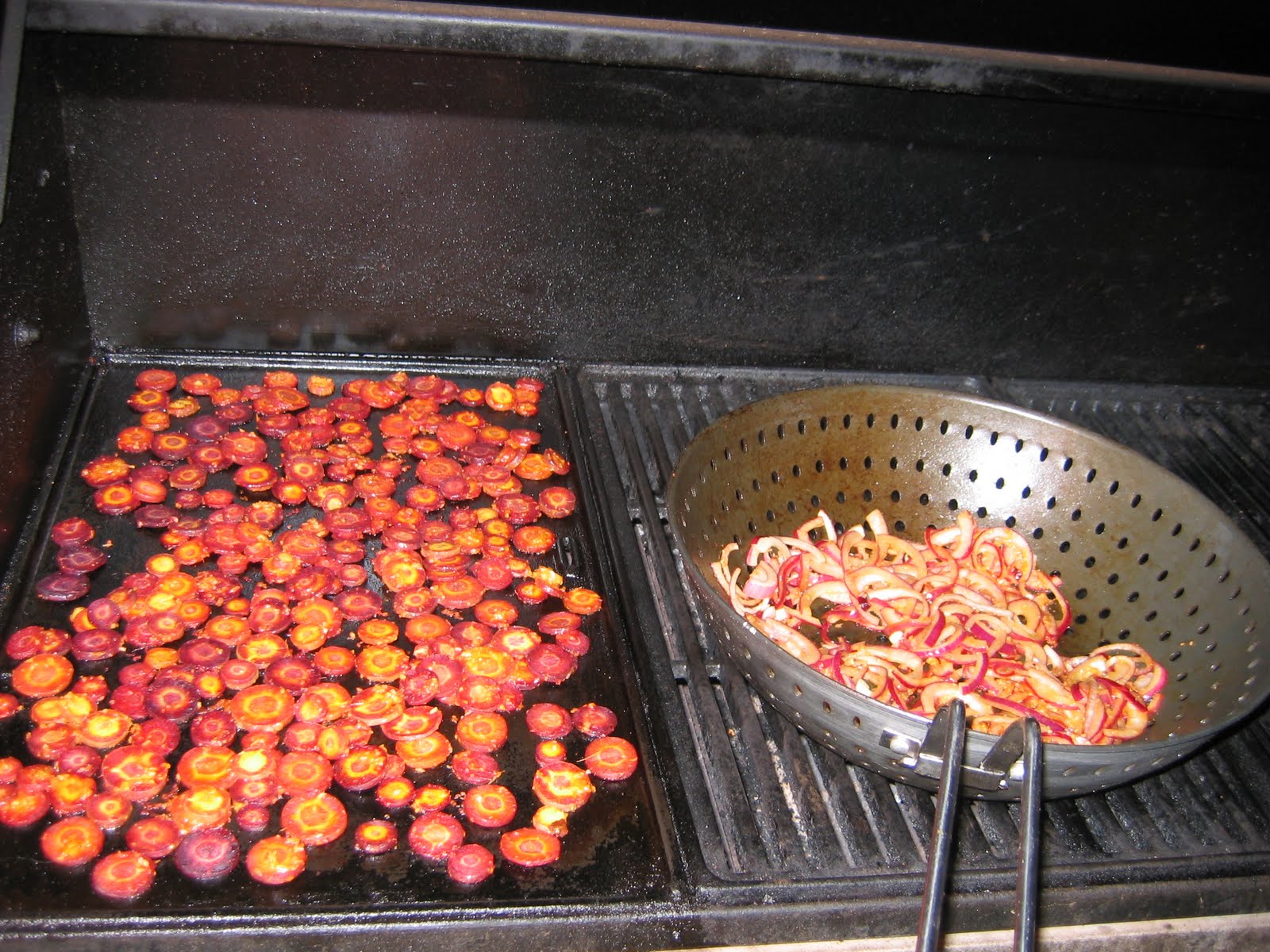
Grilling: Usually people don’t think of grilling carrots, which is a shame, because the caramelization around the edges is delicious. Just cut them thinly. I like slices about 1/8” thick. Use a griddle or grill-wok so they don’t fall through the grill, and watch them closely so that they don’t burn. I describe a Southeast Asian seasoning here, but again the technique is key, and once you get the hang of it, you can season them any way you like. Trim and scrub 3-4 large carrots of any color, and slice them thinly. Toss with two chopped cloves of garlic, a 1” chunk of ginger grated, a tablespoon of Asian fish sauce (you can use soy sauce instead if you insist,) a tablespoon of agave nectar or coconut sugar, and 2 tablespoons of canola oil or similar. Heat the grill to medium-high and spread the carrot slices out on the griddle section or put them in the grill-wok. If griddling them, turn them in bunches with a spatula about halfway through. If using the wok, you will need to turn several times during cooking. Taste to see when the texture seems just right to you, salt a little if they need it (the fish sauce is fairly salty) and serve with some chopped cilantro on top.