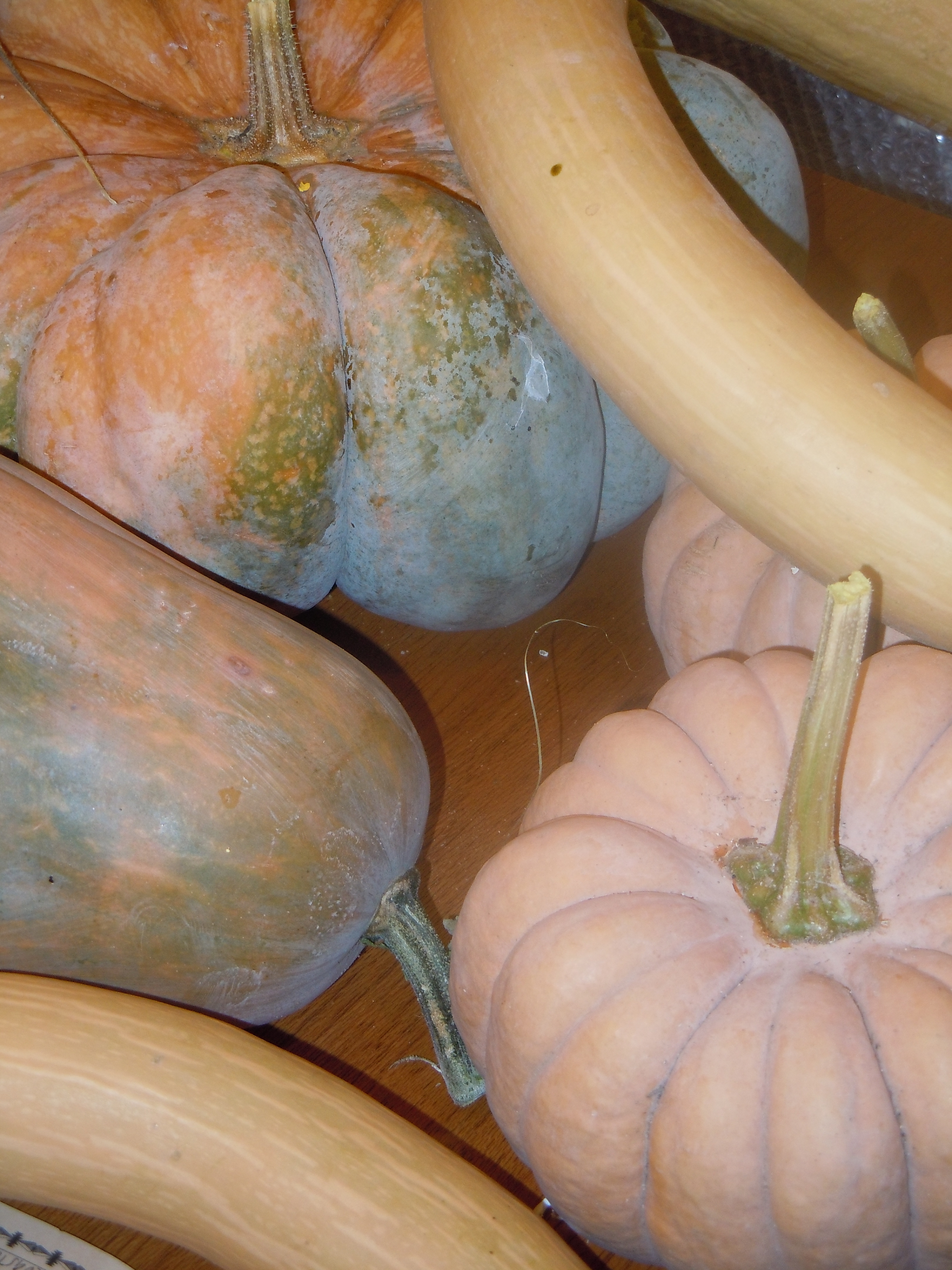
I love winter squash, and they can be hard to grow here in central New Mexico because of our thriving population of squash borers. The vine grows beautifully and sets baby squash in a responsible fashion, then one day it wilts, then it dies. I have tried all the organic “remedies” listed in the books, and don’t think that any of them are worth my time, in that the vine may survive (barely) but the chance of a good crop is nil. So this year I tried to beat the borers genetically. I grew only squash varieties of the species Cucurbita moschata, which is rumored to be borer-resistant. All I can say is, there are no guarantees in gardening, but I didn’t lose a single vine and my garage shelves are heaped with squash.
To use this method, you have to find a catalog that identifies squash by species as well as varietal name. I got mine from Baker Creek Heirloom Seeds. They are a great source for interesting heirlooms. I chose five varieties: Waltham Butternut, Musquee de Provence, Kikuza, Chiriman, and Sucrine du berry. All bore fairly well, although the sucrine du berry were the clear winners in terms of total pounds of squash. So far, the Kikuza are the best in flavor and texture, but I’ve only tasted three of the five varieties so far.
My favorite way to eat squash is halved,seeded, and roasted, with maple syrup or agave nectar and a pat of butter in the hollow. They will roast nicely at any temperature from 350 to 425 degrees, although of course they need more oven time at lower temps. Be sure to roast them long enough, by the way. The flesh should be soft and the syrup well sunken into the flesh. My preference in squash is a sweet dry flesh with no stringiness about it. To let any squash reach its best potential, it’s important to leave them on the vine as long as possible. Often the vines will die back in late fall, signaling harvest time, but if they don’t, harvest the evening that your first frost is predicted. It’s tempting to harvest them earlier when the skin hardens and they look mature, but this is the road to stringy watery flesh. Let the vine do its work. Once harvested, be careful not to bump or bruise them and set them on shelves in a cool place, not touching each other. I like to set several of mine on one end of my dining room table, where they look opulent and festive, but be sure to cook them within a month, since storage conditions in the average dining room are not ideal. The ones kept in a cooler (but not refrigerated) place will often keep well until January or February, but they do lose quality if kept too long. If you suspect that they are past their peak, roast them as described above and freeze the flesh.
I see a lot of recipes for squash that involve steaming the flesh, but I would never bother with them steamed. Roasting brings out the lovely caramelly notes and gives a rich flavor. Whenever I have something baking that doesn’t fill up the whole oven, I roast a split squash in the remaining space, and since the halves keep well in the refrigerator and are even better warmed up a day or two later, I have a handy adjunct to a meal waiting. If you have chickens, don’t forget to give them the stuff you scooped out when preparing the squash. They relish the nutrient-rich seeds. I also give the scooped-out shells to the chickens after dinner, and they enjoy those too.
Archive for the ‘preserving’ Category
23 Oct
Squash without end, amen
10 May
The Perfect Brunch, and notes on the Los Ranchos Farmers’ Market
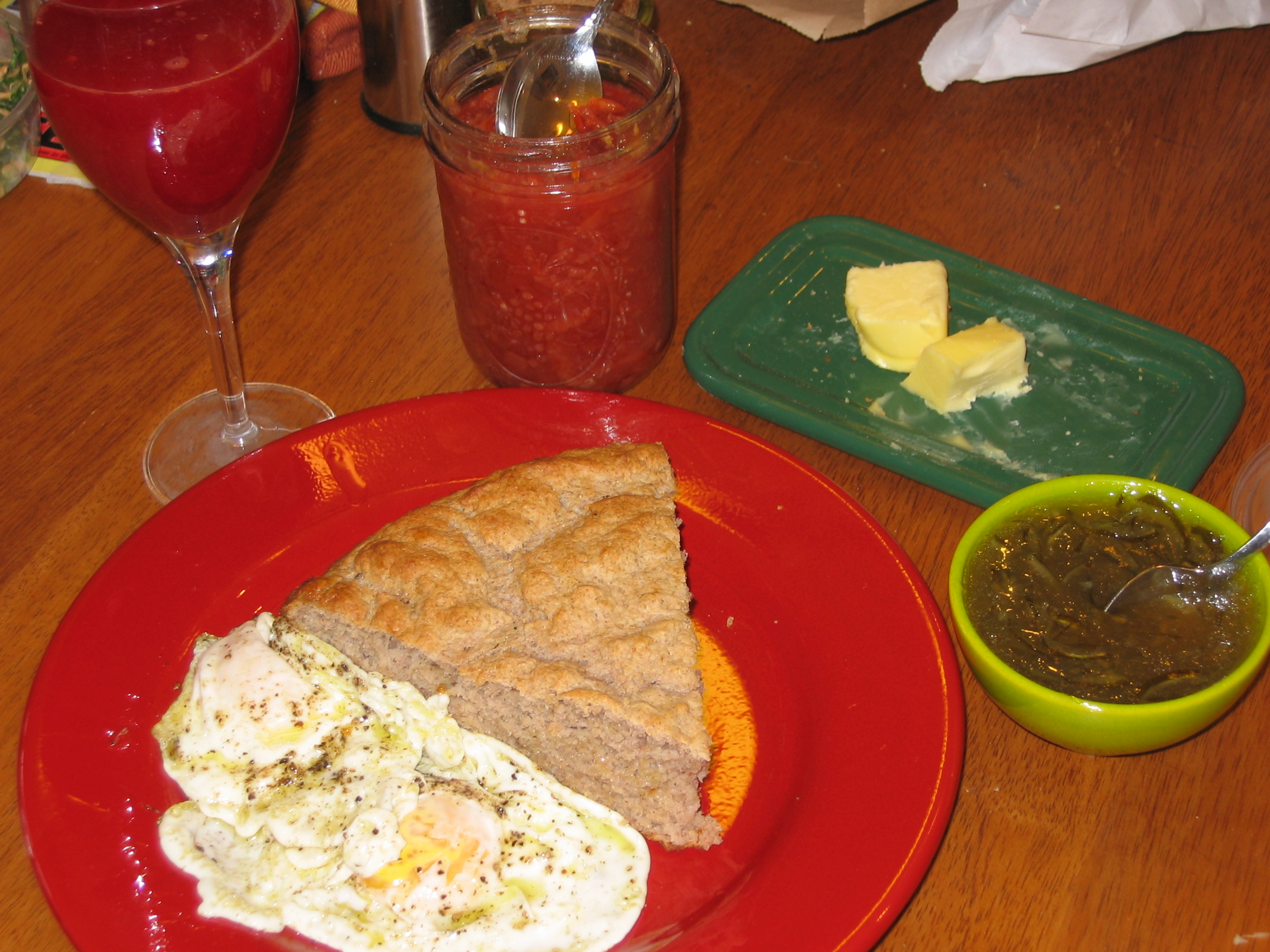
For the gardener and urban homesteader weekend mornings are a busy worktime, with plenty to do and (usually) cool and pretty weather in which to do it. But after a few hours, it feels good to relax with a perfect brunch. To me, the essence of the perfect breakfast or lunch is simplicity. This is not the time for fuss. Its simpicity relies on perfect ingredients, and that gives me a chance to showcase some of my favorites. Please let these good suppliers know that Local Food Albuquerque sent you.
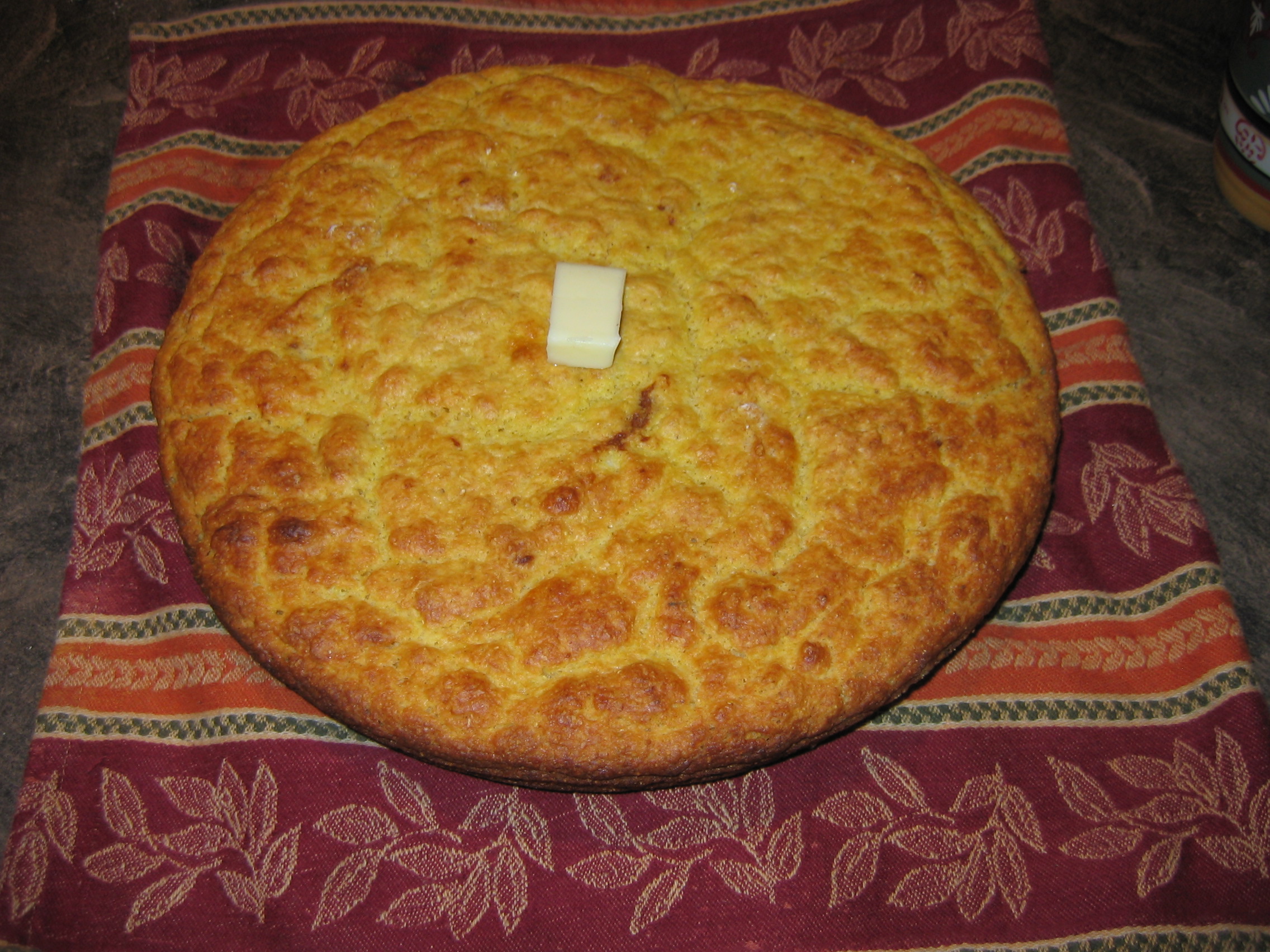
Corn bread: All Southerners and a lot of other people feel strongly about cornbread. I’m no exception. I give my recipe below, but cornbread preferences are very individual, so use your own favorite. The quality of the cornmeal is essential, and in my opinion there is none better than the roasted blue cornmeal sold by Oracio and Lourdes Molina at the Los Ranchos Farmers Market. They grow the blue corn, shell the kernels off the cob, roast the kernels, and grind them finely. The result is full of toasty corn flavor and makes cornbread that fills the kitchen with irresistable scent as it bakes. Oracio also sells his self-published book Hidden Village, which contains some fascinating bits of old New Mexico. Incidentally, their cornmeal makes the best blue corn tortillas imaginable.
Scones: if you don’t happen to be a cornbread fan, or even if you are, visit Hand to Mouth Foods at the Los Ranchos farmers Market (they are at the Corrales market too.) Jeffrey has a great hand for pastry, and his scones are very delicious. I also love his date and pine nut tarts, and my husband is an addict of the cranberry-pecan biscotti. They make a perfect finish to a perfect brunch. Email Jeffrey and Elaine at handtomouth@zianet.com and ask to be on their email list; you’ll get useful reminders of market times and products available.
The Best Butter: Good cornbread deserves to be slathered with good butter, and I use the only completely grass-fed butter that I know of, Pastureland. It’s made by the Pastureland Dairy Co-op in Minnesota that makes butter and cheese only in the summer, when the cows are eating 100% grass and nothing else. It’s shipped frozen in styrofoam cartons, and a prepaid UPS label is included so that you can send back the carton for reuse, free of charge. They also offer 100% grassfed cheeses. Grassfed butter is a good source of CLA, and you’ll have to decide for yourself whether that’s important to you. I eat Pastureland butter because it’s wonderfully delicious and because the grass-fed life is best for the cows. To arguments that it isn’t local, I can only respond that if a local dairy changed to 100% grass-feeding in season, I’d buy their products.
Blood orange marmalade: my favorite thing to dress up hot or toasted bread. See my post for the recipe.
Freshly squeezed orange juice: I used the very last blood oranges of the season. Any very good orange makes very good juice. In my view, the idea of adulterating something so perfect with champagne is sacrilegious, but suit yourself.
Eggs: The Los Ranchos Farmers Market has at least three egg vendors, and these are real free range eggs, not the pale imitations sold as free-range in grocery stores. Fry them according to your favorite method. Like cornbread, preferences are very personal. I’ve seen directions in cookbooks about how to avoid “undesirable brown crusting” at the rims, while to others that delicate crispy rim is the best possible contrast to the sapidity of the rest of the egg. Again, suit yourself. Next year I hope to be eating home-produced eggs, but right now my future laying hens are bouncy little fluffballs, so thank goodness for the farmers markets.
Put it all together and you have a simple and perfect meal. Enjoy it with people you really care about, who can be counted on to contribute to the general harmony.
Corn bread:
2 cups fine cornmeal, preferably Oracio’s
2 cups all-purpose flour
1 scant tablespoon baking powder
1/2 teaspoon baking soda
1/4 cup sugar (optional)
1 and 1/2 teaspoons salt
1/2 teaspoon cayenne pepper (optional)
2 cups buttermilk
1/4 cup melted butter
3 large eggs
Preheat the oven to 400 degrees. Heat a 12-inch iron skillet in it (without a hot heavy pan, your crust will never be what it could be.) Mix all the dry ingredients thoroughly in one bowl and all the wet ingredients in another. When the oven and the skillet are thoroughly hot, mix the wet ingredients into the dry with a few quick strokes. Stirring too much activates the gluten and makes your cornbread tough. Pull the skillet out of the oven, swirl a couple of tablespoons of butter in it until melted and the skillet is greased all over, pour in the batter, and pop back in the oven. Bake until done, ie the top crust is browning and an inserted knife comes out clean. Take out of the oven, invert the skillet over a clean towel to turn out the cornbread, then use the towel to invert the cornbread again onto a rack. This requires dexterity and practice but is worth dooing because both the bottom and the top crust stay crisp. Let rest a couple of minutes, then cut into wedges and bring on the butter.
2 Apr
Passing Pleasures: Blood Orange Marmalade, and notes on sharp knives
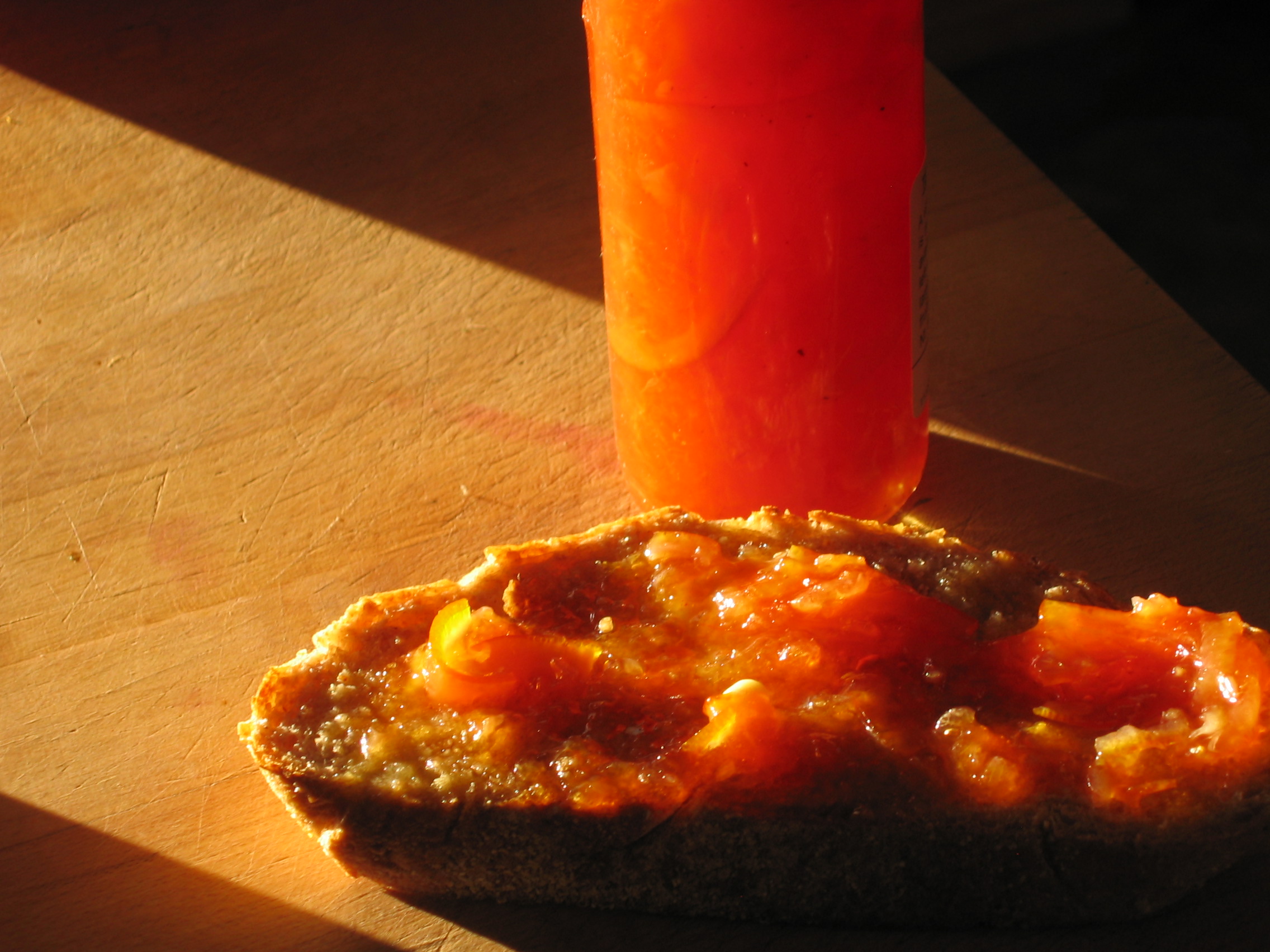
In my last post I discussed the virtues of freshly squeezed blood orange juice, and encouraged you to eat them up during the few short weeks that we can get them. In this post I’ll talk about how to preserve them so that you can spread your morning whole wheat toast with exquisite marmalade long after the season is over.
First, the disclaimer: nearly all my ideas about marmalade came from John Thorne, a remarkably quirky, idiosyncratic, and interesting food writer. I strongly advise getting his book Mouth Wide Open and reading the chapter “Maximum Marmalade,” because you’ll learn good marmalade-making technique, get all the comments and asides of a working cook in his element, and have a great time. I happened to reread his book at a time when I was thinking about the concentration of beneficial flavanoids such as naringenin, hesperidin, and rutin in citrus peel, and wondering how to make them taste good. Naturally, a chunky and delicious marmalade was the way to go.
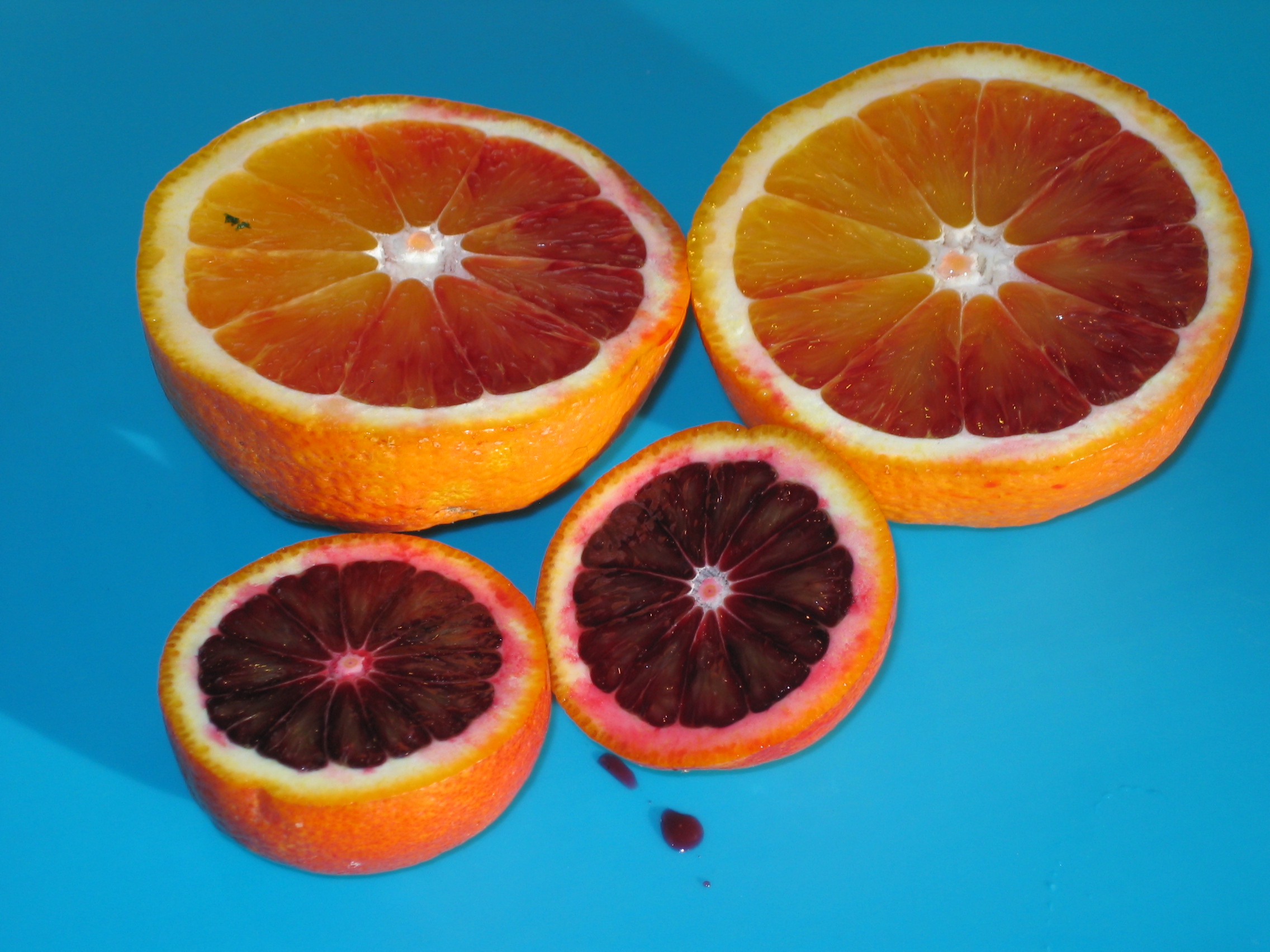
First, catch your blood oranges. There are two basic types on the market right now, one the size of a lemon or a little bigger, deep red inside, and filled with tart juice with a definite note of raspberry. The other is the size of a navel orange and only lightly blushed inside, and the juice is sweet. The former type is best for marmalade. I have only found it at the Nob Hill branch of La Montanita Co-op this week, so act fast if you want to get some. If all you can find is the other kind, you can still make a great marmalade, but it won’t be quite the same. Buy about 15 of the small ones or 7-8 of the big ones. The two types are shown below:
Next, get a really sharp knife. For my local readers I advise a trip to the Santa Fe Farmers’ Market with all your knives in hand. Look for Pat Romero’s sharpening booth, and he will sharpen them to lethality while you shop. Please let him know that Local Food Albuquerque sent you, and be damn careful when you unwrap them at home, because a knife sharpened by Pat has no margin for error.
Now wash the 4 prettiest small oranges, or the one best if using the larger sort. Cut off the two ends enough to reveal the flesh, cut in half lengthwise, and slice each half crosswise into the finest slices that you can manage. Remove any seeds, but keep everything else. Put your slices in a bowl, and juice the remaining oranges until you have enough juice to cover the slices. Cover the bowl tightly and let the slices macerate in juice overnight at room temperature.
The next day, put the entire contents of the bowl in a saucepan of at least twice the volume of the mixture, bring to a boil briefly, and simmer gently until the peel is as tender as you like, remembering that it will firm up some when cooked with sugar. When the peel is softened to your preference, measure how much orange goop you have and add 3/4 that much sugar. I recommend white sugar only, to avoid distorting the wonderful orange taste. Now bring to a boil briefly again, and cook at a fast simmer until it’s ready to gel. John’s test, which is the best one I’ve come across, is to put a heavy plate in the freezer before you start cooking. After cooking the orange-sugar mixture for 15 minutes, start putting a half teaspoon or so on the cold rim of the plate. Return to the freezer for a minute and then prod the dribble with your finger. When it softly holds its new prodded shape, it’s done. Pour it into clean jars, let cool, cover tightly, and store in the refrigerator, or see the Ball Blue Book for directions on how to heat-process so that it can be stored in the pantry until opened. In the morning, toast and butter a piece of very good bread, spread it with butter and marmalade, and eat. Oh my.
Incidentally, cooking any sugar syrup requires a watchful cook hovering over the stove to stir and prevent boil-overs. This is not a forget-it-until-it’s-done recipe. The result is worth it.
12 Jan
Kitchen Staples: Broth

Few things will improve your cooking as much as getting rid of all commercial broth products and making your own. On my website I have extensive notes about broth-making, and you can read them here. In this post, I’ll just add a few notes about broth and its uses, and refer you to that site for the details.
Use very good materials to begin with. You can get lovely flavorful pastured chicken necks and backs from Pollo Real at the Santa Fe farmer’s market, and there is no better basis for chicken broth. Give the roasting step the time it needs, and the pay-off in flavor will be considerable. Don’t salt your broth, because you may want to reduce it later which will concentrate it manyfold. I pressure-can mine for later use, but if you have room in your freezer, that’s an easier alternative.
Once you have good broth on hand, you can use it to reduce waste and pick up some goodness from all kinds of things that you might otherwise discard. If I buy a pound of oyster mushrooms or shitake mushrooms to roast for a winter dinner, I put the stems and trimmings in a quart of broth to simmer for an hour, building the foundation for a great mushroom sauce or mushroom soup on another day. Chicken bones left over after dinner? Pop them in a quart or two of broth to simmer and enrich the flavor. Onion skins and ends on your cutting board? A slow simmer in broth will improve its flavor and give it a lovely gold color, and the rawness of the onions is lost en route.Many people save their bones and vegetable trimmings in plastic bags in the freezer, but I think the flavor is better if you simmer them while they’re fresh. The broth can be frozen more successfully than the ingredients.
Fish and seafood broths need to be cooked separately from other meats, naturally, and don’t include any salmon trimmings. I love salmon, but it does ruin fish fume’. But if you buy a few mild fish heads to start fish broth, then every time you have shrimp shells, crab shells, or any other flavorful but inedible seafood bits available, you can extract its flavor in broth and save the broth for a great paella or gumbo when you’re in the mood.
Once some good enriched broth is hanging out in your kitchen, what do you do with it? There is almost no pan-grilled or roasted meat that can’t be improved by a simple reduction sauce. Remove the meat from the pan, pour a cup of good broth into the pan over high heat, boil hard and scrape all the lovely browned bits into the broth, and when it’s reduced to a few tablespoons and has a syrupy consistency, swirl in a tablespoon of butter and serve immediately. A glug of good red or white wine, depending on the meat and seasoning, can be added to the pan for the initial deglazing, then add the stock and boil down. If you want to get fancier, most of the sauces of classic French Cuisine are at your command when you have really good broth to start with, and you can check out Glorious French Food or another cookbook to consider your options. Grains like rice and bulgur are delicious when ccoked in broth. If you’re a fan of Mexican cooking, you’ll want to try Zarela Martinez’s trick of toasting dried chiles of various kinds and then soaking them in broth rather than water before grinding them into a mole’ paste or other flavoring paste. Great stews like coq au vin are within your reach, although they will use up a lot of broth, which is why you make a lot in the first place. A paprikash like the one above requires little more than a meaty main ingredient, top-notch paprika, and really good broth (my own far-from-conventional recipe is below.)When I’m feeling dispirited and glum I revert to my Louisiana roots and make gumbo, and it invariably cheers me up, and usually cheers some other people too.
I advise avoiding strong-flavored vegetables of the cabbage family, such as broccoli and kale, for general-purpose broth. If you use leafy greens, they will color the broth, so don’t use them unless you’re willing to have green broth. Onions, carrots, celery, shallots, and leeks are aromatic staples that improve any broth. If you want to make all-vegetable broth, my favorite way is to roast the vegetables to bring out their flavor via the lovely Maillard reactions, and add a few mushrooms for the base note; dried shitakes are especially good for this, and as long as you don’t use too many, the flavor will not be identifiably Asian. .
If we can grasp some positive principle from the wretched ecomony, it should be to get the best value we can from everything we use. Nothing does that better or more gracefully than broth.
Continue reading
 My urban homestead