Archive for the ‘Nose-to-tail vegetables’ Category

The Season of Scapes

image

Back in 2009 I wrote a post on onion and garlic scapes that you can find here, and all I can say is that if I had known that hundreds of people were going to look at it and it would still be going strong in 2016, I would’ve been more thorough. But then, when I think about it, I think my advice to get young tender garlic scapes, chop them in about 1 inch lengths, and pan fry them in hot olive oil is still my favorite way to use them. These days I usually cut the whole bud off before cutting them up to cook. It has a slightly starchy quality that does not, in my current opinion, go well with the greenness of the rest of the scape. Try it both ways and see what you think.
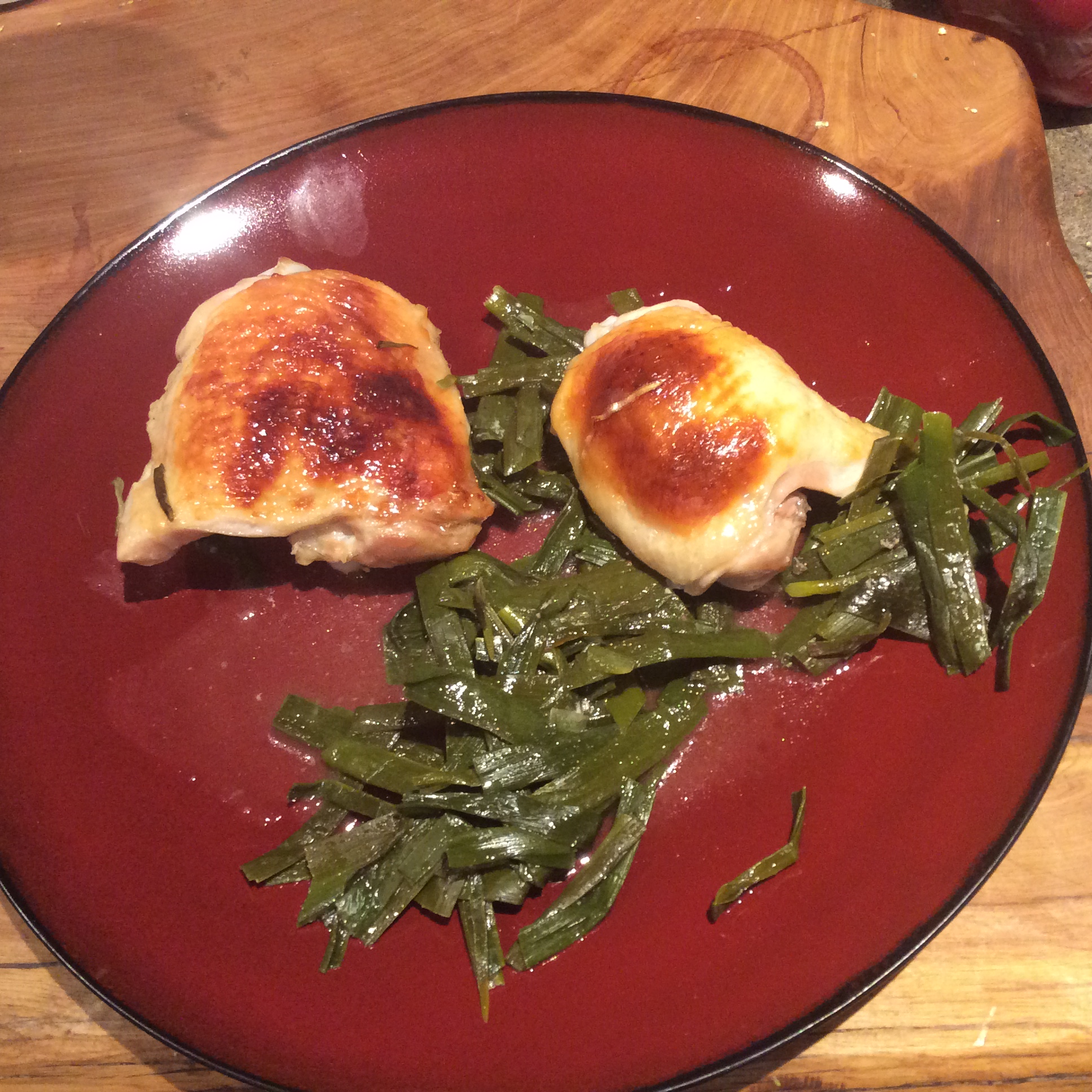
I also still enjoy putting them under roasting meat and poultry to stew in the juices, and in fact tonight I will be having roast chicken thighs on a bed of garlic scapes, almost exactly as I described in that post seven years ago. Make sure that they get 20 minutes or more to cook. If necessary, you can take the meat out to rest and continue roasting the scapes until done. Make sure the pan doesn’t get dry, which will cause them to burn. Add a little water or broth if needed to keep things a little juicy but not soupy.
I can also add that allicin, the antioxidant in garlic and other alliums that is thought to have many health benefits, is present in much higher levels in the green part of the garlic plant than in the cloves that you typically cook with, so eating the plant bits is good for you as well as tasty.
I am also experimenting with dehydrating scapes and grinding them into powder. I am not doing this with garlic scapes because I prefer to eat them as is, but I have been dehydrating onion and shallot scapes so that they can be ground into an attractive green powder that, I hope, will be useful for seasoning. So far, I have sprinkled some over salad with good effect. I am thinking about using it to coat chicken thighs, along with salt, and then searing them in olive oil and finishing them in the oven. I’m not sure how the green color will play out in this context, but I think it will brown enough that it will not be particularly startling.
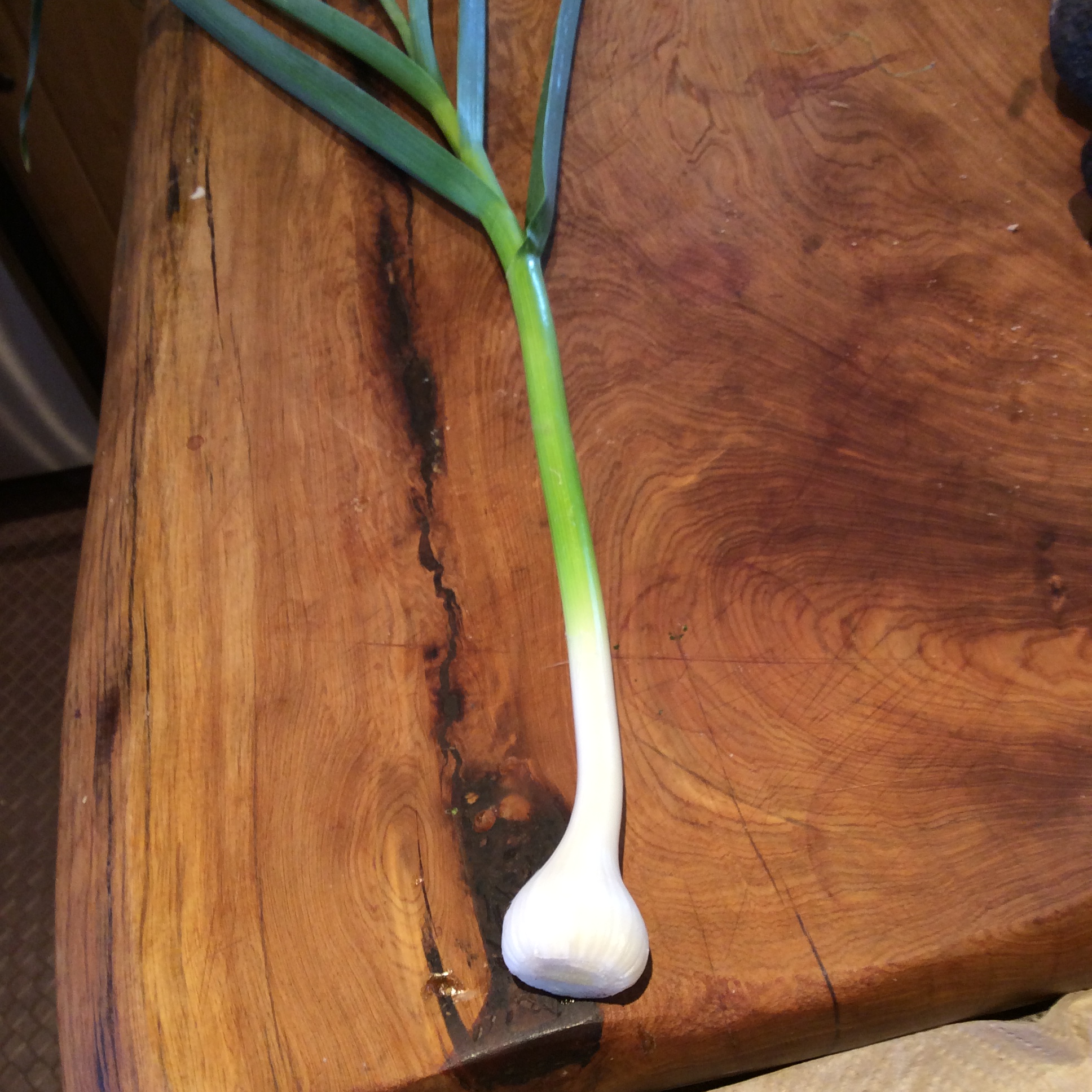
The best advice that I can give to vegetable gardeners is: grow green garlic. Grow a lot of it. Use the greens, and ignore any rigid advice to use the white parts only, because you would be missing the best part of the garlic. Remember to slice crosswise in 1/4″ slices when using the whole stalk and leaves, since they are not as tender as the scape, and once the scape appears, the stalk and leaves are too tough to use. Try it every which way, because you are probably going to love at least some cooking methods. Click the tag for “green garlic” at the head of this post to look at all my various experiments with it.  If your space is limited and you can’t grow enough for your yearly needs, you can eat all your garlic as green garlic and then buy heads of garlic at your farmers’ market, grocery, or food co-op for winter use. If you are limited to a small space, there is no point in using it on storage vegetables.
Be aware that you can create a very long season by choosing a number of different varieties. My green garlic season starts in mid-March with the very early Chinese Pink, and right now in late May the late Mount Hood and elephant garlic are still providing wonderful green garlic. I buy all my garlic from Territorial Seeds, and I strongly recommend getting your order in by June because the most interesting varieties sell out quickly. It will be delivered in fall in time for planting. This year I have finally planted enough that I think I will be able to replant from my own stock; in previous years, I’m afraid I have gluttonously eaten it all.
image

Dandelions Nose to Tail

image
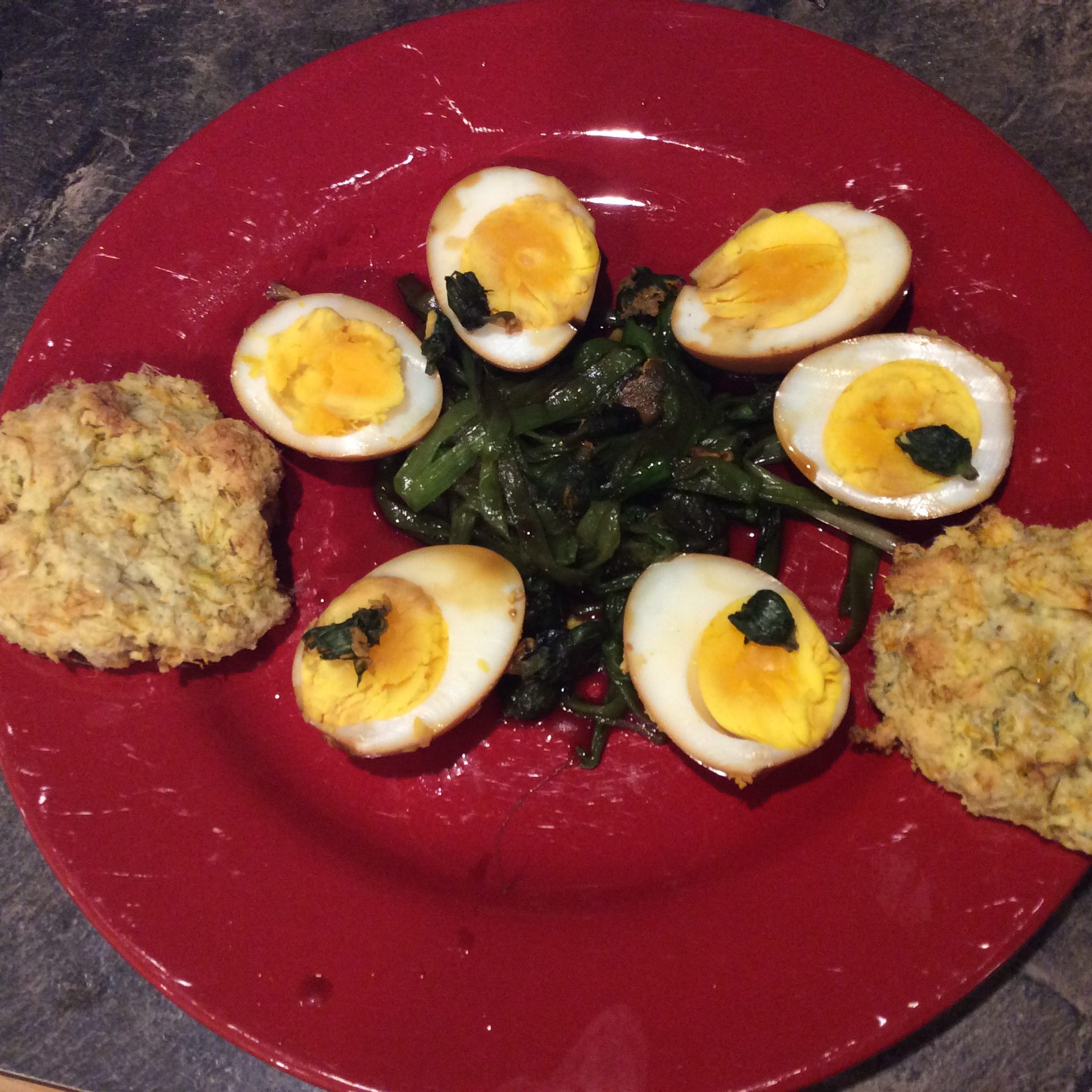
I seldom write about foraging and cooking with dandelions, because although I love them, they are the most written-about wild food and I think it’s all been said before. But yesterday I came across a patch of dandelions growing in a shady spot in moist streamside soil, and last night I challenged myself to make a dandelion dinner with dishes that I had never made before. So no recipes this time, just briefs about how a very impromptu meal came together. I had gathered flowers on the very long stems that form in shady conditions, unopened buds, and leaves.
I hard-boiled some eggs, and made a cup of sauce from 3/4 cup of soy sauce, 1/4 cup of rice vinegar, 2 cloves of garlic chopped, and a tablespoon of grated ginger, plus some sweetener. If you use sugar, to tablespoons might be about right, or just sweeten to taste. When the eggs were cooked and peeled, I set them in the dipping sauce to marinate, using a small plate to keep them completely submerged.
I prepared about two cups (loosely packed) of dandelion flowers pulled out of their bitter green calyxes. This is a tedious job and you might as well sit down for it, but I had my two cups in about 25 minutes. A few calyx tips will stay with the flowers and they don’t matter as long as none of the intensely bitter base is included. I incorporated the flowers into my favorite low-carb drop biscuit dough (use your own favorite recipe) and put them in to bake.
The unopened buds were blanched in boiling water for a minute, drained and squeezed, and put in to marinate in the soy sauce mixture with the eggs.
The stems were 8-10 inches long and barely bitter at all, thanks to the shade and wet soil. I put the stems and some leaf midribs in boiling water to blanch for one minute and drained them. In a skillet I heated coconut fat and fried a handful of 1″ pieces of green onion leaves briefly, then added the blanched stems and a couple of tablespoons of the egg dipping sauce, stir-fried over high heat until the sauce was nearly evaporated, and plated the stems with sliced marinated eggs on top and the marinated buds sprinkled over. I drizzled a bit more dipping sauce over the eggs, which spoils the neat appearance but improves the flavor. I put a Dandy Drop Biscuit on each side, and we ate.

If you question the inclusion of drop biscuits in this essentially Asian meal, well, fair enough. Sometimes my menu planning is based more on ideas I am eager to try then on careful coordination of dishes. Do not underestimate the local household joy produced by a cook who is enthusiastically trying stuff.
Take-home lessons: the stems are really fragile and can get mushy easily, and next time I will cut them in 3-4″ lengths and stir-fry them without the initial blanching. They need a lighter hand than I realized. Also, I was reminded anew how much I like the unopened buds. If I ever harvested enough of them at once, I would stir-fry some with chopped garlic and pickle some like capers.
The alert reader may note that the leaves and roots weren’t mentioned. The leaves are waiting in the refrigerator to be  cooked up tonight. I don’t care for dandelion roots, personally, but if you do, there is scads of information about using them in any wild food book or herbal. I think the highest use for the roots is to leave them in place to produce more leaves, stems, and blossoms.

Garlic Leaves

image
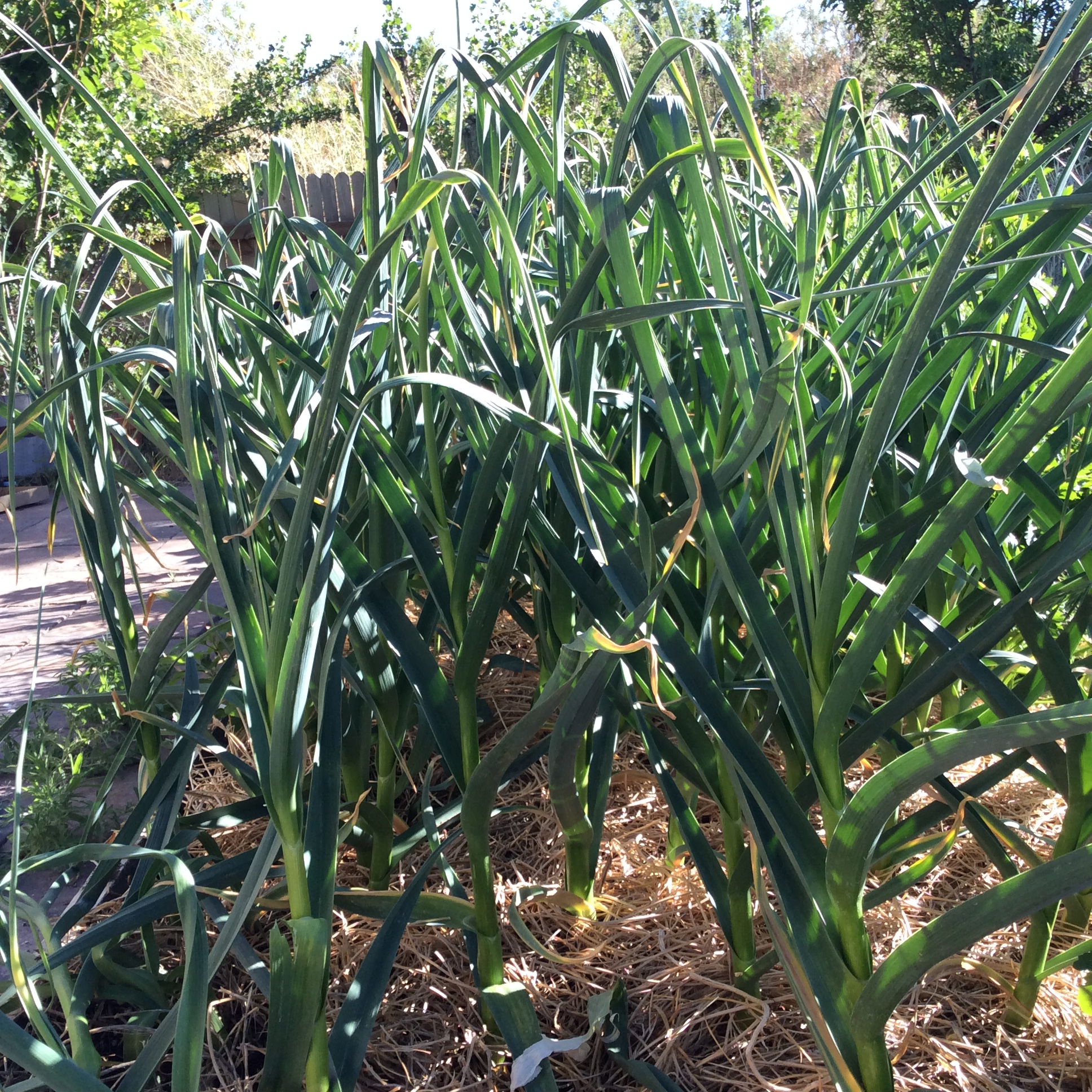
My patient readers might be wondering by now why I have so damn many posts this year on the uses of green or immature garlic. The reason is simple: last summer I ordered my garlic sets as usual, forgot about it, and a few weeks later placed the same order again. When a LOT of garlic sets arrived in fall I decided to treat this as serendipity and planted them all, and the result is that I have hundreds to thousands of stalks of green garlic right at the moment. Since I have become interested in the health benefits of alliums, especially the green parts, I am thoroughly enjoying experimenting with ways to use them. Right now they are just beginning to send up scapes, and the stalk of the plant is hard and difficult to use well. But when I pull a few plants for the newly bulging bulbs, I find that the leaves are still green, and I decided to try using them as a leafy green vegetable. I washed a bunch of them, cut them in 1 inch sections crosswise, and blanched them in boiling water for two minutes.  This initial blanching seemed to tenderize them a lot, but if you insist, try cooking them without pre-blanching and see how it goes.  Then I slowly roasted in butter with a little salt and rich chicken broth for about 20 minutes, taking care that they did not dry out. I roasted them only because I was also roasting some chicken, and it would be easier to slowly sauté them on the stovetop. Make sure that there is enough broth that no part of the leaves dries out. Kept a little moist, they develop a lovely plush texture. This turned out to be a delicious vegetable, full of flavor but not excessively garlicky. The only thing I’m going to do differently in the future is cut them in shorter sections, about half an inch, since there is a suggestion of fiber in the mouth when cut to the longer length. I did not identify any actual fibers of the nasty kind that stick between the teeth, but I just think the mouthfeel would be better if cut shorter.
I am increasingly delighted to find that every part of the garlic plant is edible, versatile, and delicious, a true nose to tail vegetable with a boatload of health benefits besides. Right now garlic, shallots, onions, and multiplier onions occupy about a third of my total available garden space, and I think this is how it should be and will do the same again next year.
Incidentally, once the emerging scape begins to show at the top of the plant, the stalk is not worth trying to use except as a flavoring for broth, in my opinion. It is just too fibrous and tough. But soon the scapes will be elongating and they are eminently edible when young, so a couple of weeks of patience will provide you with a whole new vegetable.

Continual change

image

Everything not busy growing is busy decaying. In a garden, change is the constant.  The produce that you have to work with is continually changing, and your technique has to adjust to it.  Right now in my garden, for instance, the green garlic has begun to form bulbs and the stalk is elongating considerably, forming the scape inside.  The tissue that will become the papery skin of the bulbs is still soft, and the entire plant is still usable as green garlic.  In fact, that has a somewhat stronger taste of garlic then it did in earlier stages. Just be aware that you need to cut it in fine slices across,  less than a quarter inch if possible, and sauté it longer in olive oil or butter and maybe a little water to help the leaves soften. At this stage I plan on 25-30 minutes over medium-low heat to let the leaves soften, sweeten, and develop flavor.   If you want to try dehydrating it to use as a seasoning later, this is the perfect stage. Just slice it thinly, put it in your dehydrator until thoroughly dry, and then powder it for later use if desired.

Your other ingredients are in constant flux throughout the season too. Watch them, handle them, taste them, and see where you need to adjust your technique to suit their current maturity level.