Archive for the ‘home food production’ Category

Vegetable Dinners: Black Bean Cakes, and notes on cornmeal


The famous nutritionist Marion Nestle once claimed that she could tell anyone in a sentence how to improve their health and nutritional status: “Eat less, move more, eat more fruits and vegetables.” Around my house we love to fill our plates with vegetables, so no problem there, but lately I’ve been experimenting with ways to add more dried beans to our diet. This coincides with my aquisition of a solar oven, but in this recipe the beans don’t even have to be cooked. You can soak them for 24 hours, or you can use drained cooked black beans if you have some handy. These patties make a substantial main course and are a good main dish for occasions when you have vegetarians and/or vegans over for dinner.

Black Bean Cakes

Start with one cup dried black beans. Soak in a quart of soft or filtered water at room temperature for 24 hours. If you can’t give them the full soaking time, use 2 cups of cooked drained black beans instead.
About a cup of fine cornmeal (I like finely ground blue cornmeal, which helps keep the color dark)
1 small bunch each of epazote and cilantro, or 1 large bunch cilantro
1 teaspoon lightly roasted ground cumin
2 medium or three small shallots, very finely chopped
2 limes, one juiced, one cut in wedges or slices
salt to taste
1 teaspoon ground chipotle chiles
1/2 teaspoon baking powder
about half a cup of olive oil

Drain the soaked beans very thoroughly. They should now be about 2 cups in volume. If using cooked beans, drain very thoroughly. Whichever kind of beans you are using, let them sit in the strainer for at least half an hour, because you want them as dry as you can get them. Now grind them finely in a food processor. MIx in a small handful of chopped epazote or, if you couldn’t find epazote, a large handful of chopped cilantro. Mix in the chopped shallots, cumin, chipotle, the juice of one lime, and about half a teaspoon of salt, and taste for salt. Add more if needed to make the mixture taste properly seasoned. Make it a little tiny bit on the salty side, because you are still going to add more dry ingredients. Heat about a quarter cup of olive oil in a skillet over medium heat. When almost ready to cook, process in half a cup of cornmeal mixed with the baking powder. Check the consistency; if it’s possible to mold it into cakes, you’re ready to go. Otherwise, add more cornmeal until it can be molded (with difficulty) but is still very soft. Sprinkle cornmeal on a piece of waxed paper and scoop out heaping tablespoonfuls of the mixture onto the paper. When the oil is good and hot, carefully lay the cakes in the hot oil, patting a little with fingers or a spatula to make them no more than 1/2 inch in diameter. Be careful, they’re fragile, but you don’t want to add more cornmeal unless strictly necessary because they can get dry and tough if you add too much. You can also skip the waxed-paper step and spoon the mixture directly into the hot skillet, spreading it out with the back of a damp spoon to make the cakes about 3/8″ thick. Let them sizzle at least 3-4 minutes, then when you’re sure that a good brown crust has formed on the bottom side to hold them together, carefully turn with a narrow spatula and cook on the other side until done. You can keep them warm in a 200 degree oven while you fry the second batch. The main “secrets” are to keep the dough on the moist and fragile side, get the oil hot enough, don’t omit the baking powder because it does improve the texture, and wield your spatula with caution to turn them without breaking the cakes around them. .

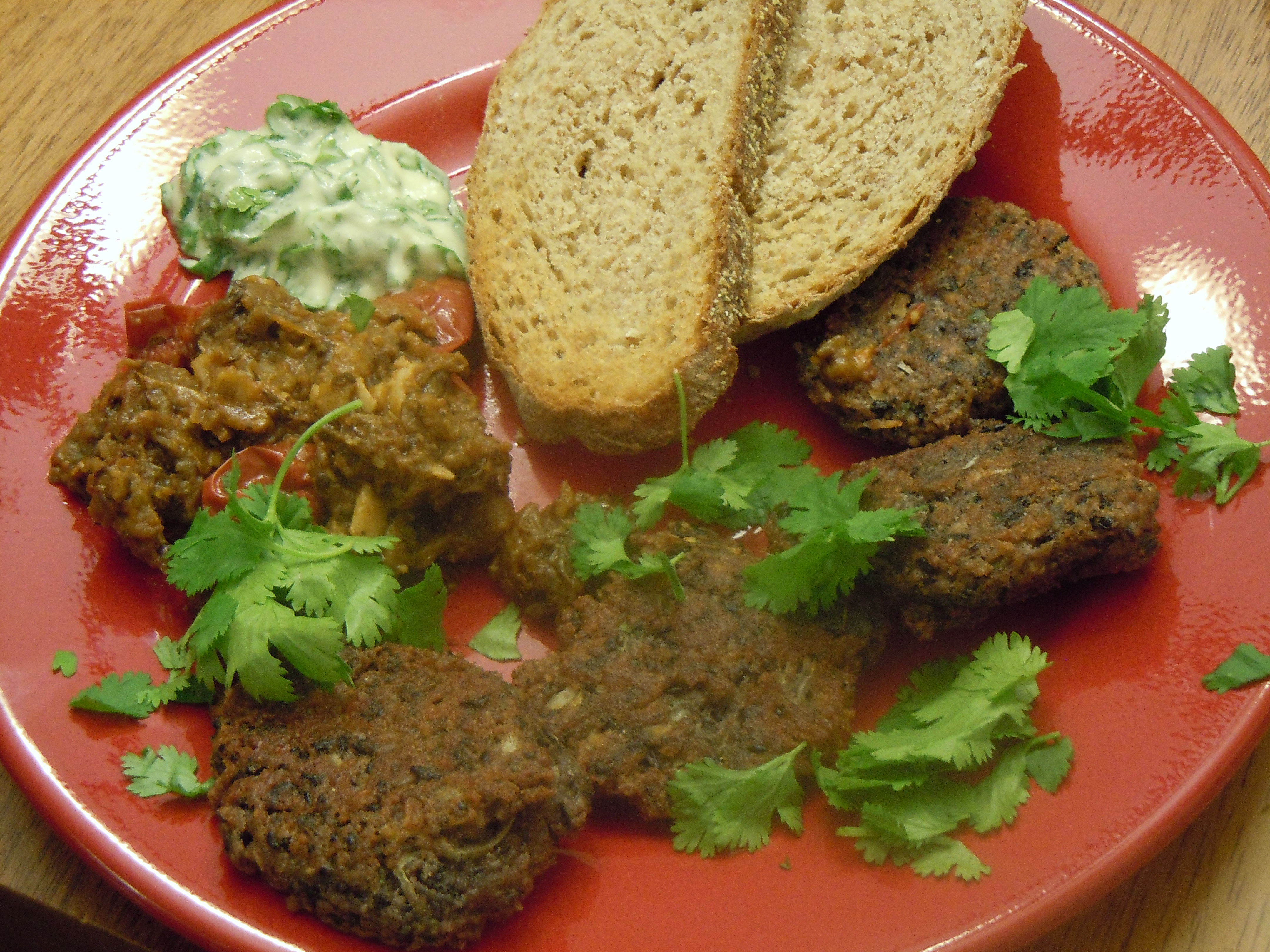
Once cooked, you can decide how to serve them. They are fine naked on a warmed platter, garnished with a large handful of cilantro leaves and wedges of lime as shown above. A squeeze of the fresh lime juice is important to the flavor, in my opinion, and I pick up a few cilantro leaves to add to each bite. My favorite garnish (vegetarian but not vegan) is some very good olive oil mayonnaise with a little extra lime juice and a lot of chopped cilantro stirred in. They can also be served with warmed small corn tortillas and guacamole, and a little heap of crumbled cotija cheese on top is a delicious tangy addition; the vegans at the table can just omit it.

The beans and blue cornmeal are both full of antioxidants, blue cornmeal is a whole-grain product, and beans have beneficial phytosterols as well as lots of fiber and other desirable nutritional factors. But I only eat things that taste good, and these cakes taste good.

Notes on cornmeal: a lot of cornmeal on the market is very uneven in grind, and any meal containing large particles will leave unpleasant hard fragments in your finished cakes. I buy a blue cornmeal made locally and ground to flour fineness. If you buy yours at the store, I suggest sifting it to get the largest chunks out, or whir it in the blender for a few minutes to grind it more finely. I would avoid the Bob’s Red Mill “medium grind” cornmeal: it seems to be a mix of the company’s fine grind and polenta grind, and can leave tooth-cracking particles in your bean cakes or cornbread. Seek out a better product.

Vegetable dinners: things to wrap in a pita


My new category, Vegetable Dinners, will be a collection of meals based on vegetables. Some are vegetarian and some aren’t, but where meat is used, it’s a small amount and is used more as a seasoning than as the bulk of the meal. Where relevant, notes on how to make them vegetarian or vegan are included, but many of them taste best with a little meat or fish included, and my recipes note this. My kitchen mantra is “Eat less meat, eat better meat,” and the same goes for eggs and dairy products. Since you aren’t using much, you can afford the best and most sustainable.
Summer vegetables are at their peak now, and in my home most of our meals are based on them. Mixtures that can be wrapped in a pita make a light easy meal on hot days. The filling can be made ahead, and keeps a few days in the refrigerator. OIl-cured black olives are used to add a meaty savor to eggplant and zucchini, and capers add an herbal note. This meal is vegetarian, and can be made vegan if you alter the sauce recipe a little.

Eggplant and Zucchini with olive paste

2 small or one large eggplant, fresh and firm
2 small zucchini
12-20 oil-cured black olives depending on your taste for them (no other kind of olive will do here)
3 tablespoons salted capers, rinsed and then soaked in cold water for an hour and squeezed dry
1/4 cup good olive oil
2 large or 3 medium cloves garlic
chopped parsley to taste, probably a couple of tablespoons

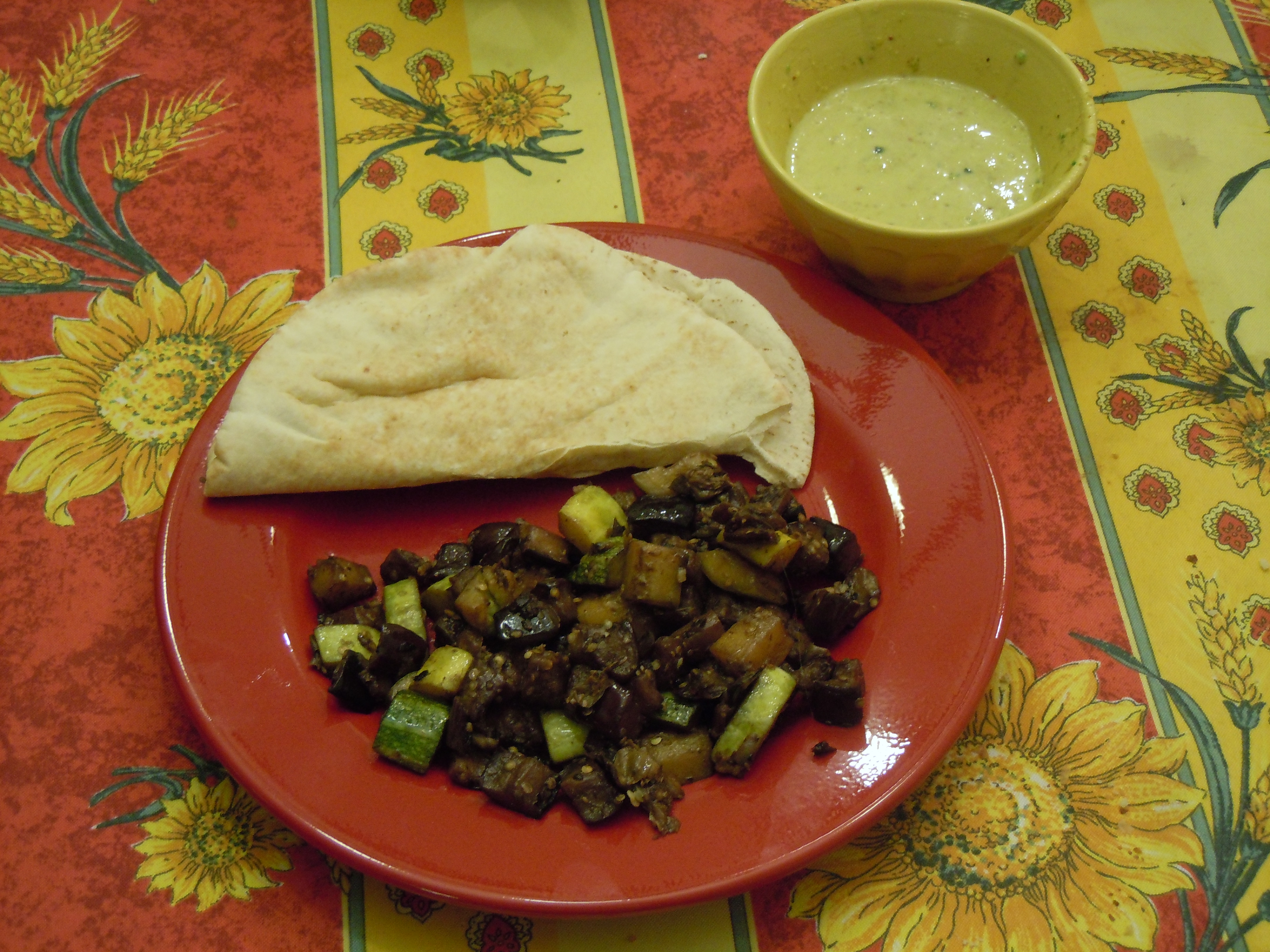
Cut the eggplant in cubes 1/2 inch or a little larger on a side. Whether you peel it first is up to you. The finished dish has a more tender texture if the eggplant is peeled, but less fiber and fewer antioxidants, so take your pick. Personally, I leave the peel on for this dish as long as the eggplants are young and tender. Cut the zucchini in quarters and slice each quarter into segments on the small side of 1/2 inch. Toss the vegetable cubes together in a bowl with 2 teaspoons of salt and let sit at least 1 hour, tossing occasionally. This step is important for this dish and shouldn’t be shortened. Don’t worry about the quantity of salt; if you do the squeezing step well, most of it will be removed with the liquid. You can soak the capers at the same time. Pit the olives and chop them coarsely, and chop the garlic finely. At the end of an hour, drain off exuded liquid and squeeze the veggie chunks in a clean kitchen towel, a few handfuls at a time, until as much liquid as possible has been squeezed out. Squeeze the capers dry and chop them coarsely. In a clay cazuela or 10″ skillet, heat a few tablespoons of the olive oil and add the garlic. Cook until opaque and cooked but do not allow it to start to brown even a little. Now add the olives, capers, and veggie chunks, toss to coat with the oil, and cook over low heat for about an hour, tossing occasionally and making sure it doesn’t burn on the bottom. Add a little water if needed to prevent burning.
Texture is very important. Start tasting a little after 45 minutes or even 30 if it looks like it’s cooking quickly. When the zucchini is just tender but not mushy, and the eggplant is melting in texture, it’s done. Also check for salt, but the seasonings are salty and you are unlikely to need any. Stir in the parsley just before serving. Serve with good pita bread, lightly warmed, and the sauce below.

Lemon-garlic sauce
This sauce is like an aioli but looser and less rich. The egg yolk just binds it and thickens it a little. If you leave out the egg yolk the whole dish is vegan, and the flavor doesn’t suffer at all but the texture will be liquid, not thick, and it will need to be stirred up by each diner before taking any.

1 egg yolk
1 large clove garlic
juice of half a lemon
1 Jalapeno pepper
olive oil as needed, usually about 1/4 cup.
salt to taste
1-2 teaspoons fresh thyme leaves

In a small food processor, chop the garlic clove and the chile pepper. I always mince fresh chiles before putting them in the processor to make sure that big chunks don’t startle diners. Add the egg yolk and lemon juice, process briefly, and slowly drip in the olive oil until it’s as thick as you want. I like it to be liquid and spoonable, but velvety. Taste and salt as needed. Add the thyme leaves and stir in. For the vegan version, proceed the same way except leave out the egg yolk, and be aware that it won’t thicken in the same way but will be more like a vinaigrette.
Don’t save leftover sauce more than a day in the refrigerator, because of the egg yolk, but I like to spread leftover sauce on a warmed pita for lunch the next day.

Kitchen Staples: Blue Corn Pancakes


I’ve written before about the wonderful blue cornmeal that’s available at the Los Ranchos Farmers’ Market on Saturday mornings. A local couple, the Molinas, grow the blue corn, shell the kernels off the ear, then (this is the important part) roast the kernels to bring out their flavor before grinding them to a flour-fine meal. I feel rather proud of having discovered this cornmeal because you can’t tell from any distance that they have it. Their small and unassuming booth is recognizable by the display of rocks that Oracio has picked up over the years. If you try to use another blue cornmeal, make sure it’s ground very finely, and if it has chunky bits in it, grind it again in the blender. Then toast the meal lightly in the oven until it has a light toasty smell, making sure not to burn it or let it darken. Personally, I buy it at the market and let Oracio and Lourdes do the work. It makes pancakes that will light up your weekend morning.

1 cup blue cornmeal, very finely ground
1 cup all-purpose flour
1 teaspoon salt
1 tablespoon agave nectar or light brown sugar
1 teaspoon baking powder
1-2 cups buttermilk
1/4 cup melted butter
3 real free-range eggs
clarified butter for frying (I seldom bother to clarify mine, but you have to fry more carefully with unclarified)
butter and maple syrup

Mix the cornmeal, flour, baking powder, salt, and sugar if using together in a mixing bowl. Get your cast-iron skillet or other big heavy skillet heating over medium heat at least 5 minutes before you want to start cooking. Beat the eggs, the melted butter, and 1 cup of buttermilk together lightly. If using agave nectar instead of sugar, add it to the egg mixture. When the skillet is hot, mix the wet ingredients quickly and roughly into the dry ingredients, and add enough of the second cup of buttermilk to make a pourable batter. Film the skillet with clarified butter, pour in about a third of a cup of batter, and spread it out a little to make a pancake. Cook on the first side until the upper side shows little holes from the leavening, then flip skillfully and cook the other side until done. Slather with the best butter you can get, repeat to make a stack, and serve with real maple syrup.
A pancake is a very personal thing, and any recipe will need adjusting to your preference. I like the batter a little on the thick side and I can only judge this by eye, so I don’t measure the buttermilk after the first cup, I just mix enough in to make the texture right. I cook the first side until it’s lightly browned, as shown above, and then cook the second side to about the same color. I prod them a little with my finger to test for any uncooked dough in the center, but if you haven’t been doing this for a few decades, you may need to cut the first one open to make sure you’re cooking them through. I don’t cook over high heat because the outside gets too brown before the inside cooks through. I hate chunky inclusions of any kind, like berries and fruit. I like real maple syrup and don’t eat any other type. Other cooks say that thin batter is good, that browner is better, that oil or lard or bacon grease are the best cooking mediums, that honey is better than syrup, and I understand that some people are so lost to decency as to put cheese, chocolate chips, or big hunks of fruit in pancakes. Suit yourself. That’s the joy of cooking at home.
By the way, it is possible and even fun to cook with two skillets, or with a big griddle, and get pancakes on the table more quickly.

Kitchen Staples: Ethical Chicken

Recently a friend came to visit me and I proudly led her to the back of the yard to see my six beautiful hens in their secure coop. Instead of admiring them, she was dismayed because “They’re so crowded.” I must admit that I was floored. I have six hens in a 4 foot by 7 foot coop, with lots of headroom and high perches, and I think my chickens have it good.   Upon questioning, it was clear that she buys her chickens and eggs from the grocery store and has no idea what conditions in a commercial chicken operation are like. So here are some images to ponder: In the best possible commercial set-up, laying hens would have a square foot per bird. That means 28 chickens in my coop instead of six. More likely, there would be 4 hens for every 3 square feet, or 36 birds in my coop. Up to 42 hens would be in it in some operations, and they would be in cages no more than a foot high, often less, so that the hens couldn’t even straighten out their necks, but stacking the cages would enable 5 layers of birds to be kept in my 28 square feet, or up to 210 birds total, since my coop is 5 feet high.  Broiler chickens are even more crowded, if you can imagine such a thing, and the stench is hellish. I refuse to discuss the slaughter practices, because I don’t care to remind myself. When I had my sheep farm , I lived near a broiler operation, and I didn’t eat chicken again for years. If you comfort yourself by buying “free range” chicken, think again; a 20′ X 20′ yard may be the “range” for a barn holding 20,000 to 30,000 chickens.  If you want to be realistic about commercial farming practices, I urge you to read Michael Pollan’s best book The Omnivore’s Dilemma. Be aware that, by the end, you will feel driven to change your habits if you haven’t already.

All too often, people refuse to think about where their meat comes from and how it’s killed for a simple reason; they would have to drastically change their eating habits if they let themselves acknowledge what goes on in standard CAFO operations. I don’t care to perpetuate such cruelties, and so I am starting my own laying flock and I get my meat chicken from Pollo Real at the Santa Fe farmers’ market. They are a pasture operation, which means that the chickens are kept on pasture in “yurts” which are moved frequently. They are fed grain and they eat plants, insects, and all the things that chicken should eat. They have plenty of room. They re slaughtered on the farm, quickly and humanely. They cost a lot more than supermarket chicken, and they should. They are better for you and yours, better for the chickens, and better for the planet. Paying more makes us realize that we have to pay to support humane farming practices, and that meat should be a pleasant addition to a meal rather than the center of it.

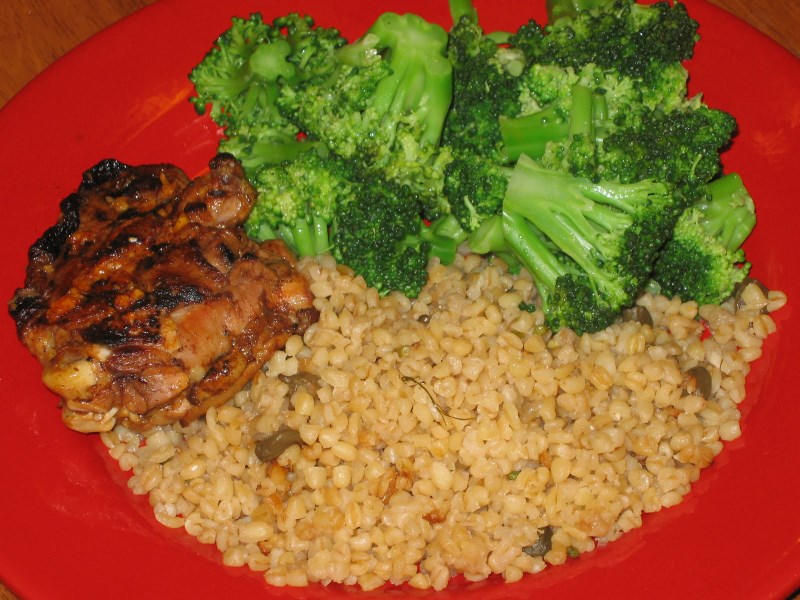
Better ethics and a better dinner; this is well worth an occasional trip to Santa Fe with a cooler, or look for Pollo Real chicken at La Montanita Co-op. Once you have some, there are a million ways to cook it, but here’s a simple favorite: just rub it with a paste made from a few clove of fresh garlic, a teaspoon of salt for every pound of chicken, a tablespoon of Spanish Pimenton de la Vera or smoked paprika, the juice of half a lemon, and enough olive oil to make  a paste. Grill it over a low fire until done to your taste, brushing with any leftover paste. Serve with lots of vegetables and whole grains. Sleep like a baby.

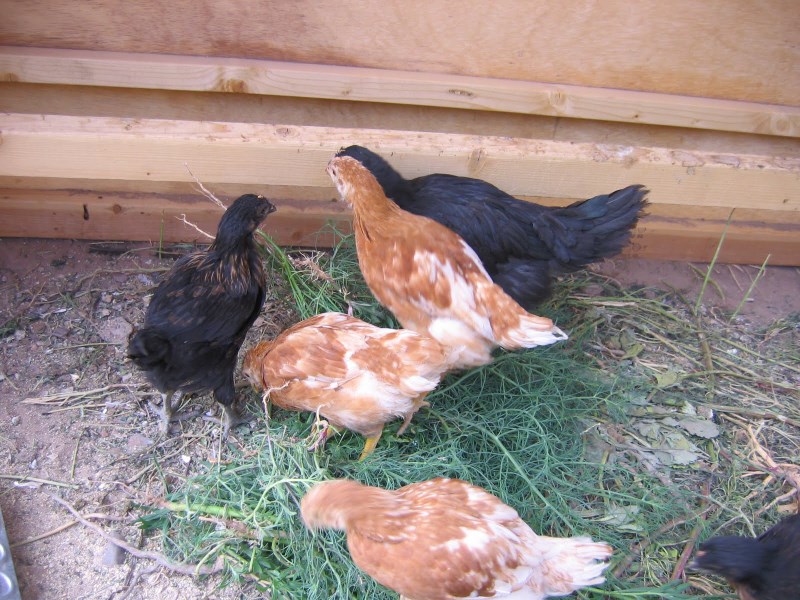
And, just for fun, here’s my own chicken flock.