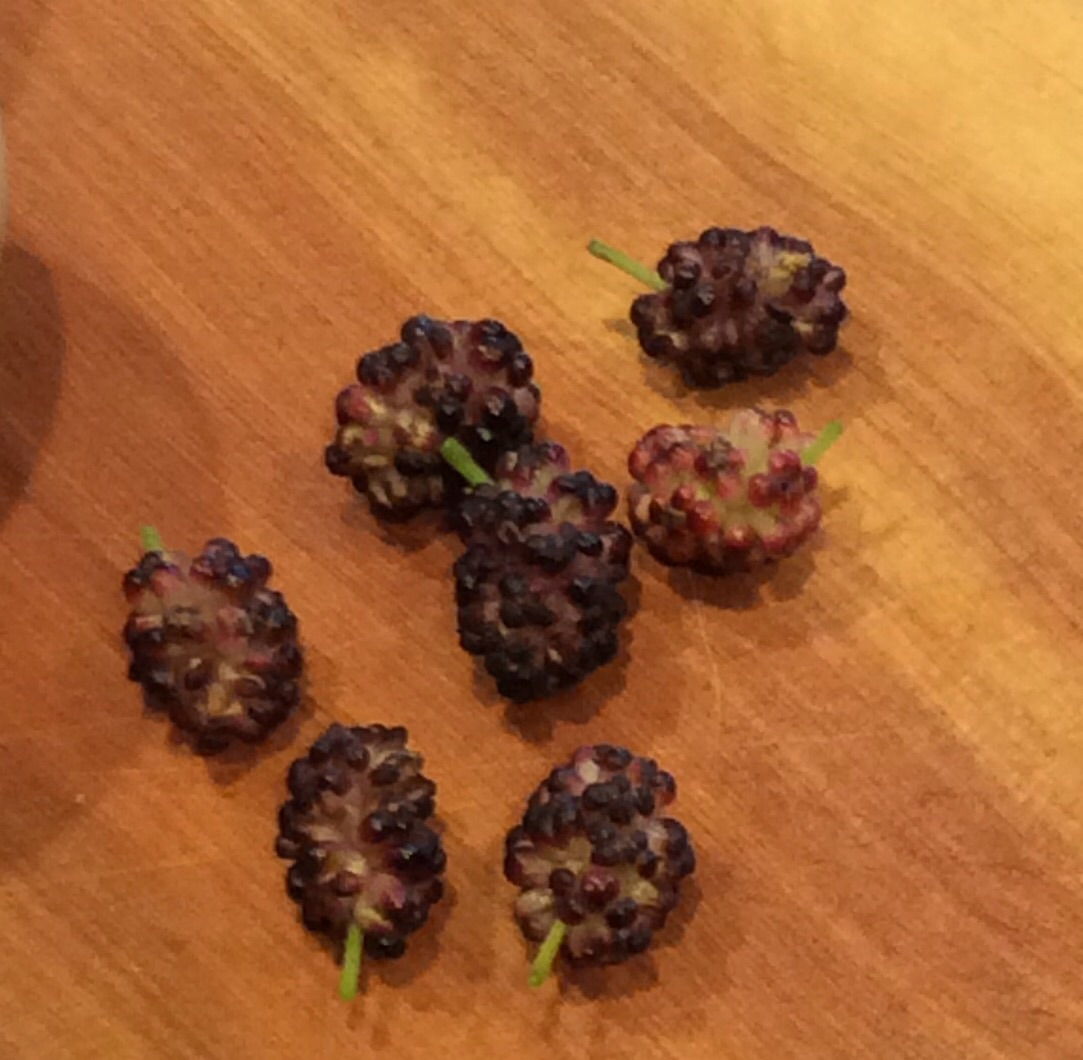
I’m an occasional fan of Persian cooking. Kukus, the seasoned egg cakes that can best be compared to frittatas, are a wonderful way to eat without fuss. Herb kukus are a special favorite of mine in the spring, when herbs are fresh and abundant, and to my taste they need barberries for the best flavor. Usually I resort to dried ones, but while having my mulberry-fest this afternoon I ate one that was only half ripe, and noticed that it was a little sweet, a lot tart, rather vegetal, and quite like a barberry. So I will pick some in this stage, with plenty of white still showing, and freeze them to throw in dolma filling or a kuku when the mood takes me.
As you get to know your plants and your land, they will drop some lovely unexpected gifts in your lap.
Archive for the ‘fruit’ Category
4 Jun
Mulberry Heaven
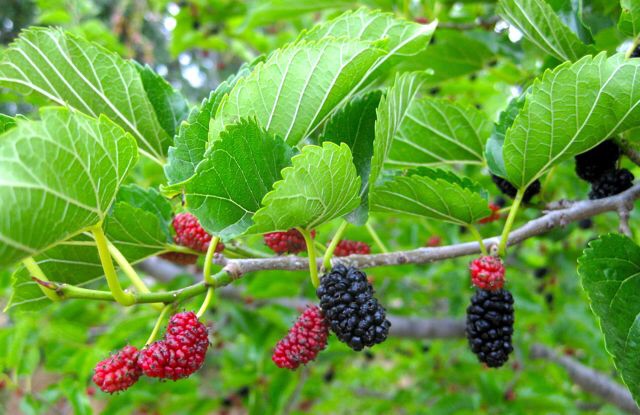
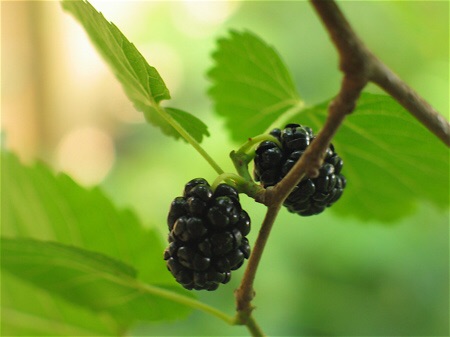
Near my home there is a mulberry tree that has delicious black fruit and low-hanging branches. When the fruit ripens, I throw my ketogenic diet temporarily out the window and go every evening to stand under it, gorging myself, while my dogs eat dropped fruit off the path. This is one of the greatest joys of the summer season. But it isn’t by any means the only use for mulberry trees.
On my own property I don’t have any mulberries big enough to fruit, but I do have two mulberries that I harvest greens from. The leaves of all mulberries are edible when young and tender, but flavor ranges from tasty to nasty. By hanging around a local organic nursery and surreptitiously tasting leaves, I got a couple that had fairly good-tasting leaves. At my last home I had a mulberry with delicious and large leaves, but alas, that tree is no longer mine, and I didn’t try rooting cuttings because I had no clue how hard it would be to replace. But the ones I now have are passable. The trees will rapidly grow tall if you let them, which I don’t. From the time they are 4 feet high I start managing them for leaf harvest by keeping them small. At first this is a matter of a little delicate trimming and weighting some branches so that they grow out nearly parallel to the ground. Later on in their lives, much harder cutting is needed, and by the time that they are 5-7 years old, they need coppicing (cutting off a few feet above the ground) to keep them in check. Coppicing keeps them from producing fruit, and incidentally they also don’t bloom and produce their incredibly allergenic pollen when managed this way. They do produce masses of young tender tips that can be pinched off at the point where they are nonwoody and break easily and cooked as a green, a good green that fills in gaps between cold-weather and hot-weather greens and contains resveratrol as a bonus.
At the point when my coppiced trees start producing more greens than I can use (which is a few years down the road,) I will start harvesting bigger branches for my goat, who thinks that mulberry branches are the food of queens. Mulberry leaves can also be dried to make tea, although I think the resulting tea is pretty insipid stuff and needs other herbs for interest. I would also use “extra” cuttings for mulch and spare biomass.
For more about mulberry trees, see the link below for a terrific and very comprehensive post about mulberries in permaculture. Don’t miss the wonderful pictures of stuffed mulberry leaves! The recipes are available too, and I plan to try this soon.
Temperate Zone Permaculture mulberry post
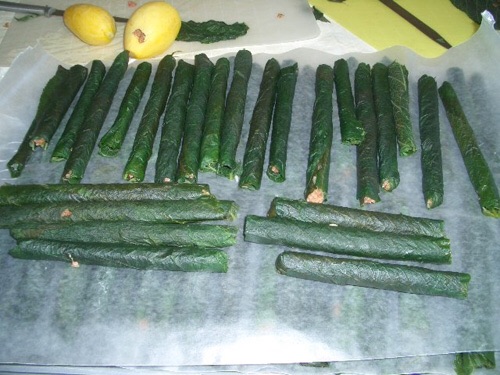
This image of stuffed mulberry leaves, poached from the Temperate Zone Permaculture post linked in above, looks especially interesting to me. Check out the recipes in that post.

The stigmata of the mulberry fancier. Consider yourself warned.
18 Dec
Winter pleasures: pomegranates
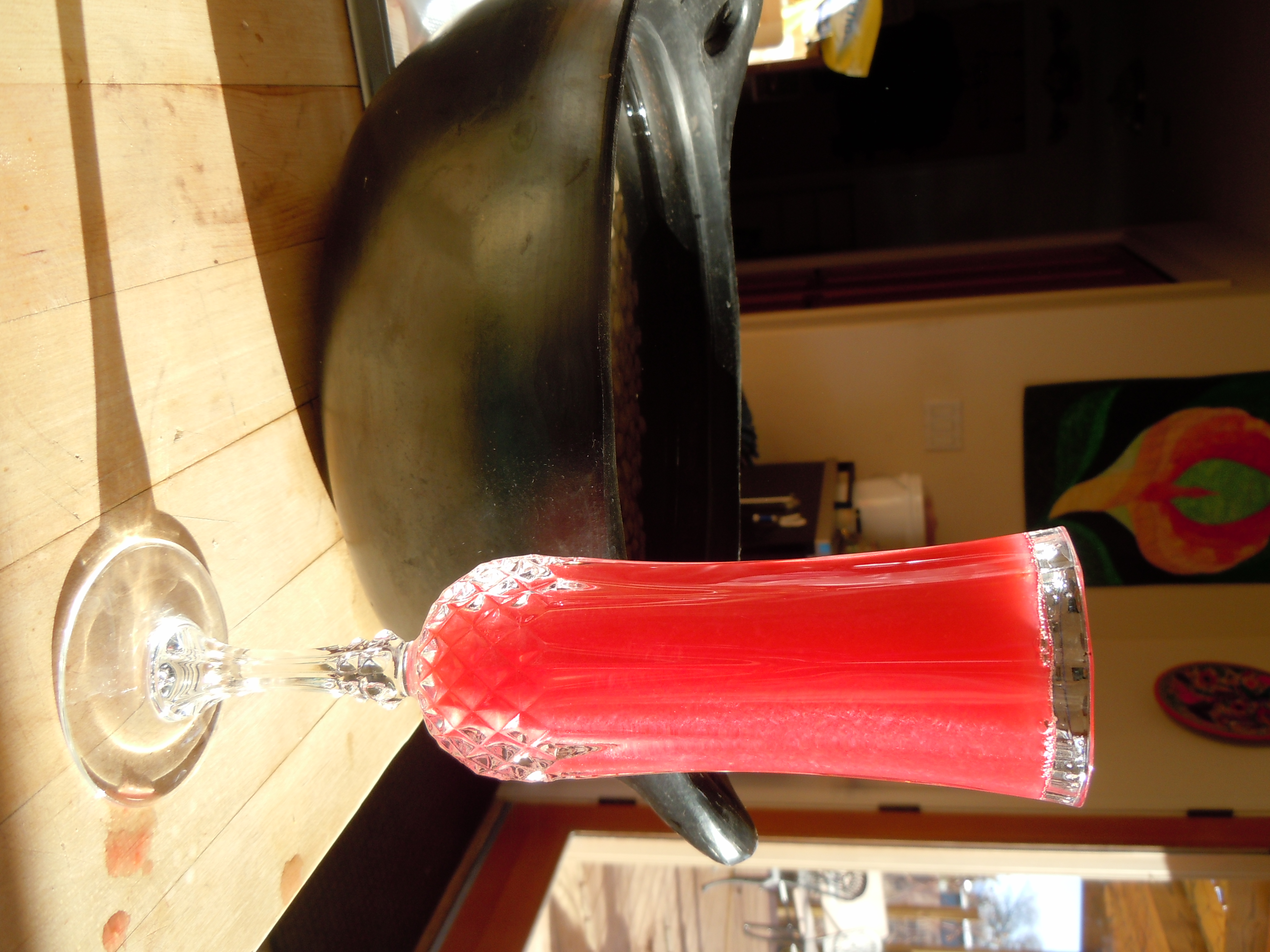
Pomegranates are a common landscape plant in our area, although our recent cold winters have culled them pretty heavily. A little further south, they can be found naturalized by roadsides. They are ripe in early winter, and there are lots of ways to use them in cooking, but I also like them as juice. The juice is tannic, and in my view needs softening, so I drink it in orange juice, using one medium-sized pomegranate for every two or three oranges. I cut the pomegranates in half and juice them in the orange squeezer, but if you don’t have one, you can hold each cut half over a bowl and squeeze the inside with a large rounded spoon to extract the lovely crimson juice. Salute the season, and enjoy. After starting a winter morning with this lovely toast, you can complete the evening with a pomegranate margarita if you feel so inclined.
22 Dec
Solstice Sunrise


It’s the day after Solstice, and the Sun rose this morning, so I guess it’s decided to stick with us for another year. Avid gardeners may start out on modern time, but after a decade or so we find ourselves living the rythm of the agricultural year. Yuletide is for feasting on our stored abundance, and it’s a wonderful time to sit by the fire and scan seed catalogs and attach some details to our hopes for the upcoming year. In a week or two I’ll be posting on my annual reassessment: what worked, what didn’t. But now is not the time for sober consideration. It’s the time to take unabashed pleasure in what worked really well. It’s time to do something that you don’t normally do, something that makes you shiver anew with love and reverence for the natural world, not because it is all good and beautiful, but because it exists and we have the good fortune to see it.
For me, feeling reverent rapture (or anything, really) before sunrise qualifies as something I don’t usually do. It takes real effort for me to function early in the morning, and a glass of fresh juice eases the effort. A juicer puts healthy stuff in your cup quickly, and doesn’t need to be expensive. I bought a reconditioned one and it works fine. Your own stored apples and carrots, or organic ones from the store, make a great seasonal juice. Prickly pear fruits are still perfectly good on the cactuses that we have everywhere, and juicing disposes of the spine problem. One prickly pear fruit, or tuna, will give a dramatic sunrise color to two big glasses of juice. To my palate the fruits don’t have a lot of flavor, but the color is reason enough to use them.
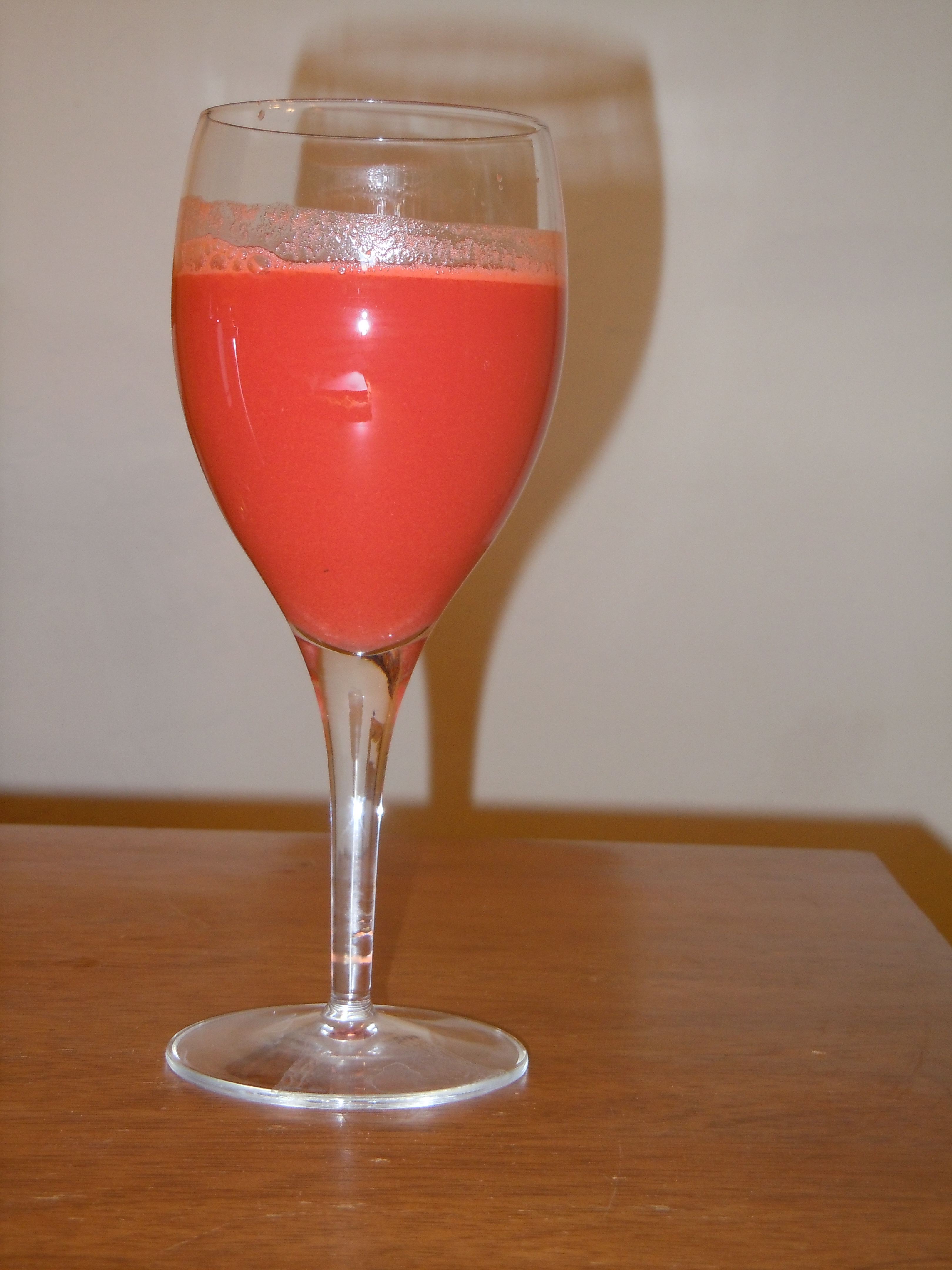
Run four apples, four large carrots, and one prickly pear fruit (two for a deeper red rather than the sunrise shade above) through your juicer. POur the juice into a clear goblet so that the color can be admired. Drink. Dispose of the pulp by burying it in a part of the garden that animals can’t get at- many animals are drawn to fruit sugars, and you don’t want all the horrid little spines in the pulp to torment any animal, wild or tame. For the same reason, handle the pulp with a wooden spoon or thick gloves, not your bare hands.
 My urban homestead