Archive for the ‘front yard gardening’ Category

Canna Lilies

img_4917

Every year I try a few new edibles, and I try to lean toward perennials. I have a lot of edible perennials in the spring but very few that produce in hot weather, so I’m especially interested in any heat-tolerant edible. This spring I read about canna lilies as a multi-purpose edible, with young leaves, rhizomes, and flowers all edible. I have seen them perennialized in my area, they tolerate heat beautifully, and I grew up in Louisiana and still have a taste for overblown tropical flowers, so putting in a canna patch was a natural. They grew well and were very pretty, and didn’t even need that much water since they were well mulched.

The hitch came in the kitchen. I tried young tightly rolled leaves sliced on salads, flower petals on top of salads, and finally the season’s new rhizomes boiled. In all three cases the problem was that there was no objectionable flavor but also no desirable flavor. Cannas taste as much like nothing at all as it’s possible to imagine. Since I don’t know of any pressing nutritional reason to eat them, and since yield is low and they use up a fair amount of space, I doubt that I will try them again. I imagined that my goat would enjoy the leafy adult stalks, but to my astonishment she won’t touch them.

So, overall, no reason to keep growing them except that they’re pretty and can make a dramatic addition to summer flowers. And this leads to a bit of ranting about the concept of permaculture. I have recently perused with interest a book claiming that  permaculture could help feed a rapidly expanding world population in an environmentally sound way, but the picture of the authors’ market display shows nothing but standard annual vegetables.  Another book which purports to be a permaculture cookbook has recipes based almost entirely on standard annual vegetables.  If you hope to eat something other than asparagus and spring greens, what exactly do you grow? My weed patch is a partial answer to this question in my own yard, and I’m experimenting with a few Japanese and Andean perennial edibles (so far without much success.) Fruit is an obvious possibility but many of us have weight or blood sugar issues and need to limit the amount of fruit we eat. So in my view the question remains unanswered, and I will be growing and eating annual vegetables for the foreseeable future.  I’m also interested in the concept of wild-crafting, and in my case this means that I attempt to grow edible perennial weeds in my own yard, where I can control soil and moisture and not worry about overharvesting in the wild.

In springtime, the asparagus springs up, nettles and a host of other wild greens sprout, and I can feel like a real permaculturist for the entire month of April. After that, it gets a lot more limited and I’m a more traditional gardener. Unfortunately, canna lilies are not going to do anything to change that.
Poblanos con Queso

image

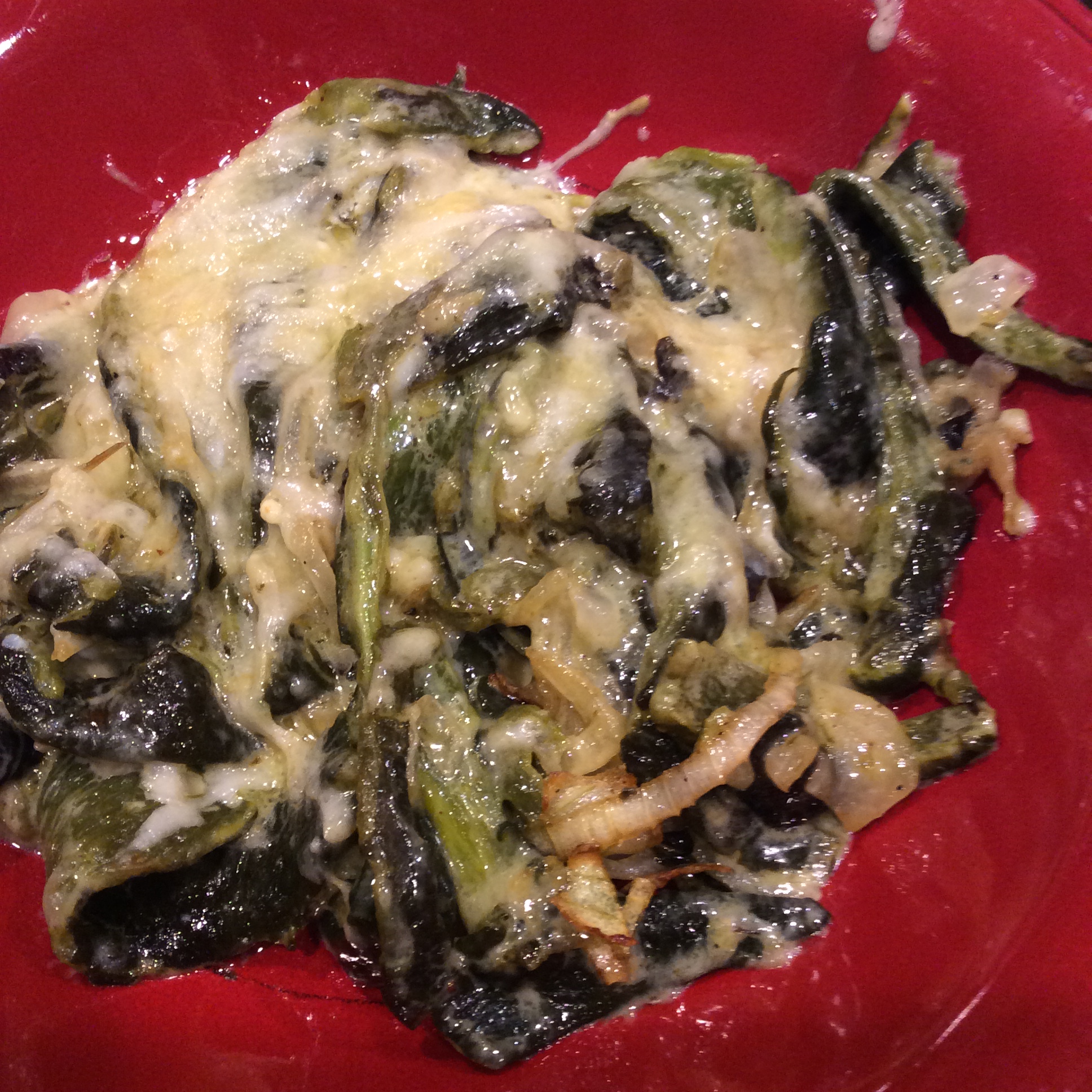
I used to love a bowl of chiles con queso to fold into soft corn tortillas,  and now that I eat low-carb and no longer eat tortillas, I find that my enjoyment of roasted chilies with cheese and cream is undiminished.

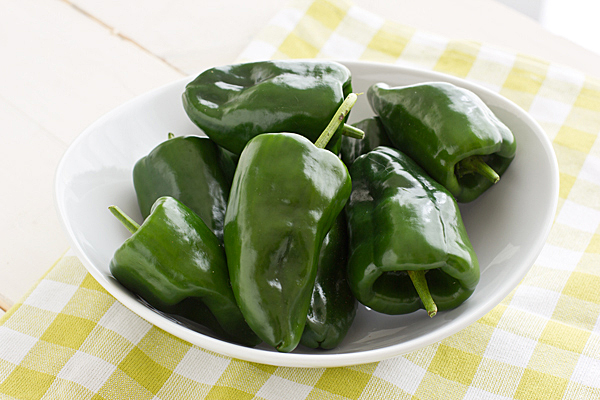
Here in New Mexico August is the great season of chilies, and soon chile roasters will appear everywhere and the aroma of roasted chile will float in a faint delicious cloud over the city.  But there are plenty of chiles around right now  and they can be roasted easily on the grill or under the broiler.  My favorites are the lovely inky green poblanos.  I was so eager to roast mine that I forgot to photograph them, so here is a borrowed photo:

image

Chile pepper plants are sturdy and attractive and can usually be grown in the front yard without comment, especially if planted in groups rather than rows. They have nice deep green foliage. In the case of poblanos, they turn very hot when red and should be harvested when dark green. They have a deep rich flavor and, depending on growing conditions, can be surprisingly hot when green, although generally they are considered a mild chile.  Roast them until they have blackened spots all over their skin, turning as needed, then throw them in a plastic bag to steam for 20 minutes. Peel off the skin and remove the core and seeds. Now tear them into strips. These are called rajas de chile.  For the roasted strips from six poblanos, chop up one small onion and one good-sized clove of garlic and sauté them until cooked; I used fat from my homemade bacon. Add the chili strips and about half a cup of cream, and boil hard for just about one minute until the cream is a little reduced.  And a generous cup of grated cheddar, stirring some into the chili strips and put in the rest over the top, and broil until the cheese is melted and maybe a little brown in spots.  It makes a delicious light meal for two. If you add soft tortillas, it will feed two  generously.  It makes a good side dish for grilled meats of many kinds.  To me roasted chile is the flavor of August, and I am happy to have a foretaste of August in July.

Tomatillos, Salsa, and the Summer Garden

image

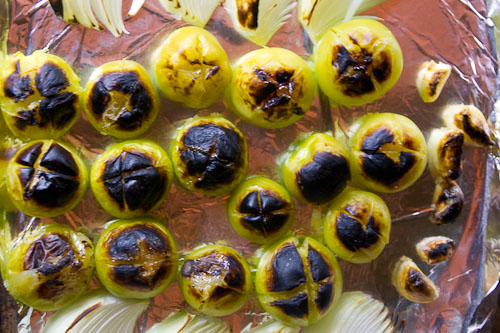
The flavor of tomatillos  is one of the wonderful flavors of summer. This is their glory time, when the plants I have stuck into odd corners have tangled themselves throughout the rest of the bed and are making fruits, almost hidden, which are a fascinating mixture of sweet, tangy, and tart when roasted. Right now tomatillos are ripening  in their husks and I can make one of my favorite salsas. This is an old Rick Bayless recipe, modified only slightly, and couldn’t be easier or more full of flavor. Start with about 30 large tomatillos (mine were about 2 inches in diameter) or maybe 50 smaller ones. Remove husks, rinse, and set in a single layer on a baking tray covered with aluminum foil.   Put five cloves of garlic on the baking sheet off to one side where they won’t burn, still in their skins. Broil under high heat until they look cooked on the top and have black spots, turn them over, and broil until that side is cooked.

Image borrowed from no recipes.com

Image borrowed from no recipes.com

Cool a little, skin the garlic cloves, and put the tomatillos and their juices and the garlic in the food processor.  Add at least two canned chilies chipotle in adobo and their associated juice, more if you like it hot. I like 4 large chipotles in this quantity of sauce.  Grind to the degree that you prefer. I like a chunky texture.

image

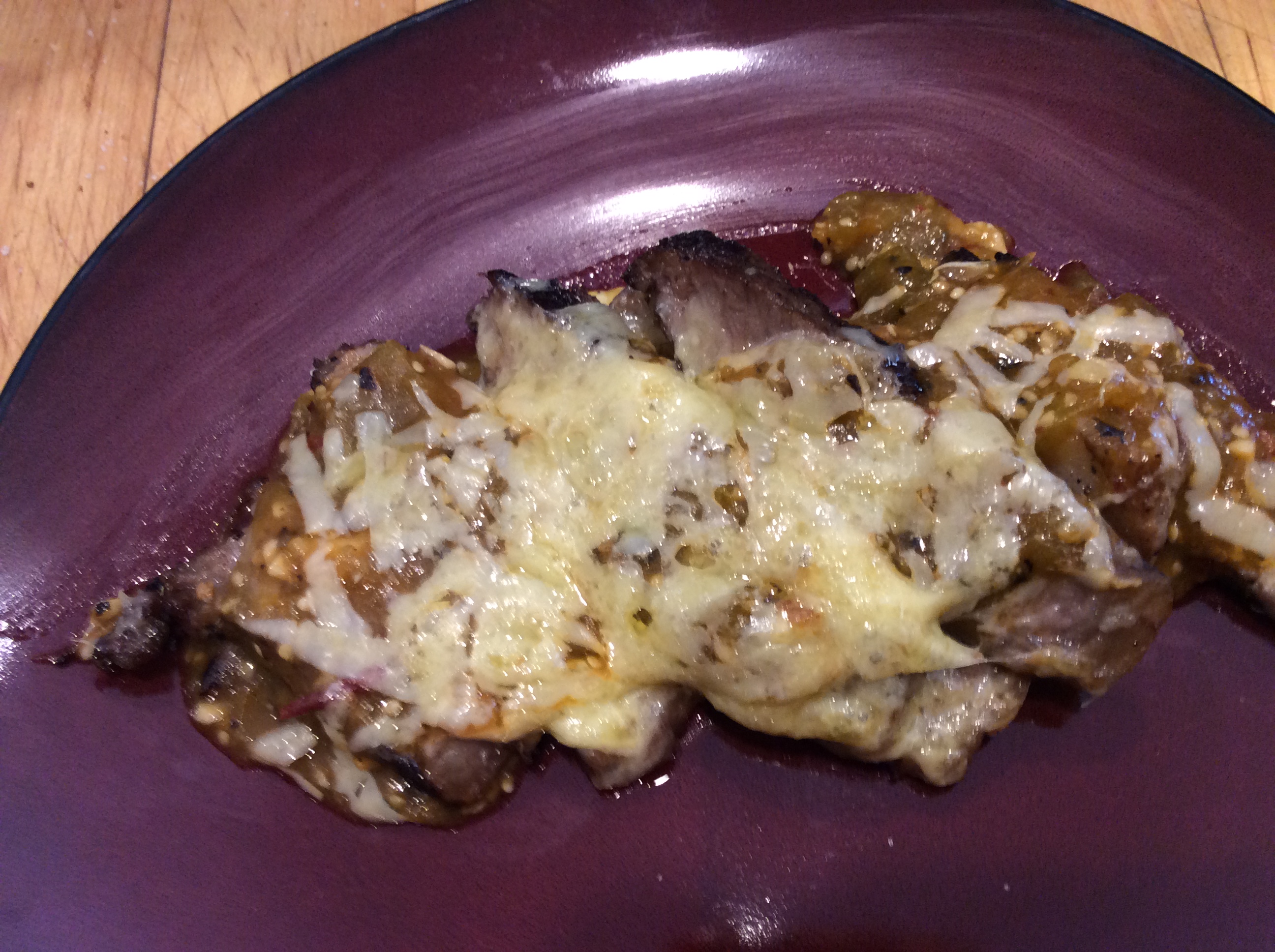
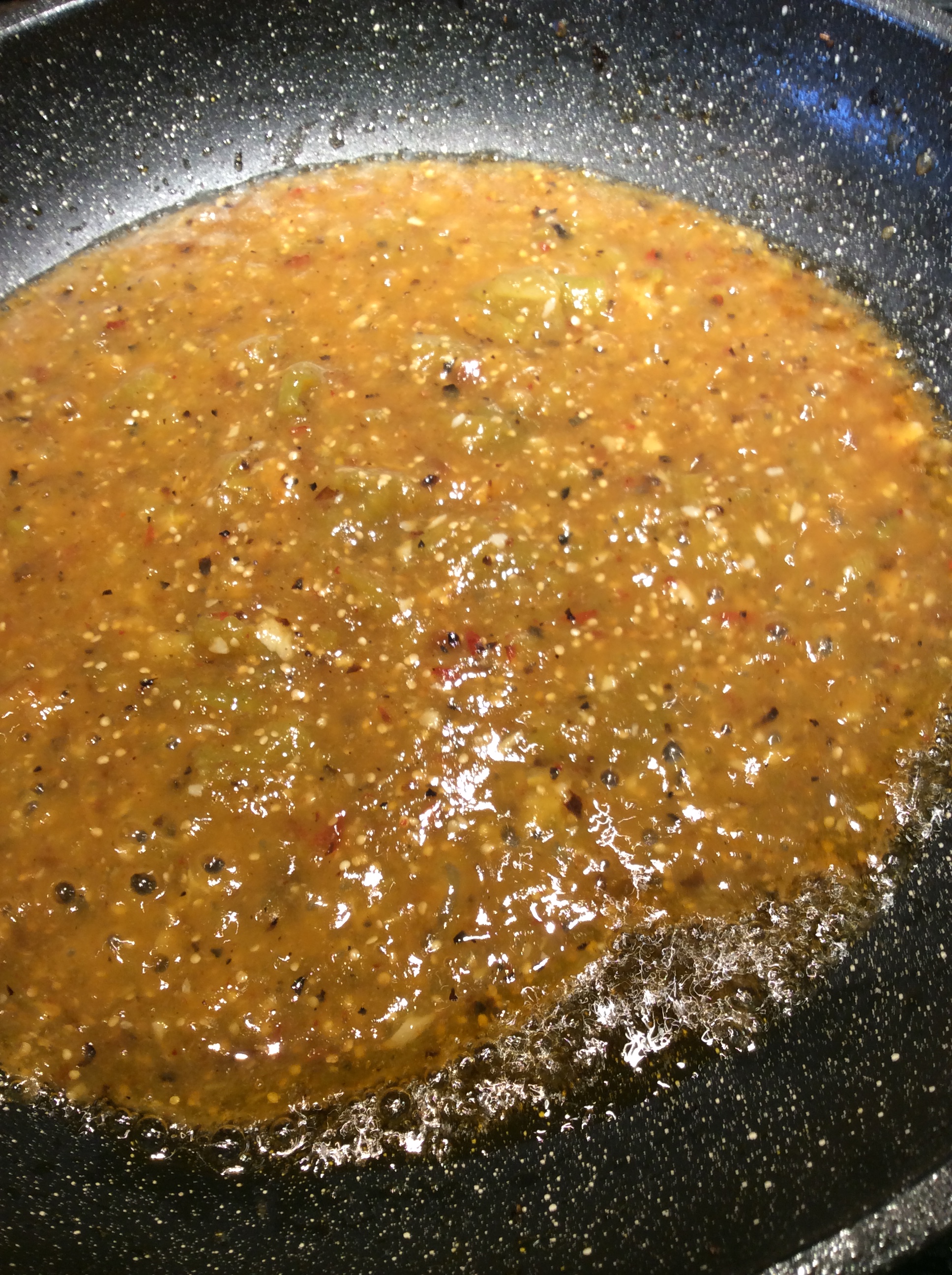
Now, I add the quintessentially Mexican step of frying the salsa.  In my largest skillet I heat 2 tablespoons of chosen fat, in this case fat from my homemade bacon. When the fat is hot, pour in the pureed salsa. It should sizzle furiously.  Fry it over high heat for a couple of minutes, until it has thickened to the degree that you want.  Salt to taste, and it is ready to use. The frying step smooths and blends the flavors in a delicious way. It’s good hot on grilled or smoked meat, gratineed with cheese, room temp with chips, or any way you like to eat salsa. I especially like the tangy-smoky flavor on grilled vegetables or mixed into cooked greens just before serving, or on top of them with a good sprinkling of Cotija or queso fresco. At the top of the page you see my lunch today, a little piece of leftover steak sliced and broiled with salsa and smoked cheddar on top, a fitting reward for the very minimal labor of making the salsa.

Incidentally, in the past I have grown several different kinds of tomatillos including the small purple ones that are supposed to have a more pronounced flavor, and at least under my growing conditions they all tasted pretty much the same. The small ones  are more tedious to pick and involve a great deal more labor in preparation per unit of finished salsa, and so I grow the biggest ones I can find.

Ricotta, the Easiest Cheese

image

One day when I have loads of leisure and energy, I plan  to get really serious about cheesemaking.   However, if you have a dairy animal or any other source of good milk, there are times when you have milk on hand but no spare time to do anything fancy with it. On those occasions, make ricotta  right away while your milk is fresh. All you need is milk, a large stainless steel pot, a stirring spoon, a strainer, fine cheesecloth, and lemon juice or vinegar. Any child old enough to use the stove at all can make ricotta with a little supervision. Determine approximately how much milk you have and put it in the pot over medium-high heat.  Milk scorches easily, and it should be stirred frequently so that it doesn’t burn on the bottom of the pot.  As soon as the milk foams and is coming to a boil, remove it from the heat and add 2 tablespoons of lemon juice or vinegar per quart of milk.  I don’t recommend cider vinegar or other strong flavored vinegars, and although I prefer lemon juice, I sometimes use rice vinegar, which does not give any off flavor to the cheese.  Stir the acid in and let the pot sit for 5 to 10 minutes. Meanwhile, line the strainer with a few layers of cheesecloth and set it over a bowl it can drain  into, or in the sink, and when the milk in the pot has definitely separated,  pour gently into the cheesecloth lined strainer. Let drain a few hours. Squeeze it a bit in the cheesecloth to get excess whey out,  salt if desired, chill, and eat.  The only reason for the milk not separating is that it wasn’t heated hot enough. If this should happen, heat again, stirring continually, until it separates. But that should not happen if you brought it to a boil in the first place.

The whey is useful and still contains a lot of nutrients.  It would be a shame to waste it. I feed it to my chickens, and they enjoy it.

When I mention cheesecloth I am talking about the real thing, specifically marketed for cheesemaking, and you can get it at New England Cheesemaking Supply along with a variety of other entrancing supplies and gadgets.

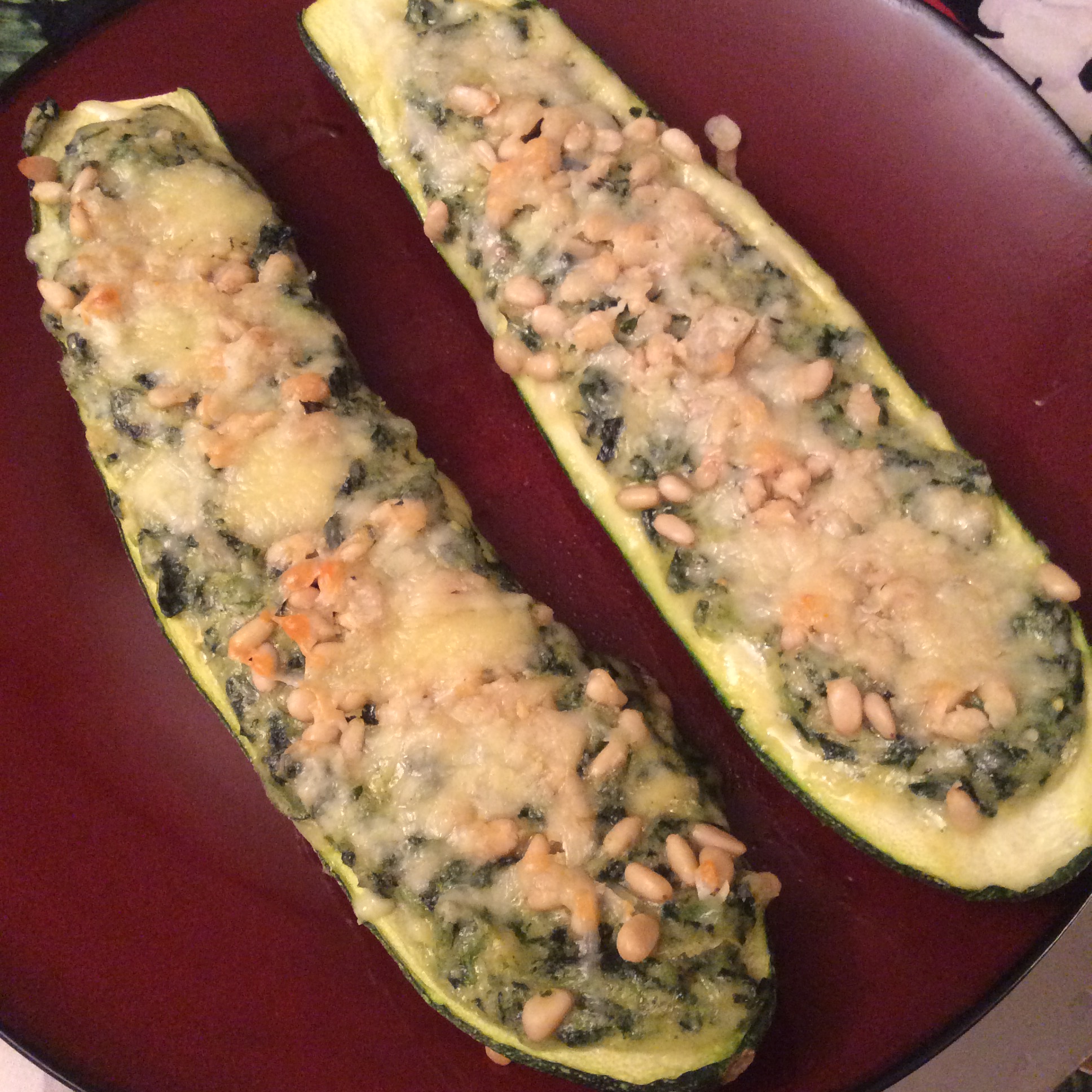
Besides just eating the ricotta itself with herbs stirred in, or sweetened and topped with fruit, it makes a good basis for a lot of other delicious meals.  I especially like it as a fill-in for stuffed vegetables. To make the zucchini above, get some good sized zucchini about 10 inches long. Cut them in half and hollow them out into boats.  Sprinkle very liberally with salt and put them in a bowl to drain for at least half an hour. This step is important. Meanwhile, preheat the oven to 450.  When ready to cook the zucchini, dry them off thoroughly with a kitchen towel. Rub with a little olive oil on the inside, put on a parchment lined baking sheet, and put them in the oven until they are fairly tender, which is about 25 minutes for me.

Meanwhile make the filling. Blanch about 2 quarts loosely packed of mixed greens; I used amaranth and lambsquarters. Drain and press the greens dry. Chop them thoroughly.  Chop one onion and two cloves of garlic and sauté them in a quarter cup of olive oil until they are thoroughly cooked but not colored very much. Stir in the chopped greens, and cook all together at least 10 minutes.  Turn the greens mixture into a bowl and mix in a heaping cup of goat ricotta (or any well-drained ricotta) and a cup of grated Parmesan cheese  or crumbled feta. Toss in a handful of chopped herbs. I used about 2 tablespoons of sweet marjoram, a scant tablespoon of winter savory, and a heaping teaspoon of fresh thyme.  Now start tasting the mixture and add salt until you feel the seasoning is perfect.  I like to add a good squeeze of fresh lemon juice at this point as well. Add more herbs if they seem indicated. Once you have the seasoning the way you want it, mix in two raw egg yolks. Pile the mixture  into the cooked zucchini canoes, top with pinenuts and more grated Parmesan, and bake at 400 until they are thoroughly done and the top is just starting to brown.  I like to serve them cooled off a bit, drizzled with a bit of extremely good olive oil.

image