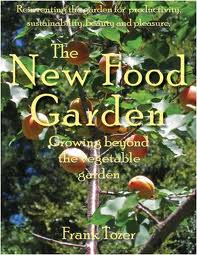
The New Food Garden is the newest volume by Frank Tozer, an author I admire for his complete and knowledgable gardening books that don’t seem to get the attention that they deserve. This book is about how to create an integrated property producing vegetables, fruit, and pleasure. He uses permaculture principles but doesn’t get dogmatic about it. There are good sections on garden design, fruit trees and trees generally, “hard drive” infrastructure garden stuff such as paths, buildings, and greenhouses, and lots of information about outdoor living areas that assumes you will want to live in and enjoy your garden as well as harvest food from it. There are brief but interesting sections on a variety of subjects that give you a good framework for more detailed reading, such as fencing, water features, and use of human urine and humanure. It doesn’t include much info on growing specific vegetables, because he’s already written an entire book about that (and a very good one, by the way.)
This and Mini Farming are my favorites of the scads of new gardening books that I’ve looked over this winter. What’s the difference between them? MIni Farming emphasizes very precise soil amendment techniques and concentrates on maximizing returns in small spaces. Tozer takes a more relaxed approach in which compost, mulch, and other organic techniques are used, parts of the property are used as living areas rather than producing a food return, and fertility builds at nature’s pace. Please also note that Mini Farming has very detailed info on integrating chickens into the small layout for meat and eggs, while Tozer is a vegetarian and includes no information on food use of animals. The best solution is to get both. They won’t go unused.
Best tip and best quote: “You probably never realized that you are a walking plant fertilizer factory and that every day you are literally pissing away money.”
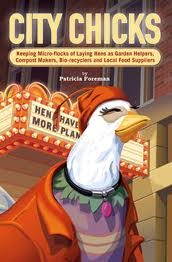
City chicks is a very good collection of information for the chicken owner who plans to have a micro-flock of laying hens. There is lots of information about every aspect of keeping a few layers, clearly organized so that beginners can find what they need. If you plan to have a dozen hens or fewer and don’t plan to produce any meat, I would recommend this book above most others. Do be aware that there is zero information about butchering and meat production, so if you plan to replace your hens every couple of years to keep production up, you’ll need another source of information about how to get them into the stockpot.
Best tip: Use plastic laying mats inside the nesting boxes. These are like stiff artificial turf, and droppings don’t stick to them. They can be hosed clean. They keep the eggs clean and dry. The hens can’t scratch them out of the laying boxes as they will with other types of bedding. This matters, because they then lay on the bare floor of the box and the eggs can be cracked, which renders them useless and introduces the hens to egg-eating. They cost about $4 each. I got mine from Murray McMurray, but other hatcheries have them too.
Archive for the ‘Books worth reading’ Category
29 Jan
My Bookshelf: Efficient Gardening and the foraging gourmet
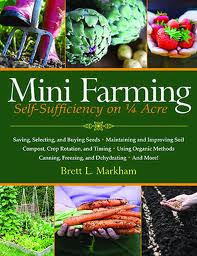
Mini Farming is about producing as much food as possible from as little space as possible. It covers a number of ways to produce food, including vegetable and fruit growing and raising chickens for eggs and meat. It goes into great detail about soil amendment so that your plants will grow. You may not want to garden in this precise fashion, and I’m with you there, since my own gardening methods are more slapdash. But it’s good to know some rules before you start breaking them. It is a very practical book, offering an astounding amount of information per dollar. The author has clearly done these things himself; sadly, this is not always the case in homesteading books. He is careful to tell you what you need to know. A pet peeve of mine is the number of homesteading books that purport to teach you how to raise animals for meat, then when the time comes to harvest the meat they go coy and soft-focus and say “Be sure to have an expert show you how to do the killing.” What nonsense. You may not have anyone available to demonstrate, or a self-elected “expert” may do such an awful job that you think you’ll never eat meat again. A good book can describe the process and ready you for what you will encounter every step of the way. This book tells you exactly how to kill and butcher a chicken as quickly and humanely as possible. If you are going to raise meat birds, read it even if you plan to have a more experienced person help you, so that you understand beforehand what’s going to happen. This is a great value and a good book for the serious “yard farmer.”
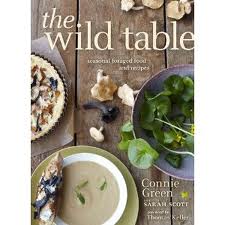
I do not ever accept free review copies of the books that appear on my blog. I buy them at my local independent bookstore, paying the price that you are likely to pay. Books like this make me realize why I set that policy. This is a very beautiful book, and the recipes are top-notch. But if you’re buying it because you are interested in wild foods, you need to know a few things:
1. A lot of the wild foods described are mushrooms, which many foragers prefer to avoid.
2. This is not a book about how to forage. You’ll need a couple of good foraging instructional books for that.
3. If you’re one of my local Albuquerque readers, a lot of the foods described don’t grow wild around here.
In short, this is a great coffee-table book and a fine high-end cookbook, and if you love to spend time in the kitchen trying to find the greatest height to which a foraged food can be brought, you’ll love this book. If you love to gaze upon exquisite (and expensive) glossy photos of resplendent food, you’ll love this book. I love this book. But $40 is a price that makes me stop and think hard about value for money, and I can’t honestly say that it represents great value for money. If I had gotten it free, I might unconsciously gloss over that part. I’m glad I bought it, but if your goal is to learn to forage, this is not the book for you.
28 Nov
Books Worth Reading: John Kallas on Edible Wild Plants
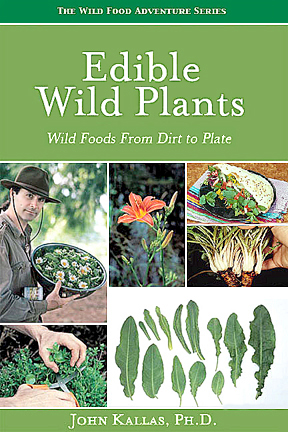
The holiday weekend was a great time to read in a warm spot, which reminded me that I should be sharing more of the books that I think are really helpful. I should add that I don’t accept free review copies; whenever I review a book, I paid the same price for it that you will. I think that this is essential to an accurate judgment of the value-for-money aspect of the books that I recommend.
With that in mind, John Kallas’s Edible Wild Plants: Wild Foods from Dirt to Plate is a very good value if you want to get started in foraging. I get a lot of inquiries about wild foods, and this is a book that I can recommend without reservation to any beginner; if you read and pay attention, you will learn to collect a number of common plants safely and prepare them well. Kallas concentrates on leafy greens which are found in most parts of the country, and he organizes them by flavor category in addition to giving accurate botanical and ID information. This is a lot more useful and practical than you might realize if you aren’t accustomed to foraging for greens. A well-balanced dish of greens needs a range of flavor notes, as well as a base of mild greens to build upon, and as you learn the plants from Kallas you will learn the notable aspects of their flavors. In my opinion, nearly any experienced forager could pick up a tip or two here, about preparation if not about identification.
Only greens and shoots are found in this book. If this seems too limited, keep in mind that most of us aren’t going to spend the time needed to forage and prepare wild staples, at least not most of the time. It’s romantic to read about gathering wild rice or arrowroot, or to imagine spending a clear autumn day gathering and storing fruit or nuts, but the wild foods that are widely available throughout much of the country for much of the year and that you can forage in a few minutes on your way home from work are mostly greens and shoots. Besides, if most of us were to make one change in our diets and maintain it, the addition of more green veggies would be a good one to pick. If foraging gets you to eat more leafy greens, this is a good thing.
If, like me, you’re a Kindle addict, this book is available on Kindle. I use the Kindle app on my Ipad so that I can see the photos in color. I daydream about eventually having a large collection of good foraging books on one e-device that I can carry around in my backpack, but unfortunately most of the wild-foods books available for Kindle are not of high quality. This one is.
DR. Kallas’s website can be found here if you’d like to order the book directly from him. You can also read his reviews of foraging books, and his thoughtful comments are invaluable when deciding what books you want to add to your collection.
23 Nov
Books Worth Reading: The Resilient Gardener
There are a lot of gardening books out there, and a lot of books on urban/suburban homesteading and on self-sufficiency. Many of them draw heavily from one another or from older books rather than from actual experience, but every now and then I come across a gardening book that I’m eager to share with others. Carol Deppe’s new book, The Resilient Gardener, is clearly based on years (decades?) of personal hands-on experience and is a must-read for anyone interested in the issue of personal food security. It is not a general gardening how-to book. Ms. Deppe discusses the best ways to improve your own food security by producing your own staple crops, and what makes a staple suitable for home food production with no unusual harvesting, threshing, or milling equipment. This isn’t one of the obnoxious-survivalist manifestos about how to be a country and a law unto yourself. It’s a sensible discussion of how ordinary people can direct their efforts to make themselves better equipped to endure the hiccups that life throws at us, whether environmental or health-related. As I read it, I found myself thinking about the spreading problems in my native Louisiana after Hurricane Katrina devastated New Orleans. Nearby cities like Baton Rouge weren’t hard hit by the storm. But Baton Rouge would nearly double in size in a week as evacuees poured in, grocery stores there would be nearly emptied of staple foods and anything fresh, streets would be filled with excess traffic and often impassable, and water and sewer systems would be strained. People with prudent habits were better equipped to help themselves and others through a difficult time.
No book about someone else’s needs and choices will ever be completely applicable to your own situation. Ms. Deppe includes a section on her own nutritional needs and decisions that can best be considered idiosyncratic. But then, as a doctor I believe that everyone’s needs are to a degree idiosyncratic, i.e. unique to themselves. Some basics apply to nearly everyone, but there’s a lot of individual variation. Her choices may have no applicability to you or me. They are, however, an encouragement to think carefully about our own needs and start doing more of what works for us.
I have no desire to be completely food-independent, even if such a thing were possible. But I do get great pleasure from contemplating the winter squash, potatoes, and sweet potatoes that came out of my own soil and will help feed me through the winter, and on winter evenings by the stove I’ll be studying Ms. Deppe’s ideas and planning how to be a more prudent member of my community next year.
 My urban homestead