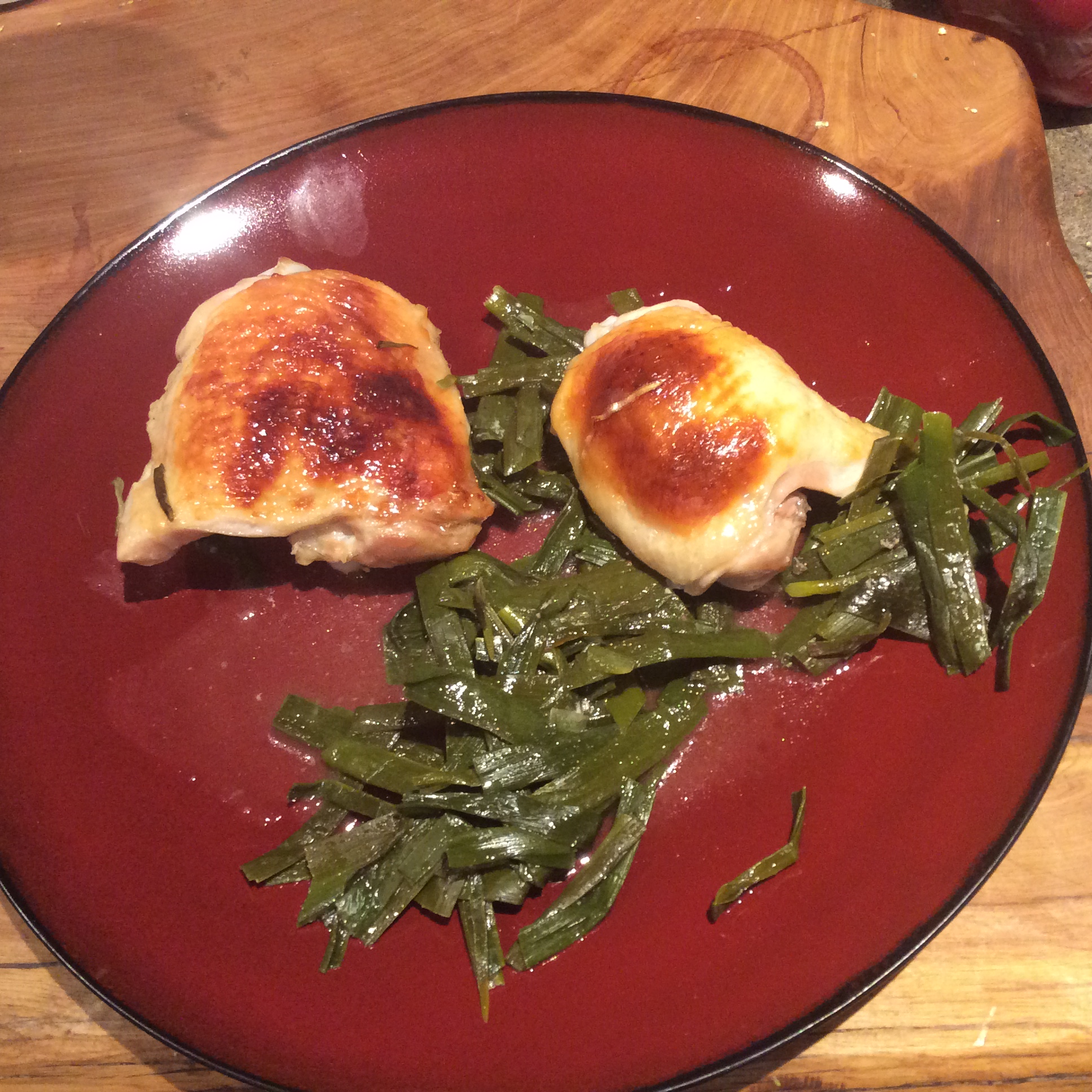
My patient readers might be wondering by now why I have so damn many posts this year on the uses of green or immature garlic. The reason is simple: last summer I ordered my garlic sets as usual, forgot about it, and a few weeks later placed the same order again. When a LOT of garlic sets arrived in fall I decided to treat this as serendipity and planted them all, and the result is that I have hundreds to thousands of stalks of green garlic right at the moment. Since I have become interested in the health benefits of alliums, especially the green parts, I am thoroughly enjoying experimenting with ways to use them. Right now they are just beginning to send up scapes, and the stalk of the plant is hard and difficult to use well. But when I pull a few plants for the newly bulging bulbs, I find that the leaves are still green, and I decided to try using them as a leafy green vegetable. I washed a bunch of them, cut them in 1 inch sections crosswise, and blanched them in boiling water for two minutes. This initial blanching seemed to tenderize them a lot, but if you insist, try cooking them without pre-blanching and see how it goes. Then I slowly roasted in butter with a little salt and rich chicken broth for about 20 minutes, taking care that they did not dry out. I roasted them only because I was also roasting some chicken, and it would be easier to slowly sauté them on the stovetop. Make sure that there is enough broth that no part of the leaves dries out. Kept a little moist, they develop a lovely plush texture. This turned out to be a delicious vegetable, full of flavor but not excessively garlicky. The only thing I’m going to do differently in the future is cut them in shorter sections, about half an inch, since there is a suggestion of fiber in the mouth when cut to the longer length. I did not identify any actual fibers of the nasty kind that stick between the teeth, but I just think the mouthfeel would be better if cut shorter.
I am increasingly delighted to find that every part of the garlic plant is edible, versatile, and delicious, a true nose to tail vegetable with a boatload of health benefits besides. Right now garlic, shallots, onions, and multiplier onions occupy about a third of my total available garden space, and I think this is how it should be and will do the same again next year.
Incidentally, once the emerging scape begins to show at the top of the plant, the stalk is not worth trying to use except as a flavoring for broth, in my opinion. It is just too fibrous and tough. But soon the scapes will be elongating and they are eminently edible when young, so a couple of weeks of patience will provide you with a whole new vegetable.
Archive for 2016
3 May
Garlic Leaves
2 May
An Assortment of Shoots
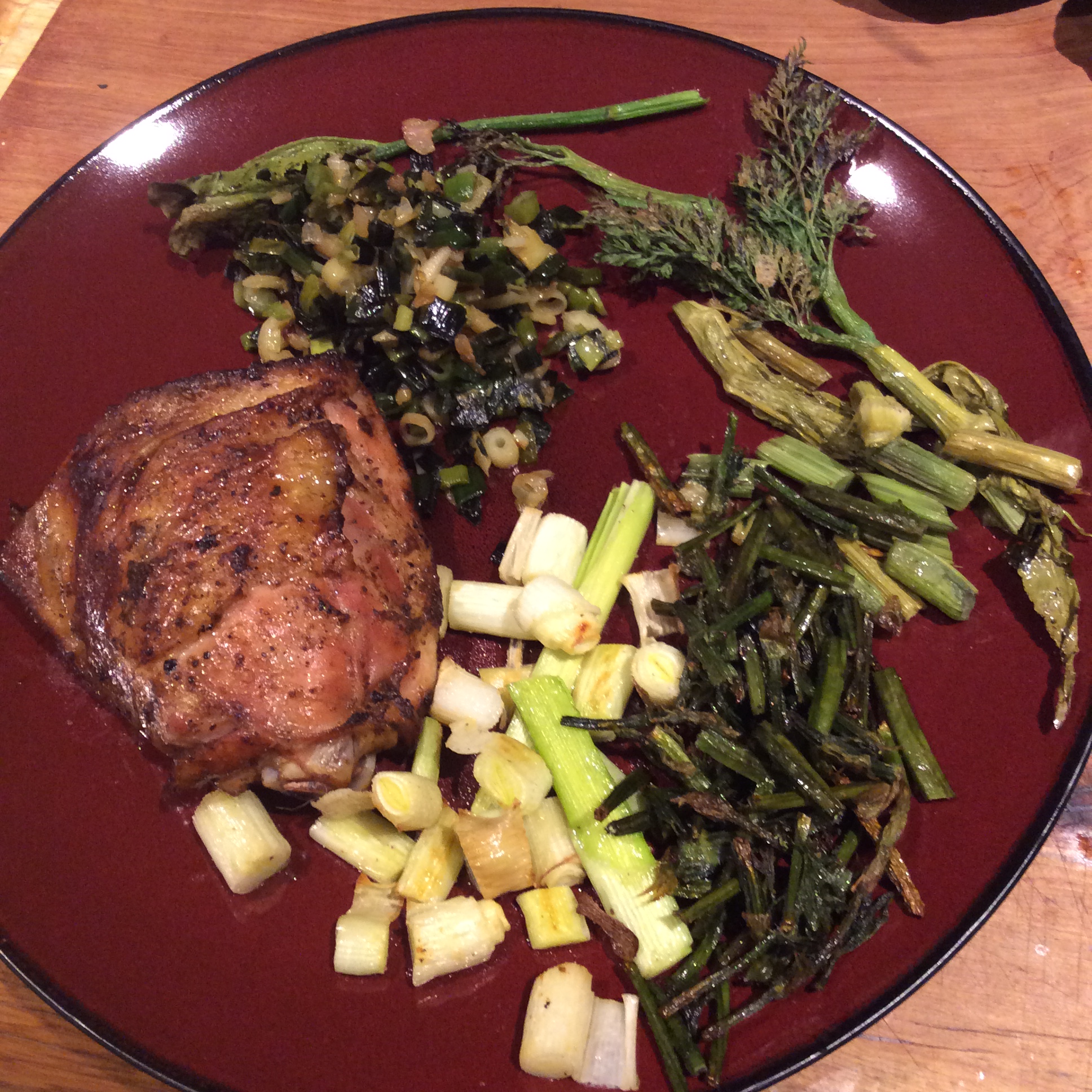
Last night I decided to try a grand assortment of the shoots found on or near my property right now. All would be oven-roasted in olive oil and salt at 500 degrees except for the garlic shoots, which are getting a bit tough this time of year as they elongate toward making scapes and need gentle stewing in olive oil over low heat for a long time, 25-30 minutes. They were cooked sparately on the stovetop.
The materials that I had to work with included a good-sized bundle of hops shoots, which I have shown many times before, and all of the following:
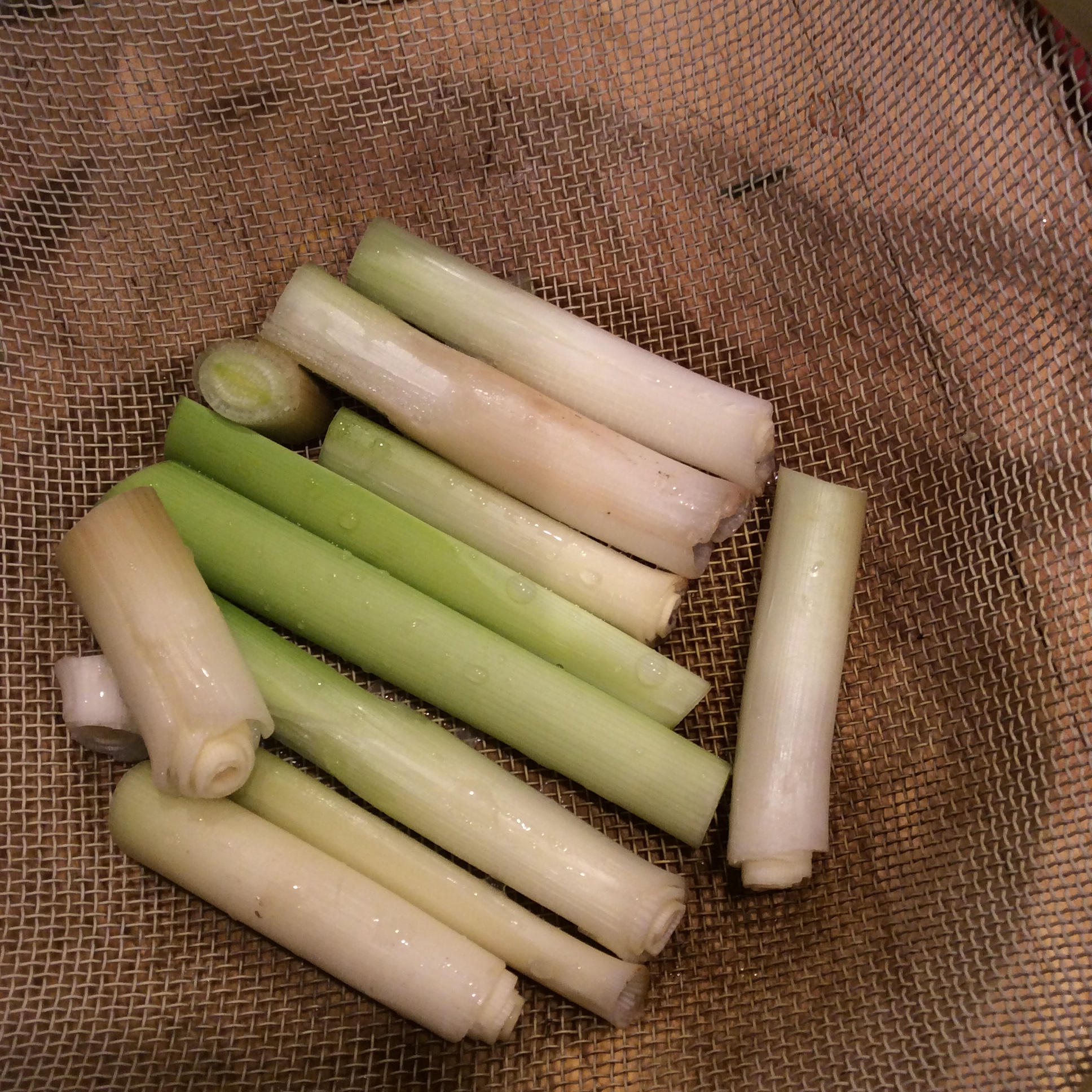
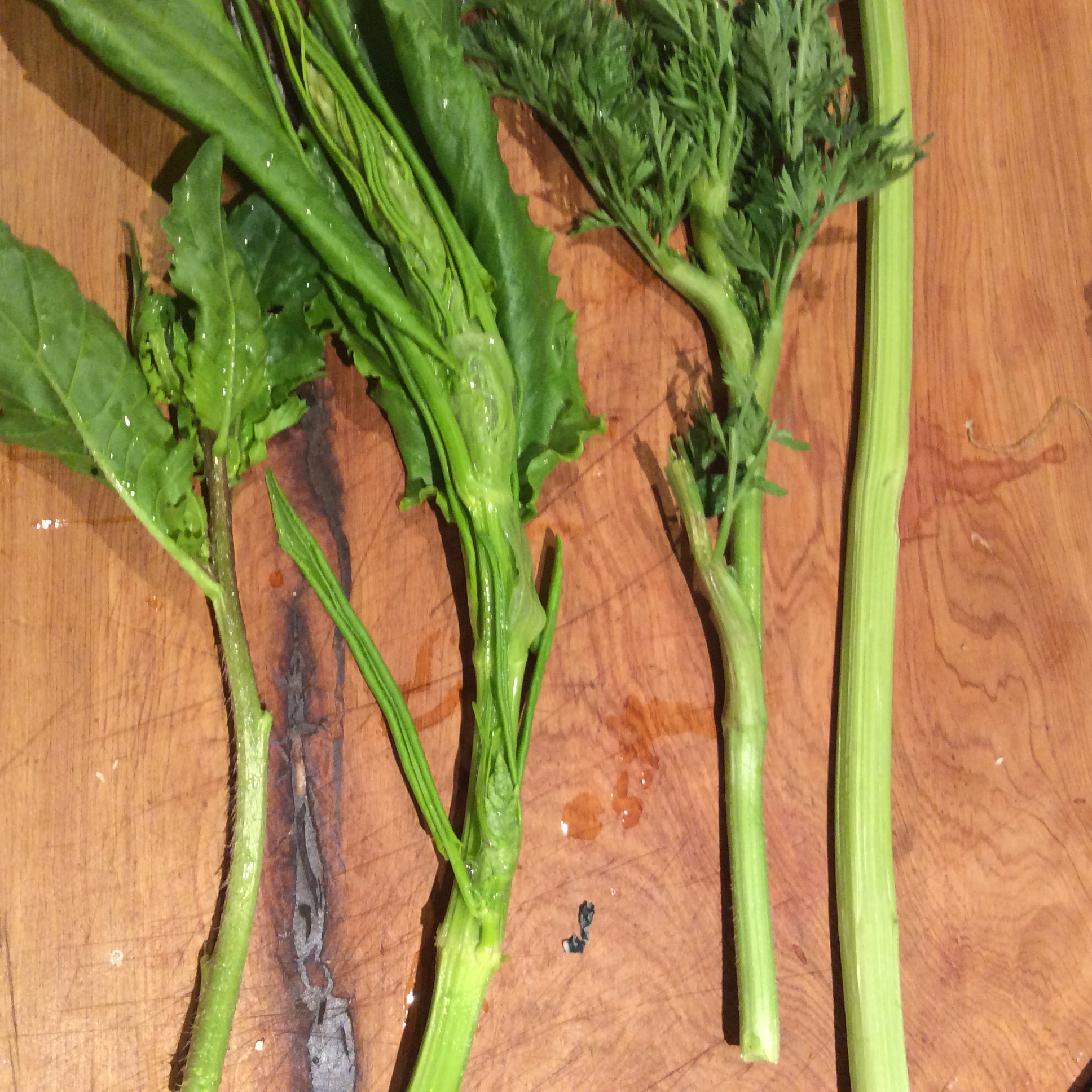
Tender cattail shoots are shown in the upper picture. The one below shows, from left to right:
- Annual arugula shoot with buds only just beginning to show.
- Dock shoots harvested before any flower buds show.
- Carrot shoots from some roots that I didn’t get around to harvesting.
- Stalk of a sunflower picked at about 18″ tall and the very fibrous outer layer carefully peeled off.
They were tossed separately in olive oil and a little salt and kept in separate piles on the baking parchment so that we could discern the flavors accurately. All but the arugula were cut in sections an inch long or less to mitigate possible stringiness. I added a couple of chard stems cut in 1/4″ cross sections, after I used the leaves for something else.
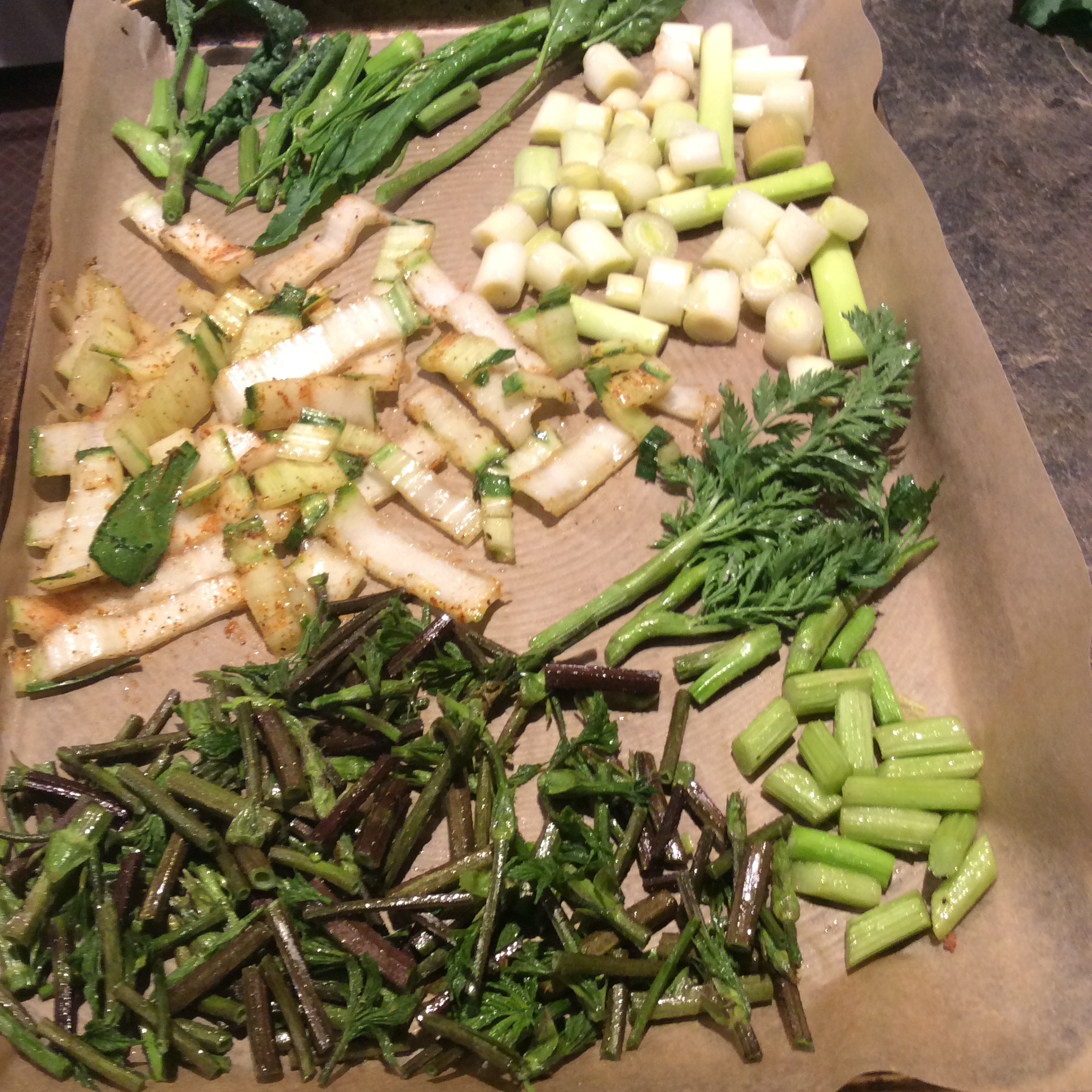
Roast away in a preheated 500 degree oven, checking frequently and removing each at its preferred stage of doneness, i.e. when it looks roasted but not burned.
Consensus:
I have been writing about green garlic all season, so no need to say anything more except that, as always, they were delicious.
I love cattail shoots but my husband finds them only passable. Probably for solitary dinners in the future.
Love hops shoots with their feral, mildly bitter, “unimproved” flavor. Love them.
Sunflower stalks have a pleasant enough, rather innocuous flavor and nice texture when carefully peeled. There are those on the Internet who claim that they just pluck them and eat them. These people have probably never been near a sunflower. More on this later.
I have not yet found any way that I like chard stems except roasted and ground into a fairly good baba ghanoush. Eaten alone, there is a touch of dirt in the flavor that doesn’t do it for me.
Dock shoots were amazingly good, with a soft center tasting of lemon with a strain of bitterness. Be sure to cut into sections before cooking to eliminate the stringy factor, and pull large leaves off. Smaller ones can be left in place and are tasty.
The arugula shoot was very slender but a bit stringy anyway. They, too, need to be cut into sections. Delicious though, although they are small and it would be tedious to pick enough for a meal.
Carrot shoots were the real surprise. When roasted in sections they were tender, sweet, and full-flavored with a touch of the terpene scent that makes carrot foliage smell aromatic and carroty. The remaining leaves got brown and crisp during roasting and added textural interest. I liked them so much that I am going to leave the rest of the row of woody second-year carrots in place until they produce shoots. Even when the roots are at this advanced stage my goat loves them, so the roots will not be wasted.
Initially I wanted to taste each type of shoot individually, but I will make a grand mixture in the near future by sorting sections roughly according to size, i.e. thin, medium, or thick. Then I’ll pan-fry them in olive oil in my biggest skillet, putting thick ones in first, then two minutes later mediums, followed by thin bits in another two minutes, then cook until done. Yum.
Look around you and see what’s producing shoots right now. If (and only if) you’re certain that the foliage of that plant is edible, try them out in hot olive oil. I enjoyed goji berry shoots a little earlier in the season, and will be trying wild lettuce and sow thistle within a week or two. Some grapevines produce delicious shoots, although some ( most notably my Concord vine) have so much papery fiber in the leaves and shoots that I consider them inedible; read more here.
1 May
Continual change
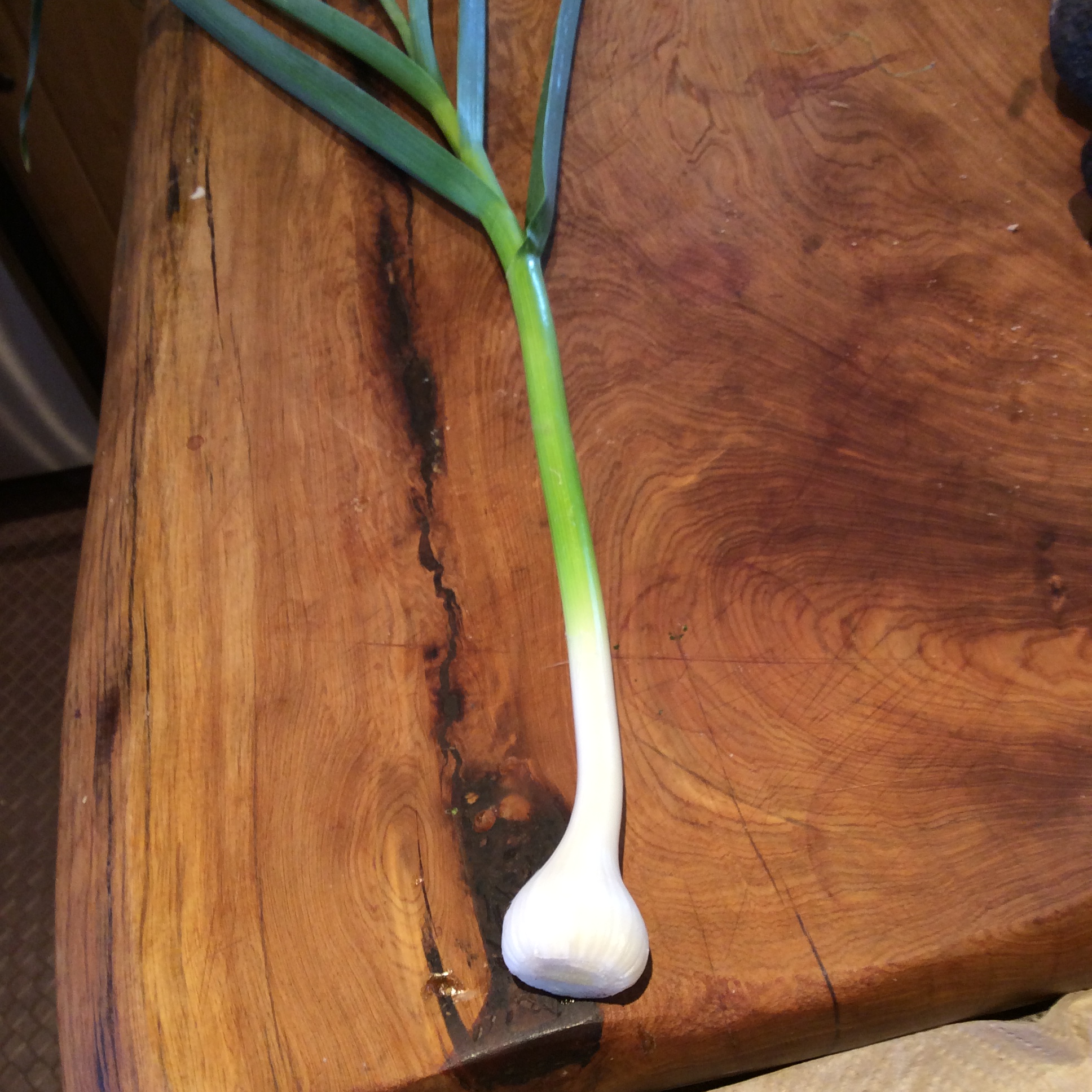
Everything not busy growing is busy decaying. In a garden, change is the constant. The produce that you have to work with is continually changing, and your technique has to adjust to it. Right now in my garden, for instance, the green garlic has begun to form bulbs and the stalk is elongating considerably, forming the scape inside. The tissue that will become the papery skin of the bulbs is still soft, and the entire plant is still usable as green garlic. In fact, that has a somewhat stronger taste of garlic then it did in earlier stages. Just be aware that you need to cut it in fine slices across, less than a quarter inch if possible, and sauté it longer in olive oil or butter and maybe a little water to help the leaves soften. At this stage I plan on 25-30 minutes over medium-low heat to let the leaves soften, sweeten, and develop flavor. If you want to try dehydrating it to use as a seasoning later, this is the perfect stage. Just slice it thinly, put it in your dehydrator until thoroughly dry, and then powder it for later use if desired.
Your other ingredients are in constant flux throughout the season too. Watch them, handle them, taste them, and see where you need to adjust your technique to suit their current maturity level.
26 Apr
Integrating Your Weeds I: lambs-quarters
I decided to reblog this post from last spring because this is the time to start thinking about utilizing your edible weeds, before you have hoed them all out. Lambsquarters, also called wild spinach, is one of the most accessible of wild greens, with a mild flavor that can be used in any spinach dish that you fancy. it grows everywhere and grows with lightning speed, and so you can get an excellent crop around your standard crops. Just be sure to harvest it at about six weeks so that the other crops in the bed can take over. If you are unsure how to identify it, get “Edible Wild Plants: Wild Foods from Dirt to Plate” by John Kallas, and no doubt you will learn to identify several wild greens in your immediate area, and learn delightful ways to prepare and cook them. Just keep in mind that lambsquarters is more nutritious than many of the things you are planting on purpose.


I’ve written a lot at various times about the Holy Trinity of edible weeds: lambs-quarters, amaranth, and purslane. In this post I don’t plan to say anything much about harvesting and cooking lambs-quarters, Chenopodium album, since I’ve said that already and the short version is “harvest them young, collect as little stem as possible, and use them like any other mild-flavored leafy green.” Personally I dislike the texture and mouthfeel of the raw leaves intensely, and only like them cooked, but others see it differently. This is their great season; after midsummer they are very eager to make seeds and are no longer very usable as a leafy green.
The focus today is on how to have them in your garden without losing everything else. They are highly competitive. First, don’t just let a nice big plant go to seed in your garden, unless you have a lot more space…
View original post 425 more words
 My urban homestead