Archive for the ‘farmers market’ Category

The Very Composed Salad, and notes on vinaigrette


For the most part I make simple salads when I make salads at all, relying on top-quality greens and a well-made vinaigrette for effect. But the salade composee, or composed salad, will always be dear to me because I can remember when Salade Nicoise was the very height of Manhattan foodie chic and Nocoise olives were hard to find. The urge to make a greater spectacle of my salads comes over me in midwinter, when short days and long nights give me more time to fiddle. In my opinion, this salad is one worth fiddling with.
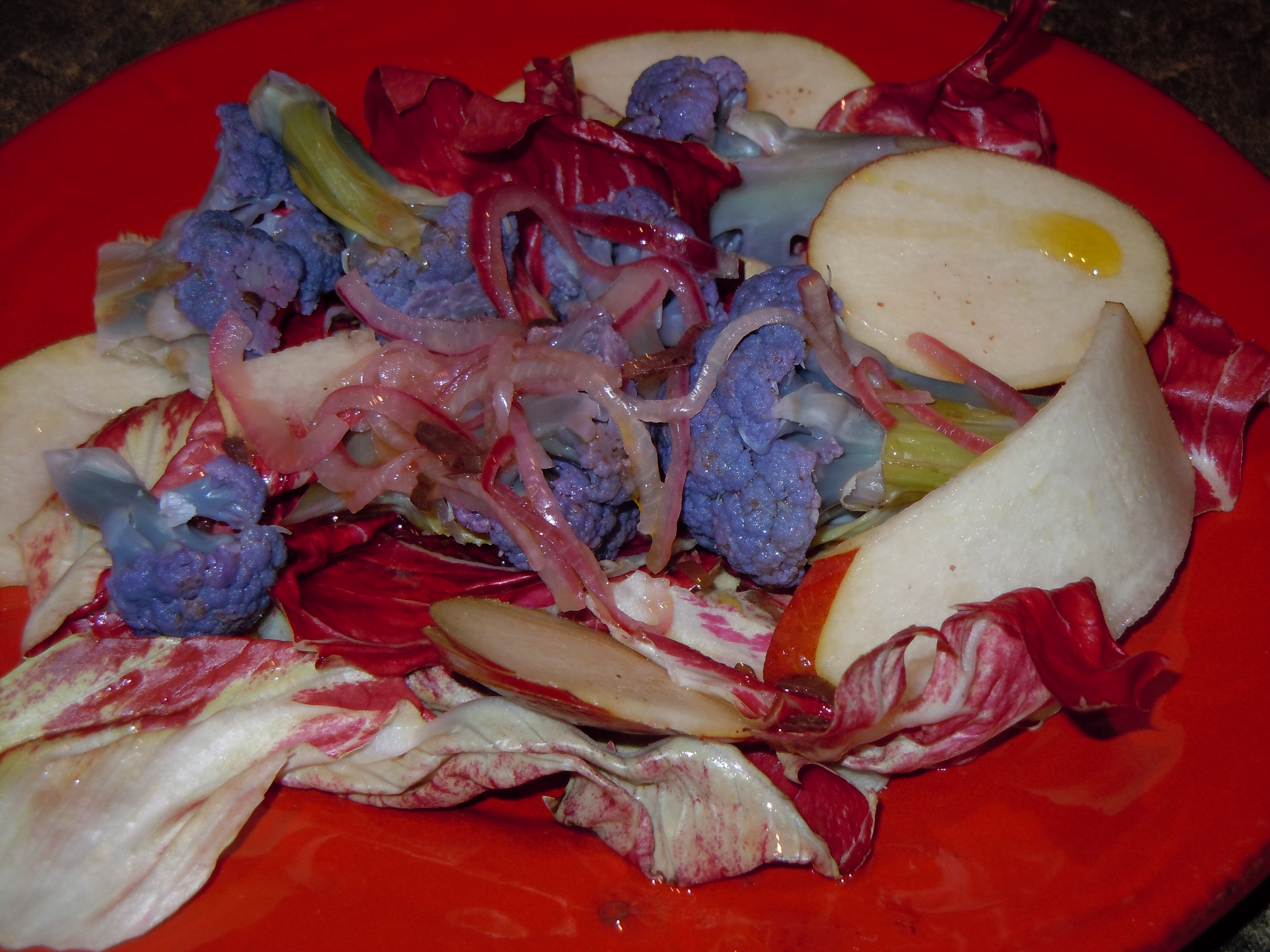
For two people, I started with a small red onion, half a head of purple cauliflower (probably 5-6 ounces, or a heaping cup of trimmed florets) , a very firm red-skinned pear, and a small head of castelfranco raddicchio from the garden. A small head of round or Treviso raddicchio from the store would work just as well. I had on hand a third of a cup or so of red-wine-vinegar vinaigrette (see notes below) and a bottle of truly superb olive oil.
First, heat 1.5 cups of water to boiling, adding a tablespoon of salt and the juice of half a lemon. The lemon juice is essential to keep the red/purple veggies from turning an awful muddy grey. Trim the cauliflower florets neatly, slicing the stems where needed so that all pieces are about the same size. Drop them in the boiling acidulated water, cover tightly and turn the heat down to medium, and poach at a fast simmer for eight minutes. While it cooks,slice half of the onion very finely (save the other half for something else) and put them in a bowl. After eight minutes, drain the cauliflower, pouring its poaching liquid into the bowl with the onion slices. Run cold water over the cauliflower pieces to chill them, and set them aside to drain thoroughly. Stir the onions around a little, then let sit for half an hour. Drain the onion, press out excess moisture but don’t rinse, squeeze on a few more drops of fresh lemon juice, work them through the soft onion strands with your fingers, and set aside. Wash the radicchio thoroughly and spin it dry or whirl it around in a kitchen towel (outdoors, please) until reasonably dry. Put it back in the refrigerator. Rinse the lemon juice off the onion slices and squeeze them dry in a towel. You can do all this up to two hours before dinner. Everything should be at room temperature except the radicchio, which is used cold from the refrigerator.

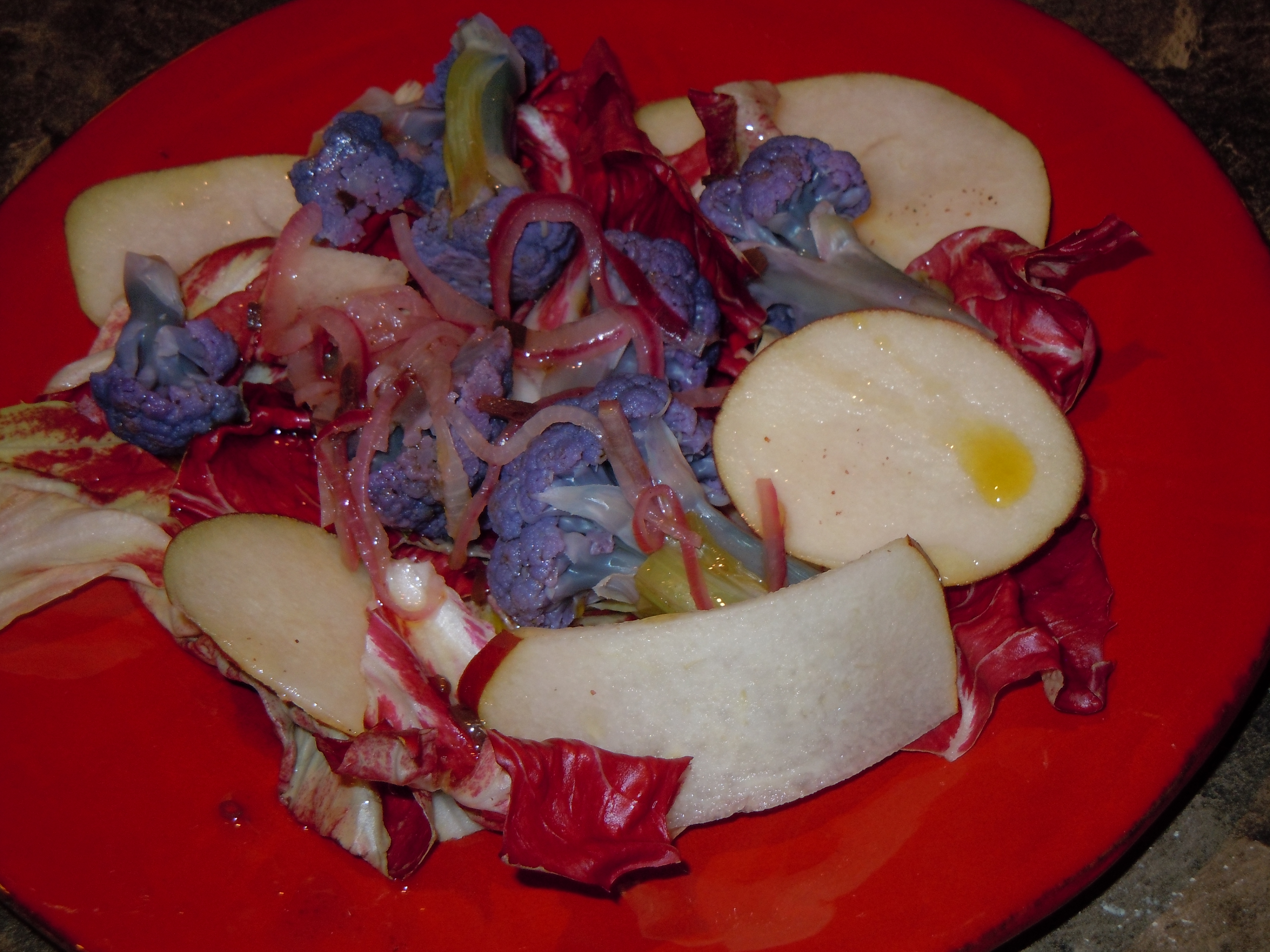
When ready to eat, use a very sharp knife to cut thin slices off the pear. Choose your salad plates, preferably red ones, but black looks equally good and very dramatic. White will do. Arrange some torn radicchio leaves artistically on two plates. Toss the thin pear slices around over them. Pile half the cauliflower florets on each plate, keeping them toward the center so that the radicchio and pear show clearly. Place some onion slices (which will now be soft and magenta in color) over and around the salad. Drizzle with a tablespoon or two of the vinaigrette, and then drizzle lightly with your very best olive oil, taking care to get some gleaming golden drops on the pear slices. Grind just a touch of pepper over the top. Serve.
Purple cauliflower is widely available in this season. Check your favorite food co-op if it has a good produce section, or try Whole Foods. If you can’t find any, the yellow Cheddar cauliflower will give a different but still nice effect. A light scattering of toasted pine nuts or walnuts would be a great addition to this very autumnal salad. Don’t be tempted to throw in any cheese, no matter how fine a cheese it is. The pure flavors will get muddy, and the result will be undistinguished. Half the art of the composed salad is being able to stop before you ruin it with over-elaboration.

I have strong, even violent, opinions about vinaigrette. Each vinaigrette has to be made to suit the materials it is meant to enhance. In my opinion, this is the right one for this salad. Nothing that came premixed in a bottle is going to work. I have noted the steps that I consider especially important.

Opinionated Red Wine Vinaigrette

Start with really good olive oil and the best red wine vinegar you can lay hands on. I make my own wine vinegar, so I can’t help you with brands, but it’s essential that it be aged in oak and have a full flavor. The steps fit into general kitchen preparation, so you can do lots of other things while marinating the alliums.
Chop allium: 1 clove garlic chopped very finely, or one small shallot sliced finely, or half a small onion sliced finely. Put the prepared allium of your choice in a small bowl and add half a teaspoon of salt and 3 tablespoons of red wine vinegar. Stir around, and let sit at least 15 minutes. The “sit” is essential to get the right flavor. After this brief curing, add a teaspoon of fresh thyme leaves chopped and half a mashed anchovy fillet or a dash of colatura (my preference.) If you are vegan, or an irredeemable anchovy hater, you can substitute one or two pitted oil-cured olives thoroughly mashed in a mortar and pestle to give the meaty-umami undertone that helps tame bitter leaves like radicchio. Grind in fresh pepper, about 6 turns of the mill, and stir in half a cup of really good olive oil and a tablespoon of roasted walnut or roasted hazelnut oil. Taste and check for salt (remember, it should be on the salty side to season the veggies properly) That’s all there is to it. For other uses you may want to add a little Dijon mustard, vary the herb(s), use lemon juice instead of vinegar, or any of a million other variations, but this is the basic. The worst offenses that I taste in vinaigrettes are mediocre olive oil, bad wine vinegar, and a general excess in seasoning. No amount of herbs will make up for poor basic ingredients. I also dislike drippy, overdressed salads. As I see it, if you can’t taste the leaves and florets, why have them on the plate?
Since young adulthood I’ve cherished a story someone told me about seeing Alice Waters dining out in San Francisco; the eager voyeur insisted that she ate a large salad with her fingers, and then licked them. I have no idea whether it’s true, but if it is, more power to her. I’ll bet that was a good vinaigrette.
How to love Your Carrots


I’m doing a blog series for our local newspaper this month, but some readers had trouble accessing those posts, so I decided to put them on my own blog as well. Here’s the third one:
Eating seasonally is a pleasure for most of the year, and fall is a wonderful time to eat carrots. We all know how healthy carrots are, so I’ll skip over that part and concentrate on how delicious they are. When I cook carrots I make a lot, because they are wonderful for at-your-desk lunching the next day. Usually I retrieve my lunch from the refrigerator at my mid-morning brief break and eat it at room temperature at lunchtime, as long as no egg yolks, mayonnaise, or other extreme perishables are involved. If I plan to eat them at room temperature for lunch I use olive oil instead of butter, since animal fats congeal unattractively when they aren’t hot, but if you prefer to use butter, no problem. Just heat your carrots a little the next day, then carry them back to your desk and eat happily, with the slightly smug glow that comes of doing the right and healthy thing and getting your work done at the same time.

First, catch your carrots. Real carrots come in bunches with the tops on, and if the tops look withered, don’t bother with those carrots. Get some fresh ones instead. Your nearest growers’ market is a great place to shop for them. Here in Albuquerque you can find several colors, including yellow, the standard orange, red, and a glowing royal-purple. I love the purple ones, but any of these techniques can be used for any carrot.

I use the word “technique” with forethought, because it is basic technique that makes it quick and easy to cook and eat lots of vegetables. If you have to read a recipe in the kitchen as you work, you will eventually get fed up, but technique lives in your brain and makes it a snap to blanch, saute’, stir-fry, bake, boil, or grill any veggie that you care to eat. No precise measurements are needed. So here are a couple of basic techniques for carrots:

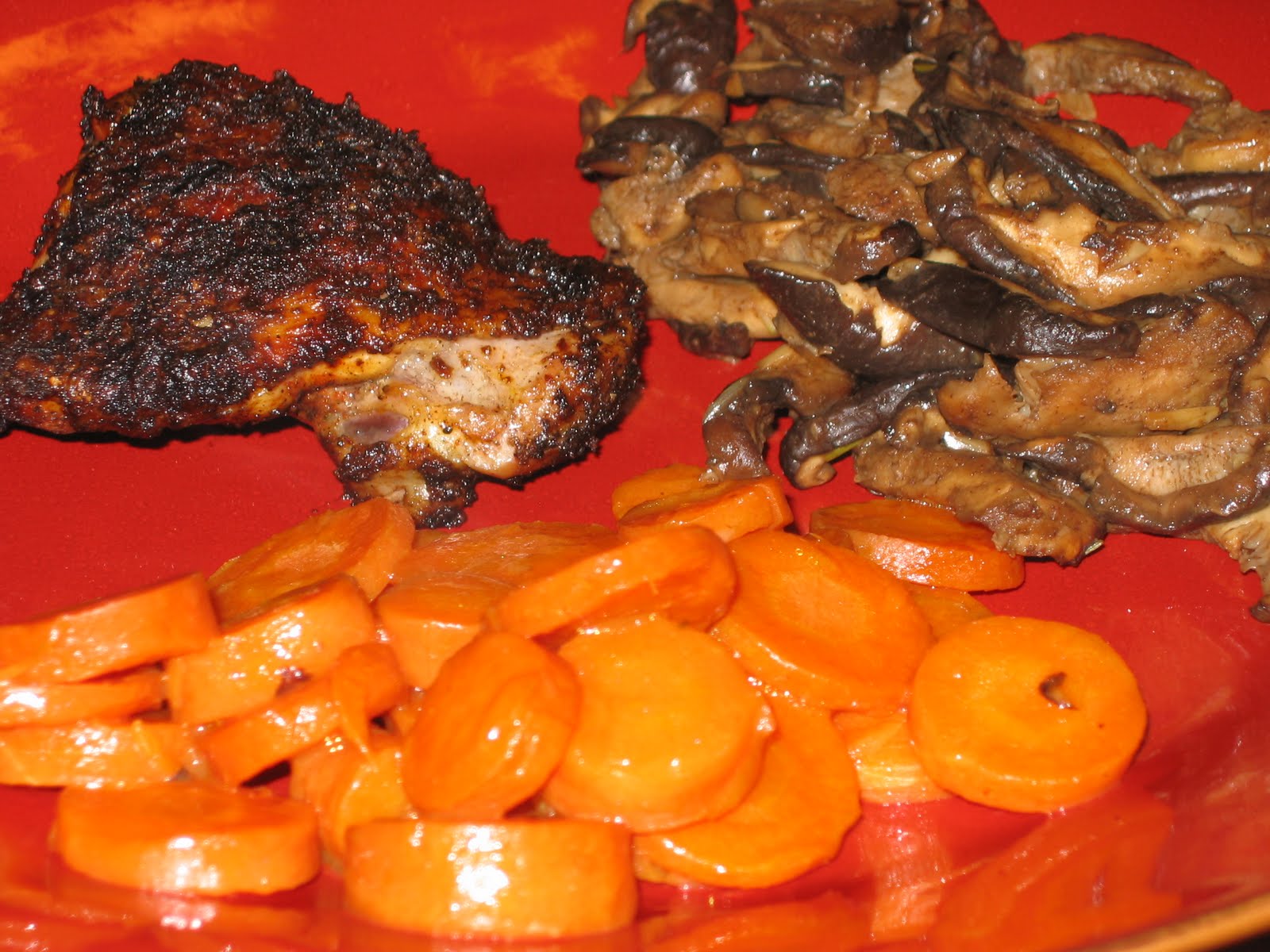
Blanch, then saute’: trim and scrub four large carrots or six smaller ones of any color. Peel if needed (usually I scrub well with a brush instead.) Slice into slices about a quarter inch thick. Fill a large saucepan with about 2 quarts of water, add 2 teaspoons of salt, bring to a boil, toss in the carrots, boil 5 minutes, and drain thoroughly. If you want to, you can hold the drained carrots at room temperature for 2-3 ours, making it easy to do some work ahead of time if needed. Melt two tablespoons of butter in a frying pan, or use olive oil if you prefer. Put in the carrots, 2-3 teaspoons of honey, salt to taste, and a grating of fresh nutmeg. Saute’ over medium heat until the carrots are done to your liking, and serve. The blanching makes sure that the carrots cook evenly, and the saute’ing brings out their flavor. You can vary this infinitely: add herbs in the saute’ stage; thyme or savory are especially good with carrots. Chop a clove of garlic or half a small onion and cook in the butter or oil until just cooked through before adding the carrots. Use a tablespoon of balsamic vinegar instead of honey. Add a squeeze of fresh lemon juice for a very fresh flavor. Add half a teaspoon of grated orange rind with the honey. Add a tablespoon or two of dark rum and cook it off thoroughly before serving. Or, if you have access to some good artisanal root beer (I brew my own. Just don’t use the grocery-store glop) you can add a quarter cup of it when you add the carrots to the butter, and cook over high heat until the root beer is reduced to a syrup that just coats the carrots. A quarter-cup of dark ale produces a malty, ever-so-faintly bitter glaze that’s great with game. You can also cut the carrots into chunks about 2 inches long and then cut those into quarters at the initial prep, for a different texture. When using orange carrots, sometimes I cook a couple of purple potates separaely, slice them, and add them in for the saute’ stage.

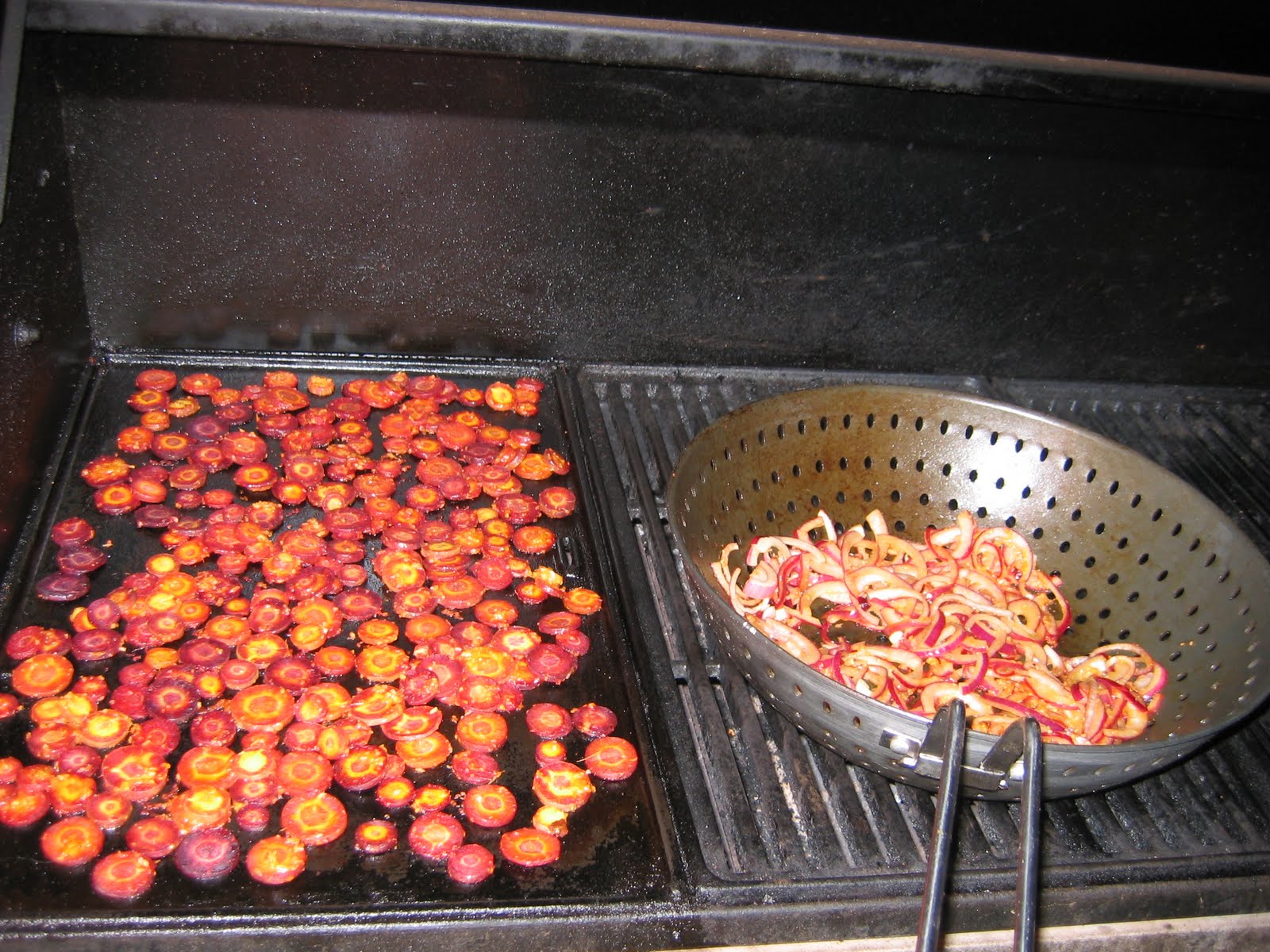
Grilling: Usually people don’t think of grilling carrots, which is a shame, because the caramelization around the edges is delicious. Just cut them thinly. I like slices about 1/8” thick. Use a griddle or grill-wok so they don’t fall through the grill, and watch them closely so that they don’t burn. I describe a Southeast Asian seasoning here, but again the technique is key, and once you get the hang of it, you can season them any way you like. Trim and scrub 3-4 large carrots of any color, and slice them thinly. Toss with two chopped cloves of garlic, a 1” chunk of ginger grated, a tablespoon of Asian fish sauce (you can use soy sauce instead if you insist,) a tablespoon of agave nectar or coconut sugar, and 2 tablespoons of canola oil or similar. Heat the grill to medium-high and spread the carrot slices out on the griddle section or put them in the grill-wok. If griddling them, turn them in bunches with a spatula about halfway through. If using the wok, you will need to turn several times during cooking. Taste to see when the texture seems just right to you, salt a little if they need it (the fish sauce is fairly salty) and serve with some chopped cilantro on top.

The Pollo Real Chicken: A real chicken, indeed


As you may know if you’ve seen my post on The Meaty Issue, I started raising my own meat chickens this summer. The results have been thrilling, but I have been hesitant to write about my kitchen experiments with them because most readers don’t grow their own and wouldn’t have access to this kind of chicken. This problem has now been solved because our local growers of pastured chickens, Pollo Real, have returned to the local farmers’ markets. Their French Label Rouge chickens are absolutely the best that I know of besides my own, and the pasture-raising is humane, environmentally friendly, and results in higher omega-3 content and a better taste. There is no such thing as a completely grass-fed chicken- they just aren’t able to survive on pasture alone- but these chickens have access to all the things that chickens naturally eat. Look for the Pollo Real booth at the Albuquerque downtown market on Saturday mornings and at the Corrales market on Sunday mornings. Ask them about their CSA, and please be sure to tell them that Heather at My Urban Homestead sent you. I want our local ethical growers to know that I’m recommending them.

The first time you get hold of a really good chicken, roast it fairly plainly and enjoy the meaty, nonmushy texture and the full flavor. My favorite method is this:
24 hours before you plan to roast the chicken, salt it generously inside and out or (my preference) put it in a large plastic bag with a brine made from half a gallon of water and half a cup of salt. If just salted, leave it in the refrigerator until ready to cook. If brined, leave it in the bag of brine in the refrigerator overnight, and in the morning pour the brine down the drain. Return the chicken to the bag and put it back in the refrigerator until ready to cook. This lets the added salt and liquid distribute themselves more evenly throughout the flesh.

When ready to make dinner, preheat the oven to 375 degrees. Smash two cloves of garlic in a mortar and pestle or chop them finely, add a tablespoon or two of white wine, a teaspoon of freshly ground black pepper, and two tablespoons of chopped fresh tarragon or one tablespoon of chopped fresh thyme. Rub the paste over the chicken inside and out, cut a lemon in half and stick it in the cavity, truss the chicken, and put it breast down in a baking pan. Pour about half a cup of good white wine in the baking pan and set in the hot oven. Roast for half an hour, and meanwhile cut some cleaned potatoes into chunks about an inch on a side. After half an hour take the pan out, turn the chicken breast side up, rub all visible skin well with good butter, and add a little more water if needed to keep the bottom of the pan lightly filmed with liquid. Roast until done, basting with more butter every 15 minutes. When the chicken is done, remove to a platter to rest for 15 minutes and, if the potatoes aren’t done, return them to the oven until they are. Pile them around the chicken and carve the chicken at the table. Pass the pan juices in a gravy boat. A salad and a good bottle of wine are all that you need to complete the meal.

What does “roast until done” mean? Well, it all depends on the size of your chicken. An oven thermometer is an absolute necessity, and oven heat can still vary depending on how often you open the oven. I have been cooking chickens for 30+ years and I roast them until the drumstick wiggles just right in its socket, but this isn’t something that can be conveyed in writing. so it’s safest to use a good meat thermometer and roast until it reads 170 degrees in the thickest part of the thigh. Even so, prick the thigh and check for any pink juices running onto the platter. If pink shows, return it to the oven until the juices run clear. Roasting a chicken well is a skill worth mastering. I aspire to roast a chicken on a spit next to a hot wood fire, but I haven’t tried it yet. If you have, leave a comment to let me know how it worked out. For that matter, every enthusiastic cook has a favorite way of roasting a chicken, so feel free to leave yours in the comments. And please, support our great local growers and farmers!

Passing pleasures, gratitude, and September 11th


Some of the pleasures of having a little piece of land to call your own are direct. The joy of a perfect bacon, avocado, and tomato sandwich in late summer, with bacon cooked on the grill campfire-style and bread toasted likewise, and the juices of a perfect beefsteak tomato running down your chin, gratifies a hunger that goes well beyond the physical: the hunger for one simple thing in your life to be exactly right. Then there are the hungers that aren’t physical at all, and that you don’t even know you feel until they are unexpectedly fulfilled. I was reminded how lucky I am to be able to have a mini-wildlife refuge in my back yard when a couple of mornings ago, while I trudged around feeding the animals and wishing I was back in bed, I realized that a little flock of Wilson’s warblers was bouncing around in my sunflower jungle. They came out to watch me, and one graciously posed for a picture before heading down the flyway.

Then there’s hearing the “clomp” as my doe kid, Cocoa, practices her newfound skill of leaping onto the roof of the goathouse.

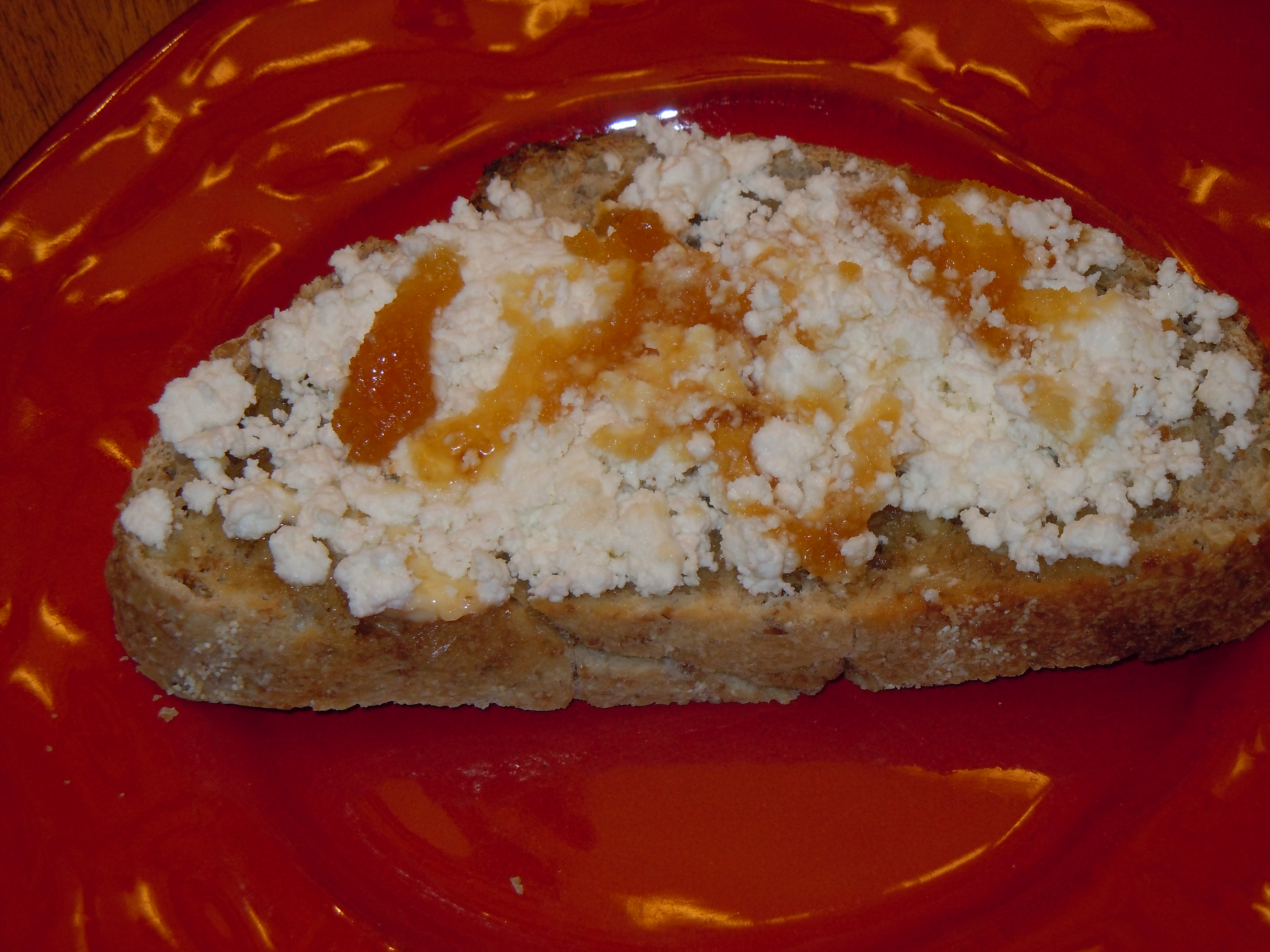
A breakfast of grainy bread spread with homemade goat cheese and drizzled with honey makes me purely happy to be where I am in the morning.

On September 11th we were reminded as a nation that life contains tragedy, disappointment, and sickening despair. Only a fool finds it easy to live in a stance of perpetual gratitude. But there are these radiant moments that push us to remember that there is also beauty, connection with the Earth, and genuine reason for gratitude. May our lives, and the intertwined lives of all the creatures of the planet, continue to draw us toward wholeness.