Archive for the ‘Books worth reading’ Category

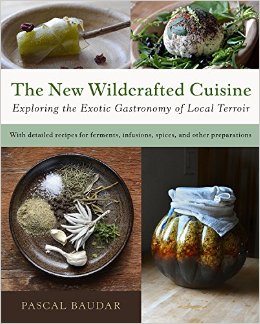
A Cookbook to Make You Think: The New Wildcrafted Cuisine


image

Some cookbooks make you cook. The recipes are smart and well-crafted and will clearly work, and you want to run to the kitchen and get started.

Other cookbooks make you think. They are provocative and, at their best, subversive, and expand your possibilities even if you never cook a single recipe.

Today we have a thinking cookbook. When I first looked at this book a few weeks ago it seemed meant to be weird. In fact, it seemed at first to have a self-consciously outré quality that set my teeth on edge. An example: “lemonade” made, not with citrus, but with 2000 lemon ants, a citrusy-tasting ant found in Southern California, crushed and macerated. Surely juicing a lemon would be quicker and better, although the image of some earnest chef-wannabe counting out 2000 lemon ants is an interesting one that will be with me for a while. The author proposes that some fermentations to make vinegar need to get started from the fruit flies that they naturally attract because the little bugs carry something (Acetobacter presumably) that start the conversion to vinegar. Yech. As I see it, fruit flies are why humans invented cheesecloth, and nothing will convince me that they are better fermented than slurped straight-up just as they land in your wineglass, an ingestion that I avoid if at all possible. There are a series of recipes with “forest floor” seasonings composed of grass and leaves found under trees, and I can’t say that I have ever nibbled on a grass that I would consider potentially useful as a seasoning. There are a lot of recipes for lacto-ferments, and having lived through the last lacto-fermenting craze, I am not very enthusiastic about having another one. Lacto-fermented elderflower “beer” might sound elegant but is nowhere near as good as a well-made wine. The current obsession with local terroir in wine often involves mediocre grapes, inferior bottling practices, and determination to drink bad wine because it somehow tastes of the locale, and I thought that author/forager Baudar’s “primitive brews” would be much like that.

In short, I thought that I would pan this book and get on with other things. Instead, after owning it for a few weeks, I keep going back to it and thinking, and gradually realizing how wrong my first impression was. I have seldom encountered a book that makes me think as creatively about possibilities, and this is after reading, foraging, and cooking for decades. Now the lemon-ant lemonade seems, not tricksy and silly and literally intended, but an invitation to explore the possibilities around you in ways that you might never have thought of on your own. In effect, the recipe tells you “Don’t limit yourself. Think about every possibility.”  Bauder’s practice of letting his gaze light on something familiar and spending some time thinking about its culinary possibilities is infecting me with new pleasures and possibilities. Make wild greens kimchee out of whatever greens suit your fancy, and not only enjoy it as is but dehydrate it to use as a seasoning? Sure. Try cold-infusing the deliciously honey-scented goumi blossoms in my front yard to make a drink, as Baudar does with elder flowers and others? Not until my bushes get bigger, but then I will. Put a few of their blossoms on salads now? Of course. The trash Siberian elms that invade the Rio Grande bosque; have I ever thought about whether their scented cambium (inner bark) had any flavoring possibilities if roasted or smoked and infused? Not until I read this book. I like to make verjus from unripe grapes in the summer and enjoy its clean sourness anywhere that I might use lemon juice, but I’ve never thought of juicing other unripe fruits for the same purpose, and I’ll enjoy testing their range of flavors. I may well try roasting outdoors on a hot stone, or cooking something fast and delicate by arranging pine needles and herbs over the food in question and burning them. It has been a decade since I made flavored vinegars for shrubs, but now I will because this book has excited me all over again about the possibilities. And yes, I will certainly be trying “primitive brews” akin to his and experimenting with my local versions of his SoBeers, fizzy low-alcohol concoctions somewhere in between soda and beer. I’ll be tasting my own local grasses and herbs again to test their flavoring possibilities. I’ll be making vinegar-based and fermented hot sauces. I’ll try vinegars flavored with an assortment of my local seeds to grind into a mustard-like condiment. In short, I will view the familiar things around me, with uses that I think I already know, with new excitement and find new uses for them. Once over my initial dubiousness, I began to think that this is one of the most exciting cookbooks that I have read in a very long time. See where it leads you. Odds are that I will never cook a single recipe from it as written, because that isn’t the point.

I trust that it goes without saying (but here it is anyway): YOUR SAFETY IS YOUR RESPONSIBILITY when foraging. Study, consult guidebooks, and know for certain what you are about to taste. This book is not a guidebook and will not teach you the safety of your own local plants and animals. Don’t wander around tasting things at random, like a feckless innocent in Not-Eden. That kind of thing gives foraging a bad name.
A Cookbook to Make You Cook

Right now I am reading two cookbooks that could hardly be more different from one another. Both are large, high quality, available only in hardcover, and gorgeously illustrated. One will make you cook, and one will make you think. The think-book will be reviewed tomorrow.

The one that will make you cook:

image

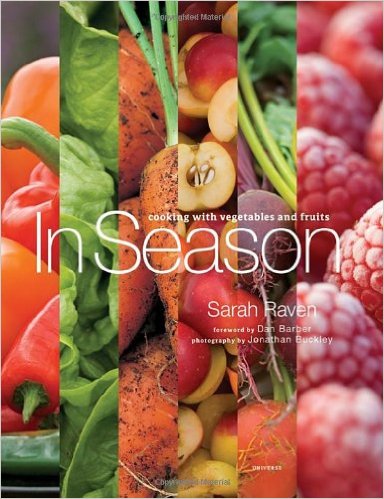
I have owned Sarah Raven’s addictive book about garden-based seasonal cooking for years. It has stood the test of time. Each spring I rediscover it, and it is on my bedside table right now. It seems to be neglected these days, which is why I’m doing my bit to get people to remember that it’s there. It is chock full of pretty photographs and, far more important, recipes that work and taste good. You can flip it open almost at random and come to a recipe that will become a kitchen favorite. It will help you cook your way through your garden or farmer’s market, and while your seasons might not correspond exactly to British seasons, you will cook through the seasons at your own pace in practice. The recipes are never tricksy or overly fussy, and lean toward full pure flavors.

Favorite recipes: Peaches with Bourbon, Romano Beans with Cream and Savory, Lamb with Thyme Tapanade, Cranberry Beans with Sage, Braised Celery, Parmesan and Walnut Crisps, scores of others.

Conclusion: buy it and cook from it. You will eat more fruits and vegetables and you will thereby be healthier and happier.


Wild or Cultivated? Both. Also Delicious.

image

As a general rule, I try not to review cookbooks until I have owned them for at least a year.  I buy them at retail, paying the same price that my readers will eventually pay, and then I read them, cook from them and think about them.   Many cookbooks that seemed very enticing when I first brought them home are relegated to distant shelves a year later.

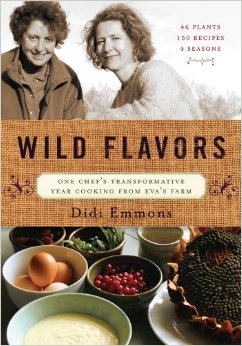
This one still has a prominent place at my bedside, which is my favorite place for reading and thinking about food. Chef Emmons  writes about a year that she spent cooking from a wildly varied organic vegetable farm, Eva’s Farm.  This farm seems to be doing on a very large scale what I am trying to do on my property on a very small scale, i.e. there is a little bit of everything and no clear line between the cultivated plants and the wildlings.  Lambsquarters and nettles are given the same culinary consideration as spinach and chard, but there is no particular emphasis on their wildness; they’re just there.  This is absolutely as it should be, in my view. The difference between a cultivated plant and a weed is a rather slight one.

The recipes read as an ongoing series of seasonal improvisations on the level of “see it growing, cook it, eat it.”  They certainly work if you want to follow them closely, but in my view are better read as a vision of the garden through the eye of a cook, who might see infinite possibilities but can only cook one of them at a time. There is an emphasis on frugality but not an obsession with it. The use of herbs in lavish free-form ways is a delightful subtext. The sidebars are full of interesting thoughts about farming, cooking, and just being alive. The recipes include meat and dairy products and, in general, everything that might grow on a vegetable farm or be bartered for.

In brief, I love this book, use it, and recommend it. I put it aside this winter, but when the first greens showed above ground, it was back at my bedside. It looks a bit worn and has a food stain on the cover, which tends to distinguish the cookbooks that I read from the ones that I use.

Foraging Know-how

I often write about my foraged and semi-foraged edibles, and periodically I like to post something about how to forage safely. With mushrooms, it’s a life-or-death matter to know what you’re doing. With plants there is sometimes a matter of deadliness at stake, but more often you are risking an upset stomach or a ghastly meal. So get it right, which is a fairly easy matter.
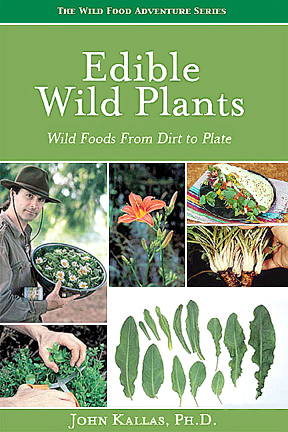
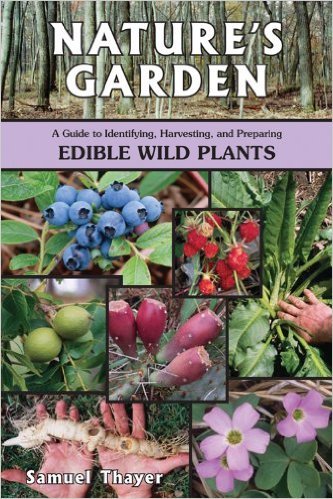
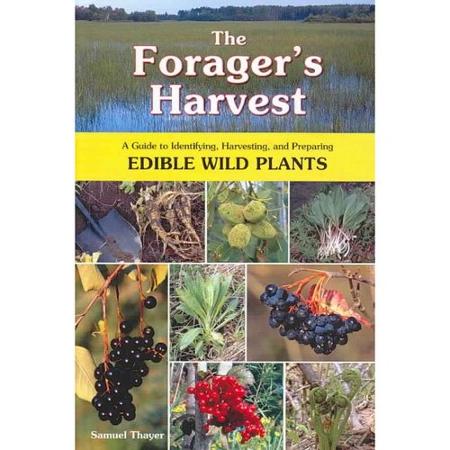
Easy instructions for beginners: buy any book by Samuel Thayer or John Kallas. They are both incredibly knowledgable foragers and good writers, and you will still be studying their books years from now and learning new things. I recommend starting with Kallas’s book, which is the comprehensive guide to wild greens that you will use for years or permanently. It is available in Kindle format, which is great because I can pull out my IPad at any time and study a bit without needing to lug around additional books with me. I have had this book since it was published and at least once or twice a month I go back to it to learn something new about using a familiar plant. Then add one of Thayer’s books, or both of them, to learn a new slant about the wild edibles you’ve already learned and learn some new ones. They aren’t available on Kindle, unfortunately, but they are wonderful.
There are a ton of other foraging books out there, and most of them have some special merit or charm, but if I ever had to narrow down my shelf, I would have these three. If you have some long winter evenings ahead of you, study and prepare so that you are ready to hit the ground in spring.
By the way, bear in mind that the original Cretan diet, the one that produced some of the longest-lived and healthiest people in the world, included wild greens as primary vegetables. They are extraordinary nutritional powerhouses and there is no better gift that you can give your body than to incorporate some of them into your diet. And, I hate to bring this up, but don’t just add them to your current diet; use them to replace something that isn’t doing your body good.
image
image
image